
A $250,000 annuity doesn't pay a single fixed amount. The monthly check depends on your age, gender, the type of annuity you choose, and how you structure the payout. Get those variables wrong, and you could leave hundreds of dollars per month on the table — or lock into a structure that doesn't match your actual needs.
This guide covers realistic monthly payout ranges by annuity type, the four factors that move those numbers most, three real-world scenarios, and practical strategies for maximizing what your $250,000 actually generates each month.
Key Takeaways
- A $250,000 annuity typically pays between $1,100 and $2,900+ per month, depending on age, annuity type, and payout structure
- Fixed and immediate annuities deliver the most predictable income — variable annuities introduce more payment uncertainty
- Older buyers receive higher monthly payments — the insurer prices payouts over a shorter expected lifetime
- Deferring payments, even by a few years, can meaningfully increase your monthly check
- The right payout covers your essential expenses and fits your broader retirement plan — not just the largest number on paper
How Much Does a $250,000 Annuity Pay Per Month?
Monthly payouts from a $250,000 annuity aren't fixed. Across all annuity types and payout structures, the realistic window for a 65-year-old ranges from roughly $1,100 to $2,900+ per month. That's a wide spread, and the structure you choose drives most of it.
Buyers who focus only on the headline monthly number often make costly mistakes: choosing the wrong annuity type, misunderstanding the difference between lifetime and period-certain payouts, or ignoring how age and gender shape what insurers will quote.
Fixed Annuity
A fixed annuity pays a guaranteed, unchanging monthly amount for life or a set term. It's the most popular choice for retirees who need to know exactly what's coming in each month.
Based on Blueprint Income's quote data updated May 2026:
- 65-year-old male: ~$651/month per $100,000 invested → approximately $1,628/month on $250,000
- 65-year-old female: ~$625/month per $100,000 invested → approximately $1,563/month on $250,000
The CANNEX PAY Index from April 2026 shows an average market yield of 7.41%, with a benchmark payout of $617/month per $100,000 — consistent with Blueprint's figures.
Variable Annuity
Variable annuities tie payouts to the performance of underlying investment sub-accounts. Monthly income fluctuates, with no guaranteed floor unless you add a Guaranteed Lifetime Withdrawal Benefit (GLWB) rider.
The trade-off is real: strong markets can push income higher, but poor markets cut it. Key factors that shape variable annuity income:
- GLWB rider rates increase with age and drop when covering a couple vs. a single annuitant
- Sub-account performance directly determines monthly income without a rider
- Predictability is limited — fixed annuities serve buyers who need reliable monthly figures
Fixed Indexed Annuity (FIA)
FIAs link interest credits to a market index — typically the S&P 500 — while protecting the principal from index losses. The contract credits interest based on index gains, subject to:
- A cap rate — the maximum interest credited in a term (commonly below 9%)
- A participation rate — the percentage of index gains applied (a 55% participation rate on a 10% index gain credits 5.5%)
- A floor — typically 0%, meaning no loss when the index falls
Monthly income from an FIA depends heavily on how the contract's caps and participation rates interact with actual index performance. FIAs suit buyers who want principal protection with some upside exposure — but the income amount isn't predictable until accumulation ends.
Immediate vs. Deferred (Quick Overview)
- Immediate annuity (SPIA): Payments begin within 30 days. Best for retirees who need income now.
- Deferred annuity: The $250,000 accumulates interest first, then converts to income at a future date. This typically results in higher monthly payments — often 20–40% more than an equivalent SPIA, depending on the deferral period.
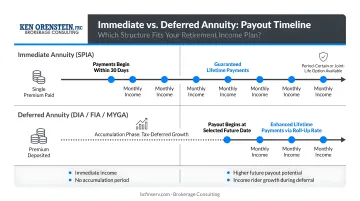
Payout structure also affects the check size. Adding a surviving spouse (joint life) lowers the monthly amount in exchange for continued payments after the first spouse dies — a trade-off worth modeling before you commit.
Key Factors That Affect Your Monthly Payout
Four variables, more than any others, determine what a $250,000 annuity will actually pay each month.
Age at Purchase
Older buyers receive higher monthly payments. Insurers calculate payouts based on expected lifetime — the shorter the window, the higher the monthly check.
Using the CANNEX PAY Index (April 2026):
- A 65-year-old male single-life SPIA yields approximately 7.41% on average
- A 70-year-old male single-life SPIA yields approximately 8.37%
On $250,000, that difference translates to roughly $120–$150 more per month at age 70 versus 65 — from the same premium, same product type.
Gender and Life Expectancy
Women statistically outlive men. According to SSA actuarial data, a 65-year-old woman has a life expectancy of 20.12 years, compared to 17.48 years for a 65-year-old man — a gap of 2.64 years.
Insurers spread the same $250,000 over more expected payments for women, so monthly checks are lower:
| Monthly (per $100,000) | Monthly (on $250,000) | |
|---|---|---|
| 65-year-old male | ~$651 | ~$1,628 |
| 65-year-old female | ~$625 | ~$1,563 |
That's roughly $65/month less for a woman. For couples evaluating joint-life options, this gap also factors into which payout structure makes the most financial sense.
Payout Structure
Once age and gender are set, the next lever you control is how the payout is structured — and that choice directly affects your monthly check:
- Single life only — highest monthly payment; stops at death, nothing to heirs
- Life + 10-year certain — slightly lower payment; guarantees at least 10 years of payments
- Life + 20-year certain — lower still; guarantees 20 years regardless of when you pass
- Joint and survivor — lowest payout; continues until the second spouse dies
- Period certain only — fixed payment window regardless of age; insurer knows the exact horizon
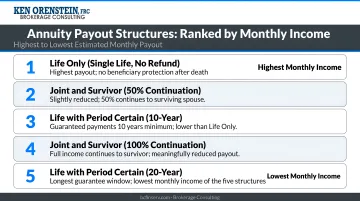
Adding guarantees or spousal coverage costs you income each month. The right structure depends on your health, whether you have a surviving spouse to protect, and what you'd like to leave behind.
Interest Rate Environment and Riders
Annuity payout rates track closely with bond yields. CANNEX research found a 0.96 correlation between SPIA payout rates and prevailing bond yields — which explains why annuity income has improved meaningfully since the rate environment shifted post-2022.
Optional riders add cost:
- COLA/inflation rider — increases monthly income 1–3% annually, but reduces the starting payment
- GLWB riders on variable or indexed annuities — typically carry annual fees of 1.0–1.5% of the income base
- Long-term care or death benefit riders — add protection but reduce base monthly income
Only add riders that fit your actual situation. A COLA rider, for example, might cut your starting payment by 15–20% — worthwhile if you expect a 20-year retirement, but a poor trade-off if your primary goal is maximizing near-term income.
Real-World Payout Scenarios
Because the same $250,000 can generate very different monthly amounts, concrete examples clarify the range of outcomes.
Scenario 1 — Immediate Income at 65 (Single Woman)
A 65-year-old woman converts $250,000 into a single-life immediate fixed annuity. Based on current Blueprint Income market rates (~$625/month per $100,000), she receives approximately $1,563/month for life.
She chose single life to maximize monthly income. The trade-off: if she passes in year three, payments stop and nothing goes to heirs. For someone with adequate savings elsewhere and no spouse to protect, this structure delivers the most income per dollar spent.
Scenario 2 — Delayed Income at 70 (Single Man, Deferred)
A 70-year-old man who deferred his $250,000 annuity purchase benefits from two advantages:
- Higher payout rate — CANNEX shows ~8.37% for a 70-year-old male single-life, up from roughly 6.25% at 65
- Accumulated growth during the deferral period compounds the effective income base
At the CANNEX 8.37% yield, his $250,000 generates approximately $1,744/month — roughly $116/month more than if he had purchased at 65, by deferring his start date. His monthly check is also higher than a woman of the same age would receive, due to the gender-based life expectancy difference insurers factor into pricing.
Scenario 3 — Joint Life at 65 (Married Couple)
A couple, both 65, uses $250,000 to purchase a joint and survivor annuity. Because payments continue until the second spouse dies, the insurer prices this over a longer combined expected lifespan — so the monthly payment is lower than either individual would receive alone.
The closest CANNEX benchmark available is a male-70/female-65 joint life at approximately 6.68%; a same-age couple at 65 would yield comparably or slightly less. On $250,000, that translates to roughly $1,300–$1,400/month, compared to $1,563–$1,628 for single-life policies.

That lower monthly figure funds a concrete guarantee: the surviving spouse keeps receiving income no matter who dies first.
Scenario Comparison at a Glance
| Profile | Monthly Payout | Key Trade-Off |
|---|---|---|
| 65F, Single Life | ~$1,563 | Stops at death; no heir benefit |
| 70M, Single Life (deferred) | ~$1,744 | Higher income; still stops at death |
| 65/65 Couple, Joint Life | ~$1,300–$1,400 | Lower income; survives both spouses |
How to Maximize Your Monthly Payout from a $250,000 Annuity
Shop Multiple Insurers
Payout rates differ considerably between companies for identical contract types and premiums. CANNEX research found that variation across insurers for the same SPIA case can reach 10–15% — on $250,000, that could mean $150–$200 more per month just from choosing the right carrier.
Working with an independent advisor like Ken Orenstein at Brokerage Consulting means comparing rates across multiple top carriers — Aetna, Humana, TransAmerica, and others — rather than accepting whatever a single company offers. An independent broker surfaces options that direct buyers often miss.
When evaluating carriers, keep two things in mind:
- AM Best rating: Stick with carriers rated A (Excellent) or higher — this reflects a company's ability to meet long-term obligations, which matters most for lifetime income contracts
- Rate comparison: Even a 1–2% difference in quoted rates can translate to $100+ more per month over decades of payments
Consider Annuity Laddering
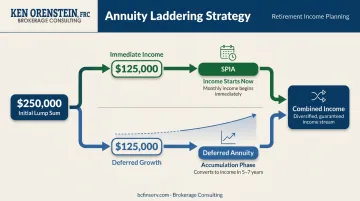
Instead of committing all $250,000 to one annuity today, split it into multiple smaller annuities purchased at different times. This approach:
- Locks in some guaranteed income now
- Preserves the option to capture higher rates if interest rates rise
- Avoids committing everything to today's rate environment
For example: purchase a $125,000 SPIA now for immediate income, and hold the remaining $125,000 in a deferred annuity or high-yield fixed account, converting it to income in 5–7 years when rates may be more favorable.
Time the Purchase Around Interest Rates
Buying when rates are higher locks in better payouts permanently. But waiting for a "better" rate environment means forgoing income in the interim — an opportunity cost that compounds quickly.
The practical approach: don't try to time the market perfectly. If current rates work for your income plan, act. If you're 5+ years from needing the income, a deferred annuity captures rate gains automatically. Either way, running the numbers with a licensed advisor before committing ensures you're not leaving money on the table.
What Most People Get Wrong About Annuity Payouts
Three mistakes come up repeatedly among $250,000 annuity buyers:
Skipping the carrier comparison. The same contract from two different A-rated insurers can pay meaningfully different amounts. Failing to shop leaves real money on the table.
Treating this as a complete retirement plan. For most retirees, a $250,000 annuity works best as a guaranteed income floor — alongside Social Security and other savings — not as a standalone solution.
Stacking riders without a clear reason. Inflation adjustments, long-term care benefits, and enhanced death benefits all reduce monthly income. Add what you genuinely need. Every rider that doesn't match your actual situation costs you income every month for life.
Frequently Asked Questions
How much would a $250,000 annuity pay per month?
Monthly income typically ranges from $1,100 to $2,900+, depending on age, gender, annuity type, and payout structure. A 65-year-old in a single-life immediate fixed annuity would generally receive approximately $1,563–$1,628/month based on current market rates.
Can you live off the interest of $250,000?
At the current 10-year Treasury yield of around 4.57%, $250,000 generates roughly $952/month before taxes without touching principal. An annuity blends interest and principal return to produce more monthly income, though most retirees still need Social Security or other savings to supplement it.
What type of annuity pays the most per month?
A single-life immediate fixed annuity generally offers the highest monthly payout for a given premium. It provides no death benefit and no period-certain guarantee, making it a structure designed purely to maximize lifetime income.
Does your age affect how much a $250,000 annuity pays?
Age is one of the most significant pricing factors. A 75-year-old will receive noticeably more per month than a 65-year-old investing the same $250,000, because the insurer calculates payouts over a shorter expected lifespan.
Are annuity payments from a $250,000 investment taxable?
It depends on funding source. Non-qualified annuities (after-tax dollars) split each payment between tax-free principal return and taxable income. Qualified annuities (pre-tax retirement money) are fully taxable as ordinary income, per IRS Publication 575.
Is a $250,000 annuity enough for retirement?
That depends on your expenses and other income sources. For most retirees, a $250,000 annuity works best as a guaranteed income foundation — complementing Social Security and savings — rather than a standalone retirement plan.