This isn't an accident. It's how the FIA market is structured. And understanding it before you sign matters, because what you don't see can still affect what you earn.
This article breaks down how FIA commissions are structured and who ultimately pays them, what explicit and implicit fees live inside these contracts, and how to evaluate whether those costs are fair given the guarantees on offer.
TLDR: Key Takeaways
- FIA commissions are paid by the insurance company from its reserves — your full premium goes to work in the contract from day one
- Agent commissions on longer-term FIA products typically range from 6%–6.5%, based on industry data
- The real cost of an FIA often shows up in tighter caps, lower participation rates, or wider spreads — not just explicit rider or admin fees
- Longer surrender periods generally mean higher agent compensation — worth knowing when evaluating any recommendation
- Fees aren't inherently bad; the question is whether the guaranteed benefits justify them for your specific situation
How FIA Commissions Actually Work
When you deposit $100,000 into a fixed index annuity, your statement shows $100,000 at work. Nothing is deducted for the agent's compensation. That's because, as the NAIC Buyer's Guide confirms, the agent is typically paid by the insurance company from its own reserves — not from your premium.
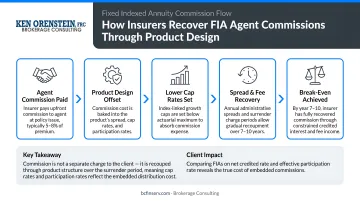
This structure is by design, not a loophole. The insurer pays the commission upfront from its general account, then recoups that cost over the life of the contract through the product's design.
What Commissions Actually Look Like
Pinning down a precise current commission range is harder than most articles suggest. Kiplinger reported that FIA agent commissions "can run as high as 6%." A 2017 industry comment submitted to the Department of Labor referenced a typical 6.5% assumption on a 10-year product. Those are the strongest publicly cited figures available — not a guaranteed industry average, but a useful benchmark.
For context, simpler annuity products generally carry lower commissions. Multi-year guaranteed annuities (MYGAs) and single premium immediate annuities (SPIAs) tend to pay considerably less because they're shorter-term, simpler products with less ongoing risk for the insurer. Across product types, complexity and term length drive compensation higher.
How the Insurer Gets Its Money Back
The commission doesn't disappear — it gets absorbed into the product's economics. Insurers recoup that upfront cost by:
- Setting tighter caps on index-linked interest
- Offering lower participation rates
- Applying wider spreads that reduce credited returns
This is the real "invisible cost." Your premium is intact, but the terms of how you earn returns are shaped by the economics that include that agent payment.
According to the American Academy of Actuaries, insurers invest most premiums in fixed income and allocate a remaining portion to an option budget — the pool used to purchase index options. Commission costs reduce that budget directly, which limits your upside exposure.
The Surrender Period–Commission Relationship
Products with longer surrender charge periods (10 years versus 5 years, for example) typically carry higher agent commissions. The insurer has more time to recoup costs, so it can afford to pay more upfront.
This creates a real incentive worth understanding: an agent recommending a 10-year surrender product over a 7-year alternative may be doing so because the longer contract pays more , not because it fits your retirement timeline better.
The "No Commission" Claim
Some agents present products as "no commission" alternatives. That framing deserves scrutiny. NAIC Model 275 defines compensation broadly to include commissions, fees, overrides, and other cash benefits, and requires producer disclosure. If an agent or advisor signs the application, some form of compensation is involved, even if labeled differently. Transparency about compensation is a consumer right, not a favor.
That disclosure requirement is one Brokerage Consulting takes seriously: Ken Orenstein is compensated through commission paid by the issuing insurance carrier, with no direct fee charged to the client. That structure is stated clearly before any product is placed.
The Explicit Fees Inside a Fixed Index Annuity
Not all FIAs carry the same fee structure. Some simpler contracts have virtually no ongoing charges beyond a surrender schedule. Others layer multiple fee types that can meaningfully affect your net return over time.
Administrative Fees
These cover basic contract servicing and account maintenance. The NAIC confirms they may appear as a flat dollar amount or be embedded in the product's rate structure. Not every carrier charges them separately — some build the cost into crediting terms rather than listing a line-item fee. Always ask whether an administrative charge exists and how it's applied.
Mortality and Expense (M&E) Charges
M&E charges are far more common in variable annuities than in FIAs. Within the Brokerage Consulting practice, M&E charges are specifically associated with variable annuity products — where all-in costs can exceed 3% annually — rather than with fixed indexed annuities. If you're evaluating a product marketed as an FIA but carrying an M&E charge, clarify what structure you're actually buying.
Rider Fees
Optional income and benefit riders are where fee exposure becomes most significant for FIA buyers. Common add-ons include:
- Guaranteed Lifetime Withdrawal Benefits (GLWBs) pay income for life regardless of account value
- Enhanced death benefits transfer a defined amount to beneficiaries beyond contract value
- Long-term care riders accelerate income distributions in qualifying care scenarios
Carrier examples illustrate the range: North American's Income Pay Pro lists a GLWB rider charge of 1.15% of the GLWB value, while Allianz 360 shows a 0.95% rider charge. Brokerage Consulting evaluates rider fees — typically 1.0%–1.5% annually on the income base — against the actual value of the guarantee provided.
Riders are optional. You only pay for what you choose. But if you're paying for a rider you won't use for 15 years, that fee erodes accumulation value the entire time.
Index Strategy Fees
Some FIAs charge a separate fee to access certain indexed strategies — particularly proprietary or volatility-controlled indexes that don't directly follow the S&P 500. Contracts may label these as an "allocation charge" or "strategy fee annual percentage."
Two examples show how this works in practice:
- Allianz 222 — current allocation charge of 0%, with a disclosed maximum of 2.5%
- North American Charter Plus — discloses a "Strategy Fee Annual Percentage" for enhanced participation strategies
Standard S&P 500 cap strategies typically carry no additional strategy fee — the cost is embedded in the cap level itself. Proprietary indexes may offer higher participation rates in exchange for a stated strategy charge, so compare net crediting potential, not just the fee in isolation.
Hidden Costs: Rate Caps, Spreads, and Participation Rates
The most misunderstood FIA costs aren't line-item fees at all. They're structural limits on how much index growth you can capture — and they function as implicit costs built directly into the product. The most misunderstood FIA costs aren't line-item fees at all. They're structural limits on how much index growth you can capture — and they function as implicit costs built directly into the product. Three mechanisms drive this: rate caps, participation rates, and spreads.
Rate Caps
A cap sets a ceiling on how much index-linked interest can be credited in a given period. If the S&P 500 gains 18% and your cap is 6%, you receive 6%. The insurer keeps the difference — or more precisely, uses it to cover operations and recoup costs including commissions.
The option budget concept explains this mechanically: according to Investments & Wealth Monitor, the option budget is what's left after the insurer allocates assets to support guarantees. A smaller option budget means lower caps and less upside exposure for you.
Participation Rates
A participation rate determines what percentage of the index gain gets credited to your account. At a 70% participation rate, a 10% index gain results in a 7% credit. The 30% difference isn't a fee you see — it's simply return you don't receive.
Spreads
A spread subtracts a fixed percentage from the index gain before crediting. A 2% spread against a 9% index gain results in a 7% credit. Spreads can be layered on top of caps or participation rates.
How these stack up in practice:
| Index Gain | Spread | Participation Rate | Cap | Net Credit |
|---|---|---|---|---|
| 12% | 1.5% | 80% | 6% | 4.8% (capped) |
| 12% | 0% | 100% | 6% | 6% |
| 12% | 0% | 70% | None | 8.4% |
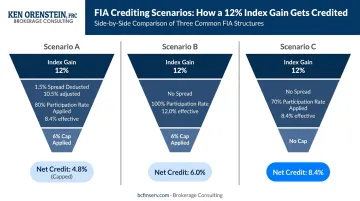
A product with lower explicit fees can still deliver worse net returns if its caps are tighter or its participation rates lower. Always evaluate crediting terms and fees together — never one without the other.
How Surrender Charges and Rider Fees Add Up
Surrender Charge Mechanics
Surrender charges apply when you withdraw more than the contract's free withdrawal allowance during the surrender period. Most FIAs allow up to 10% of contract value per year without penalty — both Allianz 222 and Athene Performance Elite confirm this in their product disclosures — though this isn't universal across all carriers.
The Allianz 222 provides a clear named-carrier example of a 10-year surrender schedule:
| Year | 1 | 2 | 3 | 4 | 5 | 6 | 7 | 8 | 9 | 10 |
|---|---|---|---|---|---|---|---|---|---|---|
| Charge | 10% | 10% | 10% | 8.75% | 7.50% | 6.25% | 5.00% | 3.75% | 2.50% | 1.25% |
Withdrawing beyond the free amount triggers a charge on the excess. And if you're under age 59½, IRS Topic 410 confirms that an additional 10% federal tax penalty applies on top of any carrier surrender charge for qualified funds — a substantial combined cost that can erode a significant portion of the withdrawn amount.
Surrender periods vary across the market. Athene offers 7-, 10-, and 15-year options. The length you choose should reflect your actual liquidity timeline, not just what's on offer.
Surrender charges address one side of the cost equation. The other is the ongoing drag from optional income riders.
Rider Fee Erosion Over Time
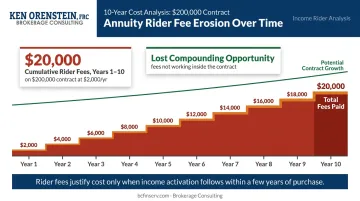
A 1% annual rider fee on a $200,000 contract costs $2,000 per year. Over 10 years of deferral before activating income, that's $20,000 in charges — plus the compounding you lost on that capital. Riders can justify their cost when income activation follows within a few years of purchase. When activation is delayed by a decade or more, or the rider is never used, those fees accumulate without delivering the income benefit the rider was designed to provide.
Are FIA Fees Worth It? How to Evaluate Before You Buy
The real question isn't whether FIA fees exist — it's whether the guarantees they fund deliver enough value for your situation. Principal protection, tax-deferred growth, index-linked upside potential, and guaranteed lifetime income are meaningful benefits. Whether they justify the cost depends on what you actually need.
An FIA makes sense when you need both protection and potential growth, or when guaranteed lifetime income is a priority. A MYGA may serve you better when you simply want a predictable, tax-deferred return with no market exposure and no ongoing fee risk.
Before You Sign: Questions to Ask
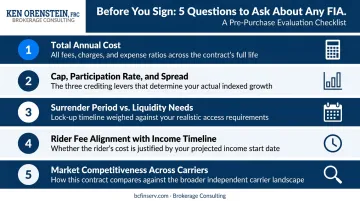
Work through this checklist with any FIA you're evaluating:
- What is the total annual cost? Add up all rider fees, administrative charges, and any strategy fees — not just the largest one
- What are the cap, participation rate, and spread on each index strategy? These determine your real return ceiling
- What is the surrender period length, and does it match my liquidity needs? A 10-year surrender period is a problem if you may need those funds in six
- Are the riders I'm paying for aligned with my income timeline? If activation is 12+ years away, calculate what those annual rider fees actually cost before income starts
- Is this product competitive across the market, or is this what one agent's carrier lineup offers?
That fifth question is where independent advice matters most. Ken Orenstein at Brokerage Consulting compares FIAs across multiple carriers — evaluating caps, participation rates, income rider growth rates, and surrender schedules side by side — with full disclosures shared before any contract is placed. A no-cost initial consultation is available by phone, virtually, or in person.
Frequently Asked Questions
What are typical commissions on fixed index annuities?
Industry sources cite FIA agent commissions reaching approximately 6%–6.5% on longer-term products, based on a Kiplinger report and a 2017 DOL-filed industry comment. These commissions are paid by the insurance company from its general reserves, not deducted from your premium — so your full deposit goes to work in the contract from day one.
Do fixed index annuities have fees, and what are they?
FIAs can carry administrative fees, optional rider fees (commonly 0.95%–1.15% annually based on carrier disclosures), and in some cases index strategy charges. Beyond these explicit costs, implicit limitations such as rate caps, participation rates, and spreads reduce how much index growth reaches your account without showing up as line-item fees.
How much monthly income would a $100,000 annuity provide?
There's no universal figure. Monthly income depends on your age, payout structure (lifetime, joint-life, or period-certain), any income rider attached, and current interest rates. An independent advisor can run personalized projections across multiple carriers based on your situation.
Are FIA commissions paid out of my premium?
No. Commissions are paid from the insurance company's general reserves, so your full premium is credited to your contract. However, the commission does indirectly influence product terms — carriers with higher commission costs tend to offer tighter caps or lower participation rates to offset that expense.
What is a surrender charge and when does it apply?
A surrender charge is a penalty for withdrawing beyond your contract's free withdrawal allowance (typically 10% of contract value per year) during the surrender period. Charges generally start at 7%–10% in year one, then decline annually to zero by the end of the surrender term.
How do I know if a fixed index annuity's fees are worth it?
Compare total cost — explicit fees and crediting limitations together — against the guaranteed benefits: principal protection, index-linked growth potential, and lifetime income. Getting quotes from multiple carriers through an independent advisor is the most reliable way to confirm whether the terms you're being offered are competitive.