This isn't a trivial question. The wrong choice can cost you years of compounding growth, create an unexpected tax bill, or leave you scrambling for cash when you need it most. Both products protect your principal. Both earn interest. But they work in fundamentally different ways — and serve completely different purposes in a retirement plan.
This article explains how each product works, how they're taxed, what they cost, and which one fits which situation.
Key Takeaways
- Fixed annuities lock in a guaranteed rate for 3–10 years, grow tax-deferred, and can convert to guaranteed lifetime income
- Money market accounts offer full liquidity at variable, lower rates — best suited for emergency reserves and short-term savings
- Top MYGA rates currently reach 6.30–6.50% for 5–7 year terms; the national MMA average sits at 0.57% — a spread of nearly 6 percentage points
- MMA interest is taxed annually; fixed annuity earnings grow tax-deferred until withdrawal — a key advantage in higher tax brackets
- Most savers benefit from both: an MMA for liquidity, a fixed annuity for committed retirement funds
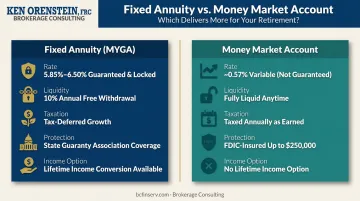
Fixed Annuity vs Money Market Account: Quick Comparison
| Feature | Fixed Annuity (MYGA) | Money Market Account |
|---|---|---|
| Interest Rate | Guaranteed rate locked for full term | Variable; fluctuates with market rates |
| Current Rates | Top rates: 5.85–6.50% (May 2026) | National average: 0.57% (FDIC/FRED) |
| Liquidity | Limited; 10% annual free withdrawal typical | Fully liquid at any time |
| Tax Treatment | Tax-deferred until withdrawal | Taxed as ordinary income annually |
| Principal Protection | Contractual guarantee by insurer | FDIC-insured up to $250,000 |
| Insurance Backstop | State guaranty associations | FDIC (federal) |
| Investment Term | Fixed: 3, 5, 7, or 10 years | No fixed term |
| Lifetime Income Option | Yes — SPIA or income rider | No |
What Is a Fixed Annuity?
A fixed annuity is an insurance contract between an individual and a life insurance company. The insurer guarantees a specific interest rate for a defined period — and unlike a bank, the insurer assumes the investment risk entirely.
Two types matter most for this comparison:
- MYGAs (Multi-Year Guaranteed Annuities): Lock in a guaranteed rate for 3, 5, 7, or 10 years. Used for accumulation — growing a lump sum safely before income is needed.
- SPIAs (Single Premium Immediate Annuities): Convert a lump sum into guaranteed monthly income starting within 30 days. Used when income is needed now.
Fixed annuities are insurance products, not securities. They're regulated at the state level, not by the SEC.
How Tax Deferral Works
Inside a fixed annuity, interest compounds without triggering annual taxes. You owe nothing to the IRS until you take a withdrawal. That's the opposite of a money market account, where every dollar of interest generates a 1099-INT and a tax bill each year.
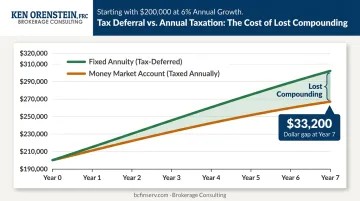
For savers in the 22–32% bracket, this difference is material. Consider a $200,000 lump sum earning 6% annually: inside a MYGA, the full 6% compounds each year. In a money market account, a portion of each year's return goes to taxes before it can compound again. Over a 5–7 year horizon, that drag can cost tens of thousands in lost compounding.
When withdrawals do happen, they're taxed as ordinary income. Per IRS rules, a 10% additional tax applies to distributions taken before age 59½, with limited exceptions.
Principal Protection and Guaranty Associations
The insurance company contractually guarantees your principal plus the stated interest rate. If you hold the contract to term, you receive exactly what was promised.
This protection is backed by state guaranty associations, not the FDIC. According to NOLHGA, most states cover up to $250,000 in present value of annuity benefits, though limits vary. New York covers up to $500,000; California covers 80% up to $250,000. Check your state's specific limits before placing large sums with a single carrier.
Surrender Charges and the 10% Free Withdrawal
Liquidity is the main trade-off. Most MYGAs impose a declining surrender charge schedule — for example, 9% in year one, declining by one percentage point per year until the term ends. Withdrawing more than the free withdrawal amount before the contract matures triggers these charges.
The offsetting feature: most contracts allow up to 10% of contract value withdrawn annually without any surrender charge. For a $200,000 MYGA, that's $20,000 per year accessible without penalty — enough to cover modest income needs without fully surrendering the contract.
Lifetime Income Conversion
That surrender charge structure highlights the trade-off at the heart of fixed annuities: less liquidity in exchange for something money market accounts cannot offer. At maturity, a fixed annuity can be converted into a guaranteed lifetime income stream. Through a SPIA or a fixed annuity with a guaranteed lifetime withdrawal benefit (GLWB) rider, this creates a private pension-like structure. Monthly payments continue regardless of how long you live, transferring longevity risk to the insurer.
Fixed annuities suit clients who:
- Have a defined lump sum they won't need for 3–10 years
- Want to lock in today's rates before they potentially decline
- Rolled over 401(k) or IRA funds and want principal-protected growth
- Need to supplement Social Security or pension income with guaranteed monthly payments
What Is a Money Market Account?
A money market account (MMA) is a deposit product offered by banks and credit unions that earns a variable interest rate — typically higher than a standard savings account, but lower than a CD or fixed annuity. It's FDIC-insured up to $250,000 per depositor per institution (NCUA for credit unions).
Important distinction: a money market account at a bank is not the same as a money market mutual fund. The mutual fund version is an investment product — it is not FDIC-insured, and investors can lose money.
Variable Rates and Rate Risk
MMA rates track the current rate environment and can move without notice. The numbers tell the story: in January 2022, the national MMA rate was 0.08%. By August 2023, as the Fed pushed rates higher, it climbed to roughly 0.63%. By May 2026, with policy rates declining, it sits at 0.57%, still well below the federal funds rate of 3.62%.
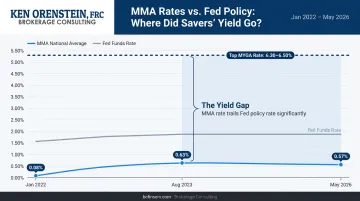
That lag is the core problem. Even in a high-rate environment, the national MMA average captured only a fraction of the Fed's rate increases. When rates fall, MMA yields follow, with no floor and no contract locking in yesterday's higher rate.
A fixed annuity eliminates this risk entirely. Whatever rate is locked in at signing is what you earn for the full term.
Practical Liquidity Features
MMAs offer genuine flexibility:
- Withdraw funds at any time, no penalty
- Many accounts include check-writing or debit card access
- No fixed term or commitment period
Regulation D previously limited savings account and MMA withdrawals to six per month — a restriction worth knowing about. The Federal Reserve eliminated that rule in April 2020, though individual banks may still impose their own limits. Minimum balance requirements and monthly fees can also reduce effective yield — worth checking before opening an account.
The Tax Reality
Every dollar of MMA interest is reported as ordinary income in the year it's earned. If you're in the 24% federal bracket and earn $5,000 in MMA interest, you net $3,800 after federal taxes — before state taxes. For longer-term savings, that annual tax drag compounds into a meaningful drag on real returns.
MMAs are the right tool for:
- Emergency funds (3–6 months of expenses)
- Short-term savings goals (1–24 months)
- Holding accounts while evaluating longer-term options
- Money that may be needed without warning
Which Is Right for You?
Three questions drive this decision:
- How long can you leave the money untouched?
- Do you need locked-in guaranteed growth or maximum flexibility?
- Is this money for near-term access or retirement income planning?
Choose a Money Market Account If:
- You need the money within 1–2 years
- You're building or maintaining an emergency fund
- You want FDIC insurance with zero commitment
- You're in a lower tax bracket where annual taxation isn't a significant drag
Choose a Fixed Annuity If:
- You have a lump sum you won't need for 3–10 years
- You want to lock in today's rates — top MYGAs currently offer 5.85–6.50% — before they potentially drop
- You're in a higher tax bracket and want to defer taxation
- You're planning for retirement income and want the option to convert to guaranteed lifetime payments
The "Both" Strategy
Many savers approaching or in retirement don't need to choose. A tiered approach makes practical sense:
- Tier 1: Keep 3–6 months of expenses in an MMA for immediate liquidity and emergencies
- Tier 2: Place longer-horizon retirement funds into a MYGA for guaranteed compounding, tax deferral, and future income conversion
This bucket strategy separates money by purpose — liquid funds stay liquid, growth funds compound without annual tax drag, and retirement income funds convert to guaranteed payments when needed.

For federal employees and retirees, coordinating a fixed annuity alongside TSP distributions, Social Security, and a FERS or CSRS pension means evaluating the income gap and total tax picture together. Ken Orenstein at Brokerage Consulting maps guaranteed income sources against essential expenses, then pinpoints where a MYGA or SPIA fills the remaining gap.
A no-cost initial consultation is available by phone, virtual, or in-person at bcfinserv.com or by calling (888) 315-3608.
Conclusion
Money market accounts are built for flexibility. Fixed annuities are built for committed, tax-advantaged growth and retirement income. Each serves a distinct purpose — and the strongest retirement plans often include both.
The decision comes down to what the money needs to do. If you have funds you won't touch for several years and want to lock in a guaranteed rate while deferring taxes, a fixed annuity is the stronger tool. If that money might be needed at any time, an MMA keeps it accessible and insured.
If you're approaching or already in retirement and want to see how a fixed annuity fits your income picture, Brokerage Consulting offers free consultations — by phone, virtually, or in person — with no obligation.
Frequently Asked Questions
Which is better: a fixed annuity or a money market account?
Neither is universally better. A money market account is better for short-term liquidity and emergency savings; a fixed annuity is better for guaranteed long-term growth and retirement income planning. The right choice depends on your timeline, tax bracket, and whether you need income guarantees.
Are fixed annuities FDIC insured like money market accounts?
No. Fixed annuities are not FDIC insured. They're backed by the issuing insurance company's financial strength and protected by state guaranty associations, which typically cover up to $250,000 in annuity benefits — though limits vary by state. Money market accounts at FDIC-member banks carry federal deposit insurance up to the same $250,000 threshold.
Can I lose money in a fixed annuity or a money market account?
Both are considered principal-protected products. A fixed annuity guarantees your principal contractually if held to term, while a money market account is FDIC-insured up to $250,000. The primary risk in a fixed annuity is surrendering early and incurring surrender charges, not market loss.
How are fixed annuities taxed compared to money market accounts?
MMA interest is taxed as ordinary income each year it's earned. Fixed annuity earnings grow tax-deferred until withdrawal, at which point they're taxed as ordinary income. Withdrawals from a fixed annuity before age 59½ also carry a 10% IRS early withdrawal penalty.
What happens to my money market rate if interest rates drop?
MMA rates are variable and will decline when the Federal Reserve cuts rates — your returns are not guaranteed from year to year. A fixed annuity locks in your guaranteed rate for the full contract term, protecting you from rate fluctuations throughout.
Can a money market account replace a fixed annuity for retirement income?
No. A money market account earns interest on deposited funds but cannot generate guaranteed lifetime income. Certain fixed annuity structures — SPIAs or annuities with income riders — convert accumulated savings into a monthly income stream that lasts for life, regardless of how long you live.