
That gap matters more than most people realize. The title "financial advisor" is essentially unregulated—anyone can use it. "Registered Investment Advisor," on the other hand, is a verifiable legal status with specific regulatory requirements attached.
This guide breaks down exactly what an RIA is, what they're required to do for you, how they charge, and how to find the right one for your situation. By the end, you'll have a concrete framework for evaluating any advisor you're considering.
Key Takeaways
- An RIA is legally registered with the SEC or a state regulator—not just a marketing title
- RIAs must act as fiduciaries, meaning your interests come first by law
- AUM fees average 0.94% annually (Schwab 2024 RIA Benchmarking Study)
- Verify any advisor's registration for free at adviserinfo.sec.gov
- Federal employees benefit most from advisors with deep knowledge of FERS, TSP, and FEHB
What Is a Registered Investment Advisor?
"Registered" here is a legal term, not a credential someone earns by completing a course. An RIA is a person or firm formally registered with the U.S. Securities and Exchange Commission (SEC) or a state securities regulator to provide investment advice in exchange for compensation.
The Three-Prong Legal Test
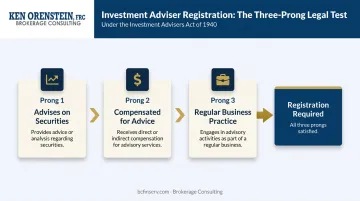
Under Section 202(a)(11) of the Investment Advisers Act, you're legally an investment adviser if you meet all three of these conditions:
- You advise others on securities — recommendations, analyses, or reports about stocks, bonds, funds, or other investment vehicles
- You're compensated for that advice — any form of payment qualifies
- You do this as a regular business — not as an incidental part of another profession
Meet all three? Registration is required. As of the most recent data, there are 15,906 SEC-registered investment advisers managing a combined $145.8 trillion in assets, plus 16,575 state-registered firms.
RIA Firm vs. Investment Adviser Representative
The firm holds the registration. Individual advisors who work under that registration are called Investment Adviser Representatives (IARs). When you hire an "RIA," you're typically working day-to-day with an IAR who operates under a registered firm's umbrella.
Ken Orenstein at Brokerage Consulting, for example, operates as an IAR through Brookstone Capital Management, LLC (BCM), a registered investment advisor, for investment advisory services. That structure means his advisory work carries BCM's fiduciary obligations.
What RIA Status Actually Guarantees
Unlike "wealth manager" or "financial planner," RIA status requires:
- Formal registration with a securities regulator
- Mandatory disclosure filings (Form ADV, Form CRS)
- Ongoing compliance obligations
- Legal fiduciary accountability
It doesn't guarantee expertise in your specific situation, but it does give you a defined baseline of regulatory accountability: documented disclosures, compliance requirements, and a fiduciary obligation that you can verify.
What Services Does an RIA Provide?
The service range varies considerably across firms. Based on SEC Form ADV data, 15,506 SEC-registered advisers report portfolio management as a core activity, while 7,145 report financial planning services.
Core Investment Management
Most RIAs start here:
- Portfolio construction across equities, fixed income, and alternatives
- Risk tolerance assessment and asset allocation
- Ongoing monitoring and rebalancing
- Tax-efficient investment positioning across taxable and tax-advantaged accounts
Broader Financial Planning
Many RIAs layer financial planning on top of investment management:
- Retirement income strategy and decumulation planning
- Tax-efficient withdrawal sequencing
- Estate planning coordination (with attorneys)
- Insurance review and optimization
- Social Security claiming strategy
The distinction between "investment management only" and "comprehensive planning" matters when you're comparing firms. Always check what's actually included in the advisory agreement.
Specialized Services for Specific Client Needs
Some RIAs focus on particular niches. For federal employees, that specialization is especially valuable — the benefit decisions involved are complex, and several are irreversible.
Federal-focused RIAs typically cover:
- FERS pension timing, survivor benefit elections, and FERS supplement strategy
- TSP distribution options — installment payments, rollover decisions, Roth TSP vs. Roth IRA distinctions
- FEGLI review — premium trajectory modeling, continuation vs. cancellation at retirement
- FEHB and Medicare coordination — how federal health coverage interacts with Medicare Parts A, B, and D
Ken Orenstein at Brokerage Consulting concentrates specifically on this work. He holds the Federal Retirement Consultant (FRC) designation and authored The Informed Fed: A Survival Guide to Federal Employee Benefits (2021). These decisions are irrevocable — objective, specialized advice before retirement can prevent mistakes that have no remedy after the fact.
RIA Fiduciary Duty and Regulation
What Fiduciary Duty Actually Means
RIAs are legally required to act as fiduciaries. Under the SEC's 2019 interpretation of the Advisers Act, this means two distinct obligations:
- Duty of care — advice must be based on a reasonable understanding of your objectives and be in your best interest
- Duty of loyalty — conflicts of interest must be eliminated or fully disclosed so you can make an informed decision
Compare this to the suitability standard that governs broker-dealers: their recommendations only need to be "suitable" given your general investment profile — a lower threshold than the full fiduciary standard. SEC Regulation Best Interest (Reg BI) tightened the rules for brokers, but it stops short of the complete fiduciary obligation that applies to RIAs.
Who Regulates Which Firms
Registration level depends on assets under management:
| AUM Threshold | Register With |
|---|---|
| Under $100M | State securities regulator |
| $100M–$110M | May register with SEC |
| Over $110M | Must register with SEC |
| Below $90M (existing SEC firms) | Must withdraw to state |
Required Disclosures You Should Actually Read
Every RIA must file publicly accessible documents:
- Form ADV Part 2A — firm brochure covering services, fees, conflicts, disciplinary history
- Form ADV Part 2B — individual advisor supplement with background and qualifications
- Form CRS (SEC-registered firms serving retail clients) — plain-language summary of the relationship
These documents aren't fine print — they're designed as investor tools. Review them before committing to any advisor.
How RIAs Are Paid
The AUM Model
Most RIA revenue comes from AUM fees. According to Schwab's 2025 RIA Benchmarking Study, AUM fees represented 80% of total revenue for RIA firms in 2024. The average AUM fee was 0.94% annually per Schwab's 2024 data.
Fees typically decline as portfolio size grows:
| Portfolio Size | Typical Fee |
|---|---|
| Under $1M | ~1.00% |
| $1M–$2M | ~0.80% |
| $2M–$5M | ~0.65% |
| Over $5M | ~0.50% |
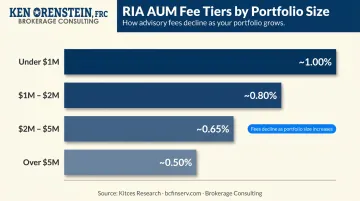
Source: Kitces research on independent advisory fee structures
Alternative Fee Structures
Not every RIA charges AUM fees. Other models include:
- Flat retainer — a set annual fee regardless of portfolio size (median: around $5,000/year for retainer-only arrangements)
- Hourly fees — typically $220–$238/hour for planning-specific questions
- Project fees — for defined deliverables like a one-time retirement plan
Some advisors blend models, charging a lower AUM fee plus a retainer for planning work.
Fee-Only vs. Fee-Based: A Critical Distinction
How an advisor gets paid shapes what they recommend — so the distinction matters.
- Fee-only — the advisor is paid exclusively by the client. No commissions, no product-related income. NAPFA membership requires strict adherence to this standard.
- Fee-based — the advisor charges fees and may earn commissions from product sales, which can create conflicts of interest worth understanding.
At Brokerage Consulting, investment advisory services through Brookstone Capital Management (BCM) operate on an AUM-based monthly fee with fiduciary duty. Insurance and annuity services are separate — delivered on a commission basis, with that distinction clearly disclosed upfront.
When evaluating any advisor, ask directly: are you fee-only, or do you also earn commissions?
RIA vs. Other Financial Professionals
Comparison at a Glance
| RIA | Broker-Dealer | Financial Planner (non-RIA) | |
|---|---|---|---|
| Legal standard | Fiduciary | Suitability / Reg BI | Varies (no universal standard) |
| How they're paid | Fees (AUM, flat, hourly) | Commissions / transaction fees | Fees, commissions, or both |
| Regulated by | SEC or state | FINRA | No single regulator |
| Relationship type | Ongoing advisory | Primarily transactional | Varies |
| Title regulated? | Yes (legal status) | Yes (FINRA registration) | No |
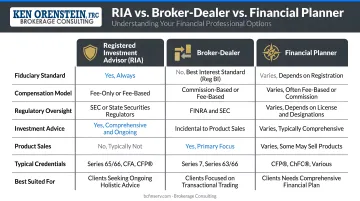
The table captures the formal distinctions — but three categories cause the most real-world confusion:
Financial Planners
"Financial planner" is not a regulated title. A CFP® (Certified Financial Planner) designation signals training and ethical standards, but doesn't mean the person holds RIA registration or operates as a legal fiduciary. Many RIAs are also CFPs — the credentials often overlap, but they're not interchangeable.
Robo-Advisors
Digital platforms like Betterment and Wealthfront are typically registered as RIAs and carry the same fiduciary obligations as human advisors. They charge lower fees, but they don't offer personalized planning or human judgment for complex situations — which matters significantly for retirees, federal employees, and anyone with layered financial needs.
Dual Registrants
Some professionals hold both RIA and broker-dealer registrations. The fiduciary standard applies when they're acting in their advisory capacity; the suitability standard applies when executing transactions. Before engaging one, ask directly: "Are you acting as my fiduciary advisor right now, or as a broker?"
How to Choose the Right RIA
Step 1: Verify Registration
Don't take anyone's word for it. Search the advisor or firm at adviserinfo.sec.gov to confirm registration status, review Form ADV disclosures, and check for any disciplinary history. FINRA BrokerCheck is useful for dually registered individuals.
Step 2: Read the Form ADV
Focus on:
- What services are actually included
- How fees are calculated and billed
- Disclosed conflicts of interest
- Any past disciplinary actions
Step 3: Ask These Questions Before Committing
A qualified advisor will answer these without hesitation:
- Are you a fiduciary at all times, or only sometimes?
- How are you compensated—fees, commissions, or both?
- What credentials do you hold?
- Who is your typical client? Do you have experience with situations like mine?
- How often will we meet and review my plan?
- What happens to my account if you retire or leave the firm?
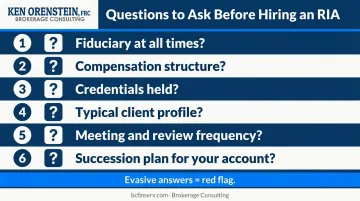
Evasive or vague answers are a red flag.
Step 4: Match Specialization to Your Situation
A generalist RIA can handle most retirement and investment planning scenarios. But if your situation involves specific complexity, look for someone who works with those cases regularly. Common examples include:
- Federal employee benefits (FERS, TSP, FEGLI, Medicare coordination)
- Business ownership and succession planning
- Equity compensation and stock option strategies
Federal employees in particular face decisions where specialist knowledge matters most. FEGLI Option B reductions, TSP distribution sequencing, and FERS supplement timing are each largely irreversible once made — getting them wrong is costly and often unfixable.
Ken Orenstein of Brokerage Consulting holds the Federal Retirement Consultant (FRC) designation and authored The Informed Fed, a guide specifically covering these decisions. Investment advisory services are offered through Brookstone Capital Management (BCM), an RIA, alongside the federal benefits consulting work.
Frequently Asked Questions
What is the difference between a registered annuity advisor and a financial advisor?
"Registered annuity advisor" is not a standardized regulatory title—FINRA lists it as a professional designation, not an SEC or state registration category. "Financial advisor" is a broad, unregulated term that can describe brokers, planners, insurance agents, or RIAs. What actually matters is the advisor's credentials, regulatory registration, and whether they're legally required to act in your interest.
What is the average fee for a registered investment advisor?
Schwab's 2024 RIA Benchmarking Study reported an average AUM fee of 0.94% annually. Fees typically range from about 0.50% to 1.00% depending on portfolio size, with larger accounts generally paying lower percentages. Flat and hourly fees vary widely by scope of services.
Is a registered investment advisor a fiduciary?
Yes. Under the Investment Advisers Act, RIAs are legally required to act as fiduciaries—meaning they must prioritize your interests, disclose conflicts of interest, and provide advice free from outside financial incentives that could compromise their recommendations.
What is the difference between an RIA and a broker-dealer?
An RIA provides ongoing investment advice under a fiduciary standard and is regulated by the SEC or state. A broker-dealer primarily executes transactions and is regulated by FINRA under a suitability standard. The distinction matters most when those two things diverge.
How do I verify that an advisor is a registered investment advisor?
Search the SEC's Investment Adviser Public Disclosure database at adviserinfo.sec.gov. You can look up firms or individuals, review their Form ADV filings, and check for any disciplinary history—all at no cost.
Do federal employees need a specialized RIA?
Any qualified RIA can provide investment advice to federal employees. But FERS pension elections, TSP distribution strategies, FEGLI continuation decisions, and FEHB-Medicare coordination involve rules and tax implications that generalist advisors may not know well. Many of these decisions are irreversible, so verifying that an advisor has documented federal benefits expertise is worth the extra due diligence.