
Introduction
More Americans are taking a hands-on approach to retirement planning — and for good reason. LIMRA data shows that only 47% of working adults ages 50–75 expect guaranteed income sources to cover their basic expenses in retirement, down 11 percentage points from 2017. That gap is pushing pre-retirees toward structures that combine income guarantees with greater control.
Self-directed annuities — annuity contracts held inside a Self-Directed IRA (SDIRA) — sit at that intersection. They offer access to guaranteed lifetime income features while keeping everything within a tax-advantaged retirement account.
The IRS rules governing these accounts are strict, the custodian requirements are non-negotiable, and setup errors can be expensive. Improper titling, a single prohibited transaction, or choosing a carrier that doesn't accept SDIRA ownership can disqualify the entire account.
This guide covers:
- What a self-directed annuity is and how it differs from a standard annuity
- How it works inside an SDIRA
- The IRS rules you need to follow
- A step-by-step setup process
- What to look for in a custodian and carrier
Key Takeaways
- A self-directed annuity is an annuity contract owned by a Self-Directed IRA — not by you personally
- All transactions must route through an IRS-approved custodian; the account holder cannot sign contracts or write checks directly
- Prohibited transactions can cause the entire IRA to be treated as distributed on January 1 of that tax year
- Contribution limits for 2025 are $7,000 (or $8,000 if age 50+); RMDs begin at age 73
- Not all carriers accept SDIRA ownership — confirm eligibility first before taking any other steps
What Is a Self-Directed Annuity?
A self-directed annuity is an annuity contract held within a Self-Directed IRA. The key word is "self-directed" — this describes the IRA structure, not the annuity product itself.
FINRA defines a self-directed IRA as an IRA held by a custodian that permits a broader range of investments than most IRA custodians allow, including real estate, private equity, and annuity contracts alongside traditional securities.
IRC Section 408 requires an IRA to be held by a qualifying bank or IRS-approved nonbank trustee. Custodian involvement is a structural requirement, not an optional preference.
How This Differs from a Standard IRA Annuity
Both structures hold an annuity inside an IRA. Here's where they diverge:
- Standard IRA annuity: Purchased through a conventional IRA with a limited investment menu
- Self-directed annuity: The SDIRA is the legal contract owner, allowing the account to also hold alternative assets like real estate or private equity alongside the annuity
In a standard annuity outside any IRA, the individual owns the contract directly. Inside an SDIRA, the account owns it, and all transactions flow through the custodian.
Why Use an SDIRA for an Annuity?
IRAs already provide tax deferral, so the real case for holding an annuity inside an SDIRA comes down to the annuity's own features. Within a single retirement account, that means access to:
- Guaranteed lifetime income options
- Death benefit provisions
- Ability to move among investment options without triggering surrender charges
- Portfolio diversification beyond stocks and bonds within a single account
How a Self-Directed Annuity Works Within an SDIRA
Funding the Purchase
All money used to buy the annuity must come from within the SDIRA. Three funding paths exist:
- New contribution — within the annual IRS limits ($7,000 in 2025; $8,000 if age 50+)
- Direct trustee-to-trustee transfer — from an existing IRA, with no tax consequence and no limit on frequency
- Rollover from a qualified plan — from a 401(k) or 403(b), with the funds deposited within 60 days to avoid current taxation
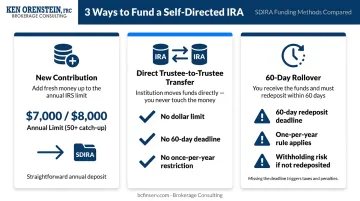
The account holder cannot write personal checks or sign contracts individually. Everything moves through the custodian.
Two Purchase Methods
- Direct purchase: Open the SDIRA, fund it, then instruct the custodian to purchase an annuity from a carrier that accepts SDIRA ownership
- Transfer of an existing IRA-held annuity: Move an annuity already inside an IRA into the SDIRA. This must be completed as a direct trustee-to-trustee transfer, not a personal withdrawal
Earnings, Withdrawals, and Penalties
| Event | Tax Treatment |
|---|---|
| Investment growth inside SDIRA | Tax-deferred until withdrawal |
| Withdrawals in retirement | Taxed as ordinary income |
| Early withdrawal (before age 59½) | Ordinary income tax + 10% penalty |
| RMDs | Must begin at age 73 |
Surrender Charge Risk
If transferring an existing annuity before its surrender period ends, the insurance company may impose early exit fees. The NAIC's model regulation illustrates surrender schedules starting at 8% in year 1, declining to 0% by year 8 — though actual schedules vary by carrier and product. Some carriers extend surrender periods beyond 10 years, which NAIC model regulations require carriers to disclose prominently.
Before initiating any transfer, confirm the remaining surrender period and calculate the exit cost against the benefit of moving.
Carrier Acceptance: A Critical Filter
Surrender charges are only one constraint on a transfer. Carrier acceptance is another. Not all insurance carriers allow an SDIRA to own their annuity contracts, which narrows the available product pool considerably.
Confirming carrier eligibility should be the first step in setup. Before comparing products or rates, verify:
- Whether the carrier permits SDIRA ownership of the contract
- Whether the custodian has an established relationship with that carrier
- What documentation the carrier requires to complete the transfer or purchase
IRS Rules Governing Self-Directed Annuities
SDIRAs follow the same core IRS rules as traditional IRAs, with a few additional compliance layers worth knowing.
Current limits:
- 2025 contribution limit: $7,000 (or $8,000 if age 50+)
- RMDs begin at age 73
- Early withdrawal penalty: 10% for distributions before age 59½
Prohibited Transactions
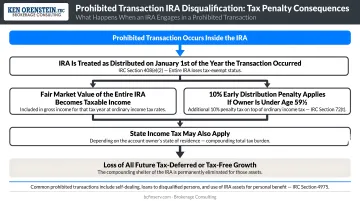
IRC Section 4975 prohibits any transaction where IRA assets directly or indirectly benefit the account holder outside of qualified distributions. Common examples:
- Signing annuity paperwork as an individual instead of through the custodian
- Using an SDIRA-owned asset personally (such as living in property the IRA owns)
- Borrowing against the annuity contract
- Selling or buying assets between the SDIRA and yourself or related parties
The consequences are severe. Under IRC Section 408(e)(2), a prohibited transaction causes the IRA to cease being an IRA as of January 1 of that tax year. The entire account value is treated as distributed at fair market value — triggering ordinary income tax on the full balance, plus the 10% early withdrawal penalty if the owner is under age 59½.
Disqualified Persons
Transactions between the SDIRA and "disqualified persons" are prohibited. This includes:
- The account holder and their spouse
- Parents, children, grandchildren, and spouses of lineal descendants
- Any business entity the account holder controls (50% or more ownership)
- Fiduciaries and service providers to the plan
Even an unintentional transaction with a disqualified person can trigger full account disqualification — so documentation and custodian oversight matter at every step.
UBIT (Unrelated Business Income Tax)
Beyond self-dealing rules, the IRS also monitors how SDIRA income is generated. If the account earns income from an active business or uses debt financing to purchase an asset, that income may be subject to Unrelated Business Income Tax. An SDIRA with $1,000 or more in gross unrelated business income must file Form 990-T. This is less common with annuities specifically, but becomes relevant if the SDIRA holds business interests alongside the annuity contract.
How to Set Up a Self-Directed Annuity: Step-by-Step
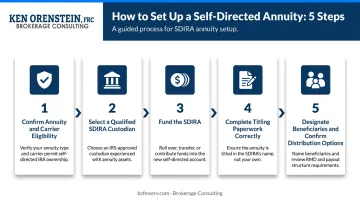
Step 1 — Confirm Annuity and Carrier Eligibility
Before opening any account, verify two things:
- The annuity contract is IRA-eligible under IRC Section 408(b)
- The specific insurance carrier will accept an SDIRA as the policy owner
This step alone eliminates a significant portion of the market. It requires direct contact with the carrier — not just a product brochure review. Working with an advisor who has existing relationships across multiple carriers can shorten this process considerably.
Step 2 — Select a Qualified SDIRA Custodian
All SDIRAs legally require a custodian — a bank or IRS-approved nonbank entity. FINRA notes that custodians hold and administer assets but do not evaluate investment quality, provide investment advice, or verify that an annuity is suitable for your situation. That due diligence is the investor's responsibility.
Key criteria when evaluating custodians:
- Documented experience handling annuity contracts specifically (not all SDIRA custodians are equipped for this)
- Verify a transparent fee schedule covering setup fees, annual maintenance fees, and per-transaction costs
- Clear process for coordinating directly with insurance carriers
- Responsive client support with reasonable processing timelines
Step 3 — Fund the SDIRA
Each funding method has different timing and documentation requirements:
- New contribution: Subject to annual IRS limits; straightforward but capped at the annual IRS limit
- Direct transfer: No dollar limit, no 60-day clock, not subject to the one-rollover-per-year rule
- 60-day rollover: Must be deposited within 60 days; subject to one-rollover-per-year restriction; withholding may apply
Direct transfers are generally the cleanest option when moving from an existing IRA.
Step 4 — Complete Titling Paperwork Correctly
This is one of the most common setup errors. The annuity contract must be titled in the name of the SDIRA, not the individual. The standard format:
"[Custodian Name] FBO [Your Name] IRA Account # [Account Number]"
Improper titling (for example, placing the contract in the individual's name) can cause the IRS to disqualify the account's tax-advantaged status. Confirm the exact format required by both the custodian and the carrier before submitting any paperwork.
Step 5 — Designate Beneficiaries and Confirm Distribution Options
Select beneficiaries aligned with your estate planning goals. Then confirm that the annuity's payout options are compatible with IRA withdrawal rules, including RMD requirements:
Select beneficiaries aligned with your estate planning goals. Then confirm the annuity's payout options are compatible with IRA withdrawal rules, including RMD requirements:
- Lifetime income: Ongoing payments for the annuitant's life
- Period certain: Payments guaranteed for a set number of years
- Lump sum: Single distribution (verify RMD compatibility before electing)
Under Treasury Regulation 1.401(a)(9)-6, distributions must generally be paid as periodic annuity payments to satisfy RMD rules. Document all elections in writing with both the carrier and the custodian.
Pros, Cons, and Who It's Best For
Pros
- Locks in guaranteed lifetime income inside a tax-deferred structure, combining the annuity's income guarantee with SDIRA tax advantages
- Enables alternative investment diversification — real estate, private equity, or other assets can sit alongside the annuity in a single account
- Supports contract flexibility: fixed, indexed, or variable annuities can all potentially qualify, so investors can match the structure to their risk tolerance and income timeline
Cons
- Requires ongoing custodian coordination at every step — significantly more complex than a standard IRA annuity
- Carries meaningful prohibited-transaction risk; the rules are detailed, violations are costly, and administrative errors leave almost no margin for recovery
- Limits your carrier options, since not all insurers accept SDIRA ownership — this can narrow both rate competitiveness and available contract features
Who Is This Best For?
The strongest candidates share a few characteristics:
- Existing retirement assets sufficient to fund the SDIRA meaningfully (a typical minimum investable amount for annuity placement is $250,000)
- Desire for guaranteed income plus exposure to alternative assets within the same account
- Willingness to manage ongoing custodian coordination and compliance requirements
This structure is especially relevant for federal employees approaching retirement who want to supplement TSP income and a FERS pension with an additional guaranteed income layer. For that audience, the layered income approach matters: Brokerage Consulting frames annuities as Layer 3 in a multi-source retirement plan — after Social Security and pension income — targeting the income gap that TSP distributions alone may not cover.
Choosing the Right Custodian and Carrier
What to Look for in a Custodian
- Confirm directly whether the custodian handles annuity contracts — not all SDIRA custodians do, and processes vary significantly
- Compare the full fee schedule upfront: setup fees, annual maintenance, and per-transaction charges before committing
- Verify they have a defined workflow for coordinating with carriers on titling, premium submission, and policy changes
- Prioritize responsive support — custodian delays can trigger missed deadlines and compliance problems
What to Look for in a Carrier
- Documented willingness to accept SDIRA ownership of their contracts
- Competitive rates and reasonable surrender periods (ask for the full declining schedule in writing)
- Payout options compatible with IRS RMD requirements
- Strong financial strength ratings (A.M. Best, Moody's, S&P, or Fitch) to support long-term income guarantees
Working with an advisor who maintains established relationships across multiple top carriers — Ken Orenstein at Brokerage Consulting works across the carrier landscape in this way — can identify compatible options faster and cut out the trial-and-error of contacting carriers one by one.
Regardless of which custodian or carrier you choose: retain everything. Signed confirmations, correspondence, forms, and carrier approvals all belong in a dedicated file — this paper trail is your primary defense in the event of an IRS audit or a future dispute over account structure.
Frequently Asked Questions
Can I roll over an existing annuity into a self-directed IRA?
Yes — an annuity already held inside an IRA can generally be transferred into an SDIRA without triggering taxes, provided the move is completed as a direct trustee-to-trustee transfer. Check whether your existing annuity's surrender period would impose early exit fees before initiating the transfer.
What types of annuities can be held inside an SDIRA?
Fixed, indexed, and variable annuities can all potentially qualify, but the specific contract must be IRA-eligible under IRC Section 408(b) and the insurance carrier must agree to accept SDIRA ownership. Not all carriers or products meet both requirements.
What is the difference between a self-directed annuity and a standard IRA annuity?
A standard IRA annuity is purchased through a conventional IRA with a limited investment menu. An SDIRA allows the owner to hold alternative assets alongside the annuity, but compliance requirements and custodian responsibilities are far more intensive.
What happens if I make a prohibited transaction in my SDIRA?
The IRS treats the entire IRA as distributed as of January 1 of that tax year, making the full account value immediately taxable as ordinary income. If the account owner is under age 59½, the 10% early withdrawal penalty also applies on top of the income tax.
Do self-directed annuities have required minimum distributions (RMDs)?
Yes. Self-directed annuities inside a traditional SDIRA are subject to RMDs beginning at age 73. The annuity's payout structure must satisfy RMD requirements, so confirming distribution options during setup is a necessary step, not an afterthought.
Are self-directed annuities a good fit for federal employees?
Federal employees with TSP accounts and FERS pension income may find a self-directed annuity useful as a supplemental income layer for assets held outside the TSP. The decision should be evaluated alongside existing federal benefits to avoid overlap or tax complications — a Federal Retirement Consultant can clarify where it fits in the broader plan.