
Both fixed annuities and fixed indexed annuities (FIAs) promise principal protection and tax-deferred growth. But they achieve those goals in fundamentally different ways, and choosing the wrong one for your situation can mean leaving money on the table — or accepting more uncertainty than you bargained for.
This article breaks down exactly how each product works, who each is best suited for, and how to decide which fits your retirement plan.
Key Takeaways
- Fixed annuities credit a guaranteed, pre-set interest rate — your future value is calculable from day one
- Fixed indexed annuities link interest credits to a market index (like the S&P 500), with a 0% floor so index losses never reduce your principal
- Both are insurance products, not securities — neither puts your money directly in the stock market
- FIAs introduce caps, participation rates, and spreads that can limit upside — review these terms carefully before committing
- The right choice hinges on your time horizon, risk tolerance, and income certainty needs
Fixed Annuity vs. Fixed Indexed Annuity: Quick Comparison
| Feature | Fixed Annuity (MYGA) | Fixed Indexed Annuity (FIA) |
|---|---|---|
| Interest Type | Guaranteed declared rate | Index-linked, subject to caps/participation rates |
| Risk Level | Lowest | Low to moderate |
| Earnings Potential | Predictable, capped at declared rate | Higher potential, but limited by crediting mechanism |
| Principal Protection | Yes — guaranteed | Yes — 0% floor; index losses never reduce principal |
| Liquidity | Surrender charges apply; typically 10% free withdrawal/year | Surrender charges apply; typically 10% free withdrawal/year |
| Ideal Candidate | Conservative savers, near-retirees (within 2–3 years) | Growth-seeking pre-retirees with 5+ year horizons |
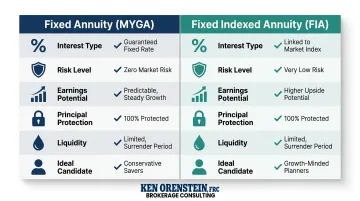
Common ground: Despite their differences, fixed and fixed indexed annuities share the same structural foundation:
- State-regulated insurance products (not securities)
- Tax-deferred growth under IRC Section 72
- Surrender charges for early withdrawal, with typical 10% annual free withdrawal provisions
The right choice depends on your timeline, income goals, and tolerance for interest variability — not on one being inherently superior to the other.
What Is a Fixed Annuity?
A fixed annuity is an insurance contract that credits a pre-agreed interest rate for a specified term — regardless of what markets do. Rates are locked in at purchase, which makes future value predictable.
Traditional Fixed vs. MYGA: Know the Difference
Two main subtypes exist:
- Traditional declared-rate fixed annuities — the insurer guarantees a rate for an initial period, then resets it annually (within a contractual minimum) at its discretion
- Multi-Year Guaranteed Annuities (MYGAs) — lock in a fixed rate for the entire contract term, typically 2–10 years; often the more competitive choice
MYGAs lead all annuity subtypes by volume — sales hit $162.5 billion in 2025. As of May 2026, top 5-year MYGA rates reach approximately 6.30% — compared to roughly 4.15% for a comparable 5-year CD. On a $100,000 deposit held five years, that 2.15-point difference adds up to roughly $11,000 in additional growth.
How Accumulation Works
Deposited premium earns compound interest at the declared rate, all tax-deferred. A simple example:
- $100,000 deposited into a 5-year MYGA at 6.00%
- After 5 years: approximately $133,800 accumulated
- No taxes owed on that growth until withdrawal
Withdrawals before age 59½ may trigger a 10% IRS penalty on the taxable portion, per IRS Publication 575.
Key Benefits
- Predictable income floor — you know exactly what you'll have at maturity
- Zero market exposure — recessions don't touch the account value
- Simplified planning — no need to monitor index performance or crediting adjustments
- Behavioral protection — removes the temptation to react to market swings
Use Cases for a Fixed Annuity
Fixed annuities suit situations where a guaranteed floor matters more than chasing growth. The ideal candidate:
- Is retired or within 2–3 years of retirement
- Needs a predictable supplement to Social Security or a FERS pension
- Wants to cover essential expenses (housing, healthcare, utilities) with guaranteed income
- Has already reduced portfolio risk and doesn't need additional growth potential
In a bucket income strategy, a fixed annuity sits naturally in the near-term bucket — covering non-negotiable expenses while other assets stay invested. For federal retirees with a FERS pension and Social Security already in place, a MYGA can fill the income gap without adding market uncertainty.
At Brokerage Consulting, Ken Orenstein works with federal retirees (FERS and CSRS) to position MYGAs as a complement to existing guaranteed income sources — not a duplication of them. Every recommendation includes a carrier financial-strength review across MYGA terms of 3, 5, 7, and 10 years — so clients understand not just the rate they're locking in, but the stability of the insurer backing it.
What Is a Fixed Indexed Annuity?
A fixed indexed annuity (FIA) credits interest based on the performance of an external market index — most commonly the S&P 500. Your money is never directly invested in the market. The insurer holds premiums in its general account and uses the index purely as a benchmark for calculating credits, not as an investment vehicle.
If the index falls, your account credits 0% — not a negative number. Principal is never reduced by market losses.
The Three Crediting Mechanisms
These are non-negotiable to understand before purchasing an FIA:
- Cap rate: the ceiling on credited interest — a 10% cap means you receive 10% even if the index gains 18%
- Participation rate: the share of index gains credited to your account — an 80% rate on a 10% index gain = 8% credited
- Spread/margin: a fixed percentage subtracted before crediting — a 2% spread on a 9% index gain = 7% credited
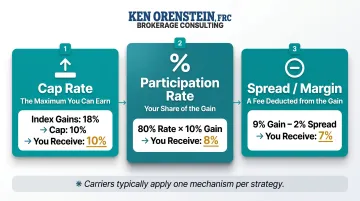
Carriers typically use one mechanism per strategy, not all three simultaneously. As of May 2026, top FIA cap rates on S&P 500 annual point-to-point strategies reach 10.50% across select carriers — a meaningful improvement from lower interest rate environments.
Floor Protection in Practice
A flat or negative index year looks like this:
| Scenario | Index Return | Credited to Account |
|---|---|---|
| Strong market | +14% | +10% (10% cap applied) |
| Flat market | 0% | 0% (no growth, no loss) |
| Down market | -20% | 0% (floor protects principal) |
That floor protection sets the stage for the next layer of planning: guaranteed income.
Income Riders
FIAs can be paired with Guaranteed Lifetime Withdrawal Benefit (GLWB) or Guaranteed Minimum Income Benefit (GMIB) riders for an annual fee.
These riders allow for predictable retirement income even if the account value fluctuates based on crediting performance. Brokerage Consulting's annuity review process includes income rider comparison across carriers, covering roll-up rates, payout percentages, and total cost relative to projected benefit.
Use Cases for a Fixed Indexed Annuity
FIAs suit a different profile than fixed annuities:
- 5–10 years before retirement, with enough runway to accumulate through favorable market cycles
- Concerned about inflation eroding fixed income over a 20–30 year retirement
- Comfortable understanding caps and participation rates in exchange for higher upside potential
- Federal pre-retirees with equities-heavy TSP allocations (C Fund, S Fund) who want a complementary, principal-protected growth vehicle
At a 3% average annual inflation rate, purchasing power is cut roughly in half over 24 years. Fixed annuity payments don't adjust for inflation — FIAs offer partial mitigation by linking credits to index performance that has historically outpaced inflation over long periods.
Which Is Better for You?
Neither product is universally superior. The right choice depends on where you are in your retirement timeline, how much certainty you need, and how much complexity you're willing to manage.
Three Primary Decision Factors
- Risk tolerance — how comfortable are you with variable annual credits versus a guaranteed rate?
- Time horizon — how many years before you need income from this money?
- Income certainty requirements — do you need to budget to an exact number, or can you work with a range?
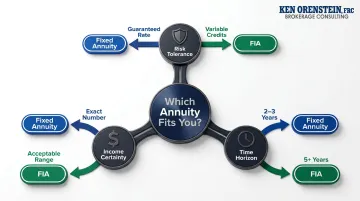
Situational Recommendations
Choose a fixed annuity if:
- You're retired or within 2–3 years of retirement
- You need a guaranteed income supplement with no ambiguity about future value
- You find variable-interest products stressful to monitor
- You're looking to cover essential expenses with a predictable floor
Choose a fixed indexed annuity if:
- You have 5+ years before you need income from this account
- You want upside participation in strong market years with a guaranteed downside floor
- You're concerned about inflation eroding purchasing power over a long retirement
- You're comfortable learning how caps and participation rates work
Two Hypothetical Scenarios
These are illustrative examples, not real clients.
Scenario 1 — Fixed Annuity Fit: A 67-year-old retired federal employee has her FERS pension and Social Security in place but has a $150,000 gap in monthly income coverage. She needs predictability — a MYGA locking in a guaranteed rate for 5 years lets her plan expenses precisely without any market exposure or monitoring.
Scenario 2 — FIA Fit: A 58-year-old federal employee with a heavy C Fund and S Fund TSP allocation has 7 years before retirement. He wants to diversify away from pure equity risk without moving to low-yield fixed instruments. An FIA gives him principal protection plus the opportunity to capture partial index gains during the accumulation window, complementing his TSP equity exposure rather than duplicating it.
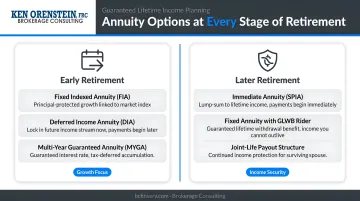
Getting the Decision Right
Every retirement situation is different. TSP account size, Social Security timing, FERS pension amount, existing portfolio mix, and tax situation all shape which annuity structure makes sense.
Working with Ken Orenstein at Brokerage Consulting means getting a no-cost annuity review covering carrier financial-strength analysis, income rider comparison, 1035 exchange analysis (if you're moving from an older contract), and annuity laddering strategy tailored to your full income picture.
Conclusion
Fixed annuities and fixed indexed annuities share the same core purpose — protecting savings and producing retirement income — but they serve different timelines and temperaments. Fixed annuities offer predictable, guaranteed returns; FIAs trade some of that certainty for protected upside tied to market performance. For many retirees, the most effective strategy combines both — a fixed annuity as a reliable income floor, and an FIA for incremental, inflation-aware growth.
Which structure fits your situation depends on your timeline, income needs, and what's already in your plan. A brief conversation can clarify which approach makes sense.
To find out which annuity type fits your situation, request a no-cost annuity consultation with Ken Orenstein at Brokerage Consulting — available by phone, virtual, or in-person. Visit bcfinserv.com/request-a-quote or call (888) 315-3608.
Frequently Asked Questions
How does an index annuity differ from a fixed annuity?
A fixed annuity credits a guaranteed, pre-set interest rate — you know the exact return before signing. A fixed indexed annuity credits interest based on an external market index (like the S&P 500), subject to caps and participation rates. Both protect principal from market losses; the difference is how interest is calculated and how much variability you accept.
What's the difference between a fixed annuity and a deferred annuity?
"Fixed" describes how interest is calculated : a guaranteed rate set by the insurer. "Deferred" describes the timing of income payments — the contract grows during an accumulation phase before payouts begin. (One em-dash retained here intentionally.) Most fixed annuities are also deferred, but the two terms describe different contract features, not different products.
What is the difference between a fixed index annuity and an immediate annuity?
A fixed indexed annuity is an accumulation product that grows tax-deferred over time, with income typically accessed later. An immediate annuity (SPIA) starts paying income within a month of purchase in exchange for a lump-sum premium. They serve different stages: FIAs build toward retirement income, while SPIAs convert savings into income right now.
Is a fixed index annuity better than a variable annuity?
FIAs offer principal protection — no universal figure applies. An annuity calculator or advisor consultation will produce a personalized estimate for your specific situation.
Does annuity income affect SSDI?
SSDI (Social Security Disability Insurance) is not means-tested, so annuity income does not affect SSDI benefit amounts — the program focuses on Substantial Gainful Activity (earned income), not unearned income. SSI is different: annuity income counts as unearned income and can reduce SSI benefits. A benefits specialist can clarify how either program applies to your situation.