
These are legitimate concerns. According to the 2025 EBRI/Greenwald Retirement Confidence Survey, 44% of retirees say they spend less than they could because they fear outliving their money. That fear shapes spending, quality of life, and financial decisions—often unnecessarily.
This guide cuts through the confusion. It covers whether an annuity makes sense at 70, what a $100,000 annuity actually pays, which product types fit this stage of life, and what red flags to avoid.
Key Takeaways
- Annuities can make strong sense at 70—especially immediate annuities that begin paying within months of purchase
- A $100,000 SPIA pays approximately $699–$778/month for a 70-year-old male and $655–$711/month for a female (life-only, May 2026 data)
- Immediate annuities and QLACs are the best fits for most 70-year-olds — variable annuities rarely make the cut
- Annuity income counts as ordinary income and can affect Social Security taxation and Medicare premiums
- Always keep a separate cash reserve outside your annuity, and use your free-look period if the contract isn't right
Is Buying an Annuity at Age 70 a Smart Move?
The Core Appeal
At 70, the math on longevity is more concrete than most people expect. The SSA's actuarial tables show a 70-year-old male has 14.09 years of remaining life expectancy on average; a female, 16.27 years. Those aren't short timelines—and they don't account for the possibility of living into your late 80s or beyond.
Social Security helps, but often not enough. SSA data shows that 44% of women and 39% of men aged 65+ rely on Social Security for at least half their income. For seniors without a pension, that gap between Social Security and actual living costs is exactly what an annuity can fill—with contractually guaranteed, market-proof monthly payments.
Benefits Specific to Age 70 Buyers
- Immediate income: Immediate annuities (SPIAs) start paying within 30 days to 12 months—no waiting phase
- Market protection: Annuity income doesn't drop when markets fall, unlike portfolio withdrawals
- Portfolio preservation: Using annuity income to cover fixed expenses reduces pressure to sell investments during downturns
- Simplified income management: Replaces the ongoing burden of portfolio management for a defined income slice
Honest Drawbacks
- Reduced tax-deferral value: Less time to grow tax-deferred means less compounding benefit than at 55 or 60
- Liquidity loss: Once annuitized, that capital is no longer accessible—you must maintain a separate cash reserve before purchasing
- Fee exposure: Some products carry fees that erode returns, particularly variable and indexed annuities with riders
- Principal risk: If you pass away earlier than expected without a refund or period-certain option, your heirs may receive nothing from that premium
Should You Wait Until 75?
Monthly payouts are higher at 75 because the insurance company expects fewer payments. But waiting means forfeiting five years of guaranteed income you could have already been receiving. If you need income now or your health is uncertain, those five years of payments you'd be giving up typically outweigh the higher payout rate you'd gain by waiting.
Quick Self-Assessment Checklist
Once you've worked through the timing question, these four readiness checks help confirm whether you're in a position to move forward:
- Do I have liquid savings set aside separately from this purchase?
- Do I have other income sources (Social Security, pension, investments)?
- Am I in reasonably good health with no immediate need for large cash reserves?
- Have I reviewed multiple carriers to compare rates?
Ken Orenstein at Brokerage Consulting helps seniors model these scenarios using their complete financial picture—across Social Security, Medicare, and existing assets—before any annuity decision is made. A no-cost consultation is available at bcfinserv.com or by calling (888) 315-3608.
How Much Will a $100,000 Annuity Pay Per Month at Age 70?
What Determines Your Payout
Monthly income from a Single Premium Immediate Annuity (SPIA) depends on four variables:
- Premium amount — how much you invest
- Age and gender — older buyers and males receive higher monthly payments
- Payout structure — life-only, period-certain, or cash refund
- Carrier rates — which vary by insurer and current interest rate environment
Current Payout Estimates
The following figures are sourced from ImmediateAnnuities.com, surveyed May 6, 2026, for a $100,000 single premium:
| Payout Structure | Male Monthly Payout | Female Monthly Payout |
|---|---|---|
| Single life only — best rate | $778 | $711 |
| Single life only — average rate | $699 | $655 |
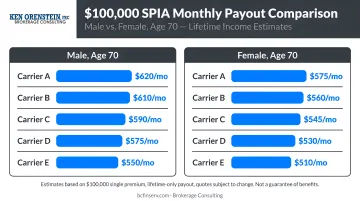
Note: Period-certain and cash refund payout amounts were not available from a verified source at publication time. Rates exclude state premium taxes and are subject to change. Contact an annuity specialist for current, carrier-specific quotes.
Why Women Receive Lower Payments
The difference comes down to actuarial math. At 70, women have roughly 2.18 more expected years of remaining life than men. The insurance company spreads the same premium over more expected payments, which reduces each individual check.
The Period-Certain and Cash Refund Trade-Off
That longer life expectancy also shapes how you should think about payout structure. Adding a period-certain guarantee (such as 10 years) or a cash refund option reduces your monthly payment, because the insurer takes on an additional obligation to your beneficiaries. Consider that trade-off if:
- You have a spouse or heirs you want to protect
- You're concerned about dying before recovering your premium
- Your other income sources are sufficient to absorb a lower monthly amount
For larger purchase amounts—$250,000 or $500,000—payouts scale proportionally, though carrier rates and structure affect the exact figures. Comparing quotes across multiple carriers is the fastest way to see where the best rates land for your age, gender, and payout preference — something a no-cost consultation with an annuity specialist can walk you through in one conversation.
Best Types of Annuities for Seniors Over 70
Immediate Annuities (SPIAs)
SPIAs are generally the strongest fit for 70-year-olds. There's no accumulation phase to wait through—payments begin within 12 months of purchase, typically within 30 days. The structure is transparent: you hand over a lump sum, and the carrier sends you a guaranteed check every month for life (or for a defined period).
Key payout options to know:
- Life-only: Highest payment, but stops at death—no benefit to heirs
- Joint-and-survivor: Payments continue for a surviving spouse, at a reduced percentage (commonly 50–100% of original payment)
- Period-certain: Guarantees payments for a set number of years regardless of when you die
For married seniors, the joint-and-survivor option deserves serious consideration. Brokerage Consulting evaluates all four survivor percentage tiers (50%, 66.67%, 75%, 100%) as part of the consultation process for couples.
Fixed Annuities and MYGAs
Fixed annuities offer a guaranteed minimum interest rate for a defined term—often 3, 5, 7, or 10 years. They function as a CD alternative: rates are often higher, growth is tax-deferred, and principal is fully protected with no market exposure.
Teaser rate warning: Some fixed annuities advertise an attractive first-year rate that drops sharply after year one. Always ask: What is the minimum guaranteed rate for the full contract period? Ken Orenstein's carrier review process compares both the offered rate and the carrier's financial strength ratings from A.M. Best, Moody's, S&P, and Fitch—ensuring the guarantee is backed by a financially sound insurer.
Deferred Annuities and QLACs
Standard deferred annuities are generally less suitable at 70. Surrender charge periods often run 7–15 years, which creates a real liquidity problem for someone who may need those funds within that window. The notable exception is a Qualified Longevity Annuity Contract (QLAC), which sidesteps that problem entirely. Key QLAC facts (per IRS Form 1098-Q instructions, April 2025):
- Funded with IRA assets
- Maximum premium: $200,000 (the old 25%-of-balance cap was repealed for contracts purchased on or after December 29, 2022)
- QLAC value is excluded from RMD calculations until income begins
- Income must begin no later than age 85
This makes QLACs a practical tool for reducing taxable income in early retirement while locking in longevity protection for later years. Brokerage Consulting positions QLACs within a broader RMD management strategy for seniors with substantial IRA balances.
Variable annuities round out the category—but are generally not the right fit at 70. They carry the highest fees, often exceeding 3% annually when M&E charges, administrative costs, and rider fees are combined, and they expose principal to market risk. Most 70-year-olds prioritize income security over growth potential. Variable annuities are better suited for younger accumulation-phase buyers or retirees who already have substantial guaranteed income in place.
Annuity Riders Worth Considering at 70
Riders are optional add-ons that customize coverage for an additional annual fee. Not every rider makes financial sense—each one reduces your base monthly payout. The value depends on your health, existing coverage, and budget.
Three riders most relevant for seniors over 70:
- Long-term care (LTC) rider: Provides enhanced payouts if you need nursing or home care. HHS research shows 70% of adults reaching 65 will develop severe long-term care needs, so evaluate this rider if you lack a standalone LTC policy
- Inflation rider: Adjusts payments upward annually (commonly 1–3% or CPI-linked) to preserve purchasing power over a 15–20 year retirement
- Impaired risk rider: Available from select carriers for individuals with serious pre-existing conditions. Insurers offer higher payments based on a shorter projected lifespan, which can meaningfully increase monthly income
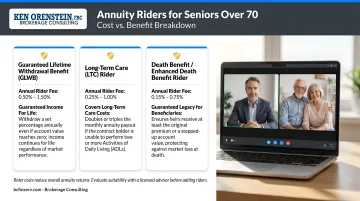
Critical caveat: If you already hold a standalone long-term care insurance policy, paying for an LTC rider inside an annuity may duplicate coverage you're already paying for. Review existing policies before adding riders.
How Annuities Interact With Social Security, Medicare, and RMDs
Annuity income doesn't exist in isolation. It affects Social Security taxation, Medicare premiums, and RMD obligations in ways that catch many seniors off guard.
Social Security Taxation
Annuity payments count as ordinary income. When combined income (one-half of Social Security plus other income) crosses IRS thresholds, a larger share of your Social Security benefits becomes taxable. Per IRS Publication 915:
| Filing Status | Up to 50% of SS taxable above | Up to 85% of SS taxable above |
|---|---|---|
| Single / Head of Household | $25,000 | $34,000 |
| Married Filing Jointly | $32,000 | $44,000 |
Annuity income can push you from one tier to the next—or to the maximum 85% taxable threshold—depending on your total income picture.
Medicare IRMAA Surcharges
Higher income also triggers Income-Related Monthly Adjustment Amounts (IRMAA) on Medicare Part B and Part D premiums—based on income reported two years prior. For 2025, IRMAA begins above $106,000 MAGI (individual) or $212,000 (joint). At the highest income tier, total Part B premiums reach $628.90/month versus the standard $185.00—a difference of over $5,300 annually.
That lag surprises many retirees: the income triggering the surcharge happened two years earlier, often before the annuity purchase was fully planned. Factor your two-years-prior MAGI into any annuity income decision.
QLACs and RMD Reduction
If you hold substantial IRA assets, a QLAC can reduce near-term RMD obligations. The IRS excludes the QLAC's value from the RMD calculation until income payments begin. This lowers taxable income during early-to-mid retirement while positioning guaranteed income for later years—a practical way to defer both income and the tax bill that comes with it.
How to Avoid Annuity Scams Targeting Seniors
The FBI reported 147,127 elder fraud complaints and $4.885 billion in losses in 2024. Elder financial fraud is a serious and growing problem—and annuity scams are a documented part of that picture.
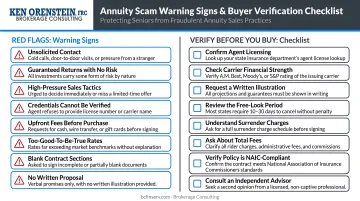
Common High-Pressure Tactics
- Unsolicited cold calls or mailers promising guaranteed income with no risk
- "Free lunch" or "free dinner" seminars where the real agenda is selling annuities
- Fake credentials—titles like "Senior Trust Advisor" or "Certified Retirement Planner" that sound official but aren't regulated designations
- Artificial urgency: "This rate expires today" or "I can only hold this for 48 hours"
Legitimate advisors never rush you. If an agent applies pressure to sign before you've had time to review the contract, walk away.
The Liquidity Trap
One documented abuse pattern involves selling deferred annuities with long surrender periods to seniors who clearly need liquidity for healthcare or living expenses. The product itself isn't inherently fraudulent. It's simply unsuitable for the buyer's situation.
FINRA's suitability rules require that a client's age, liquidity needs, financial situation, and time horizon all be considered before a deferred variable annuity is recommended.
Know your free-look rights. NAIC model regulations require a minimum 15-day free-look period after receiving your contract; some states offer longer windows (Florida, for example, provides at least 21 days). Within that period, you can return the contract for a full refund.
Before You Buy: A Verification Checklist
- Confirm the agent holds a valid life insurance license (and a securities license for variable annuities)
- Check the insurance company's financial strength through AM Best, Moody's, or S&P
- Never consolidate all your assets into a single annuity product
- Get a second opinion if any part of the offer feels rushed or unclear
Frequently Asked Questions
Should a 70-year-old buy an annuity?
It can make strong sense for seniors who need guaranteed lifetime income and have sufficient liquid savings set aside separately. The right choice depends on health status, existing income sources, and whether the annuity type fits a realistic planning horizon.
How much will a $100,000 annuity pay monthly at age 70?
Based on May 2026 data, approximately $699–$778/month for a 70-year-old male and $655–$711/month for a female on a single life-only structure. Exact amounts vary by carrier, gender, payout option, and current interest rates.
What type of annuity is best for a 70-year-old?
Immediate annuities (SPIAs) work best for most seniors because of their fast income access and straightforward structure. QLACs are a strong alternative for seniors wanting to reduce RMDs and defer guaranteed income until later in retirement.
Are there downsides to buying an annuity at age 70?
Yes. Key drawbacks include reduced tax-deferral benefit, potential fees that erode returns, loss of liquidity after annuitization, and the risk of not recovering your premium if you pass away early without a refund or period-certain option.
How does an annuity affect Social Security benefits?
Annuity payments are ordinary income, which can push more of your Social Security benefits into taxable territory—up to 85% at higher income thresholds. Higher income may also trigger Medicare IRMAA surcharges on Part B and Part D premiums based on income reported two years prior.
Should I buy an annuity at 70 or wait until 75?
Waiting until 75 typically yields higher monthly payments due to shorter life expectancy, but forfeits five years of income you could have already received. The better choice hinges on your current cash flow needs, health outlook, and how much guaranteed income you already have.