What Is an Immediate Annuity?
The fear most retirees actually carry into retirement isn't losing money in the stock market — it's running out of income. A portfolio can recover. A depleted monthly cash flow cannot.
A Single Premium Immediate Annuity (SPIA) addresses this directly. You hand an insurance company a lump sum, and they send you regular income payments — monthly, quarterly, or annually — for as long as you live. According to the ACLI, those payments begin "immediately or within one year" of purchase.
This guide is for retirees and pre-retirees (including federal employees layering a SPIA alongside a FERS pension and Social Security) who want a clear-eyed look at whether a SPIA belongs in their income plan.
The core trade-off is real. Immediate annuities offer unmatched income certainty, but they come with meaningful limitations:
- Liquidity — your lump sum is converted and largely inaccessible
- Inflation — fixed payments lose purchasing power over time
- Flexibility — payout terms are locked in at purchase
Whether a SPIA makes sense depends on your full financial picture.
TLDR: Key Takeaways
- A SPIA converts a one-time lump sum into guaranteed income that begins within one year of purchase
- Main advantages: predictable lifetime income, zero market exposure, and lower fees than other annuity types
- Key drawbacks include losing access to your principal, inflation eroding fixed payments over time, and a contract you cannot reverse
- Best fit for retirees without pensions who need a reliable income floor — especially those with longevity in their family history
- Always compare multiple carriers — payout rates can vary by nearly 10% or more across insurers
How Does an Immediate Annuity Work?
You pay a single premium to an insurance company. They agree to send you income payments — typically monthly — for a defined period or for life. There are no ongoing investment decisions and no account to manage.
What Determines Your Payout
According to New York Life, your monthly payment depends on:
- Premium size — larger lump sums produce larger payments
- Your age at purchase — older buyers receive higher payments because the payment period is statistically shorter
- Gender — women typically receive lower monthly payments than men of the same age due to longer average life expectancy
- Prevailing interest rates — higher rates at the time of purchase produce higher payouts
- Your chosen payout structure — life-only, joint, period-certain, and cash-refund options each yield a different monthly figure
One point that trips up many buyers: the quoted payout rate is not a pure investment return. Each payment blends return of your original principal with interest earned — and that split matters for taxes. With nonqualified (after-tax) SPIAs, IRS rules allow a portion of each payment to come back to you tax-free as a return of principal.
That tax treatment also varies by payout structure, which is where the table below becomes useful.
Payout Structures Available
| Structure | What It Does | Trade-Off |
|---|---|---|
| Life-Only | Highest monthly payment; stops at death | Nothing passes to heirs |
| Period-Certain | Pays for a set term (e.g., 10 or 20 years) even if you die early | Lower payment than life-only |
| Joint-and-Survivor | Continues for a surviving spouse | Lower payment; survivor % options typically 50–100% |
| Cash-Refund | Returns remaining premium to heirs if you die before exhausting it | Lower payment than life-only |

Each structure produces a different monthly figure. If you're married, joint-and-survivor or cash-refund options protect your spouse or estate — but you'll give up some monthly income to do it. Single buyers in good health often get the most from life-only.
Pros of an Immediate Annuity
Guaranteed Lifetime Income You Cannot Outlive
The defining feature of a SPIA is income that never stops, regardless of how long you live. An insurance company is contractually obligated to keep paying, which transfers longevity risk away from you entirely.
This works because of mortality credits: insurers pool longevity risk across thousands of policyholders. Those who live longer effectively benefit from the contributions of those who don't. TIAA Institute research confirms that this pooling mechanism can generate income levels that a self-managed portfolio cannot replicate — and that the wealth-equivalence value for women (who statistically live longer) averages 0.91 compared to a world without annuities.
Consider what that means practically. According to SSA period life tables, a 65-year-old woman has a 54% probability of reaching age 85 and a 32% probability of reaching 90. A SPIA keeps paying through all of it.
Protection from Market Volatility
Your monthly SPIA check stays the same whether the S&P 500 is up 25% or down 35%. For retirees in early retirement who cannot afford to sell assets at depressed prices — a scenario called sequence-of-returns risk — this stability is real and measurable.
This isn't just a conservative investing choice. It means a portion of your income is structurally immune to market conditions, which changes how you can manage the rest of your portfolio.
Simplicity and Lower Fees
Variable annuities typically carry a mortality and expense risk charge of around 1.25% of account value per year, plus additional investment management fees and rider charges, according to the SEC. Immediate annuities carry no such ongoing account-based fees.
The cost is embedded in the payout rate itself, which makes cross-carrier comparison straightforward: you're simply comparing how much monthly income $X buys at company A versus company B.
Filling the Income Gap
For retirees without a traditional pension, a SPIA can serve as a private pension substitute, creating a predictable monthly income base alongside Social Security.
Federal employees often face a specific version of this gap. The average FERS retiree receives around $2,126 per month in pension income (per Congressional Research Service data), which frequently falls short of actual living expenses. A SPIA funded from a TSP rollover or other lump sum can close that gap without requiring ongoing portfolio management decisions.
This type of income layering — stacking FERS pension, Social Security, and a SPIA before touching any discretionary portfolio assets — is a core planning approach Ken Orenstein applies for federal employee clients at Brokerage Consulting.
Legacy Options Are Better Than Many Assume
A common misconception: SPIAs leave nothing for your family. In practice, most SPIAs sold today include death benefit options.
A cash-refund feature returns any remaining premium balance to your heirs if you die before recovering your full investment. CANNEX data shows this rider reduces the single-life payout by roughly 9% for a 65-year-old — a meaningful but often worthwhile cost for clients who want both guaranteed income and some legacy protection.
Key payout options worth comparing include:
- Single-life with cash refund: Full lifetime income; remaining premium returned to heirs at death
- Joint-life payout: Continues payments to a surviving spouse, typically at 50%–100% of the original amount
- Period-certain: Guarantees payments for a set term (10 or 20 years) even if you die early
- Life with period-certain: Combines lifetime income with a minimum guaranteed payment window
Cons of an Immediate Annuity
Irrevocability and Loss of Liquidity
This is the most significant drawback — and it deserves direct language. Once you fund a SPIA, that money is gone. You cannot access it in an emergency, use it for a major medical expense, change your mind, or redirect it elsewhere. The decision is permanent.
Some insurers offer a one-time cash advance option, but this is not universal and comes with conditions. Do not assume it will be available until confirmed in writing before purchase.
If maintaining access to principal is a priority — for example, to self-fund potential long-term care costs — committing a large sum to a SPIA may create a liquidity problem later.
Inflation Erodes Fixed Payments Over Time
A fixed SPIA payment that comfortably covers your bills today may cover significantly less a decade from now. BLS data shows that cumulative U.S. inflation from 2004 to 2024 was approximately 66%, meaning a fixed dollar retained only about 60% of its original purchasing power over that period.
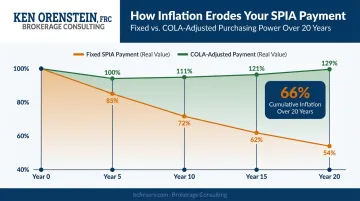
A COLA rider can add annual payment increases (commonly 1%, 2%, or 3%), but comes with a notably lower starting payment. The trade-off requires careful evaluation: if you add a COLA rider and live only 10 years, you may never recoup the lower early payments. If you live 25+ years, the inflation protection could prove essential.
Opportunity Cost
Money placed in a SPIA stops compounding in the market. If you're a younger retiree, or if you purchase during a period when market returns are strong relative to SPIA payout rates, you may generate more total income over time by managing those funds differently.
This risk is highest for buyers in their early 60s or when purchasing during low-rate environments.
Poor Fit for Shorter Life Expectancies
A life-only SPIA is structurally a bet on longevity. If you have serious health conditions or a family history of shorter lifespans, you may receive far less in total payments than your original premium. Adding a cash-refund or period-certain rider directly addresses this risk — both protect your principal if you die early and should be evaluated before committing to a life-only structure.
Interest Rate Sensitivity
SPIA payout rates move closely with interest rates. CANNEX analysis of over 55,000 bi-weekly quotes from 38 U.S. insurers found a 0.96 correlation between annuity payout rates and Moody's Seasoned Aaa Corporate Bond Yields.
Buy during a rate trough and those lower payments are locked in for life. Buy when rates are elevated, and you lock in stronger income. If rates are currently unfavorable, some clients fund a deferred annuity first and convert later — or simply wait.
Who Should (and Shouldn't) Consider a SPIA
Strong Candidates
The ideal SPIA buyer typically looks like this:
- At or near retirement (generally mid-60s to mid-70s)
- Has a lump sum available from a 401(k), IRA, TSP rollover, pension buyout, or inheritance
- Lacks a pension, or has an income gap between guaranteed sources and actual living expenses
- Prioritizes predictability over growth
- Has a family history of longevity, or simply wants the certainty of income they cannot outlive
Federal employees approaching retirement frequently fit this profile. A FERS pension alone often doesn't cover full living expenses, and the gap between early retirement and full Social Security eligibility creates an immediate income need.
Brokerage Consulting helps federal employees model this kind of layered income structure — mapping the FERS pension alongside a SPIA before drawing on discretionary TSP or IRA assets.
People Who May Not Be a Good Fit
Think carefully if you:
- Need to preserve principal access to fund potential long-term care costs
- Have significant health concerns or a shorter expected lifespan
- Already have sufficient guaranteed income from pensions and Social Security
- Have a young family depending on a larger inheritance
The Income Floor Framework
Putting all savings into a SPIA rarely makes sense. The more practical approach: use an immediate annuity to fund non-negotiable fixed expenses — housing, food, utilities — and keep remaining assets invested for growth and flexibility.
Consider a 67-year-old retiree with $400,000 in savings who uses $150,000 to purchase a SPIA generating monthly income for essential fixed expenses. The remaining $250,000 stays invested for growth, discretionary spending, and emergencies. This is an illustrative scenario only and does not represent any guaranteed outcome.

This structure gives you a guaranteed income floor while preserving portfolio flexibility.
How to Evaluate and Buy an Immediate Annuity
Shop Multiple Carriers
This step is non-negotiable. CANNEX found that median payout variation across carriers runs close to 10%, with variation spiking to 33.7% during periods of rapid rate movement. On a $200,000 premium over a 20-year retirement, a 10% difference in payout rate translates to tens of thousands of dollars in total income.
No single carrier is consistently the best option. Rates shift with each insurer's investment portfolio, pricing strategy, and reaction speed to interest rate changes.
What to Evaluate Beyond the Payout Rate
- Financial strength ratings: AM Best grades carriers from A- ("Excellent") up to A++ ("Superior") — and Moody's, S&P, and Fitch provide additional cross-checks. Your income depends on that carrier honoring payments decades from now.
- Death benefit options: cash-refund vs. period-certain, and how each choice affects your monthly payment
- COLA riders: weigh the reduced starting payment against how long inflation exposure matters for your timeline
- Joint-life provisions: for married couples, survivor percentage options (50%, 66.67%, 75%, or 100%) affect both the monthly amount and long-term household income security
Work With a Multi-Carrier Specialist
Ken Orenstein at Brokerage Consulting operates as an independent broker, not a captive agent for any single insurer. That means he can compare SPIA income quotes across multiple top carriers side by side — and screen each one for financial strength across AM Best, Moody's, S&P, and Fitch.
No-cost consultations are available in three formats:
- Phone — (888) 315-3608
- Virtual — scheduled video or call session
- In person — Flemington, NJ office
Visit bcfinserv.com to get started.
Frequently Asked Questions
How much will an immediate annuity pay?
Payout depends on your age, premium size, chosen structure, and interest rates at the time of purchase. For reference, Blueprint Income showed a $100,000 SPIA paying up to $651/month for a 65-year-old male and $625/month for a 65-year-old female as of May 2026. Actual figures vary by carrier, state, and payout option.
Are immediate annuities worth it?
For retirees who need guaranteed income, lack a pension, and value predictability over growth or liquidity, SPIAs can be highly worthwhile. For those with health concerns, sufficient existing guaranteed income, or strong liquidity needs, other strategies may be more suitable.
What happens to an immediate annuity when you die?
It depends on your chosen payout structure. A life-only contract stops at death with nothing passing to heirs. A cash-refund option returns any unrecovered premium to beneficiaries, and a period-certain option continues payments to heirs through the guaranteed term.
What is the difference between an immediate annuity and a deferred annuity?
An immediate annuity begins payments within one year of purchase using a lump sum. A deferred annuity allows the premium to grow tax-deferred before income begins at a future date, making it useful for clients who are still years away from needing income.
Can you add inflation protection to an immediate annuity?
Yes. A COLA rider increases payments annually — commonly by 1%, 2%, or 3% — but typically results in a lower starting payment. Whether this trade-off makes sense depends on your life expectancy and how much you expect inflation to affect your expenses over time.
Can you lose money with an immediate annuity?
You cannot lose principal due to market performance. However, if you choose a life-only contract and die early, the remaining premium stays with the insurer. A cash-refund or period-certain rider reduces this risk if you die early.