
The mechanics matter. How withdrawals are taxed, when penalties apply, what happens when you inherit one — these aren't small print. They determine whether the tax benefit actually works in your favor.
This guide covers how tax deferral functions inside a variable annuity, the distinction between qualified and non-qualified contracts, how the LIFO rule affects withdrawals, early withdrawal penalties, death benefit taxation, and which investors are most likely to benefit.
Key Takeaways
- Variable annuity earnings — gains, dividends, and interest — compound tax-deferred until withdrawal
- Under the LIFO rule, non-qualified withdrawals pull earnings out first, taxed as ordinary income
- Qualified variable annuities (IRA, 401(k), 403(b), TSP) are 100% taxable on withdrawal; non-qualified contracts only tax the earnings portion
- Withdrawals before age 59½ trigger a 10% IRS penalty on taxable earnings, on top of regular income tax
- Taxable variable annuity income is taxed as ordinary income, never at the lower long-term capital gains rates
How Tax Deferral Works in a Variable Annuity
The Core Mechanics
Inside a variable annuity, subaccount investments — whether they generate capital gains, dividends, or interest — are not taxed each year. As the SEC's variable annuity guidance confirms, investors pay no tax on income and investment gains until money is withdrawn. IRC Section 72 governs how those amounts are included in income when distributions occur.
This contrasts directly with a taxable brokerage account, where dividends are taxed the year they're paid, capital gains are taxed when realized, and interest is taxed annually. In a variable annuity, none of that happens inside the contract.
When gains aren't siphoned off for taxes each year, the remaining balance compounds on a larger base — and over a decade or more, that gap widens considerably. That advantage has a catch, though.
The Trade-Off You Need to Understand
Tax deferral is not tax elimination. Every dollar of deferred earnings will eventually be taxed — as ordinary income, not at capital gains rates. That rate difference is a real cost. IRS Topic 409 identifies long-term capital gains rates at 0%, 15%, and 20% depending on taxable income. Under Rev. Proc. 2025-32, the 0% rate applies through $49,450 in taxable income for single filers in 2026, while ordinary income rates can reach 22%, 24%, or higher at those same income levels.
For investors holding growth stocks or equity funds in a taxable account, the long-term capital gains rate advantage can partially or fully offset the benefit of tax deferral — especially if annuity fees are high.
The deferral benefit works best when:
- You're in a high bracket now and expect a lower bracket at retirement
- The time horizon is long enough for compounding to overcome the ordinary income rate differential
- The investments inside the annuity are tax-inefficient assets (bond funds, high-dividend holdings)
No Contribution Limits, No RMDs (Non-Qualified)
Non-qualified variable annuities carry two structural advantages that IRAs and 401(k)s don't offer:
- No contribution ceiling — the SEC confirms there are no IRS limits on amounts invested, making them useful once qualified plan contributions are maxed out
- No RMD requirements — unlike traditional IRAs, 401(k)s, and 403(b)s, non-qualified annuities aren't subject to IRS required minimum distribution rules, giving the owner more control over withdrawal timing
Qualified vs. Non-Qualified Variable Annuities: Tax Treatment
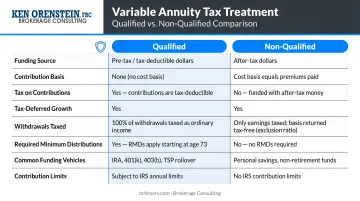
The qualified/non-qualified distinction drives almost everything about how a variable annuity is taxed.
| Feature | Qualified | Non-Qualified |
|---|---|---|
| Funded with | Pre-tax dollars (IRA, 401(k), 403(b), TSP) | After-tax dollars |
| Tax during growth | Tax-deferred | Tax-deferred |
| Tax on withdrawal | 100% taxable as ordinary income | Earnings portion only |
| Subject to RMDs | Yes — beginning at age 73 (age 75 for those who turn 73 after Dec. 31, 2032) | No |
Qualified Variable Annuities
A qualified variable annuity is funded with pre-tax dollars inside a tax-advantaged plan. Because those contributions were never taxed, IRS Publication 575 states that payments are fully taxable if the taxpayer has no investment in the contract — meaning 100% of every distribution is ordinary income.
These contracts also follow RMD rules: withdrawals must begin at age 73 under current law, or age 75 for individuals who turn 73 after December 31, 2032, per SECURE 2.0.
Non-Qualified Variable Annuities and the Exclusion Ratio
A non-qualified variable annuity is purchased with after-tax money. The original principal — your cost basis — is not taxed again on withdrawal. Only the earnings are taxable.
When a non-qualified annuity is annuitized (converted into regular income payments), the IRS applies an exclusion ratio under IRC Section 72(b): the fraction of each payment representing a return of principal is excluded from income.
Example: If $100,000 in principal grows to $200,000 and is annuitized, roughly 50% of each payment represents a return of basis and is received tax-free — until the full $100,000 of principal is recovered. After that, payments are fully taxable. Per IRS Publication 939, a monthly payment of $833.33 with a 12% exclusion ratio yields $100 excluded per month — ending after 100 months once basis is fully recovered.
Roth IRA-Held Variable Annuities
A variable annuity held inside a Roth IRA follows Roth rules, not annuity rules. Contributions are after-tax, and qualified distributions are entirely tax-free per IRS Publication 590-B. That said, the SEC explicitly states that placing a variable annuity inside an IRA or 401(k) provides no additional tax-deferral benefit beyond the retirement account itself. The Roth's tax advantage comes from the account structure — not the annuity wrapper.
How Variable Annuity Withdrawals Are Taxed: The LIFO Rule and Payout Options
The LIFO Rule for Partial Withdrawals
For non-qualified variable annuity withdrawals before annuitization, the IRS requires earnings to come out first. IRC Section 72(e)(2)(B) taxes pre-annuity-start withdrawals to the extent allocable to income on the contract — and Section 72(e)(3)(A) defines that income as cash value over investment in the contract.
For example, if you invested $100,000 and the contract is now worth $160,000, the first $60,000 you withdraw is fully taxable as ordinary income. Only after all $60,000 of earnings have been distributed do you begin receiving tax-free return of principal.
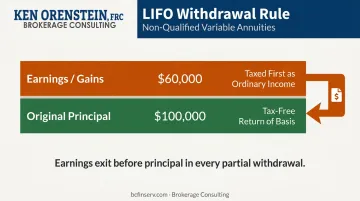
Many investors assume partial withdrawals are split proportionally between earnings and principal. They aren't — not for lump-sum or partial withdrawals from non-qualified contracts.
Annuitization: A More Tax-Efficient Alternative
When the contract is converted into a stream of periodic payments, the exclusion ratio replaces LIFO. Tax is spread more evenly across each payment rather than front-loaded into early withdrawals. For retirees who need predictable income, this approach avoids a large taxable spike in any single year.
Full Surrender: Watch the Bracket Impact
Full surrender is the opposite of that spread: the entire gain — contract value minus cost basis — is taxable as ordinary income in a single tax year. Using 2026 brackets from Rev. Proc. 2025-32, a married couple filing jointly with $100,800 in other income would enter the 22% bracket. Adding a $150,000 annuity gain on top pushes substantial income into the 24% and 32% brackets.
Timing matters here. Staggering a large surrender across two calendar years — or coordinating it with significant deductions — can meaningfully reduce the effective rate paid on that gain.
Reporting
The insurance company issues a Form 1099-R at year-end. Key fields to know:
- Box 1 — gross distribution amount
- Box 2a — taxable portion
- Lines 5a and 5b on Form 1040 — where you report the distribution
Keep documentation of your cost basis. Without it, accurately calculating the taxable portion of non-qualified distributions becomes difficult, and the IRS may treat the full amount as taxable.
Early Withdrawal Penalties, Death Benefits, and Inherited Variable Annuities
Penalties for Early Withdrawal
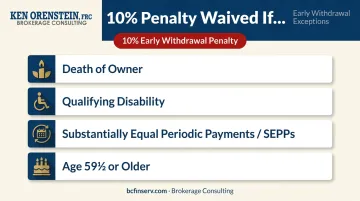
Withdrawals before age 59½ trigger a 10% penalty on the taxable portion — on top of ordinary income tax. For qualified variable annuities, the authority is IRC Section 72(t). For non-qualified contracts, the parallel rule is IRC Section 72(q). Both carry the same 10% rate, but they're separate statutes.
Main exceptions that waive the penalty:
- Death of the owner
- Qualifying disability
- Substantially equal periodic payments (SEPPs) meeting specific IRS distribution rules
- Age 59½ or older
Death Benefits and Inherited Variable Annuities
When a variable annuity owner dies, the beneficiary owes ordinary income tax on the earnings portion — but not on the original principal. IRC Section 1014 normally provides a step-up in cost basis for inherited assets like stocks or real estate — but it explicitly excludes income in respect of a decedent under IRC Section 691. Variable annuity earnings don't qualify for that step-up. Heirs pay tax on the same gains the original owner deferred.
For qualified variable annuities, the SECURE Act's 10-year rule generally applies to non-spouse beneficiaries: all funds must be withdrawn within 10 years of the owner's death (for deaths after December 31, 2019). Surviving spouses may continue the contract or roll it over.
For non-qualified variable annuities, IRC Section 72(s) requires distribution within 5 years if the holder dies before the annuity start date — unless payments to a designated beneficiary begin within 1 year and are structured over life or life expectancy. Surviving spouses may treat the contract as their own.
Non-qualified inherited annuity payout options — lump sum, 5-year deferral, or annuitization — each shift the tax exposure differently. Annuitization spreads income (and tax) over time; a lump sum front-loads it. Understanding which option fits the beneficiary's tax situation is often worth a direct review before taking any distribution.
Who Benefits Most from Variable Annuity Tax Advantages
The Right Investor Profile
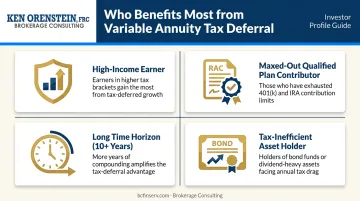
Variable annuities work best as a tax-deferral vehicle for a specific type of investor:
- High-income earners currently in elevated brackets who expect to drop into a lower bracket at retirement
- Investors who have maxed out IRA, 401(k), TSP, or 403(b) contributions and want additional tax-deferred accumulation
- Investors with long time horizons — generally 10 or more years for compounding to overcome the ordinary income rate disadvantage
- Holders of tax-inefficient assets like bond funds or high-dividend portfolios who want to shield annual distributions from taxation
For 2024, the TSP and 401(k) elective deferral limit is $23,000 ($30,500 with catch-up for those 50 and older); IRA contributions cap at $7,000 ($8,000 with catch-up). Once those limits are reached, a non-qualified variable annuity offers no-ceiling tax deferral with no RMD requirement.
Who Should Think Twice
- Short-term investors — variable annuity fees (Mortality & Expense charges typically 1.0–1.5% annually, plus sub-account and rider costs that can push all-in costs above 3%) erode the tax benefit quickly
- Investors who will remain in the same or higher bracket in retirement — deferral saves nothing if the rate doesn't change
- Those relying on long-term capital gains rates — equity growth investors in particular may come out ahead keeping assets in a taxable account
Working with a Federal Retirement Advisor
For federal employees with access to the Thrift Savings Plan, the question of what comes next after hitting contribution limits is worth a careful look. A non-qualified variable annuity is worth evaluating as a supplemental vehicle — but only when the costs and income guarantees actually pencil out.
Ken Orenstein at Brokerage Consulting works with federal employees and pre-retirees to assess whether a variable annuity belongs in a low-cost, tax-efficient retirement plan. That review covers:
- GLWB and GMIB rider costs weighed against income guarantees
- Full fee analysis — M&E charges, administrative fees, and sub-account expenses
- 1035 exchange analysis for clients holding older contracts that may no longer be competitive
Consultations are no-cost and available by phone, virtually, or in person. Reach Ken at (888) 315-3608 or through Brokerage Consulting's website.
Frequently Asked Questions
How is income from a variable annuity taxed?
Variable annuity income is taxed as ordinary income — not at capital gains rates. For non-qualified contracts, only the earnings portion is taxable, determined by the exclusion ratio for annuitized payments or the LIFO rule for partial withdrawals. Qualified variable annuity distributions are 100% taxable.
Are variable annuities taxed FIFO or LIFO?
Non-qualified variable annuity withdrawals follow LIFO: earnings are distributed and taxed first before any tax-free return of principal begins. Annuitized payments use the exclusion ratio instead, spreading the tax burden more evenly across each payment.
What type of annuity is not taxable?
Variable annuities held inside a Roth IRA can produce tax-free qualified distributions under Roth IRA rules. Outside of that, no annuity is entirely tax-free — for non-qualified contracts, the return of original principal is not taxed, but all earnings are taxable upon distribution.
How are variable annuities paid out?
The main payout options are lump-sum withdrawal, periodic (systematic) withdrawals, and annuitization (converting the contract value into a guaranteed stream of payments for a fixed period or lifetime). Each option carries different tax timing and bracket implications.
Do variable annuities have required minimum distributions (RMDs)?
Non-qualified variable annuities are not subject to IRS RMD rules, giving owners flexibility on withdrawal timing. Qualified variable annuities within an IRA or employer plan are subject to RMDs starting at age 73 — or age 75 under SECURE 2.0 for those who turn 73 after December 31, 2032.
What is a 1035 exchange and is it taxable?
A 1035 exchange lets you transfer funds from one annuity contract to another without triggering a taxable event, as long as the exchange meets IRC Section 1035 requirements. The original cost basis carries over to the new contract, preserving your tax position.