
Introduction
Federal employees face a retirement planning challenge that rarely surfaces until the paperwork is close: FERS is a strong foundation, but it was deliberately designed as just one leg of a three-part system.
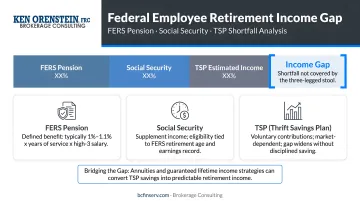
Even with your FERS pension, Social Security, and TSP combined, many retirees discover an income gap. That gap bites hardest for those who retire before age 62 or hit market downturns in their early retirement years, when sequence-of-returns risk does the most damage.
Most federal employees spend years mastering FERS benefit calculations, COLA adjustments, and survivor benefit elections. Far fewer explore how private annuities can add a predictable, guaranteed income layer on top — misconceptions about cost, complexity, and suitability usually get in the way.
That's changing fast. With the FERS Special Retirement Supplement potentially facing elimination under H.R. 1 (which passed the House in May 2025), alternative guaranteed income strategies have moved from "nice to have" to necessary.
This guide explains what private annuities are, when they make sense for federal employees, and how to actually incorporate one into your federal retirement plan. Concrete steps, not abstract concepts.
Key Takeaways
- FERS's basic pension replaces only 30–33% of pre-retirement salary, leaving up to 70% of income unaccounted for even after TSP and Social Security
- H.R. 1 proposes eliminating the FERS Special Retirement Supplement starting January 2028, removing a critical income bridge for early retirees
- Private annuities offer guaranteed income that TSP distributions alone can't reliably replicate—especially during market downturns
- Not all annuities fit every timeline—calculating your actual income gap comes before choosing any product
- Work with a federal retirement specialist to ensure your annuity choice integrates properly with survivor benefits, TSP strategy, and tax planning
What FERS Provides—and Where the Income Gaps Are
The FERS Three-Tier Structure
FERS retirement rests on three components: the basic annuity (your pension), Social Security, and the Thrift Savings Plan. Each has its own variables, limitations, and timing dependencies that create compounding income uncertainty.
| Component | Description | Key Variables |
|---|---|---|
| Basic Annuity | Defined-benefit pension | Based on years of service and high-3 salary |
| Social Security | Standard Social Security benefits | Claiming age and earnings record |
| Thrift Savings Plan | Defined-contribution plan | Account balance, market performance, withdrawal strategy |
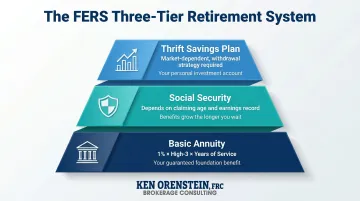
The basic annuity uses a simple formula: 1% of your high-3 average salary for each year of creditable service if you retire before age 62, or 1.1% if you're 62 or older with at least 20 years of service. Your high-3 is typically your final three years of basic salary—excluding overtime, bonuses, and other supplemental pay.
Understanding the Replacement Rate Gap
A federal employee retiring with 30 years of service receives 30% of their high-3 salary (1% × 30 years) if they retire before age 62, or 33% with the 1.1% multiplier. That falls well short of the 70–80% income replacement most financial planners recommend for a comfortable retirement.
If you elect a full survivor benefit—which reduces your annuity by 10%—that 30% pension drops to 27% of your pre-retirement income. Add in FEHB premiums in retirement and the reality becomes clear: FERS alone leaves a substantial gap.
The Social Security Timing Gap and SRS Risk
Most FERS employees who retire before age 62 rely on the Special Retirement Supplement (SRS) as a bridge. The SRS approximates what you'd receive from Social Security if you were eligible, using this formula:
(Total years of FERS service ÷ 40) × Estimated Social Security benefit at age 62
The SRS is temporary—it ends when you turn 62 or become eligible for Social Security. It's also subject to an earnings test: payments reduce by $1 for every $2 earned above the Social Security exempt amount.
The legislative picture makes this worse. Section 90001 of H.R. 1, which passed the House on May 22, 2025, proposes complete elimination of the SRS effective January 2028 for most employees. Only law enforcement officers and air traffic controllers who qualify for immediate retirement would be exempt. If enacted, federal employees retiring before 62 would lose this income bridge entirely.
TSP Income Risk and Sequence-of-Returns
Unlike your FERS pension, TSP balances fluctuate with market performance. Retirees who draw from TSP during a market downturn in their early retirement years face sequence-of-returns risk—a phenomenon that can permanently reduce the income your TSP can sustain.
Morningstar research found that nearly 70% of retirement plan failures occurred when portfolios lost value by the end of year five. Avoid those early losses, and the risk of depleting savings drops to approximately 4%. The safe starting withdrawal rate for 2026 is just 3.9% for a balanced portfolio—below the traditional 4% rule.
That rate matters in dollars. A $500,000 TSP balance supports roughly $19,500 per year in sustainable income. For most federal retirees, that figure alone won't close the income gap.
The Cumulative Income Gap
Consider a federal employee retiring at 57 with 30 years of service and a $90,000 high-3 salary:
- FERS pension: $27,000/year (30% of high-3)
- After survivor benefit election: $24,300/year (10% reduction)
- Social Security: Not available until age 62
- SRS (if it survives): Provides temporary bridge, but may not exist by 2028
- TSP: Subject to market risk and conservative withdrawal limits
This employee faces five years without Social Security, healthcare premiums to cover, and TSP withdrawals that must be carefully managed. A private annuity can convert a portion of accumulated savings into guaranteed income—filling that five-year window and reducing the pressure on TSP withdrawals.
How Private Annuities Can Supplement Your FERS Pension
What Private Annuities Are
A private annuity is a contract with an insurance company where you exchange a lump sum (or series of payments) for a guaranteed income stream. Unlike your FERS pension (a government annuity) or the SRS (a temporary bridge payment), a private annuity is an independent insurance product you purchase to meet specific income needs.
Three Annuity Types Most Relevant to Federal Employees
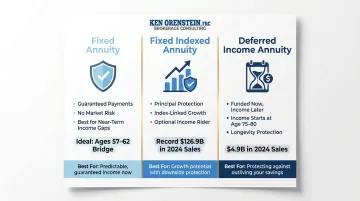
Fixed Annuities provide a guaranteed, predictable monthly payment regardless of market conditions. You know exactly what you'll receive and when. These are ideal for retirees who want certainty and need to reduce reliance on TSP distributions during early retirement years when sequence risk is highest.
Fixed Indexed Annuities (FIAs) tie growth to a market index (like the S&P 500) while protecting your principal from losses. They offer higher return potential than fixed annuities while maintaining downside protection, and many include optional income riders that guarantee future income regardless of market performance. According to LIMRA, FIA sales reached a record $126.9 billion in 2024, reflecting growing demand for protected growth products.
Deferred Income Annuities (DIAs) are funded now but income starts at a future age—often 75 or 80. These address the risk of outliving your TSP savings in your later retirement years. DIA sales hit a record $4.9 billion in 2024, up 19% year-over-year, as more retirees recognize the value of longevity protection.
How Annuities Interact with Your FERS Pension
Your FERS pension provides fixed income with modest COLA adjustments (typically capped at 2% or less). An annuity matched to a specific income need — covering healthcare premiums or filling the Social Security gap from 57 to 62, for example — lets TSP funds stay invested for longer-term growth.
Example: A federal employee retiring at 57 with a $24,300 annual FERS pension (after survivor benefit reduction) purchases a 5-year immediate fixed annuity for $100,000 that pays $21,000/year. This covers the Social Security gap from age 57-62, allowing TSP assets to remain invested and potentially recover from any early-retirement market volatility.
What Annuities Are NOT Suitable For
That example works precisely because the annuity fills a defined gap. Outside of that context, annuities have real limitations worth understanding.
Annuities are not liquid. Once purchased, accessing principal typically triggers surrender charges lasting 6-10 years. They're not appropriate for emergency funds, short-term savings, or money you might need within 5-7 years.
Annuities should address a specific income gap, not replace your entire retirement strategy. Match the type and structure to a precise need before purchasing.
Tax Treatment Overview
Tax treatment depends on how you fund the annuity:
- After-tax (non-qualified) annuities: Only the earnings portion is taxable. The IRS exclusion ratio determines what percentage of each payment represents tax-free return of principal versus taxable earnings.
- TSP rollover-funded annuities: Fully taxable as ordinary income, since the original TSP contributions were pre-tax.
This distinction matters significantly for tax planning. Rolling a large TSP balance into an annuity in a single year can push you into a higher tax bracket. Partial rollovers spread over multiple years are often more tax-efficient.
When Should Federal Employees Consider Adding an Annuity?
Scenarios Where Annuities Make the Most Sense
Annuities provide the greatest value when:
- You're retiring before age 62 and face a Social Security gap, especially with SRS potentially disappearing
- You have a shorter service history resulting in a smaller FERS pension (e.g., 20 years = 20-22% income replacement)
- You're single without a spouse to provide TSP income continuity
- You're concerned about longevity and outliving your TSP in your 80s and beyond
- Market volatility makes you anxious about relying exclusively on TSP withdrawals
OPM data shows that 25% of federal retirees leave service before age 57.8, meaning a substantial portion face extended periods without Social Security.
When Annuities Are Likely NOT the Right Move
Skip the annuity conversation if:
- Your FERS pension plus Social Security already meets your essential spending needs
- You have a very large TSP balance ($1M+) and modest fixed expenses
- You're still more than 10 years from retirement and have better wealth-building options
- You need liquidity and flexibility more than guaranteed income
- Your health suggests a shorter-than-average life expectancy
Start with an income gap analysis. Calculate what FERS + Social Security will provide, subtract your projected expenses, and let that number tell you whether an annuity makes sense.
Optimal Timing Window
The years immediately before retirement — or within the first few years after separation — is the right time to evaluate annuities seriously. By then:
- Your FERS pension calculation is nearly final
- You know your survivor benefit election
- Your TSP balance is large enough to fund an annuity purchase
- Your retirement timeline is concrete
Waiting too long after retirement means you've already drawn down TSP assets that could have funded an annuity. Starting too early means you're locking in guarantees when you could still be accumulating growth.
How to Add an Annuity to Your Federal Retirement Plan
Adding an annuity to your federal retirement plan works best when it fills a defined income gap — not when it's purchased in isolation. Without first mapping how it fits alongside FERS, TSP, and Social Security, you risk coverage gaps, unnecessary costs, or a tax structure that works against you.
Step 1: Assess Your Retirement Income Gap
Calculate your rough income gap using these steps:
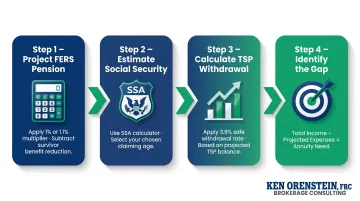
- Project your FERS pension: Use the annuity formula (1% or 1.1% × high-3 × years of service). Subtract 10% if electing full survivor benefits or 5% for partial.
- Estimate Social Security: Use the Social Security Administration's online calculator to project your benefit at your chosen claiming age (62, full retirement age, or 70).
- Calculate TSP sustainable withdrawal: Apply the 3.9% safe withdrawal rate to your projected TSP balance at retirement.
- Add up income sources and subtract projected expenses.
Account for:
- The SRS ending at age 62 (or not existing at all if H.R. 1 passes)
- FEHB premium costs in retirement
- Survivor benefit election impact on FERS pension amount
The resulting gap is what an annuity should fill—no more, no less.
Step 2: Choose the Right Annuity Type
Your income gap determines the annuity type that fits:
- Near-term gap (retiring at 57, need income until 62): Immediate fixed annuity providing predictable payments for 5 years
- Longevity gap (concerned about outliving TSP after age 75): Deferred income annuity purchased now, with income starting at age 75 or 80
- Growth-plus-income goal (want protected growth before converting to income): Fixed indexed annuity with an optional income rider that activates at a chosen future date
Once you've identified your gap type, Step 3 covers how to fund and structure the annuity — including the tax implications of each approach.
Step 3: Fund and Structure the Annuity
Two main funding approaches:
Option 1: After-tax personal savings (non-qualified)
- Use savings outside TSP/IRA
- Tax treatment: Only earnings portion is taxable
- Preserves TSP for continued growth and flexibility
Option 2: TSP rollover to IRA, then to annuity (qualified)
- Roll TSP funds directly to a traditional IRA (tax-free transaction)
- Purchase annuity from IRA
- Tax treatment: All payments fully taxable as ordinary income
Critical rollover rules (per FINRA and TSP guidance):
| Rollover Type | Tax Consequence | Key Risk |
|---|---|---|
| Direct rollover (TSP → IRA) | Not taxable | None (preferred method) |
| Indirect rollover (check to you) | 20% mandatory withholding | Must replace withheld 20% within 60 days or it becomes taxable |
Watch the age-55 rule before rolling over: If you separate from federal service between age 55 and 59½, TSP allows penalty-free withdrawals. Rolling those funds to an IRA eliminates this protection — you must wait until 59½ to avoid the 10% early withdrawal penalty.
TSP's internal annuity option: TSP offers annuity purchases through MetLife, but limits you to one carrier and a small set of product types (life annuity, joint annuity, with or without inflation protection). Rolling to an IRA opens access to fixed, indexed, and deferred income annuities across multiple carriers — but timing the rollover around the age-55 rule and RMD schedules matters.
Step 4: Monitor and Adjust
After purchase, review your annuity income alongside FERS COLA adjustments annually. Most fixed annuities do not include automatic inflation adjustments. As your FERS pension increases with COLA, your annuity's real value gradually declines.
Plan for this by:
- Ensuring TSP or other savings absorb inflation risk over time
- Budgeting for healthcare cost increases separately
- Reviewing your overall income mix every 3-5 years
What to Watch Out For: Costs, Taxes, and Common Mistakes
Cost Risks and Fee Disclosure
Not all annuities are priced the same — and some carry costs that quietly erode their value. FINRA warns that surrender charges, internal fees, and complex riders can add significant cost without proportional benefit.
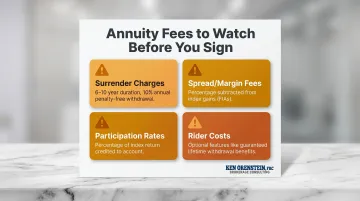
Watch for these common fees:
- Surrender charges: Typically apply for 6-10 years; often allow 10% annual penalty-free withdrawals
- Spread/margin/asset fees: Percentages subtracted from index gains (common in FIAs)
- Participation rates: The percentage of index returns credited to your account
- Rider costs: Optional features like guaranteed lifetime withdrawal benefits
Ask for a complete fee disclosure before signing anything. Compare products from multiple carriers — the same rider can cost significantly more at one company than another.
Common Mistake: Purchasing Before FERS Paperwork Is Final
The most common error federal employees make: purchasing an annuity before completing FERS retirement paperwork and survivor benefit elections.
If you choose a joint-life annuity to cover your spouse, but your spouse is already covered under FERS survivor benefits, you've created redundant coverage — paying twice for the same protection. That overlap quietly erodes your monthly income.
Finalize your FERS survivor benefit election first. From there, you can determine whether a private annuity supplements or replaces that coverage — not duplicates it.
Tax Timing Mistake: The Single-Year Rollover
Rolling a large TSP balance into an annuity (or into a Roth IRA for conversion) in a single tax year can trigger a significant tax bill. A $300,000 traditional-to-Roth conversion could push you into the 32% or even 35% marginal bracket.
Partial rollovers spread across multiple years keep the tax hit manageable — often dropping you one or two brackets lower. TSP permits partial distributions (minimum $1,000), so staged transfers are both allowed and practical.
One more distinction worth knowing before you move funds:
- Direct rollovers (TSP → traditional IRA) are not taxable
- Indirect rollovers trigger mandatory 20% federal withholding — you must replace those withheld funds from your own pocket within 60 days or face taxes and potential penalties
Best Practices for Federal Employees Using Annuities
Annuities work best when they fill a specific gap in your retirement income, not when they replace the diversified foundation FERS, TSP, and Social Security already provide.
Core principles:
- Calculate the income gap you're solving for before purchasing — whether that's a Social Security bridge, longevity protection, or a healthcare cost buffer.
- Start comparing products 2-3 years before retirement — this gives you time to understand tax implications and align with FERS survivor benefit elections and TSP withdrawal strategies.
- Match the product to your timeline: immediate annuities for near-term gaps, deferred annuities for longevity protection, and FIAs when you want protected growth before income begins.
- Keep 6-12 months of expenses in accessible savings — annuities should supplement your emergency fund, not replace it.
- Work with a federal retirement specialist, not a generalist. Advisors unfamiliar with FERS may recommend strategies that conflict with survivor benefit elections or trigger unnecessary tax consequences.
That 2-3 year window also matters for how you hold the funds. According to Fidelity, money earmarked for an annuity purchase within three years should stay in conservative assets — cash or high-quality bonds — rather than the stock market. Protecting that principal matters more than pursuing short-term market gains.
One final approach worth considering: start with a smaller annuity to secure immediate guaranteed income, then purchase more later if rates improve or your income needs shift. This laddering strategy preserves flexibility without leaving gaps in coverage.
Frequently Asked Questions
Can federal employees use both the FERS Special Retirement Supplement and a private annuity at the same time?
Yes. The SRS is a government-administered temporary benefit, while a private annuity is an independent insurance contract. They do not offset each other, though both count toward your overall retirement income for tax purposes.
What types of annuities are most commonly used by federal employees to supplement FERS?
Fixed annuities and fixed indexed annuities are most common. Fixed annuities offer simplicity and guaranteed income, while FIAs provide market-linked growth potential with downside protection — both well-suited to the income security goals of federal retirees.
How are annuity payments taxed in retirement for federal employees?
If purchased with after-tax money, only the earnings portion is taxable (using the IRS exclusion ratio). If funded via a TSP rollover to an IRA, all payments are typically fully taxable as ordinary income.
Can TSP funds be used to purchase a private annuity?
Yes. TSP funds can be rolled over directly to a traditional IRA, then used to purchase an annuity. TSP also offers an annuity purchase option through MetLife, but rolling to an IRA typically provides access to a wider range of products and carriers.
When is the best time for a federal employee to buy an annuity?
The optimal window is generally 1-3 years before retirement or in the first few years after separation. This allows you to accurately assess your income gap after FERS paperwork is finalized and survivor benefit elections are made.
Does purchasing a private annuity affect FERS survivor benefits or the FERS pension?
No. A private annuity is entirely separate from the FERS retirement system and does not affect your pension amount or survivor benefit elections. However, your FERS survivor benefit election (which reduces your pension by up to 10%) should influence how much private annuity income you need.
Federal employees face real planning challenges, particularly as legislative shifts put income bridges like the SRS at risk. Private annuities — integrated with your FERS pension, TSP strategy, and Social Security plan — can close critical income gaps and deliver reliable, guaranteed income throughout retirement.
Need help determining whether an annuity fits your federal retirement plan? Contact Brokerage Consulting at (888) 315-3608 or korenstein@brookstoneadvisor.com to schedule a no-cost consultation with a federal retirement specialist.