
According to the EBRI's 2024 Retirement Confidence Survey, 62% of workers say preparing for retirement makes them feel stressed — and with good reason. The SSA's actuarial life table shows a 65-year-old man can expect to live another 16.91 years on average, and a woman another 19.53 years. That's nearly two decades of income to fund.
This guide breaks down both annuity types — living and guaranteed — compares them across the dimensions that matter most, and helps you identify which option, or combination, fits your retirement picture.
Key Takeaways
- A living annuity keeps your savings invested — you draw income from portfolio value and bear the investment and longevity risk.
- A guaranteed annuity converts a lump sum into fixed, lifelong income, with the insurer absorbing all market and longevity risk.
- Living annuities offer flexibility, growth potential, and legacy benefits but require active management.
- Guaranteed annuities deliver income certainty and longevity protection but lock in terms at purchase.
- A blended approach — combining both — is increasingly popular and often the most effective strategy.
Living vs. Guaranteed Annuity: Quick Comparison
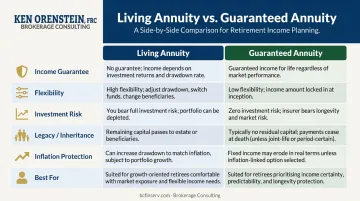
Here's how the two annuity types stack up across the dimensions that matter most to retirees.
| Dimension | Living Annuity | Guaranteed Annuity |
|---|---|---|
| Income Guarantee | Not guaranteed; depends on returns and drawdown rate | Guaranteed for life regardless of market conditions |
| Flexibility | Annual adjustments to drawdown rate and investments permitted | Fixed at purchase; no adjustments after contract begins |
| Investment Risk | Borne by the retiree | Borne by the insurer |
| Legacy / Inheritance | Remaining capital passes to nominated beneficiaries | Income typically ceases at death (or second death for joint annuity) |
| Inflation Protection | Growth potential can outpace inflation — not guaranteed | Fixed payments may erode unless an inflation-linked rider is added |
| Best For | Market-tolerant retirees who want control and legacy flexibility | Those prioritizing income certainty, simplicity, and longevity protection |
What Is a Living Annuity?
A living annuity is an investment-style retirement income product. Your savings move into an annuity wrapper, remain invested across a range of asset classes, and you draw income as a percentage of the account's remaining value on a regular basis.
How Income Drawdown Works
Rather than a fixed payment, income from a living annuity fluctuates with your portfolio. Each year, you select a drawdown percentage within limits set by your contract — this flexibility lets you adjust income as your needs evolve. But that same flexibility creates risk: if your drawdown rate, combined with fees and inflation, consistently exceeds your investment returns, capital depletes faster than expected.
That threshold is simple to state, harder to maintain:
Investment returns must exceed: drawdown rate + fees + inflation
Fall short of it consistently, and the portfolio shrinks faster than withdrawals can compensate.
Investment Risk and Sequence of Returns
The retiree bears all market risk. Strong early-retirement returns can grow the portfolio and extend its life by years. Poor early returns, combined with ongoing withdrawals, can permanently impair the income stream. This is called sequence-of-returns risk, and it's the central vulnerability of any investment-based income strategy.
Morningstar's 2026 retirement income research pegs a safe initial withdrawal rate at approximately 3.9–4.0% for a 30-year horizon. Staying near or below that level improves the odds your portfolio lasts the distance.
Legacy and Inheritance Benefits
When you die, any remaining capital passes directly to nominated beneficiaries, bypassing probate and potentially reducing estate tax exposure. For retirees with legacy goals, this is a meaningful planning tool that guaranteed annuities typically cannot replicate.
Who Should Consider a Living Annuity
- Retirees with other guaranteed income sources (Social Security, a FERS or CSRS pension) who don't need heavy drawdowns
- Those comfortable managing market volatility or working with an advisor to do so
- Retirees who want to preserve and pass on capital
- Anyone who values income flexibility over income certainty
What Is a Guaranteed Annuity?
A guaranteed annuity — also called a life annuity, income annuity, or SPIA — is an insurance contract. You pay a lump sum to an insurer and receive a fixed, regular income payment (typically monthly) for the rest of your life, regardless of how long you live or what markets do during that time.
Types Available
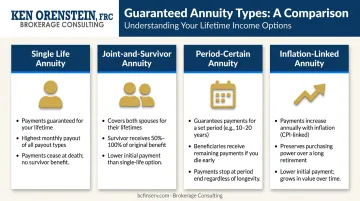
- Single life annuity — highest monthly payout, covers one person
- Joint-and-survivor annuity — income continues until the second spouse dies, with survivor percentage options typically at 50%, 75%, or 100%
- Period-certain annuity — guarantees payments for a set number of years even if you die early; payments continue to beneficiaries for the remaining term
- Inflation-linked / escalating annuity — income rises annually to offset inflation, though the initial payment is lower
To illustrate current market rates: as of May 6, 2026, a $100,000 premium for a 65-year-old male produced a best monthly quote of $685 and an average of $623, according to ImmediateAnnuities.com. For a 65-year-old female, the best quote was $634 and average $596. These are illustrative benchmarks — actual payouts vary by insurer, state, premium size, and payout option.
The Core Value: Longevity Protection
The insurer absorbs both investment risk and longevity risk entirely. You cannot outlive your income. That directly addresses the single greatest financial fear in retirement: running out of money. The result is the ability to spend confidently without watching your portfolio every month.
Key Limitations
- The contract is irrevocable once established
- Income cannot be adjusted after purchase
- Capital is not returned to beneficiaries at death without a joint or period-certain payout structure
- Fixed payments lose purchasing power over time — only 1.9% of SPIA quotes in 2021 included a COLA feature, per CANNEX
Tax Treatment
Income from a guaranteed annuity is taxed as ordinary income in the year received. If funded with pre-tax dollars (such as a 401(k) or IRA rollover), the full distribution is taxable. If funded with after-tax money, only the growth portion is taxed.
A 1035 exchange allows a tax-free transfer between annuity contracts if you want to change providers without triggering a taxable event — per IRS Publication 575.
Key Differences: What Really Sets Them Apart
Flexibility vs. Security
A living annuity lets you adjust your drawdown percentage annually and change investment allocations as your situation evolves. A guaranteed annuity offers no such adjustments — what you lock in at purchase is what you receive for life. The tradeoff is straightforward: more flexibility means more responsibility on your end; more certainty means giving up control over the funds.
Risk Allocation
Risk ownership is where these two products diverge most sharply. A living annuity puts both investment risk and longevity risk on you — if markets underperform or your savings run thin at age 90, the shortfall is yours to manage. A guaranteed annuity transfers both risks to the insurer. Whether markets collapse or you live to 98, the insurer remains on the hook for your monthly income.
Estate and Legacy Planning
Living annuities are powerful legacy tools. Remaining capital passes to beneficiaries outside the estate, potentially avoiding estate taxes and probate. Guaranteed annuities generally provide no lump-sum benefit at death unless structured as joint-life or with period-certain or cash-refund features. Retirees who prioritize leaving assets to heirs will typically find living annuities more suitable on this dimension alone.
Inflation Protection Dynamics
A living annuity's growth potential can naturally hedge against inflation if returns outpace rising costs. The BLS reported a 3.8% all-items CPI increase for the 12 months ending April 2026. A fixed guaranteed annuity paying the same dollar amount each month loses real purchasing power against that backdrop every year. An escalating rider addresses this, but it reduces your starting payment.
Management Burden
- Living annuity: Requires continuous monitoring of allocations, drawdown rates, and portfolio performance — ideally with ongoing professional guidance
- Guaranteed annuity: Requires almost no active management after purchase; one decision, then hands off
Which Annuity Is Right for You?
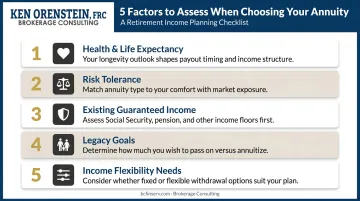
The right choice depends on your income gaps, risk tolerance, and legacy goals. Work through these five factors to narrow it down.
Five Factors to Assess
- Health and life expectancy — Longer expected lifespan favors guaranteed annuities; a shorter horizon may favor the flexibility and legacy benefits of a living annuity
- Risk tolerance — Can you stomach market volatility without panic-selling? Living annuities require emotional discipline
- Existing guaranteed income — Do Social Security and any pension already cover essential expenses? If yes, a living annuity can serve as a flexible supplement
- Legacy goals — Is passing capital to heirs a priority? Living annuities win here
- Income flexibility needs — Will your spending vary significantly year to year? Living annuities accommodate that; guaranteed annuities don't
Situational Recommendations
| Your Situation | Recommended Approach |
|---|---|
| Essential expenses not covered by existing income | Guaranteed annuity as income floor |
| Existing pension + Social Security covers core needs | Living annuity for growth and legacy |
| Want both security and flexibility | Blended approach — guaranteed floor + living annuity supplement |
| Federal employee with FERS pension gap | SPIA or FIA with income rider to close the gap |
The Federal Employee Context
Federal employees bring unique variables to this decision. 98.4% of current civilian federal employees participate in FERS, per Congressional Research Service data — but FERS pensions, while valuable, often don't fully cover essential expenses on their own. The median monthly FERS annuity for FY2022 retirees was just $1,452.
Ken Orenstein, a Federal Retirement Consultant (FRC) at Brokerage Consulting and author of The Informed Fed: A Survival Guide to Federal Employee Benefits, builds retirement income plans that coordinate FERS pension, Social Security, TSP distributions, and private annuities. For federal retirees whose pension falls short of covering essential expenses, a SPIA or Fixed Indexed Annuity with a lifetime income rider often closes that gap.
Whether you're a federal employee navigating FERS integration or a private-sector retiree weighing your TSP rollover options, a no-cost initial consultation is available by phone, virtual, or in-person at bcfinserv.com or by calling (888) 315-3608.
Conclusion
Neither annuity type wins universally. A living annuity rewards disciplined management and serves retirees who value flexibility and legacy. A guaranteed annuity delivers unmatched income certainty for those who prioritize simplicity and protection against outliving their savings. Many retirees benefit most from combining both — using guaranteed income to cover essential expenses while keeping some capital invested for growth and inheritance.
The most important step is building a retirement income strategy that integrates both products thoughtfully, based on your specific income needs, risk tolerance, and legacy goals. That process starts with a conversation with an advisor who understands your complete financial picture. Ken Orenstein at Brokerage Consulting offers no-cost consultations — by phone, virtually, or in person — specializing in guaranteed lifetime income planning for retirees and pre-retirees across the US.
Frequently Asked Questions
What is the difference between a living annuity and a guaranteed annuity?
A living annuity is an investment-based product where you control how your savings are invested and draw income as a percentage of your portfolio — bearing all investment and longevity risk. A guaranteed annuity is an insurance contract that provides fixed, lifelong income in exchange for a lump sum, with the insurer absorbing all risk.
Can you switch from a living annuity to a guaranteed annuity?
Moving from a living annuity to a guaranteed annuity is generally possible, but once purchased, that decision is irrevocable. A 1035 exchange can allow a tax-free transfer between contracts in certain situations — consult an advisor before making any switch.
Which annuity is better for avoiding outliving your money?
A guaranteed annuity provides the strongest protection against longevity risk since it pays income for life regardless of how long you live. A living annuity carries the risk of capital depletion if drawdowns, fees, and inflation consistently exceed investment returns over time.
Are annuity income payments taxable?
Income from both annuity types is taxed as ordinary income in the year received. Pre-tax funding (such as a 401(k) or IRA rollover) means the full distribution is taxable; after-tax funding means only the growth portion is taxed, per the IRS exclusion ratio method.
Can you combine a living annuity and a guaranteed annuity?
Yes. Many retirees use a guaranteed annuity to cover essential monthly expenses and a living annuity for flexible, growth-oriented income. This blended approach balances income security with flexibility and legacy potential.
What happens to my annuity when I die?
With a living annuity, any remaining capital passes directly to nominated beneficiaries. With a guaranteed annuity, income typically ceases at death unless a joint-life or period-certain structure was selected — in which case payments continue to a spouse or beneficiary for the guaranteed term.