
Introduction
Retirement income planning rarely fits a single template. Some people need income for a defined window — bridging the years before Social Security starts, or covering a gap before a pension activates. Others want to avoid locking in a lifetime annuity rate at 60 when they suspect their situation will look different at 70.
A fixed term annuity addresses both concerns. It pays guaranteed income for a set period, then returns a residual lump-sum payout when the contract ends. That structure puts it in its own category: not a lifetime commitment, not a pure accumulation product.
Before committing retirement savings to any fixed term contract, buyers need to understand what the guarantees actually cover, how term length and income level interact, and where the real limits lie. "Guaranteed" here means the income payments are contractually fixed for the term — not that income continues for life or that the payout adjusts with inflation.
Key Takeaways
- A fixed term annuity pays guaranteed income for a set period, then returns a pre-agreed lump sum (the maturity sum) at term end
- Unlike a lifetime annuity, it does not lock you in permanently — the maturity event gives you an active decision point about what comes next
- Both the income level and the maturity sum are agreed at purchase, not tied to market performance
- Five variables shape the value you receive: term length, income level, maturity sum size, death benefit provisions, and the issuing insurer's financial strength
- Fixed term annuities, MYGAs, and lifetime annuities are structurally distinct products; understanding the differences prevents costly mismatches at purchase
What Is a Fixed Term Annuity and How Does It Work?
A fixed term annuity is an insurance contract funded by a lump sum — typically from pension or retirement savings — that pays a guaranteed income stream for a chosen period, then releases a pre-agreed lump sum back to the policyholder when the contract ends.
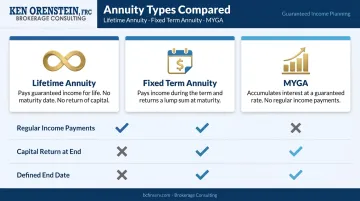
This combination of income payments and capital return sets it apart from similar products:
- Lifetime annuity: Pays income for as long as you live, with no end date and no return of capital
- MYGA (Multi-Year Guaranteed Annuity): Accumulates interest at a guaranteed rate but does not generate regular income payments during the term
- Fixed term annuity: Generates income during the term and returns capital at maturity — a hybrid of income security and capital recovery
Two structural phases define every contract. During the income phase, the insurer makes scheduled payments — monthly, quarterly, or annually — according to the agreed terms. At the maturity event, the pre-agreed lump sum is released. What happens to that capital is entirely the policyholder's choice: purchase a lifetime annuity, roll into a new fixed term contract, or deploy it elsewhere.
How the Maturity Sum Works
The maturity sum is a contractual figure set at purchase. It does not fluctuate with markets or interest rates during the term.
The insurer calculates the expected return on the premium over the term, deducts the cost of the income payments, and the remainder becomes the guaranteed maturity sum.
This creates a direct trade-off that every buyer must resolve:
- Higher income during the term → Lower maturity sum at the end
- Lower income during the term → Larger maturity sum at the end
Neither option is wrong. A buyer who needs maximum current income — and has Social Security or another pension to cover expenses after the term — may reasonably prioritize income now. A buyer planning to purchase a lifetime annuity later may accept less income in exchange for a larger maturity sum.
Death Benefit Before Term End
The maturity sum trade-off is one piece of the evaluation — what happens to the contract if the policyholder dies early is another.
Most fixed term annuity contracts include provisions to direct remaining funds or ongoing payments to a named beneficiary. The mechanism varies by product and carrier. Some contracts pay a lump sum equal to the outstanding maturity value; others continue scheduled payments to the beneficiary for the remainder of the term. Ask for the specific death benefit terms in writing before committing to any contract.
Fixed Term Annuity Options: What You Can Customize
Fixed term annuities offer more flexibility than many buyers realize. Each option shapes both the income level and the maturity sum — and every choice carries a cost worth understanding before signing.
Term Length Options
In the US market, fixed-period income annuities typically range from 1 to 10 years, though some products go considerably longer. Schwab lists New York Life's Guaranteed Period Income Annuity II with period-certain options of 5 to 30 years.
Term length is a strategic planning tool. The most effective use of a fixed term contract is matching its end date to a known future income event:
- Social Security commencement at 62, 67, or 70
- FERS pension activation after a minimum retirement age separation
- A spouse's pension start date
- A defined benefit plan early retirement bridge
When the term end aligns with an incoming income source, the annuity fills the gap precisely — covering the gap without overlap or an uncovered period.
Shorter terms offer more flexibility to reassess; longer terms lock in current rates, which matters when the rate environment is favorable. With the 10-year Treasury yield at 4.57% as of May 21, 2026 (FRED, St. Louis Fed), the current backdrop supports competitive fixed annuity pricing compared to the low-rate environment of the previous decade.
Income Frequency and Structure
Buyers typically choose from:
- Monthly, quarterly, or annual payments — frequency affects cash flow management but not the total income delivered
- Level payments — fixed for the entire term, providing maximum predictability
- Escalating payments — increase by a set percentage each year (for example, 3% annually), with a lower starting income in exchange for rising payments later
- Inflation-linked payments — tied to CPI or a similar index, providing real-value protection at the cost of a reduced initial income level
Escalating or inflation-linked structures make sense when a buyer is concerned about purchasing power erosion over a long term. The trade-off is accepting less income upfront.
Optional Riders and Add-Ons
The most common optional features include:
- Joint life coverage — extends income to a surviving spouse after the primary annuitant's death, typically at 50%, 66.67%, 75%, or 100% of the original payment. Adding joint coverage reduces the income level compared to a single-life contract — sometimes by 10–20% depending on the ages and payout percentage selected
- Enhanced or impaired-life rates — available from some carriers for buyers with qualifying health conditions, reflecting reduced life expectancy. These can meaningfully increase income, though the underwriting process requires medical documentation
- Death benefit riders — specify exactly what is paid to beneficiaries before the term ends, whether a lump sum, ongoing payments, or a cash refund of unpaid premium
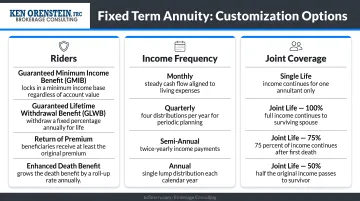
Every rider has a cost expressed as a reduction in income or maturity sum. There is no free option. Start by identifying which protections address a real gap in your plan — then price only those.
Understanding the Guarantees — and Their Real-World Limits
The word "guaranteed" in a fixed term annuity is a contractual term, not a government-backed protection like FDIC deposit insurance. Knowing exactly what it covers — and what it does not — prevents expensive disappointment.
The Income Guarantee
The income payments are contractually guaranteed to remain fixed (or follow the agreed escalation schedule) for the full term. Market movements, interest rate changes, and economic conditions during the term do not affect the payment. This income certainty is the core reason buyers choose fixed term products over variable alternatives.
That guarantee is backed solely by the financial strength of the issuing insurer — not by any government fund. State guaranty associations provide a safety net if an insurer becomes insolvent, but coverage levels vary. According to NOLHGA's 2024–2025 Safety Net report, all member associations cover $250,000 or more in annuity benefits per policyholder. Several states exceed that floor:
| State | Annuity Coverage Limit |
|---|---|
| Connecticut, New York, Washington | Up to $500,000 |
| California | 80% of annuity value, capped at $250,000 |
| Florida, Georgia | Varies by deferred vs. payout status |
| All other member states | $250,000 minimum |
These associations are not government agencies — they are funded by assessments on member insurers and respond only after a court-ordered liquidation. Coverage can also exclude contract portions where the insurer does not guarantee the benefit or where the policyholder bears the investment risk.
The practical implication: verifying an insurer's AM Best or S&P rating before purchase is not optional. Ken Orenstein's practice at Brokerage Consulting includes carrier financial-strength review — using AM Best, S&P, Moody's, and Fitch ratings — as a standard component of every annuity selection process, because the income guarantee is only as durable as the insurer behind it.
The Maturity Sum Guarantee
In fixed-maturity-value contracts, the maturity sum is guaranteed at the outset and will not be reduced by market underperformance. This is a contractual number, not a projected one.
One important distinction: some products link the maturity sum to investment performance. Those are not "fully guaranteed" maturity products — they can return less than the original premium if markets underperform. Before signing, confirm in the contract whether the maturity sum is fixed at purchase or contingent on investment results.
What Guarantees Do Not Cover
"Guaranteed" always applies within the contract's terms and conditions. Specific exclusions buyers often overlook:
- Inflation erosion — level payments lose real purchasing power over time unless an inflation-linked rider is purchased
- Early exit penalties — surrender charges apply if the buyer exits before the term ends; the guarantee does not waive these
- Personal tax changes — annuity income is taxable; changes in the buyer's tax situation during the term are not addressed by the contract
- Coverage above guaranty association limits — buyers with premiums substantially above state limits carry uninsured exposure to insurer insolvency
Key Factors That Determine Your Income and Maturity Sum
Several inputs determine the income level and maturity sum at the point of purchase:
| Factor | Effect on Income and Maturity Sum |
|---|---|
| Premium amount | Larger premium produces proportionally higher income and maturity sum |
| Term length | Longer terms generally allow higher income at the same maturity sum level, though this depends on rate environment |
| Annuity rate at purchase | Directly influenced by prevailing interest rates — higher rates produce more favorable income/maturity combinations |
| Policyholder age | More significant for lifetime annuities; less so for pure fixed-term structures |
| Options selected | Each rider or feature reduces income or maturity sum by a calculable amount |
The income-maturity sum trade-off is the central decision every buyer makes. A $100,000 premium invested across a 10-year term will produce different monthly income amounts depending on how much maturity sum the buyer wants to recover at term end. Choosing a higher maturity sum, say $80,000 at the end of 10 years, means accepting lower monthly income than if the buyer opted for a $50,000 maturity sum.
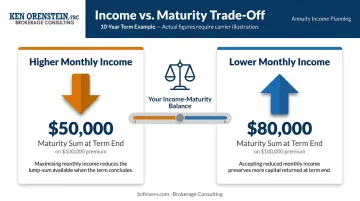
The actual figures depend on the annuity rate offered by the insurer at the time of purchase, which cannot be calculated in advance without a current carrier illustration.
Working with an advisor who has access to multiple carriers allows buyers to identify the most competitive combination of income level and maturity sum for their specific timeline. Ken Orenstein at Brokerage Consulting compares rates across top financial and insurance companies to help clients find that fit. This is particularly relevant for federal employees bridging to a FERS pension or Social Security start date, where matching the contract's end date to an incoming income source is a core planning objective.
Risks, Limitations, and Common Misconceptions
Inflation Erodes Fixed Payments Faster Than Most Buyers Expect
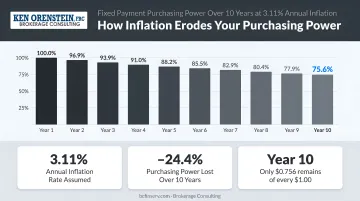
BLS CPI-U data shows that a fixed dollar of income in 2015 retained only about 73.6 cents of its original purchasing power by 2025 — a 26.4% loss over 10 years, based on CPI-U rising from 237.017 to 321.943. The annualized 10-year average inflation rate calculated from this data is approximately 3.11%.
For a buyer taking $1,500 per month from a 10-year fixed term annuity starting in 2025, the real purchasing power of that payment in 2035 would be closer to $1,100 in today's terms — assuming similar inflation patterns. Without an inflation-linked rider, that gap is simply absorbed by the buyer.
Insurer Default Is Rare but Not Impossible
AM Best reported 5 US life and health insurer impairments in 2024, down from 10 in 2023. Impairment is not the same as liquidation, and most policyholders at impaired carriers are transferred to solvent companies. But the risk is real, and state guaranty association protection is capped.
Before purchasing any fixed term contract, buyers should:
- Confirm the issuer's AM Best or S&P financial strength rating
- Check their state's specific guaranty association limit
- Consider whether their premium exceeds that limit
Fixed Term Annuities, MYGAs, and Lifetime Annuities Are Not Interchangeable
Conflating these products is one of the most common errors buyers and advisors make:
- A MYGA accumulates interest at a guaranteed rate: it does not pay regular income during the term
- A lifetime annuity pays income until death: there is no maturity date and no capital return
- A fixed term annuity pays income for the term and returns a pre-agreed lump sum at the end
The maturity event in a fixed term contract is an active decision point, not an automatic renewal. Buyers need a clear plan for what happens when the term ends. That includes knowing whether the maturity sum will be sufficient to fund a lifetime annuity at that future date — one of the most costly planning gaps advisors see in practice.
Frequently Asked Questions
How much will a $100,000 fixed term annuity pay per month?
The monthly income depends on the annuity rate at the time of purchase, the term length selected, the maturity sum chosen, and any optional features added. There is no single answer without a current carrier illustration. Use an annuity calculator or consult a licensed advisor for a personalized estimate based on live market rates.
Do you get your money back at the end of a fixed term annuity?
Not in full. The maturity sum, agreed at purchase, reflects the original premium plus expected growth, minus the cost of income payments already received. It is a contractual figure, not a full refund. The size of the maturity sum depends on how much income was taken during the term.
Does income from a fixed term annuity affect SSDI?
Annuity income counts as unearned income for SSI under SSA POMS SI 00830.160 and can affect eligibility and benefit levels. The impact on SSDI — which turns on work credits and disability status — is more nuanced and varies by situation. Consult a Social Security specialist before purchasing.
Can I buy a fixed term annuity directly from an insurer?
Direct purchase is possible with some carriers. However, working through an independent broker provides access to multiple carriers, rate comparisons, and guidance on selecting the right term, income level, and riders for your specific situation rather than being limited to one company's offerings.
Is a fixed term annuity better than a lifetime annuity?
Neither is universally better. A fixed term annuity offers flexibility, a maturity sum, and the ability to reassess at term end. A lifetime annuity provides income that cannot be outlived. The right choice depends on health, other income sources, the actual length of the income gap, and how much flexibility the buyer needs.
What happens to a fixed term annuity if I die before the term ends?
Most contracts direct remaining funds to a named beneficiary as a lump sum or continued scheduled payments. The exact mechanism depends on the product terms and the payout option selected at purchase. Always confirm the death benefit structure before signing.