
Annuity settlement options define the structure, duration, and flexibility of your payments. Choose wrong and you may outlive your money, leave a spouse without income, or trigger an unnecessary tax bill. Choose well and you lock in a predictable income stream tailored to your retirement goals.
This guide covers the six most common payout options, what happens when an annuity owner dies, the key factors that should drive your decision, and the tax implications every annuitant needs to understand.
Key Takeaways
- Annuity settlement options are the payout structures you choose when an annuity begins making payments — and most choices are irrevocable once elected
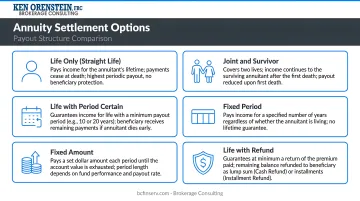
- The six most common options are: lifetime income, joint and survivor, fixed period, fixed amount, lump sum, and systematic withdrawal
- Taxes, life expectancy, spousal needs, and surrender charges all factor into which option fits your situation
- Consult a retirement planning advisor before committing; the wrong choice can cost you tens of thousands over a 20- or 30-year retirement
How Annuity Payouts Work: The Two Phases
The Accumulation Phase
During the accumulation phase, your premiums are deposited and grow tax-deferred. How that growth happens depends on the annuity type:
- Fixed annuities — earn a guaranteed interest rate, similar to a CD but with tax deferral
- Fixed Indexed Annuities (FIAs) — growth tied to a market index like the S&P 500, with principal protection when markets fall
- Variable annuities — funds invested in sub-accounts similar to mutual funds, with market-level upside and corresponding risk
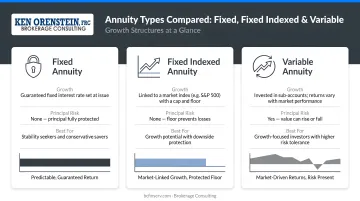
The NAIC describes this accumulation phase as the period during which contributions grow with interest before the annuitant may elect to annuitize for income. Product type, premium structure, and income rider elections made during this phase all shape which settlement options will be on the table when income begins.
The Payout Phase (Annuitization)
The payout phase begins when the insurance company converts your account value into a scheduled income stream. This can be triggered at a predetermined maturity date or elected by you.
TIAA describes annuitization as a permanent decision: once income payments begin, you generally cannot switch to a different option. That permanence means your settlement option review belongs at the purchase stage, not the retirement stage — when it's too late to change course.
The 6 Most Common Annuity Settlement Options
Available options vary by contract and insurer. One critical point applies to all of them: the choice is typically irrevocable once made. Here's what each option delivers.
Lifetime Income (Life Only)
Pays a guaranteed income for the rest of your life, no matter how long you live. This eliminates longevity risk — the fear of outliving your savings.
The tradeoff: if you die early, remaining funds typically do not pass to a beneficiary. The insurance company keeps them. This option tends to produce the highest monthly payment of any structure, because the insurer assumes the full longevity risk.
It's best suited for single annuitants in good health with no dependents who need maximum monthly income.
Joint and Survivor Annuity
Provides guaranteed income for two lives — typically spouses — with payments continuing after one person dies. The surviving spouse receives a continuation percentage of the original payment. Common options: 50%, 66.67%, 75%, or 100%.
According to Blueprint Income's April 2024 quote data, a $100,000 annuity for a 65-year-old couple with 100% survivor continuation paid roughly $515/month — compared to $630/month for a male single-life option. That's approximately a 14–18% reduction in exchange for covering both lifetimes.
The exact reduction varies based on ages, gender, interest rates, and the continuation percentage selected. For married clients, comparing these options across multiple carriers is essential — the continuation percentage chosen has a direct bearing on whether a surviving spouse can maintain their income. Brokerage Consulting evaluates these tradeoffs across carriers as part of its annuity planning process.
Fixed Period (Period Certain)
Payments are guaranteed for a specific number of years — commonly 10, 15, or 20 — regardless of whether the annuitant is alive. If you die before the period ends, your named beneficiary receives the remaining payments until the term expires.
Once the term ends, payments stop. There is no lump-sum refund, and no further payments are made after the period concludes.
This structure works well for annuitants who want legacy protection and a defined income window rather than lifetime coverage.
Fixed Amount
You select a specific dollar amount to receive each period — monthly, quarterly, annually — and payments continue until the account balance is depleted. This option does not guarantee income for life. It works best for annuitants with a defined spending need over a known timeframe — for example, bridging income from retirement to Social Security eligibility.
Lump-Sum Payment
The entire account value is distributed in a single payment, giving you immediate access to all funds. The major drawback: for qualified annuities, the full amount is taxable as ordinary income in the year received.
This can push you into a significantly higher federal tax bracket and may trigger Medicare IRMAA surcharges — see the Tax Implications section below for specifics. For most large balances, the lump-sum option is one of the least tax-efficient choices available.
Systematic (Flexible) Withdrawals
The most flexible option: you set payment amounts and frequency, and can adjust, pause, or stop payments over time. Unlike the fixed amount option, you can modify payments as your needs change.
This option is most commonly available with deferred annuity products and is well-suited for annuitants who want adaptability rather than a locked-in structure. The tradeoff is that there's no guaranteed lifetime income — payments depend entirely on the remaining account balance.
What Happens to an Annuity When the Owner Passes Away?
Settlement options for beneficiaries depend on three factors:
- The type of beneficiary named
- The contract type (qualified vs. non-qualified)
- The specific annuity product
Spousal Beneficiaries
Surviving spouses have the broadest set of options. Under IRC Section 72(s), a surviving spouse can be treated as the holder of a non-qualified annuity contract — known as spousal continuation — effectively stepping into the owner's role and deferring distributions.
Non-Spouse Beneficiaries
Non-spouse beneficiaries face different rules depending on contract type:
Non-qualified annuity contracts (IRC 72(s)):
- 5-year rule — the entire interest must be distributed within 5 years of the owner's death
- Life/life expectancy option — distributions can be stretched over the beneficiary's life expectancy, but payments must begin within one year of the owner's death
- Lump-sum — full distribution taken immediately, taxable in the year received
Qualified annuities (inside an IRA or employer plan):
- The SECURE Act 10-year rule generally requires most non-spouse beneficiaries to withdraw the entire inherited account by the end of the 10th year after the owner's death
- Eligible designated beneficiaries — including surviving spouses, minor children, disabled or chronically ill individuals, and beneficiaries not more than 10 years younger than the owner — may qualify for exceptions to the 10-year rule
Non-spouse beneficiaries may also be able to roll qualified annuity proceeds into an Inherited IRA to continue tax deferral, though the SECURE Act 10-year rule still applies.
These elections are typically irrevocable and carry significant tax consequences — particularly given the different treatment of qualified versus non-qualified contracts. Getting the election right the first time matters, which is why reviewing options with a qualified annuity advisor before committing is worth the time.
Key Factors to Consider When Choosing Your Settlement Option
Life Expectancy
Longer life expectancy generally favors lifetime income options — you'll collect more total payments over time. Those with serious health conditions may benefit more from fixed period or lump-sum options, since the lifetime payout advantage diminishes with shorter life spans.
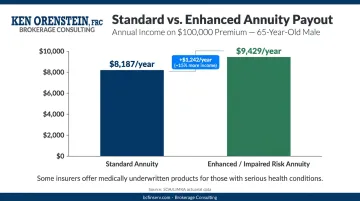
Some insurers offer enhanced (impaired risk) annuities that provide higher payouts for those with serious health conditions due to reduced life expectancy. According to SOA/LIMRA actuarial data, a 65-year-old male with a rated health condition received $9,429 annually versus the standard $8,187 on a $100,000 premium — roughly 15% more income.
Spousal and Dependent Needs
Married annuitants should weigh joint and survivor options carefully, even if the lower initial payment stings. Leaving a surviving spouse without income can be financially devastating.
For federal employees, this analysis includes coordinating with FERS or CSRS survivor benefit elections. Under FERS, a full survivor benefit equals 50% of the retiree's annuity with a 10% retiree reduction; a partial survivor equals 25% with a 5% reduction. Understanding what the federal system already provides helps size a private joint-and-survivor annuity appropriately — avoiding either duplication or gaps.
Flexibility vs. Guarantees
The core tradeoff: irrevocable lifetime income gives you certainty but no adaptability, while flexible withdrawals let you adjust but offer no longevity guarantee.
Before committing to an irrevocable payout structure, map out your other income sources:
- Social Security (and claiming-strategy optimization)
- Pension or FERS/CSRS benefit
- TSP or 401(k) portfolio
- Other savings or investment accounts
If your guaranteed income already covers essential expenses, you may need less from the annuity — allowing more flexibility in how the remainder is structured.
Surrender Charges and Early Withdrawal Penalties
Withdrawing before the surrender period ends reduces your net payout. The IRS also imposes a 10% additional tax on annuity distributions taken before age 59½ under IRC 72(q), with limited exceptions including disability, death, or substantially equal periodic payments.
Per NAIC guidelines, most annuities allow withdrawal of up to 10% of contract value per year without surrender charges — a key provision that preserves access to funds without penalty. Know this limit before selecting any large withdrawal option.
Surrender charge schedules and 1035 exchange opportunities — where you move an older contract to a more suitable product without triggering a taxable event — are worth reviewing before finalizing any settlement structure. Ken Orenstein at Brokerage Consulting walks clients through this analysis as part of the annuity selection process. No-cost consultations are available by phone, virtual, or in-person — call (888) 315-3608 or visit bcfinserv.com.
Tax Implications of Annuity Settlement Options
Qualified vs. Non-Qualified Annuities
| Annuity Type | Tax Treatment |
|---|---|
| Qualified (funded with pre-tax dollars, inside IRA/401(k)) | 100% of each payment taxable as ordinary income |
| Non-qualified (funded with after-tax dollars) | Only the gains portion is taxable; principal returns tax-free |
For non-qualified annuities, the exclusion ratio determines how much of each payment is taxable. IRS Publication 939 provides a direct example: a 65-year-old who purchases a life annuity for $10,800 receiving $100/month has an expected return of $24,000. The exclusion percentage is 45% ($10,800 ÷ $24,000), meaning $45 of each $100 payment is tax-free and $55 is taxable.
The Lump-Sum Tax Risk
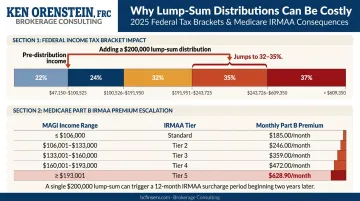
Taking a large annuity balance as a single distribution can cause a significant jump in taxable income. Here's how the 2025 federal tax brackets apply to single filers:
| Rate | Single Filer Income Range |
|---|---|
| 22% | $48,475 – $103,350 |
| 24% | $103,350 – $197,300 |
| 32% | $197,300 – $250,525 |
| 35% | $250,525 – $626,350 |
| 37% | Over $626,350 |
A retiree who would otherwise pay 22% could easily land in the 32% or 35% bracket after adding a $200,000 lump-sum distribution to ordinary income. That same spike in modified adjusted gross income (MAGI) can also trigger Medicare IRMAA surcharges, pushing Part B premiums from the standard $185/month to as high as $628.90/month for higher income tiers in 2025.
Inherited Annuity Rollovers
Non-spouse beneficiaries inheriting a qualified annuity (held inside an IRA or employer plan) may be able to roll the proceeds directly into an Inherited IRA to continue tax deferral. The 10-year rule still applies — the full balance must be withdrawn by the end of the 10th year.
The key advantage is control over when within that window to take distributions, which allows beneficiaries to spread tax liability across multiple years rather than absorbing a single large hit.
A few important boundaries apply:
- Applies only to qualified contracts (IRA or employer plan annuities)
- Non-qualified annuity contracts follow separate rules under the non-qualified annuity distribution provisions of IRC 72(s)
- SECURE 2.0 Act changes may affect RMD timing within the 10-year window for certain inherited accounts
Given the interaction between annuity type, beneficiary relationship, and current tax law, confirming rollover eligibility with a tax professional before electing any distribution option is essential.
Frequently Asked Questions
How much does a $100,000 annuity pay per month?
Monthly payouts depend on age, payout type, interest rates, and the insurer. Based on current quote platform data, a 65-year-old male could receive approximately $623–$685/month under a single-life option; a 65-year-old female approximately $600–$634/month. Joint-life payouts for a couple at 65 with 100% survivor continuation run roughly $515/month. These figures change with interest rates and should be verified with current carrier quotes.
What are the most common annuity settlement options?
The six most common options are: lifetime income (life only), joint and survivor, fixed period (period certain), fixed amount, lump sum, and systematic withdrawal. Availability varies by contract — not every insurer offers all six options, so reviewing settlement options before purchasing a contract is essential.
Do you get your money back at the end of a fixed period annuity?
No. With a fixed period (period certain) option, payments end when the term expires — there is no lump-sum refund. If you die before the period ends, remaining payments continue to your named beneficiary until the term concludes. If you outlive the period, payments simply stop.
Do health conditions affect annuity rates?
Standard annuities do not reward poor health with higher rates. However, some insurers offer enhanced or impaired risk annuities — medically underwritten products that provide larger payouts for annuitants with serious health conditions and shorter life expectancies. Availability is limited, and qualification requires a full medical review.
Are guaranteed annuities a good idea?
Guaranteed annuities work well for retirees concerned about outliving savings, but fit depends on your full income picture — Social Security, pensions, other assets — alongside your tax situation and legacy goals. They're most effective as one piece of a coordinated retirement income plan, not a standalone solution.