
The honest answer is: it depends entirely on which type of annuity you own. Some annuities genuinely insulate your principal from market losses. Others are just as exposed to a crash as any mutual fund — and come with higher fees on top of that.
This guide breaks down exactly which annuity types offer crash protection, what risks remain even in the "safer" products, and how to evaluate whether an annuity belongs in your retirement income plan.
TLDR: Key Takeaways
- Fixed annuities offer the strongest crash protection: both principal and interest rate are guaranteed regardless of market conditions
- Fixed Indexed Annuities (FIAs) protect principal but cap upside; earnings can be zero in a down year
- Variable annuities carry real market risk and can lose significant value in a crash
- Even "safe" annuities carry risks: inflation erosion, surrender charges, and carrier insolvency are all real
- The financial strength of the insurance company backing your annuity matters just as much as the product type
What Makes an Annuity "Market-Proof"?
Most annuities are insurance contracts — not securities. That distinction is the foundation of crash protection. When you buy a fixed annuity, you're transferring financial risk to an insurance company rather than absorbing it yourself.
The insurer takes your premium, invests it in its own general account (primarily investment-grade bonds), and guarantees your principal plus a fixed return. You never touch the underlying investments. The insurer assumes all the performance risk — which is precisely what separates a fixed annuity from a brokerage account during a market downturn.
The Regulatory Split That Matters
Not all annuities operate this way, and the regulatory framework tells you which do:
- Fixed and fixed indexed annuities — regulated at the state level as insurance products; guarantees are backed by the insurer's claims-paying ability
- Variable annuities and RILAs — registered securities regulated by the SEC and FINRA; account values fluctuate with market performance
According to FINRA, fixed annuity guarantees depend entirely on insurer solvency, not markets. Carrier financial strength ratings — from AM Best, Moody's, or S&P — are the first thing to verify before committing to any fixed annuity contract.
The State Guarantee Association Safety Net
If an insurer fails, state guarantee associations step in. According to NOLHGA, every state plus DC and Puerto Rico maintains a life and health guaranty association that covers annuity benefits — generally at least $250,000 — after a court-ordered liquidation. The system has protected over 2.85 million policyholders and paid out more than $25.88 billion in benefits.
Keep in mind: this is not FDIC insurance. Coverage limits vary by state and may not cover the full contract value. For larger balances, laddering contracts across multiple highly-rated carriers is one way to stay within protection thresholds while maintaining flexibility.
Annuity Types Ranked by Market Crash Protection
Fixed Annuities: The Strongest Protection
Fixed annuities (often called Multi-Year Guaranteed Annuities, or MYGAs) offer a guaranteed interest rate for the contract term with no exposure to market performance. The insurer assumes all investment risk. Your balance doesn't drop when markets fall.
Think of them as CDs with tax deferral and typically better rates. As of May 2026, competitive MYGA rates included:
| Term | Rate |
|---|---|
| 3-year | 5.65% |
| 5-year | 6.30% |
| 7-year | 6.50% |
| 10-year | 6.05% |
Source: Blueprint Income, May 2026
The trade-off: Fixed annuities offer the lowest growth ceiling. If inflation runs at 4% and your MYGA earns 3.5%, you're losing purchasing power in real terms. That's a manageable risk over a short term, but a compounding problem over a 20-year retirement.
Ken Orenstein at Brokerage Consulting works with carriers including Aetna, Humana, and TransAmerica to compare fixed annuity rates and surrender schedules across the market — independently, not limited to any single issuer.
Fixed Indexed Annuities (FIAs): Principal Protected, Growth Tied to an Index
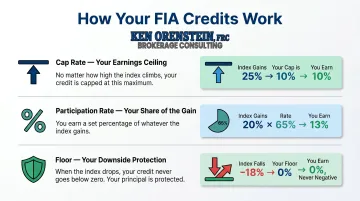
FIAs link potential growth to a market index (most commonly the S&P 500) without actually investing in it. If the index rises, you earn a credit up to a cap. If it falls, you credit zero — never negative. Your principal stays intact.
The mechanics that make this work:
- Cap rate: the ceiling on your annual credit. A 10% cap means you earn at most 10%, even if the index gains 25%.
- Participation rate: the share of index gains credited to your contract. At 65%, you earn 65 cents on every dollar of index gain.
- Floor: typically 0%, so you never receive a negative credit regardless of how the index performs.
FIA sales reached $127.9 billion in 2025, driven by sustained market volatility and elevated interest rates. FIAs appeal to retirees who want more than a fixed rate but genuinely cannot afford to lose principal.
Ken Orenstein evaluates multiple crediting methods (annual point-to-point, monthly sum, monthly average) alongside caps and participation rates across competing carriers to find the best structural fit for each client.
Registered Index-Linked Annuities (RILAs): Partial Protection With Higher Upside
RILAs, also called buffered or structured annuities, offer a middle ground. Instead of full principal protection, they offer defined downside limits in exchange for higher growth potential than a standard FIA.
Two protection structures:
- Buffer: the insurer absorbs the first X% of losses. With a 10% buffer, you're protected on the first 10% drop — losses beyond that are yours to absorb.
- Floor: you absorb losses up to a defined threshold; the insurer covers everything below it.
RILAs are not fully principal-protected. If markets drop more than your buffer, you absorb the excess loss. RILA sales grew roughly 20% year-over-year in 2025, reflecting demand for higher upside participation with some downside guardrails.
Variable Annuities: Most Vulnerable to a Market Crash
Variable annuities invest premiums into subaccounts that function like mutual funds. When markets fall, so does your account value — often substantially.
The fee structure compounds the problem. Typical costs include:
- Mortality and expense (M&E) charges: ~1.25% annually
- Administrative fees: ~0.15% or a flat fee
- Income rider fees: often 1.0–1.5% annually
- Subaccount expenses on top of all the above
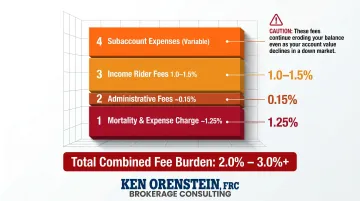
In a down market, these fees continue eroding a shrinking balance. Variable annuities are not suitable for investors who cannot absorb market risk.
At Brokerage Consulting, variable annuities are placed selectively (primarily for accumulation-phase clients with higher risk tolerance who already have a guaranteed income floor). More often, Ken evaluates whether an existing variable annuity should be exchanged for a fixed or fixed indexed product through a tax-free 1035 exchange.
QLACs: Crash-Resistant Through Deferred Guaranteed Income
A Qualified Longevity Annuity Contract (QLAC) is funded from an IRA or qualified plan and begins paying guaranteed lifetime income at a future date (often age 80 or 85). During the deferral period, the contract value is not subject to market performance.
The SECURE 2.0 Act raised the lifetime QLAC limit to $200,000 (indexed for inflation) and eliminated the prior 25% cap. Crucially, QLAC premiums are excluded from Required Minimum Distribution (RMD) calculations until income begins , making them a dual-purpose tool for longevity protection and tax management.
For federal retirees with FERS pension and Social Security already covering baseline expenses, a QLAC can fund the "late-retirement gap" starting in the mid-80s, when other income sources may no longer keep pace with healthcare costs.
Risks That Exist Even in "Safe" Annuities
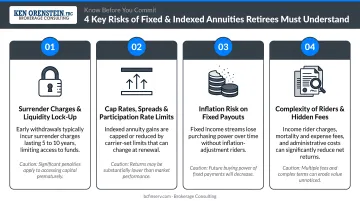
Crash protection is not the same as risk-free. Fixed and indexed annuities carry real risks that every buyer should understand before signing.
Four risks deserve close attention before you sign any annuity contract:
Carrier insolvency risk: Your guarantee is only as strong as the insurer behind it. If the company fails, state guarantee associations provide a backstop — but coverage limits may not cover the full contract value. Vetting carrier financial strength ratings before purchase is essential.
Inflation risk: A fixed annuity paying 5.5% feels comfortable today. If inflation averages 4% over a 25-year retirement, purchasing power erodes considerably. Some contracts offer Cost-of-Living Adjustment (COLA) riders — typically 1–3% annual increases — though these reduce the initial payout amount.
Surrender charges and liquidity constraints: Annuities are long-term contracts. Early withdrawals trigger surrender charges starting at 7–9% in year one, declining over a 7–10-year schedule. Withdrawals before age 59½ also carry a 10% IRS tax penalty. Most contracts allow a 10% free withdrawal annually — beyond that, charges apply.
Opportunity cost: Locking money into a fixed annuity during a sustained equity bull market means potentially missing out on stronger gains elsewhere. For most retirees, annuities work best as one income layer alongside market investments — not a full replacement for them.
How to Evaluate an Annuity Carrier's Financial Strength
The four primary rating agencies for insurer financial strength are AM Best, Moody's, Standard & Poor's, and Fitch Ratings. Each assesses the insurer's ability to meet long-term policyholder obligations — their balance sheet strength, reserve adequacy, and operating stability.
A useful shortcut is the COMDEX score, which aggregates ratings from all four agencies into a single percentile ranking. A carrier with a COMDEX of 92 sits in the 92nd percentile of all rated insurers — a much more intuitive comparison tool than cross-referencing four different rating scales.
General guidance:
- Look for AM Best ratings of A- or better (classified as Excellent or higher)
- Higher COMDEX percentiles reflect stronger relative standing among peers
- In a recession or financial crisis, reserve adequacy becomes most critical — this is exactly when weaker carriers face the most pressure
Applying this framework to real recommendations, Ken Orenstein reviews AM Best, Moody's, S&P, and Fitch ratings as part of every annuity evaluation — weighing carrier financial strength alongside product rates and features before making any recommendation.
Building Crash-Resilient Retirement Income: Is an Annuity Right for You?
Annuities work best as one component of a layered income plan, not a standalone solution. A sound retirement income plan typically looks like this:
- Layer 1 — Social Security (with optimized claiming strategy)
- Layer 2 — Pension income — FERS/CSRS for federal employees, or private pensions where applicable
- Layer 3 — Guaranteed lifetime income from annuities — fixed, FIA, or SPIA depending on your situation
- Layer 4 — Discretionary growth portfolio (handles inflation hedge, discretionary spending, and legacy)

The guaranteed layers cover essential expenses. The growth portfolio handles the rest. This structure directly addresses sequence-of-returns risk. If markets crash in year two of retirement, guaranteed income keeps flowing — so you're never forced to sell equities at depressed values.
Key Decision Factors
Before choosing an annuity type, consider:
- How close you are to retirement — principal protection becomes a priority within 5 years
- Your risk tolerance — can your plan absorb a 20–30% market drop without derailing income?
- Liquidity — do you have an emergency reserve outside the annuity?
- What guaranteed income you already have — Social Security or a pension may already cover your essentials
- Your primary goal — protection, income generation, or growth potential each point to different annuity types
For federal employees, this calculation often starts with FERS pension and Social Security providing a solid guaranteed base. A fixed or indexed annuity in Layer 3 may be most valuable for supplemental income or to fill a specific late-retirement gap using a QLAC structure.
If market volatility is a real concern — especially within 5 to 10 years of retirement — reviewing fixed and indexed annuity options can show you exactly what protection is available and what it costs. Ken Orenstein offers no-cost consultations by phone, virtually, or in person. Reach Brokerage Consulting at (888) 315-3608 or request a consultation at bcfinserv.com.
Frequently Asked Questions
Are annuities protected from stock market crashes?
It depends on the type. Fixed and fixed indexed annuities protect your principal from market losses — the insurer absorbs that risk. Variable annuities are directly exposed to market performance and can lose significant value in a crash.
What does a $1,000,000 annuity pay per month?
A rough benchmark: a 65-year-old purchasing a $1,000,000 immediate annuity (SPIA) might receive approximately $5,000–$6,500/month for life, depending on gender, interest rates, and payout structure. Fixed indexed and variable annuities vary more widely. For an accurate estimate based on your situation, use an annuity calculator or speak with an advisor.
What is the safest type of annuity during a market crash?
Fixed annuities (MYGAs) are the safest option — they offer a guaranteed interest rate and full principal protection regardless of what the stock market does during the contract term.
What happens to a variable annuity if the stock market crashes?
The account value drops along with the market because it's invested in subaccounts similar to mutual funds. High annual fees (often 2–3% or more combined) accelerate the decline by eroding a shrinking balance.
Are fixed indexed annuities 100% protected from market losses?
FIAs protect your principal from direct market losses — your balance doesn't decline when the index falls. However, earnings in a negative year are typically zero, and caps or participation rates limit upside in positive years.
What is the state guarantee fund for annuities and how much does it cover?
State insurance guarantee associations, coordinated nationally through NOLHGA, provide a safety net if an insurer is liquidated. All member associations cover at least $250,000 in annuity benefits, with some states offering more. Because limits vary and may not cover the full contract value, evaluating carrier financial strength before purchase is essential.