
Introduction
Retirement looks different than it did a generation ago. Fewer workers have pensions, Social Security covers less than most people expect, and market volatility can wipe out years of savings gains in a matter of months.
The numbers tell a stark story: according to a 2026 Allianz Life study, 67% of Americans worry more about running out of money than death — up 10 percentage points since 2022.
Only 14% of private-industry workers have access to a defined-benefit pension, meaning most retirees are left cobbling together income from Social Security, 401(k) accounts, and personal savings.
Fixed annuities address this gap directly. They're not flashy investment products, and they won't beat the market. What they offer is a guaranteed income stream — giving retirees the predictability to cover essential expenses regardless of what markets do.
This article explains what fixed annuities are, who benefits most from them, their core advantages, and what to evaluate before purchasing one.
Key Takeaways
- A fixed annuity is an insurance contract that guarantees a set interest rate during accumulation and predictable income during distribution
- Key benefits: tax-deferred growth, guaranteed lifetime income, and full principal protection from market losses
- Risk-averse individuals, retirees without pensions, and those supplementing Social Security are the strongest candidates
- Not ideal for those needing high liquidity or those seeking aggressive long-term growth
- Structuring a fixed annuity correctly requires working with an experienced retirement advisor
What Is a Fixed Annuity?
A fixed annuity is a contract between an individual and an insurance company. The insurer guarantees a minimum interest rate on the money deposited and, when the time comes, converts that balance into a regular income stream.
The NAIC (National Association of Insurance Commissioners) defines fixed deferred annuities as contracts where money earns interest at a rate the insurer sets, with a guaranteed minimum floor — meaning your rate cannot fall below a specified level regardless of market conditions.
The Two Phases
Fixed annuities operate in two distinct stages:
- Accumulation: Money grows tax-deferred at the guaranteed rate, with no taxes due until withdrawal. This phase spans the contract term — commonly 3, 5, 7, or 10 years for Multi-Year Guaranteed Annuities (MYGAs).
- Distribution (payout): The insurer makes regular payments — monthly or quarterly — either for a fixed period or for the annuitant's lifetime, converting the lump sum into a dependable income stream.
How Fixed Annuities Compare to Other Types
| Annuity Type | Return Source | Principal Risk | Complexity |
|---|---|---|---|
| Fixed | Guaranteed rate | None (market) | Low |
| Variable | Market subaccounts | Yes | High |
| Fixed Indexed (FIA) | Index-linked credits | Limited | Moderate |
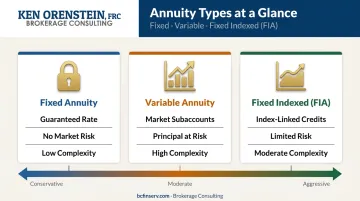
Fixed annuities sit at the conservative end of this spectrum. They are retirement income tools, not growth investments. If your priority is predictable income rather than portfolio appreciation, that positions fixed annuities as a natural fit for the income floor of a retirement plan.
In 2025, Americans purchased $160.6 billion in fixed-rate deferred annuities alone, according to LIMRA — a figure that reflects how many retirees are prioritizing guaranteed income over market gains.
Key Benefits of Fixed Annuities
Guaranteed Lifetime Income
The most compelling reason retirees choose fixed annuities is simple: the income never stops.
A fixed annuity structured with a lifetime payout option continues payments for as long as the annuitant lives — whether that's age 75 or age 95. According to SSA actuarial data, a woman reaching age 65 today can expect to live another 20 years on average. A man, roughly 17 years. That's a long time to sustain income from a finite pool of savings.
Payout options typically include:
- Single-life: Payments for the annuitant's lifetime only — no continuation to heirs after death
- Joint-and-survivor: Payments continue to a surviving spouse, typically at 50%, 75%, or 100% of the original amount
- Period-certain: Payments guaranteed for a set number of years regardless of lifespan — protects beneficiaries if the annuitant dies early
BlackRock's 2025 Read on Retirement survey found 86% of savers want guaranteed income and 93% are interested in retirement income products. And the satisfaction data backs this up: TIAA found that 48% of retirees with annuitized income described themselves as very satisfied with retirement, compared to 38% without it.
This matters most for those without a traditional pension. With only 14% of private-sector workers covered by defined-benefit plans, a fixed annuity can function as a self-funded pension — delivering a predictable monthly paycheck that sets a reliable income floor heading into retirement.
Tax-Deferred Growth
Interest earned inside a fixed annuity is not taxed until withdrawal. This allows the account balance to compound without the annual drag of income taxes, which meaningfully accelerates growth over a 10- to 20-year period compared to an equivalent taxable savings account.
Beyond the compounding advantage, most retirees are in a lower tax bracket when they begin withdrawals — so the deferred income is often taxed at a lower rate than it would have been during peak earning years.
Tax mechanics to understand:
- No annual contribution limits for non-qualified (after-tax) annuities, per FINRA — unlike IRAs and 401(k)s, which cap annual contributions
- Early withdrawal penalty: Distributions before age 59½ may trigger a 10% additional federal tax on the taxable portion, per IRS Publication 575
- Qualified vs. non-qualified treatment: Annuities funded with pre-tax money (qualified) are fully taxable at withdrawal; those funded with after-tax money (non-qualified) are only taxed on the gains
For clients who have already maxed out their IRA and 401(k) contributions, a non-qualified fixed annuity offers continued tax-deferred accumulation with no ceiling on contributions. Ken Orenstein at Brokerage Consulting incorporates this strategy as part of a tax-efficient retirement income plan — particularly relevant for higher-income earners who have exhausted qualified account options.
Protection of Principal from Market Losses
Unlike mutual funds, variable annuities, or stock-based retirement accounts, a fixed annuity guarantees that the original principal cannot be lost to market downturns. The insurer assumes all investment risk and is responsible for meeting its guaranteed rate obligations regardless of how markets perform.
This matters most in the years immediately surrounding retirement. Morningstar research found that nearly 70% of portfolio failures occurred in simulations where investments lost significant value during the first five years of retirement — the so-called sequence of returns risk.
A single bad market year at the wrong time can permanently reduce what a portfolio can sustain. Principal protection eliminates that risk entirely for the assets placed in a fixed annuity.
Principal protection matters most for:
- Individuals within 5–10 years of retirement who cannot afford to recover from a market loss
- Retirees already drawing income who need a stable floor beneath their spending
- Federal employees who want to layer guaranteed protection on top of TSP balances or other market-exposed accounts
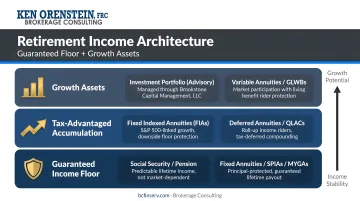
Ken Orenstein's approach at Brokerage Consulting reflects this logic directly. Fixed annuities serve as the "flooring" layer in a multi-layered income architecture: guaranteed income (Social Security, pension, and annuities) covers essential expenses, while market-based assets handle discretionary spending and long-term growth.
What Happens Without a Stable Income Plan
Retirees without a guaranteed income floor tend to encounter the same problems — and they tend to compound.
The clearest risk is behavioral: when markets drop, retirees without guaranteed income are forced to choose between selling assets at depressed prices or cutting spending. Neither is a good choice. Selling locks in losses permanently; cutting spending undermines the retirement they worked decades to fund.
A few data points illustrate the underlying fragility:
- 59% of retirees had only three months of emergency savings in 2024, down from 69% in 2022, per EBRI
- 44% of female Social Security beneficiaries age 65+ receive more than half their income from Social Security alone — a single source most treat as supplemental, not foundational
- Some Medicare households may need nearly $500,000 for healthcare costs in retirement, per a 2024 EBRI report
Without a guaranteed income floor, essential expenses — healthcare, housing, food — compete with portfolio survival. A fixed annuity addresses this directly: it separates essential income from market outcomes, so the floor stays in place regardless of what the portfolio does.
Who Should Consider a Fixed Annuity?
Fixed annuities tend to work well for:
- Retirees or near-retirees (typically ages 62–65) who prioritize income certainty over growth potential
- Those without a defined-benefit pension — which, based on BLS data, describes most private-sector workers
- Individuals who rely heavily on Social Security and want to reduce that single-source dependence
- Federal employees with FERS pension income who want additional guaranteed income to cover healthcare costs or discretionary expenses without drawing down TSP assets
If you're a federal employee, that last point is worth expanding on. A fixed annuity fits naturally into a layered income structure: Social Security and your FERS pension form the base, a fixed annuity adds a supplemental guaranteed layer on top, and TSP assets remain available as a discretionary portfolio for larger or unexpected expenses.
That said, fixed annuities aren't the right fit for everyone:
- Younger investors (under 50) with long time horizons and higher risk tolerance
- Those who need ready access to a significant portion of their capital within the surrender period
- Individuals seeking aggressive growth potential — fixed annuities prioritize stability, not returns
How to Get the Most Value from a Fixed Annuity
Buying a fixed annuity isn't complicated, but structuring it correctly requires careful decisions across several dimensions.
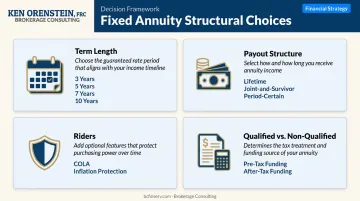
Key Structural Decisions
- Term length: MYGAs are available in 3-, 5-, 7-, and 10-year terms. Rate differentials are typically larger at longer durations, but longer terms mean longer surrender periods.
- Payout structure: Lifetime, joint-and-survivor, or period-certain — each affects the monthly payment amount and beneficiary protection.
- Riders: Cost-of-living adjustment (COLA) riders can raise payments annually to offset inflation, at the cost of a lower starting payment.
- Qualified vs. non-qualified: Whether the annuity is funded with pre-tax or after-tax money affects both contribution strategy and withdrawal taxation.
Evaluating the Insurance Company
Annuity guarantees are only as strong as the insurer behind them. Before purchasing, review financial strength ratings from agencies such as A.M. Best (scale: A++ to D) and S&P (scale: AAA to CC). A.M. Best's "A" category indicates "Excellent" financial strength — a reasonable minimum threshold for long-term retirement vehicles.
Ken Orenstein's process at Brokerage Consulting includes reviewing A.M. Best, S&P, Moody's, and Fitch ratings alongside guaranteed rates, so clients aren't simply chasing the highest advertised yield from an insurer with questionable financial footing.
Working with an Independent Advisor
Because fixed annuities vary significantly in rate, surrender schedule, and contract features, working with an independent advisor who can compare products across multiple carriers gives you a clearer picture of what's actually available. Ken Orenstein represents top carriers including Aetna, Humana, TransAmerica, and others, enabling rate comparison across the MYGA market rather than limiting clients to a single company's offerings.
For those holding older fixed annuities at below-market rates, a 1035 tax-free exchange can move accumulated gains into a current-market contract without triggering taxes — often a straightforward way to improve retirement income.
Initial consultations with Brokerage Consulting are available at no cost via phone, virtual, or in-person — a direct way to find out whether a fixed annuity fits your retirement picture.
Frequently Asked Questions
Does a fixed annuity use a general account?
Yes. Fixed annuity premiums are held in the insurance company's general account, meaning the insurer takes on the investment risk and is responsible for meeting its guaranteed interest rate obligations. This contrasts with variable annuities, where funds are held in separate accounts tied to market-linked subaccounts.
How long should you hold a fixed annuity?
The holding period depends on your surrender charge schedule and retirement timeline. Surrender charges follow a declining schedule (often starting at 9% in year one and reaching zero by term end), and early withdrawals before age 59½ can trigger IRS penalties. Fixed annuities work best when held to their designated term.
What is the difference between a fixed and variable annuity?
A fixed annuity provides a guaranteed interest rate and predictable income regardless of market conditions. A variable annuity ties returns to market-linked subaccounts — offering higher growth potential but also the risk of loss. Fixed annuities prioritize stability; variable annuities prioritize growth potential with corresponding risk.
Can you lose money in a fixed annuity?
The principal in a fixed annuity is protected from market losses. However, surrender charges and IRS penalties for early withdrawal before age 59½ can reduce your net value if you access funds before the contract term ends. Review the surrender schedule carefully before committing to a contract.
What happens to a fixed annuity when you die?
Most fixed annuities include a death benefit that passes the remaining contract value to a named beneficiary as a lump sum or continued payments. Joint-and-survivor payout structures ensure a surviving spouse keeps receiving income after the owner's death.
Are fixed annuities protected if the insurance company fails?
Fixed annuities are not FDIC-insured, but most state guaranty associations provide at least $250,000 in annuity benefit protection per NOLHGA — limits vary by state. Before purchasing, check the insurer's financial strength ratings from A.M. Best or S&P as an added layer of due diligence.