
Introduction
One of the biggest fears retirees face when considering an annuity: handing over a lifetime of savings, dying a few years later, and watching the insurance company keep the rest. With a straight life (life only) annuity, that's exactly what happens — it's a legitimate structural risk worth understanding before you commit.
A life with cash refund payout option directly addresses this. It combines guaranteed lifetime income with a promise: if you die before recovering your original premium in payments, the remaining balance goes to your beneficiary as a lump sum.
This article covers what you need to know before choosing this option:
- How the cash refund option works and how payments are calculated
- How it compares to installment refund and joint life structures
- Who this option actually suits — and who should consider alternatives
- Tax treatment and answers to common retiree questions
Key Takeaways
- A life with cash refund annuity pays income for life; if you die before recouping your premium, a beneficiary receives the difference as a lump sum
- It's a payout option within SPIAs and DIAs, not a standalone product
- Monthly payments are slightly lower than a straight life annuity because the insurer takes on added risk
- Two main structures exist: single life (one person) and joint life (two people, typically spouses)
- Tax treatment depends on whether the annuity was funded with pre-tax or after-tax dollars
What Is a Life with Cash Refund Annuity?
"Life with cash refund" isn't a standalone annuity product. It's a payout structure layered onto a life income annuity — most commonly a Single Premium Immediate Annuity (SPIA) or a Deferred Income Annuity (DIA). Schwab, New York Life, and other major insurers list it as one of several available payout options alongside life only, life with installment refund, and life with period certain.
The Problem It Solves
A straight life annuity (also called "life only") pays the highest possible monthly income. But if you die one year into a 20-year retirement, the insurer keeps the remaining balance — your beneficiaries receive nothing. LIMRA research confirms this is a top concern: retirees worry about not getting their money's worth if they die early, and they're uncomfortable giving up control of savings.
The cash refund option eliminates the all-or-nothing risk. You still receive income for life, no matter how long you live. But the contract also guarantees your premium won't disappear entirely if you die early.
The Break-Even Concept
The cash refund provision has a natural expiration point: the actuarial break-even. Once your cumulative payments equal your original premium, you've recovered your investment. At that point, the guarantee becomes moot — yet the insurer continues paying for the rest of your life. That ongoing income beyond break-even is the core value of any lifetime annuity.
The Income Trade-Off
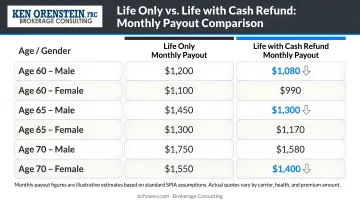
Because the insurer accepts the additional obligation of a potential lump-sum death benefit, monthly payments under a cash refund structure are slightly lower than a straight life annuity. ImmediateAnnuities.com data from May 2026 illustrates this for a $100,000 premium:
| Profile | Life Only (best) | Life with Cash Refund (best) |
|---|---|---|
| Male, age 65 | $685/month | $630/month |
| Female, age 65 | $634/month | $607/month |
That gap — roughly $27–$55/month per $100,000 of premium — is the price of beneficiary protection. For retirees with no surviving dependents, life only may be the better fit. For those wanting to protect a spouse or heirs from an early-death loss, the trade-off is often worth it.
How a Life with Cash Refund Annuity Works
The mechanics are straightforward. You exchange a lump-sum premium for guaranteed monthly payments for life. The insurer tracks cumulative payments made against your original premium.
A Concrete Example
Say you purchase a SPIA with a $150,000 premium:
- Scenario A: You pass away after receiving $90,000 total in payments. Your named beneficiary receives a lump sum of $60,000 — the unrecovered balance.
- Scenario B: You pass away after receiving $180,000 total. You've exceeded your premium, so no refund is owed. Payments would have continued regardless — the insurer honored the lifetime guarantee.
The refund only triggers when death occurs before break-even. After that point, the cash refund provision carries a $0 remaining balance.
What Drives Your Monthly Payment
Once you understand when the refund applies, the next question is: how much will you actually receive each month? Four factors determine your payout:
- Buying at an older age increases your monthly payment — the insurer projects a shorter payment window
- Women typically receive less per month than men of the same age, reflecting longer average life expectancy
- Contracts issued during higher rate environments pay more, since the insurer earns more on your premium
- Premium size affects the rate itself — New York Life notes payouts don't always scale proportionally with the deposit amount
The Social Security Administration reports that the average 65-year-old today will live to age 85, with about 1 in 3 reaching age 90 and 1 in 7 reaching age 95. Those longevity statistics matter: the longer you live, the more the lifetime income guarantee works in your favor.
Built-In Feature vs. Add-On Rider
Cash refund can be structured two ways depending on the contract:
- Built-in: Pre-priced into the contract; the lower monthly income already reflects the cost
- Add-on rider: May carry an explicit fee or a defined reduction in monthly income
Always confirm which structure applies before purchasing. A built-in provision typically means accepting a lower base payout from the start, while a rider may show up as a visible line-item cost — either way, the out-of-pocket impact is real and worth comparing across carriers.
Single Life vs. Joint Life with Cash Refund
Single Life with Cash Refund
Covers one annuitant's lifetime. Because the payout is calculated on one life expectancy, monthly income is higher than joint-life versions. At death — if cumulative payments fall short of the original premium — the named beneficiary receives the balance as a lump sum.
Best suited for single retirees, or married retirees whose spouse has sufficient independent income and doesn't need survivor income from this contract.
Joint Life with Cash Refund
Covers two annuitants, typically spouses. Income continues until both have died. The cash refund provision applies to the combined total: only if payments to both annuitants fall short of the original premium does the beneficiary receive a lump sum.
Monthly payments are lower than single-life because the insurer expects a longer combined payment period. The American Academy of Actuaries illustrates this clearly: a $100,000 premium at age 65 pays roughly $602/month for a male single life, $569 for a female single life, and $522 for a 100% joint-and-survivor couple.
Survivor Payment Options
Joint life contracts typically offer three survivor payment percentages for the surviving spouse:
- 50% — lowest survivor benefit, highest initial monthly income
- 75% — middle ground between income and survivor protection
- 100% — full income continues to the survivor, but initial payments are lowest
Note that the cash refund provision is separate from the survivor benefit — both can apply to the same contract.
Run quotes for both single and joint life structures before deciding. The dollar difference often surprises retirees, and comparing real numbers across carriers makes the choice much clearer. Ken Orenstein at Brokerage Consulting builds side-by-side comparisons across multiple carriers as a standard part of every annuity consultation.
Life with Cash Refund vs. Installment Refund
The installment refund is the closest alternative to the cash refund option. Rather than paying beneficiaries a lump sum at death, the insurer continues making the same periodic payments until the combined total — to you and your beneficiaries — equals your original premium.
Which Pays More Monthly?
The installment refund option typically produces slightly higher monthly income than the cash refund option. The May 2026 ImmediateAnnuities.com data supports this:
| Profile | Cash Refund (best) | Installment Refund (best) |
|---|---|---|
| Male, age 65 | $630/month | $632/month |
| Female, age 65 | $607/month | $620/month |
The gap is small, but the reason makes sense: since the insurer pays beneficiaries over time rather than all at once, they hold the balance longer — and pass a portion of that time-value benefit back as slightly higher monthly payments to you.
How to Choose
| If you need... | Choose... |
|---|---|
| Immediate liquidity for heirs (estate costs, debts) | Cash refund |
| Slightly higher monthly income for yourself | Installment refund |
| A steady income stream for beneficiaries | Installment refund |
| A clean, one-time settlement at death | Cash refund |
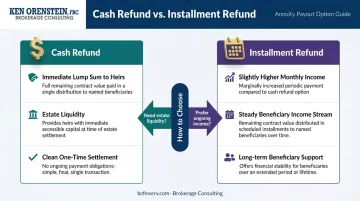
The right choice comes down to one question: does your beneficiary need a lump sum quickly, or would a continuing income stream serve them better?
Tax Implications of Cash Refund Annuity Payouts
Tax treatment hinges on one question: where did the money come from?
Non-Qualified Annuities (After-Tax Dollars)
If you funded the annuity with after-tax money, only the earnings portion of each payment is taxable as ordinary income. The return of your original premium is tax-free, recovered proportionally over the payment period. Per IRS Publication 575, total tax-free recovery cannot exceed your total cost in the contract.
When a beneficiary receives the cash refund lump sum, the taxable portion depends on what has already been returned to you. Consulting a tax professional in advance helps the beneficiary anticipate this liability and plan accordingly — a large lump sum can push them into a higher bracket in the year of receipt.
Qualified Annuities (Pre-Tax Dollars)
If funded through an IRA, 401(k), or other tax-advantaged account with pre-tax contributions, the rules are more straightforward, though less favorable. All distributions, including any lump-sum cash refund paid to beneficiaries, are taxed as ordinary income. There's no basis recovery because no after-tax dollars were contributed.
The Probate Advantage
Beyond taxation, the cash refund structure carries a meaningful estate planning benefit. Cash refund payouts go directly to named beneficiaries. Per Montana State University Extension's estate planning guide, annuity contracts with named beneficiaries generally bypass probate — unlike assets passing through a will. This speeds up fund transfers and simplifies estate settlement. That said, naming errors or estate designations can complicate the process, so review beneficiary designations regularly.
Who Should Consider a Life with Cash Refund Annuity?
Good Candidates
- Retirees who want guaranteed lifetime income but worry about dying before recovering their premium
- Single retirees with children or dependents to protect
- Couples who want both survivor income and a principal safety net
- Federal employees with FERS or CSRS pension income adding a supplemental annuity layer, where the refund feature protects against forfeiting that premium at early death
- Lump-sum recipients from pension buyouts, 401(k) rollovers, or inheritances converting assets to income
When It May NOT Be the Right Fit
- Retirees who want maximum monthly income and have life insurance covering beneficiaries — a straight life annuity pays more
- Those who need liquidity, since SPIAs and DIAs are generally irrevocable once issued
- Retirees with substantial existing death benefits who don't need the premium protection the cash refund provides
Working With an Independent Advisor
Cash refund payout rates vary by carrier, interest rate environment, and individual profile — so getting quotes from multiple insurers is the only way to find the best combination of income and legacy protection.
Ken Orenstein at Brokerage Consulting offers no-cost consultations by phone, virtually, or in person, and runs side-by-side quotes across the immediate annuity market. As an independent broker not tied to a single carrier, he can objectively compare life only, cash refund, and installment refund structures against your actual income goals and legacy priorities. Reach the practice at (888) 315-3608 or bcfinserv.com.
Frequently Asked Questions
What does life with cash refund mean?
Life with cash refund is a payout option on a life annuity that guarantees income for the annuitant's lifetime. If they die before cumulative payments equal their original premium, the remaining balance is paid to a named beneficiary as a single lump sum. Once the annuitant has received payments equal to their premium, no refund is owed at death — but income continues regardless.
What does single life with cash refund mean?
Single life with cash refund covers one annuitant's lifetime only. Because payments are based on a single life expectancy, monthly amounts are higher than joint-life options. Any unrecovered premium at death passes to the named beneficiary as a lump sum.
How does a refund annuity work?
A refund annuity converts a lump-sum premium into guaranteed lifetime income. The key distinction between options is how the remaining balance reaches beneficiaries — as a lump sum under the cash refund option or as continuing payments under the installment refund option.
Who gets the refund under a refund life annuity?
The named beneficiary designated in the annuity contract receives the refund — typically a spouse, child, or other individual selected at purchase. The refund is paid directly to the beneficiary and generally bypasses probate, unlike assets distributed through a will.
How long will a life annuity with installment refund pay?
The annuitant receives payments for life. If they die before recovering their full premium, the beneficiary continues receiving the same installment payments until all payments combined equal the original premium. After that point, payments stop.
How much will a $500,000 annuity pay per month?
Monthly payouts depend on your age, gender, current interest rates, payout structure, and the insurer. Rates vary meaningfully by carrier, so comparing quotes — or working with an independent advisor — is the most reliable way to get an accurate number for your circumstances.