IRC Section 1035 provides exactly that mechanism: a legal, IRS-sanctioned way to exchange one non-qualified annuity for another without triggering a taxable event. This guide covers what the exchange is, who qualifies, how the process works, the tax rules that govern it, and the mistakes that can cost you the tax-free treatment.
One clarification upfront: 1035 exchanges apply specifically to non-qualified contracts — those funded with after-tax dollars outside of any retirement account. If your annuity lives inside an IRA or 401(k), separate rollover rules apply instead.
Key Takeaways
- A 1035 exchange lets you move a non-qualified annuity to a better contract without paying taxes on accumulated gains
- Your original cost basis (after-tax investment) carries over to the new contract
- The transfer must go directly between insurance companies — never through your personal account
- Watch for surrender charges, rider losses, and ownership changes — these are the costliest exchange mistakes
- Form 1099-R with code 6 reports the exchange to the IRS — reportable, but not taxable
What Is a 1035 Exchange for Non-Qualified Annuities?
A non-qualified annuity is a contract purchased with after-tax dollars — funds already taxed and held outside any IRA, 401(k), or 403(b). That distinction matters because qualified accounts have their own rollover rules. Section 1035 applies to the non-qualified world.
IRC Section 1035(a)(3) permits the exchange of "an annuity contract for an annuity contract or for a qualified long-term care insurance contract" without recognizing gain or loss. In plain terms: the accumulated earnings in your old contract remain tax-deferred when they move to the new one. No taxable event occurs.
Why the IRS Allows This
Forcing taxation simply because someone wants to move from one annuity to another — to get a better rate, lower fees, or a different rider — would penalize savers for making smart financial decisions. Congress designed Section 1035 specifically to prevent that outcome.
The core principle: the tax-deferred status of your accumulated earnings travels with the money, not with the contract. Switching carriers or contract types doesn't reset the clock.
What Happens Without a 1035 Exchange
The contrast is significant. If you surrender an annuity outside of a 1035 exchange:
- The full accumulated gain becomes taxable ordinary income in the year of surrender
- IRC Section 72(q) imposes a 10% early withdrawal penalty on the taxable portion if you're under age 59½
- The gain is taxed as ordinary income — not capital gains — per IRS Publication 575
These consequences make a properly structured 1035 exchange worth the effort. Your cost basis (the after-tax dollars you originally invested) carries over intact to the new contract — so you don't lose the tax-free treatment you've already paid for on that principal.
What Qualifies — and What Doesn't — for a 1035 Exchange
Permitted Exchange Combinations
| From | To |
|---|---|
| Life insurance | Life insurance, annuity, or qualified LTCI |
| Endowment contract | Annuity or qualified LTCI |
| Annuity contract | Annuity or qualified LTCI |
| Qualified LTCI | Qualified LTCI |
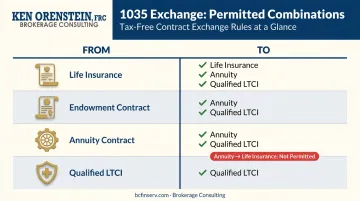
The LTCI path was added by the Pension Protection Act of 2006 and applies to exchanges completed after December 31, 2009.
What Is NOT Permitted
- Exchanging an annuity into a life insurance policy is barred — Treasury Regulation 26 CFR 1.1035-1 makes this a one-way street
- IRA-to-IRA and 401(k)-to-401(k) transfers fall under rollover rules, not Section 1035 — qualified accounts are excluded entirely
- Changing contract ownership disqualifies the exchange — the same contract owner(s) must appear on both the old and new contract
Partial 1035 Exchanges
Not every exchange has to be all-or-nothing. You can move only a portion of an annuity's value into a new contract, leaving the rest in the original. When you do, the cost basis splits proportionally between both contracts.
Per IRS Notice 2003-51, the investment in the contract is divided ratably between the retained and new contract. That split directly determines how future withdrawals from each contract are taxed — making the basis allocation one of the most important numbers to track after a partial exchange.
How a 1035 Exchange Works: Step by Step
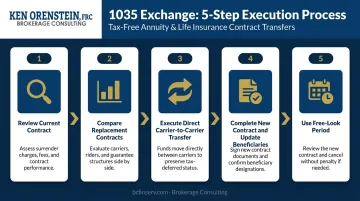
Step 1 — Review your current contract thoroughly
Before anything else, pull your contract and identify:
- Remaining surrender charge period and current penalty percentage
- Any riders (GMIB, GLWB, death benefit) that would be forfeited
- Current accumulation value versus surrender value (they may differ significantly)
Step 2: Compare replacement contracts
Evaluate new contracts for better rates, lower fee structures, or riders that fit your current retirement stage. Run a break-even analysis: how long will it take for gains in the new contract to offset surrender charges on the old one? The SEC notes that variable annuity surrender periods often run 6 to 8 years, sometimes up to 10 years — that window shapes whether a replacement actually makes financial sense.
Step 3: Execute a direct, institution-to-institution transfer
Once you've confirmed the new contract is worth the switch, execution is where most errors occur. The contract owner must never receive a check or have funds pass through a personal account.
Under IRS Rev. Rul. 2007-24, a taxpayer who received a check from one insurer and endorsed it to another did not complete a valid 1035 exchange — the full amount became a taxable distribution. The transfer must go directly from carrier to carrier.
Step 4: Complete the new contract and update beneficiaries
Once the transfer settles, review all new contract documents for accuracy. Update beneficiary designations before filing the paperwork away — it's one of the most commonly skipped steps in any contract replacement.
Step 5: Use the free-look period
Most states require a free-look period of 10 to 30 days on new annuity contracts, during which you can cancel for a full refund. Read every term before this window closes — confirm that the contract you signed reflects exactly what was presented to you.
Important Tax Rules and the Cost Basis Carryover
How the Cost Basis Carries Over
The original investment transfers to the new contract even if the contract's value has declined below that basis.
Example: You invested $100,000 in an annuity (your cost basis). Market performance drops the contract's value to $80,000. If you execute a 1035 exchange at that point, the new contract still carries a $100,000 cost basis — meaning you'll owe taxes on less gain when you eventually withdraw, because the IRS recognizes your full original investment as already-taxed principal.
How the IRS Sees the Transaction
The transferring insurance company issues Form 1099-R with distribution code 6, indicating a Section 1035 exchange. When you receive this form, no immediate tax bill is due — the transaction is reportable but not taxable. It simply documents that the exchange occurred.
Get a tax advisor's assessment before initiating the transfer, since the taxable amount depends on your contract's specific gain position.
When a 1035 Exchange Makes Sense — and When It Doesn't
Strong Candidates for an Exchange
- Locks in higher guaranteed rates by moving an older fixed annuity into a current-market MYGA — capturing growth without triggering taxes on accumulated gains
- Cuts costs on high-fee variable annuities: VAs often carry mortality and expense charges around 1.25% annually (per Morningstar), plus admin fees, sub-account expenses, and rider charges, with all-in costs that can exceed 3% per year. A fixed indexed annuity can significantly reduce that drag
- Adds missing rider coverage — guaranteed lifetime withdrawal benefits, inflation protection, or long-term care riders — when your current contract no longer fits your situation
At Brokerage Consulting, Ken Orenstein regularly conducts variable annuity replacement analyses to evaluate whether older VA contracts, often sold in a different rate environment, should be 1035-exchanged into fixed indexed annuities for lower costs, principal protection, and stronger income riders.
As an independent broker representing multiple top carriers, that analysis covers the full picture: surrender charge schedules, income rider growth rates, and fee structures across competing products.
When an Exchange Likely Doesn't Make Sense
- Surrender charges on your current contract are steep, and the break-even period stretches several years into the future
- Your existing contract carries a high roll-up rate on a GMIB or similar rider that won't be replicated in the new contract — that benefit is gone permanently once you exchange
- You're close to annuitization and transaction costs outweigh any realistic gain
The real question is whether your current annuity still fits who you are today: your income timeline, health situation, and goals for your heirs.
Mistakes That Can Cost You Tax-Free Status
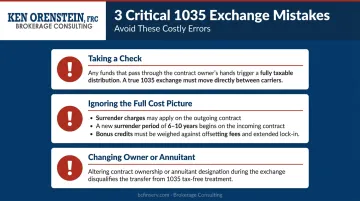
Three mistakes consistently derail otherwise valid exchanges. Each one is avoidable — but only if you know to look for it.
Taking a Check
If the surrender proceeds pass through your hands — even briefly — the IRS treats the entire transaction as a taxable distribution. Rev. Rul. 2007-24 is unambiguous on this point. There are no exceptions. The transfer must be direct, carrier to carrier.
Ignoring the Full Cost Picture
Many owners focus on the tax benefit while overlooking what the exchange actually costs:
- Surrender charges on the outgoing contract
- A new surrender charge period on the incoming contract (potentially another 6–10 years)
- Whether any bonus offered by the new insurer actually offsets those charges after the math is done
Changing the Owner or Annuitant
Treasury Regulation 26 CFR 1.1035-1 requires the same obligee(s) on both contracts. Adding a spouse, removing a co-owner, or any other change to policy ownership disqualifies the transaction from 1035 treatment — and turns it into a taxable event. If an ownership change is necessary, complete the exchange first, then address ownership in a separate step with your advisor.
Frequently Asked Questions
Can you 1035 exchange a non-qualified annuity?
Yes. Non-qualified annuities — funded with after-tax dollars outside of any retirement account — are the primary contract type eligible for a 1035 exchange under IRC §1035(a)(3). Qualified annuities held inside IRAs or 401(k)s do not qualify; those are governed by separate rollover rules.
Can a non-qualified annuity be transferred to an IRA?
No. A non-qualified annuity cannot be rolled into an IRA through a 1035 exchange. The two account types operate under different IRS frameworks — merging them would create tax complications and risk losing the cost basis tracking that protects your already-taxed principal.
What is the difference between a 1035 exchange and a non-1035 exchange?
A 1035 exchange is a direct, tax-free transfer between like annuity contracts where the cost basis carries over and no gain is recognized. A non-1035 exchange — surrendering the old contract and buying a new one — is a taxable event: the owner recognizes the full accumulated gain as ordinary income and may owe the 10% early withdrawal penalty if under age 59½.
What is the 6-month rule for 1035 exchanges?
There is no formal 6-month rule in Section 1035 itself. IRS Rev. Proc. 2011-38 governs partial exchanges and scrutinizes withdrawals taken within the 180-day window after a transfer — amounts pulled too soon may be reclassified as taxable distributions from the original contract. Consult a tax advisor before taking any withdrawals after a partial exchange.
Do you have to pay taxes on a 1035 exchange?
A properly executed 1035 exchange is not a taxable event — accumulated gains remain deferred in the new contract. The transaction is still reportable: the transferring carrier issues Form 1099-R with distribution code 6. Receiving this form does not mean you owe taxes; it confirms the exchange was completed.
What are the biggest risks of doing a 1035 exchange?
Three risks can turn a tax-free exchange into a taxable distribution:
- Losing guaranteed riders on the old contract permanently
- Triggering surrender charges that erode the transfer value
- Disqualifying the exchange by taking possession of funds or changing contract ownership
A full review with a knowledgeable advisor before initiating any transfer can prevent all three.
Ken Orenstein at Brokerage Consulting offers no-cost consultations for clients evaluating whether a 1035 exchange fits their retirement picture. Contact the practice at (888) 315-3608 or visit bcfinserv.com to schedule a phone, virtual, or in-person review.