The short answer is: it depends, and the details matter enormously. Some annuities allow direct borrowing, others can be pledged as collateral for an outside loan, and some — including IRA annuities — prohibit borrowing entirely under federal law. Each path carries distinct tax consequences that can make a seemingly simple solution surprisingly expensive.
This article breaks down how annuity loans actually work, the qualified vs. non-qualified distinction that determines your options, the real risks involved, and when accessing your annuity might actually make sense.
TLDR: Key Takeaways
- True annuity loans (borrow-and-repay) exist only in certain employer-sponsored plans like 403(b)s; most individual contracts don't allow direct borrowing
- For most annuity owners, "borrowing" means a partial withdrawal or collateral-based bank loan; both trigger tax consequences
- IRA annuities cannot be borrowed against — any money out is a taxable distribution
- Pledging a non-qualified annuity as collateral may be treated as a taxable withdrawal by the IRS (IRC Section 72(e)(4)(A))
- Exhaust all other liquid assets before tapping annuity funds
What Is an Annuity Loan?
The term "annuity loan" covers several very different arrangements. Depending on your contract type, it could mean borrowing directly from the annuity (only possible in certain qualified plans), or using your annuity's value as collateral to secure financing from a bank or third-party lender.
The factor that determines which options are available to you — and what the tax consequences look like — is whether your annuity is qualified or non-qualified:
- Qualified annuities sit inside tax-advantaged plans like IRAs, 401(k)s, or 403(b)s — funded with pre-tax dollars and governed by IRS rules under IRC Section 72 and ERISA.
- Non-qualified annuities are purchased individually with after-tax dollars, outside of any employer plan — subject to complex tax treatment, but under a separate set of rules.
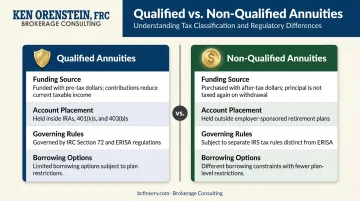
That one distinction drives everything else: which borrowing options exist, what tax treatment applies, and whether early withdrawal penalties come into play.
Two Ways to Borrow Against an Annuity
Two primary methods exist for accessing annuity value before income payments begin. Which one applies to you depends entirely on your contract terms and plan structure.
Direct Borrowing from the Contract
Direct borrowing is available only from certain qualified annuities held inside employer-sponsored retirement plans — most commonly 403(b) plans. This is particularly relevant for teachers, nonprofit employees, public sector workers, and some federal employees who hold annuity products through their workplace retirement plan.
IRS rules for qualified plan loans set clear limits:
- Maximum loan: $50,000 or 50% of your vested account balance, whichever is less
- Repayment term: within five years, with payments made at least quarterly
- Exception: the five-year rule doesn't apply if the loan is used to purchase your primary residence
- Plans must allow loans in their documents — they are not required to offer them
Some non-qualified annuity contracts also allow direct borrowing from the contract's cash value (often up to 50%), but this varies widely by insurer. Review your contract terms before assuming this option exists.
Using Your Annuity as Collateral
For many annuity owners — especially those holding non-qualified deferred annuities — the more accessible route is assigning the annuity as collateral to secure an external bank loan. The annuity stays intact as long as you repay the loan.
The critical tax risk: IRC Section 72(e)(4)(A) treats a collateral assignment of a non-qualified annuity as a taxable event. The IRS may count the pledged portion as a distribution — meaning accumulated gains get taxed as ordinary income. If you're under age 59½, a 10% early withdrawal penalty applies on top of that. Before using your annuity as collateral, confirm the tax consequences with a qualified advisor.
Qualified vs. Non-Qualified Annuities: Tax Rules That Matter
The qualified/non-qualified distinction directly determines how much the IRS takes when you access your money.
Borrowing from a Qualified Annuity
IRA annuities are off-limits entirely. The IRS classifies borrowing from an IRA — or using an IRA as collateral — as a prohibited transaction under IRC Section 4975. The consequence isn't just a penalty; if you engage in a prohibited transaction, the IRS may treat the entire IRA as if it was distributed on January 1st of that year. Every dollar becomes taxable immediately, plus a 10% penalty if you're under 59½.
403(b) plans are the exception. These plans — common among teachers, hospital workers, and nonprofit employees — often include loan provisions and are one of the few places where a genuine borrow-and-repay annuity loan is possible without immediate tax consequences, as long as you follow IRS rules precisely.
Qualified plan loan repayments are made with after-tax dollars, yet that same money gets taxed again as ordinary income when you withdraw it at retirement.
According to Morningstar's analysis of 401(k) loan double-taxation, this effect hits hardest on the interest you pay — not the principal — but it's still a real cost most borrowers underestimate.
Borrowing from a Non-Qualified Annuity
Most individual non-qualified annuity contracts don't include a loan provision at all. A handful of insurers do allow direct borrowing from cash value — and when set up with a clear repayment schedule, it typically doesn't trigger immediate taxes.
Before considering any loan or withdrawal, check your free withdrawal provision first. Most deferred annuity contracts allow you to withdraw up to 10% of the account value per year during the surrender period without triggering surrender charges. According to the NAIC Buyer's Guide for Deferred Annuities, this is the standard across most contracts.
The free withdrawal provision exempts you from surrender charges only. It does not shield your earnings from tax. Under IRS Publication 575, withdrawals taken before the annuity start date are allocated first to earnings (gains) — and those gains are taxable as ordinary income.
Pros and Cons of Borrowing Against an Annuity
Potential Advantages
- Avoids full surrender — a loan keeps the contract intact rather than triggering surrender charges on the entire balance
- May defer immediate tax — a compliant qualified plan loan doesn't create a taxable event while it's outstanding
- Preserves future income — if the loan is repaid in full and on time, the annuity's long-term income potential remains intact
Real Disadvantages
- Loan interest adds to the cost — you're paying interest on top of any tax liability, reducing net benefit
- Lost compound growth — money out of the contract stops growing, which can reduce future income payments or erode a death benefit over time
- Surrender charges can accelerate — most variable annuity contracts carry surrender charge periods of six to ten years, with early charges starting around 7% per the SEC's Variable Annuities guide — a loan default can trigger these fees without warning.
- Collateral assignment tax trap — for non-qualified annuities, the IRS may treat the entire pledge as a taxable distribution regardless of your repayment intent
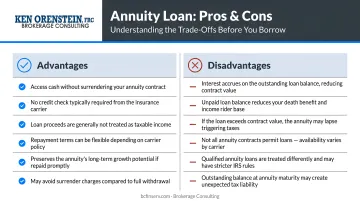
Before deciding, it's worth running the full numbers — loan interest, potential taxes, surrender exposure, and lost growth — against whatever alternative you're comparing it to. The gap is often wider than it first appears.
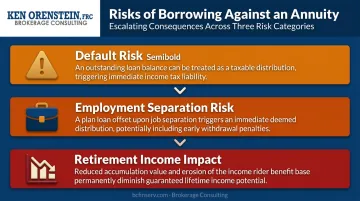
Key Risks of Borrowing Against Your Annuity
Default Risk
If you fail to repay a qualified plan loan on schedule, the outstanding balance becomes a deemed distribution in the year of default. The full amount is taxable as ordinary income, and if you're under 59½, the 10% penalty applies. One often-overlooked detail: a deemed distribution doesn't erase your repayment obligation — you still owe the loan even after paying taxes on it.
For collateral-based loans, the lender can surrender the annuity contract outright to recover the outstanding balance, potentially eliminating the contract's value.
Employment Separation Risk
Federal employees and 403(b) participants face a specific trap: if you leave your job — voluntarily or otherwise — your plan may require immediate full repayment of any outstanding loan balance. Failure to repay triggers a plan loan offset, which the IRS treats as an actual distribution.
You may be able to roll the offset amount into an IRA by your tax filing deadline (including extensions) to avoid the tax hit — but this requires acting quickly and having the cash on hand to fund the rollover.
Impact on Retirement Income
Tapping an annuity's cash value early — even through a loan — shrinks the compounding base and can undercut the income the contract was designed to deliver. Two specific consequences stand out:
- Reduced accumulation value lowers the total amount earning tax-deferred growth over time
- Rider benefit base erosion — for GLWB or GMIB income riders, a smaller accumulation value can reduce the guaranteed benefit base, directly cutting future guaranteed income payments
When Does Borrowing Against an Annuity Make Sense?
Accessing annuity value — by any method — is generally a last resort. It makes the most sense only under these conditions:
- There is a genuine emergency and no other liquid assets are available (savings, taxable brokerage accounts, or a home equity line have already been exhausted)
- You're in a 403(b) or similar qualified plan, the loan is structured within IRS limits, and you're confident you can repay it within five years without risk of job loss or plan termination
- The free withdrawal provision covers the amount you need, and you understand the income tax implications on the earnings portion
When none of these conditions apply, the tax consequences and lost growth make this one of the more expensive ways to access cash. Identifying alternatives first — before touching annuity value — is almost always the better path.
Every annuity contract has different terms, and the tax outcome depends on your age, annuity type, plan structure, and income tax bracket. Ken Orenstein at Brokerage Consulting works with clients across Fixed, Fixed Indexed, Variable, and Deferred Annuities from multiple carriers. The no-cost initial consultation covers free withdrawal provisions, surrender schedules, and alternative strategies — so you understand the full picture before making any decision. Reach out at (888) 315-3608 or through bcfinserv.com.
Frequently Asked Questions
Can you take a loan against a qualified annuity?
It depends on the plan type. 403(b) plans and certain other employer-sponsored qualified plans often allow loans up to $50,000 or 50% of your vested balance. IRA annuities cannot be borrowed against under any circumstances — the IRS treats any money removed as a taxable distribution.
Can I borrow from an IRA annuity?
No. The IRS prohibits loans from IRAs entirely, regardless of whether the IRA holds an annuity. Any money taken out is treated as a distribution subject to income tax and, if you're under 59½, a 10% early withdrawal penalty.
What is the free withdrawal provision in an annuity?
Most deferred annuity contracts allow you to withdraw up to 10% of the account value per year during the surrender period without triggering surrender charges. This is often the least costly way to access funds, though you'll still owe ordinary income tax on the earnings portion withdrawn.
What are the tax consequences of using an annuity as collateral?
The IRS may treat a collateral assignment of a non-qualified annuity as a taxable withdrawal under IRC Section 72(e)(4)(A). Accumulated gains could be taxed as ordinary income, and a 10% penalty may apply if you're under 59½. Because the rules vary by contract and carrier, get written tax guidance from a qualified advisor before proceeding.
What happens if you default on an annuity loan?
For a qualified plan loan, the unpaid balance becomes a taxable distribution in the year of default, triggering income taxes and the 10% early withdrawal penalty (unless an exception applies). For a collateral loan, the lender can surrender the annuity contract to recover the outstanding balance.
Is borrowing against an annuity a good idea?
Rarely, and not as a first option. Tax consequences, surrender charges, and lost compound growth make it an expensive way to access cash. Consider it only when no other liquid resources are available, and after reviewing your specific contract terms with a retirement advisor.