
Introduction
Running out of money in retirement is the fear that keeps most retirees up at night. Both pensions and annuities exist to solve exactly that problem — but they work in fundamentally different ways, and mixing them up can create costly gaps in your retirement plan.
The distinction matters more now than it did a generation ago. According to the Bureau of Labor Statistics' March 2025 data, only 14% of private-sector workers have access to a defined benefit pension — compared to 86% of state and local government workers.
For the vast majority of Americans outside government employment, a pension simply isn't on the table. That makes understanding annuities, and how they compare, critical to building a retirement income plan that lasts as long as you do.
This article breaks down how each instrument works, where they differ, and how to determine which option (or combination) fits your situation — including a close look at federal employees navigating the FERS retirement system.
Key Takeaways
- A pension is employer-funded; an annuity is individually purchased from an insurance company
- Pensions are primarily available to government and federal workers; annuities are available to anyone
- Annuities offer flexibility pensions don't — you can add inflation protection, death benefits, or joint-income riders
- Neither is inherently better — the right choice depends on your existing guaranteed income and what gaps remain
- Most federal employees do best combining both: FERS pension as the base, annuity to cover what's left
Annuity vs. Pension: Quick Comparison
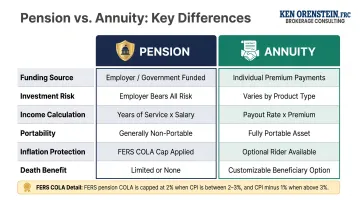
| Feature | Pension | Annuity |
|---|---|---|
| Funding source | Employer-funded | Individually purchased |
| Who bears investment risk | Employer | Insurance carrier (for fixed/FIA types) |
| Income calculation | Formula-based (salary × service years) | Based on premium, age, and payout option |
| Portability | Tied to employer; not transferable | Owned by the individual |
| Inflation protection | Rare in private sector; limited in FERS | Optional riders available (at added cost) |
| Death benefit | Reduced survivor option or none | Customizable — joint-life or lump-sum options |
| Availability | Government/union employees primarily | Anyone with savings to convert |
On inflation protection, the details matter: FERS retirees don't receive cost-of-living adjustments until age 62, and even then, the adjustment is capped when inflation runs above 3%. CSRS retirees receive full CPI-based COLAs at any retirement age — a gap that can cost early retirees thousands in purchasing power over a long retirement.
What Is a Pension?
A pension — formally called a defined benefit (DB) plan — is an employer-sponsored retirement benefit. The employer promises a specific monthly payment at retirement, calculated using a formula. The employer bears all investment risk. The employee doesn't manage any portfolio; they simply receive a payment each month for life.
The Two Main Pension Systems in the U.S.
For most Americans, pensions fall into two categories:
- Private-sector pensions — increasingly rare, covering primarily unionized industries like utilities, transportation, and manufacturing
- Government pensions — federal (FERS and CSRS), state, and local government, where traditional pensions remain the norm
Federal employees hired after January 1, 1987, fall under FERS (Federal Employees Retirement System) — a three-part system combining the FERS Basic Benefit pension, Social Security, and the Thrift Savings Plan (TSP). The pension is one layer, not the whole picture.
Those hired before 1987 fall under CSRS (Civil Service Retirement System), which uses a more generous tiered formula and provides full CPI-based cost-of-living adjustments (COLAs) at any age.
How the FERS Pension Formula Works
The FERS benefit calculation is straightforward:
Multiplier × High-3 Average Salary × Years of Service
| Scenario | Multiplier |
|---|---|
| Under age 62 at separation, OR age 62+ with fewer than 20 years | 1.0% |
| Age 62 or older with 20+ years of service | 1.1% |
Example: A federal employee who retires at 62 with 25 years of service and a high-3 average salary of $85,000 would receive:
1.1% × $85,000 × 25 = $23,375/year ($1,948/month)
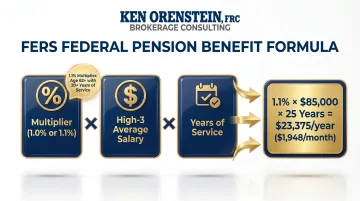
The "high-3" is the highest average basic pay earned over any three consecutive years — typically the final three before retirement.
Key Pension Advantages and Limitations
Advantages:
- Predictable lifetime income requiring no investment decisions
- Employer-funded accumulation — no employee contribution to investment returns
- Survivor benefit options available at election
Limitations:
- No lump-sum access (FERS essentially eliminated this option in 1993)
- No portability if you leave before vesting (5 years minimum under FERS)
- Income is fixed at retirement — cannot be adjusted upward outside COLA provisions
- Shrinking availability in the private sector
That fixed income structure is precisely where annuities enter the picture — offering similar lifetime income guarantees, but with more flexibility in how and when you fund them.
What Is an Annuity?
An annuity is a contract between you and an insurance company. You provide a lump sum (or series of payments), and the insurer guarantees income — either immediately or at a future date. Unlike a pension, you initiate and fund the contract yourself. This means anyone with savings can create pension-like income, regardless of employer.
Annuity Types Relevant to Retirement Income
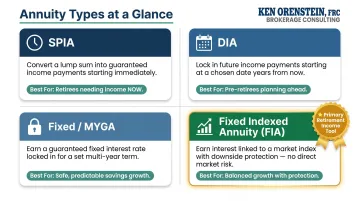
| Type | How It Works | Best For |
|---|---|---|
| SPIA (Single Premium Immediate Annuity) | Lump sum → income begins within 30 days to 1 year | Retirees who need income now |
| Deferred Income Annuity (DIA) | Premium paid today; income activates at a future date | Pre-retirees locking in future income |
| Fixed Annuity / MYGA | Guaranteed interest rate; principal protected | Conservative savers, CD alternatives |
| Fixed Indexed Annuity (FIA) | Interest linked to a market index; principal protected | Growth potential with downside protection |
For most retirees seeking to fill an income gap, FIAs with guaranteed lifetime income riders represent the primary tool — they provide contractually guaranteed monthly income regardless of market conditions, while still allowing participation in index-linked growth during accumulation.
Advantages and Limitations
Advantages:
- Available to anyone, regardless of employer
- Customizable with riders: inflation protection, death benefits, joint-life income, long-term care
- Fills income gaps that Social Security and pensions don't cover
- Tax-deferred growth during accumulation phase
Limitations:
- Surrender charges during early years restrict liquidity — FINRA warns that variable annuities can carry surrender periods of eight years or more, with initial charges around 7%
- Optional riders add annual fees, typically 0.75%–1.50% of the benefit base for guaranteed lifetime withdrawal benefits (GLWBs)
- Product complexity makes side-by-side comparison difficult without guidance
That last point is where an independent advisor earns their value. Because they're not tied to a single carrier, they can conduct formal income rider comparisons (GLWB/GMIB), assess carrier financial strength, and run suitability reviews — matching the annuity structure to the actual income gap rather than defaulting to whatever product is available.
The "Self-Funded Pension" Strategy
For private-sector workers without a pension, a SPIA or FIA with a lifetime income rider can replicate what a pension would have provided. Retirement is fundamentally an income problem, not just an investment problem. The real question isn't how much you've saved — it's how much guaranteed monthly income you'll receive for the rest of your life.
A retiree who rolls a 401(k) or IRA balance into an annuity converts a volatile accumulation account into a predictable monthly paycheck. The insurance carrier assumes the longevity risk, meaning the retiree keeps receiving income even if they outlive the original premium by many years.
Annuity vs. Pension: Which Is Right for You?
Four questions drive this decision:
- What guaranteed income do you already have?
- Does it cover your essential monthly expenses?
- When do you need income to start?
- How much flexibility do you need in retirement?
Start With Your Income Floor
Calculate the total monthly income needed to cover non-negotiable expenses — housing, food, utilities, healthcare. Then compare that against your guaranteed income sources:
Guaranteed income sources to tally:
- Social Security (projected monthly benefit)
- Pension benefit (FERS, CSRS, private-sector, or military)
- Any existing annuity income
The gap between your income floor and your guaranteed income is where annuity planning begins.
Situational Guidance
Once you know your income floor and your gap, your situation will typically fall into one of three categories.
If you have a pension covering essential expenses: An annuity may be unnecessary for basic income security — but it can still serve legacy goals, long-term care planning, or inflation hedging. Federal employees retiring before 62 under FERS face a specific vulnerability: no COLA protection until 62, meaning real purchasing power erodes during those gap years. An inflation-adjusted annuity rider addresses this directly.
If your pension falls short of essential expenses: An annuity fills the gap. Federal employees who retire early under FERS with fewer service years often find the FERS benefit covers less than expected. Supplementing with an FIA or SPIA covers the shortfall without drawing down TSP faster than planned.
If you have no pension: An annuity becomes the primary tool for guaranteed lifetime income. Research from EBRI shows that retirees with guaranteed income streams — pensions or annuities — are significantly more likely to preserve their assets later in retirement. For private-sector workers, an annuity is the closest available substitute for a pension.
Decision Summary
| Your Situation | Recommended Approach |
|---|---|
| Federal/government employee, pension covers core expenses | Rely on pension; evaluate annuity for legacy or inflation hedging |
| Federal employee, FERS pension leaves an income gap | Use annuity to fill the gap; coordinate with TSP distribution strategy |
| Private-sector worker, no pension | Annuity is essential for guaranteed lifetime income |
| Pre-retiree, income needed in 5-10 years | Deferred annuity or FIA with future income activation |
| Recently retired, need income now | SPIA or FIA with immediate income rider |
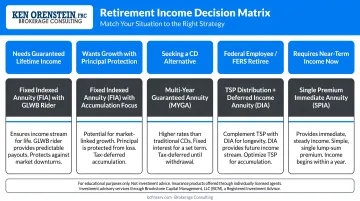
Federal employees face a layered decision — balancing FERS pension, Social Security timing, TSP distributions, and potential annuity purchases at the same time. Ken Orenstein at Brokerage Consulting works through this combined income picture with clients across all four sources, pinpointing gaps and building tax-efficient, guaranteed retirement income strategies. No-cost consultations are available by phone, virtually, or in person.
Conclusion
Pensions and annuities are both guaranteed income instruments — the difference is who builds them. A pension is built by your employer. An annuity is built by you.
Where you land on the annuity-vs-pension question depends largely on your starting point:
- If you have a pension, it forms your income floor. Whether an annuity makes sense on top comes down to whether that floor covers essential expenses — and how exposed you are to inflation risk over a 20-30 year retirement.
- If you don't have a pension — the situation for most private-sector workers — an annuity may be the most direct way to replicate that kind of guaranteed monthly income from your own savings.
The most resilient retirement income plans rarely rely on a single source. Identify your income gap, understand what guaranteed income you already have, and work backward from there to determine whether an annuity belongs in your plan.
Frequently Asked Questions
What is the difference between a pension and an annuity?
A pension is funded by your employer and pays a set monthly benefit based on your salary and years of service. An annuity is a product you purchase from an insurance company that converts your savings into guaranteed income payments. Both provide lifetime income — the source of funding and who initiates them is the key distinction.
Is a pension better than an annuity for retirement?
Neither is universally better. A pension costs the employee nothing and carries no investment risk. An annuity offers flexibility and is available to anyone. Your best move depends on whether you already have guaranteed income and how much of a gap remains between that income and your actual monthly expenses.
Can you have both a pension and an annuity?
Yes. Many retirees — especially federal employees — use both, with the pension forming the income foundation and an annuity filling the gap between the pension benefit and total monthly income needed to cover expenses.
Do federal employees get a pension or an annuity?
Federal employees under FERS receive a defined benefit pension (the FERS Basic Benefit) and may also purchase a private annuity to supplement it. Their full retirement picture typically includes the FERS pension, Social Security, and TSP — with an annuity as an optional fourth layer.
Can you convert a pension into an annuity?
In some cases, a pension lump-sum payout can be rolled into an annuity. However, FERS and CSRS pensions do not offer a general lump-sum distribution, so this conversion path is not available to most federal retirees.
What happens to a pension if you leave your job before retirement?
Under FERS, you vest after five years of creditable civilian service. Leaving before full retirement age typically results in a reduced deferred benefit that starts at a later eligible age — the earlier you separate, the smaller the eventual payment.