
Introduction
Most retirees today face a version of the same math problem: expenses that last 20+ years, Social Security that covers only a fraction of pre-retirement income, and a pension that either doesn't exist or pays far less than expected.
The numbers tell the story plainly. U.S. annuity sales hit $434.1 billion in 2024 — up 13% from 2023's record — because millions of Americans are actively looking for ways to turn savings into income that doesn't run out. Meanwhile, only 14% of private-sector workers still have access to a traditional pension, leaving most retirees entirely responsible for creating their own guaranteed income.
That responsibility is where strategy matters. Owning an annuity isn't the answer on its own — which type, when to purchase, how to fund it, and how it fits your broader income picture determines whether an annuity strengthens your retirement or simply adds complexity.
This guide covers five distinct strategies: immediate annuitization, deferred income with a lifetime withdrawal rider, tax-deferred accumulation, income tax hedging for surviving spouses, and annuity laddering. Each one addresses a specific retirement challenge — understanding the differences helps you find the right fit for your situation.
Key Takeaways
- Annuities create guaranteed income that Social Security and savings accounts alone can't reliably provide
- Five core strategies cover different timelines and tax situations: SPIA, GLWB riders, tax deferral, survivor tax hedging, and laddering
- No single strategy fits everyone — age, marital status, existing income sources, and tax bracket all shape the right choice
- Longevity, market, and inflation risk are the three threats annuities are specifically designed to offset
Why Annuities Are Central to Retirement Income Planning
The traditional retirement income model rested on three sources: Social Security, an employer pension, and personal savings. Two of those three have weakened considerably.
Private-sector pension coverage has collapsed from majority access in the mid-1980s to just 14% of workers today. Social Security pays an average of roughly $1,905 per month for retired workers — and the OASI Trust Fund is projected to cover only 77% of scheduled benefits after 2033 if Congress doesn't act.
That leaves personal savings carrying a much heavier load than the system was designed for.
Annuities directly address three structural risks that savings accounts and investment portfolios can't fully handle on their own:
- Longevity risk — CDC data shows a 65-year-old woman can expect to live another 20.8 years on average. A portfolio has no mechanism for guaranteeing it won't run dry before then.
- Market risk — A significant market decline early in retirement can permanently impair a portfolio's ability to sustain withdrawals. Annuities transfer this risk to the insurance carrier.
- Inflation risk — Fixed expenses feel larger every year as purchasing power erodes. Some annuity structures include cost-of-living adjustments to address this directly.
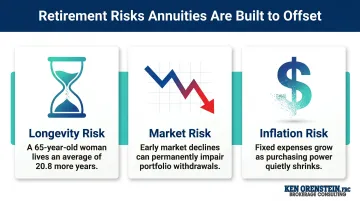
The key distinction: not all annuities address these risks equally. The strategy — which annuity type you use, when you deploy it, and how it fits alongside your other income sources — determines how effectively it closes the gap. That's what the five strategies below break down.
5 Annuity Strategies for Lifetime Income
These five approaches represent the most practical ways to use annuities in retirement planning. Each suits different circumstances, timelines, and income needs.
Strategy 1: Immediate Annuitization (SPIA)
A Single Premium Immediate Annuity (SPIA) is the most direct path from savings to income. You make a lump-sum payment to an insurance carrier and begin receiving guaranteed monthly income — often within 30 days. No accumulation phase, no market exposure, no portfolio management decisions.
Payout structure options include:
- Life-only — Highest monthly payment; stops at death with nothing passing to heirs
- Life with period certain — Payments continue to beneficiaries if you die during the guarantee window (commonly 10 or 20 years)
- Life with cash refund — Beneficiaries receive the unpaid balance of your original premium if you die early
- Joint-life — Payments continue while either spouse is alive, with survivor options typically at 50%, 75%, or 100% of the original amount
The income-versus-protection trade-off is real. Based on late 2024 data from ImmediateAnnuities.com, a 65-year-old male putting $100,000 into a life-only SPIA receives approximately $594/month. Adding a 10-year certain period drops that to roughly $578/month — a modest reduction for meaningful beneficiary protection.
Who this suits best: Retirees who need income to start immediately, those with limited guaranteed income beyond Social Security, and individuals who prioritize predictability over liquidity.
Brokerage Consulting regularly works with clients in this category — particularly those who've received lump-sum distributions from 401(k) rollovers or pension buyouts and need to convert that capital into a reliable paycheck.
Strategy 2: Deferred Annuity with a Guaranteed Lifetime Withdrawal Benefit (GLWB)
A GLWB rider attached to a fixed indexed annuity (FIA) gives you the flexibility a SPIA doesn't. The annuity accumulates during a deferral period, and the rider guarantees a minimum withdrawal amount for life once you activate income — regardless of how the market performs or whether the account value eventually reaches zero.
How the mechanics work:
- During deferral, an income base (separate from your account value) grows at a contractually guaranteed rate — commonly in the 5%–8% range depending on the carrier and product
- When you're ready for income, you withdraw a fixed percentage of that income base annually for life — typically 4%–6% depending on the age at activation
- GLWB rider charges generally run 0.75%–1.50% annually, which reduces the actual account value over time
- Remaining account value passes to beneficiaries at death
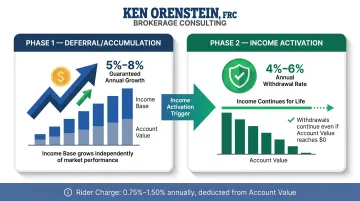
Unlike a SPIA, you keep access to your money during the accumulation phase, subject to surrender charges and free withdrawal limits (typically 10% annually). That flexibility has driven strong adoption: FIA sales hit a record $95.6 billion in 2023 and continued climbing in 2024, reflecting how well this combination of growth potential and guaranteed income resonates with pre-retirees who aren't ready to lock into an immediate income stream.
Who this suits best: Individuals 5–15 years from retirement who want downside protection, a guaranteed income floor, and the ability to delay activation for a larger eventual payout.
Brokerage Consulting's suitability review process evaluates roll-up rates, income rider growth, and carrier financial strength — rated by A.M. Best, Moody's, S&P, and Fitch — before placing any FIA with a GLWB rider.
Strategy 3: Tax Deferral Through Non-Qualified Annuities
Once you've maxed your 401(k) and IRA contributions — $23,500 and $7,000 respectively in 2025 — a non-qualified annuity offers a third bucket for tax-deferred growth with no contribution ceiling.
Non-qualified annuities are funded with after-tax dollars. The earnings compound without annual taxation, unlike a brokerage account where dividends, interest, and capital gains create a tax drag each year. When you eventually withdraw:
- Earnings come out first (LIFO treatment under IRC Section 72) and are taxed as ordinary income
- Principal is returned tax-free, since it was funded with after-tax money
- Early withdrawals before age 59½ trigger a 10% federal penalty on earnings — the same rule as IRAs
This strategy works best for people in their peak earning years who expect to be in a lower bracket in retirement. The tax deferral during the accumulation phase can make a meaningful difference over a 10–20 year horizon, and the after-tax funding means principal is never taxed again.
One important note: Funding a non-qualified annuity with IRA or 401(k) money creates a double tax problem — qualified funds have already been designated for ordinary income tax at withdrawal, so layering them into a non-qualified structure adds complexity without benefit. This is a common mistake Ken Orenstein flags during suitability reviews at Brokerage Consulting.
Strategy 4: Using an Annuity as an Income Tax Hedge
This strategy addresses a specific, often overlooked problem: what happens to a surviving spouse's tax situation when one partner dies.
The shift from married filing jointly to single filer triggers several simultaneous tax increases:
- Tax brackets compress — the 22% bracket for joint filers covers income up to ~$96,950 in 2025; for single filers, it caps at ~$48,475
- Social Security taxation thresholds drop — the threshold for Social Security becoming taxable falls from $32,000 (joint) to $25,000 (single); the 85% taxation threshold drops from $44,000 to $34,000
- One Social Security benefit disappears — when a spouse dies, the household receives only the higher of the two benefits; the lower earner's check stops entirely

The net result: the surviving spouse often pays higher taxes on lower gross income. Annuity income can serve as a stabilizing buffer — guaranteed payments remain fixed regardless of filing status changes, unlike portfolio withdrawals that may need to increase to offset a reduced Social Security benefit.
Non-qualified annuities are particularly useful here. The exclusion ratio means a portion of each payment is a tax-free return of principal, which partially offsets the bracket compression a surviving spouse faces.
Who this suits best: Married couples with a meaningful income gap between spouses, or those relying heavily on dual Social Security income. Federal employees covered under FERS should also factor in how survivor benefit elections at retirement interact with this tax dynamic — something Brokerage Consulting addresses directly in federal retirement consultations.
Strategy 5: Annuity Laddering for Inflation and Income Flexibility
Laddering means purchasing multiple annuities at different points in retirement rather than committing everything to a single contract at once. A simple example: purchase one tranche at 65, another at 70, and a third at 75.
Why the math supports this approach:
| Purchase Age | Male Life-Only Monthly (per $100K) | Increase vs. Age 65 |
|---|---|---|
| 65 | $594 | Baseline |
| 70 | $671 | +13% |
| 75 | $785 | +32% |
Source: ImmediateAnnuities.com, late 2024 data — illustrative rates subject to change
Waiting increases payout rates significantly because life expectancy has shortened. A 75-year-old male receives 32% more monthly income per dollar than the same person would have at 65.
Beyond payout rate improvements, laddering provides:
- Liquidity in early retirement — Not all capital is locked up immediately; remaining assets stay investable
- Interest rate diversification — Each tranche captures the rate environment at a different point in time
- Flexibility to adjust — Health changes, market conditions, or revised income needs can inform later purchases
- Inflation hedging — Some retirees attach cost-of-living adjustment (COLA) riders to individual tranches for additional purchasing power protection

This approach suits retirees with sufficient savings to stage purchases, those uncertain about their income needs in early versus later retirement, and individuals who want to hedge against both early market risk and long-term inflation. Brokerage Consulting incorporates laddering into broader time-segmentation strategies, particularly when coordinating with Social Security claiming decisions.
How to Choose the Right Annuity Strategy
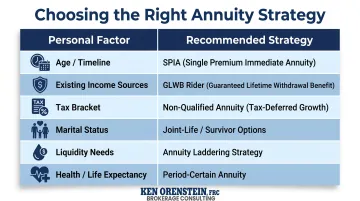
The right strategy — or combination of strategies — depends on factors specific to your situation:
- Current age and retirement timeline — SPIAs suit current retirees; GLWB riders suit those 5–15 years out
- Existing guaranteed income — Those with strong Social Security or a pension may need less annuity income than those starting from zero
- Tax bracket now vs. retirement — Non-qualified annuities make the most sense when current brackets are higher than anticipated retirement brackets
- Marital status — Survivor income needs and bracket compression risks both influence which products make sense
- Liquidity needs — Annuities are long-term commitments; money needed within 5–10 years shouldn't be annuitized
- Health and life expectancy — Shorter life expectancy may favor period-certain structures over life-only payouts
Common Mistakes to Avoid
- Over-annuitizing — Converting too much savings to guaranteed income eliminates the liquidity needed for emergencies, healthcare, or opportunities
- Mismatching funding sources — Using IRA or 401(k) money for non-qualified annuity strategies creates tax inefficiency
- Ignoring survivor needs — Selecting life-only payouts without accounting for a spouse's income requirements
- Skipping carrier analysis — Annuity guarantees are only as strong as the insurer's claims-paying ability; ratings from A.M. Best, Moody's, S&P, and Fitch matter
These variables don't operate in isolation — tax efficiency, Medicare IRMAA thresholds, and survivor planning all interact, which is where sequencing decisions get complicated.
Federal employees carry an added layer: survivor benefit elections at FERS retirement directly affect lifetime income and need to be coordinated with any annuity strategy before decisions are locked in.
Ken Orenstein at Brokerage Consulting works through exactly this kind of multi-factor planning with federal employees, pre-retirees, and seniors. No-cost consultations are available by phone, virtually, or in person.
Conclusion
Few financial tools can do what annuities do: convert a lump sum or accumulated savings into guaranteed income that holds regardless of how long retirement lasts. Whether the goal is immediate income replacement, tax-deferred accumulation, inflation protection, or survivor income stability, one or more of these five strategies can address it directly.
The right starting point is identifying your actual retirement income gap — the difference between what Social Security, pensions, and savings reliably provide and what you need to spend. From there, one or more of these five strategies can fill it.
To build a personalized, low-cost, tax-efficient annuity strategy, contact Brokerage Consulting at (888) 315-3608 or korenstein@brookstoneadvisor.com. Ken Orenstein works with clients across New Jersey and the broader Northeast — and offers no-cost initial consultations for those looking to close their retirement income gap with a clear, actionable plan.
Frequently Asked Questions
How much income does a $100,000 annuity provide per month?
For a 65-year-old purchasing a life-only SPIA with $100,000, late 2024 market data shows approximately $565–$594 per month (female-to-male range). Actual payments vary based on age, payout option selected, prevailing interest rates, and the issuing carrier. A financial advisor can run current quotes across multiple carriers for your specific situation.
Can annuities provide guaranteed lifetime income?
Yes. SPIAs, fixed indexed annuities with GLWB riders, and annuitized deferred contracts all offer income that cannot be outlived. That guarantee is backed by the issuing insurance company's claims-paying ability — making carrier financial strength ratings an important factor at purchase.
What is the difference between a fixed and variable annuity?
A fixed annuity offers a guaranteed interest rate and predictable payments; the insurer bears the investment risk. A variable annuity ties performance to underlying investment sub-accounts, so payments can rise or fall with the market. Fixed indexed annuities (FIAs) sit between the two — growth is linked to a market index but principal is protected from market losses.
Are annuity payments taxable?
It depends on how the annuity was funded. Qualified annuities (funded with pre-tax IRA or 401(k) dollars) are fully taxable as ordinary income at withdrawal. Non-qualified annuities (after-tax dollars) are only taxable on the earnings portion — principal is returned tax-free. A tax advisor can help apply these rules to your specific situation.
What is an annuity surrender period?
Most deferred annuities include a surrender period — typically 5 to 10 years — during which withdrawals above the free withdrawal allowance (commonly 10% annually) trigger a declining charge. Surrender charges typically start at 7%–10% in year one and decrease annually until expiring.
When is the best time to start taking income from an annuity?
Delaying income activation in a deferred annuity generally increases the guaranteed payout, since the income base continues to grow. The right timing depends on your other income sources, tax situation, and cash flow needs. Retirees already facing an income gap may find a SPIA or early rider activation the more practical starting point.