
Introduction
Picture this: you retire at 65 with a $3,500 monthly annuity payment. It covers your mortgage, groceries, utilities, and a modest lifestyle. Feels comfortable. Now fast-forward 15 years — your payment is still $3,500, but prices have risen steadily for a decade and a half. That same $3,500 now buys noticeably less food, pays a fraction of what healthcare costs, and doesn't stretch nearly as far as it once did.
This isn't a hypothetical edge case. The U.S. Department of Labor's 2024 report confirms that retirees living on fixed incomes are particularly vulnerable to purchasing power erosion. According to SSA's 2025 Trustees Report, a 65-year-old woman can expect to live another 21 years — long enough for moderate inflation to steadily erode what a fixed income can actually cover.
Inflation-protected annuities (IPAs) exist specifically to address this problem. This article explains how they work, what they cost, and whether one belongs in your retirement income plan.
Key Takeaways
- An inflation-protected annuity adjusts payments over time to preserve purchasing power as prices rise.
- Adjustments follow one of two structures: CPI-linked (tied to actual inflation) or fixed annual COLA (a set percentage regardless of inflation).
- The trade-off is lower initial payments — historically 25%–30% below comparable fixed annuities, per EBRI research.
- IPAs deliver the most value for retirees with long life expectancies and few other inflation-indexed income sources.
- Federal employees with FERS, CSRS, or Social Security already have partial inflation coverage, so the IPA decision hinges on how much of that gap remains unfilled.
What Is an Inflation-Protected Annuity?
An inflation-protected annuity is an income annuity contract designed to maintain its real purchasing power over time. Unlike a standard fixed annuity, which pays the same dollar amount every month regardless of what happens to prices, an IPA includes a built-in mechanism that adjusts payments upward as the cost of living rises.
The underlying concept is the real rate of return:
Real Rate of Return = Nominal Return − Inflation Rate
A fixed annuity paying $3,000/month has a nominal return. If inflation runs at 3%, the real return is effectively negative. An IPA is designed to keep the real rate positive — or at minimum neutral — over a long retirement.
Which Annuity Types Can Offer Inflation Protection?
Not every annuity structure supports inflation-adjustment features. The primary vehicles are:
- Single Premium Immediate Annuities (SPIAs) — lump sum converts to income immediately, with COLA or CPI-adjustment riders available
- Deferred Income Annuities (DIAs) — income begins at a future date, with inflation-protection features built into some contracts
Variable and fixed indexed annuities offer indirect, partial inflation hedging through market participation. Neither provides the structural guarantee that payments will rise with prices — meaning buyers take on inflation risk that SPIAs and DIAs are specifically built to eliminate.
SPIA sales reached $14.4 billion in 2025 and DIA sales hit $4.8 billion, according to LIMRA's 2025 retail annuity sales release — part of a record $464.1 billion in total U.S. annuity sales that year, a figure that underscores how many retirees are actively seeking guaranteed income structures ahead of extended retirements.
How Inflation Erodes Retirement Purchasing Power
A fixed monthly payment feels stable — until you price groceries, utilities, and medications a decade later. For retirees on fixed income, the gap between what they receive and what things cost widens every year, quietly and without pause.
How $3,500/Month Shrinks Over 20 Years
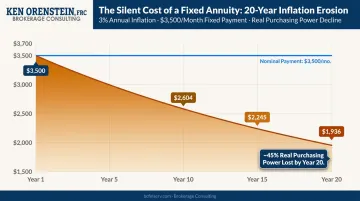
Consider a retiree receiving $3,500/month from a fixed annuity. At a consistent 3% annual inflation rate, here's what that $3,500 is actually worth in real terms over time:
| Year | Nominal Payment | Real Value (3% Inflation) |
|---|---|---|
| 1 | $3,500 | $3,500 |
| 10 | $3,500 | ~$2,604 |
| 15 | $3,500 | ~$2,245 |
| 20 | $3,500 | ~$1,936 |
Note: This is arithmetic based on standard compounding, not a third-party statistic.
By year 20, that payment has lost nearly 45% of its real purchasing power — without a single dollar changing hands. That math applies to any fixed income stream — including federal pensions that many retirees assume are fully protected.
The FERS Inflation Gap
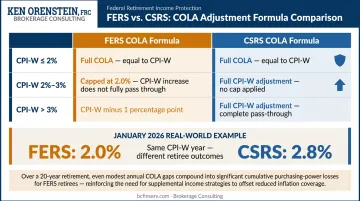
Federal employees often assume their FERS pension provides full inflation protection — but the formula tells a different story. OPM's CSRS/FERS Handbook spells out the formula:
- CPI-W ≤ 2%: FERS COLA equals CPI-W
- CPI-W between 2%–3%: FERS COLA is capped at 2%
- CPI-W > 3%: FERS COLA equals CPI-W minus 1 percentage point
In January 2026, FERS retirees received a 2.0% COLA while CSRS retirees received 2.8% — the difference reflecting FERS's built-in formula gap. CSRS comes closer to full CPI-W protection; FERS does not.
Healthcare Makes It Worse
Healthcare costs don't follow general CPI. According to the HealthView Services 2026 Retirement Healthcare Costs Data Report, medical cost inflation continues to rise at roughly twice the general CPI rate, with a 65-year-old couple retiring in 2026 projected to face 5.8% average annual healthcare cost increases throughout retirement. Medicare Part B alone jumped nearly 10% from 2025 to 2026, climbing from $185.00 to $202.90 per month.
For retirees allocating more income to healthcare in later years, the inflation gap widens precisely when financial reserves are most strained.
How Inflation-Protected Annuity Payments Work
Every IPA contract specifies its adjustment mechanism upfront. Two primary structures exist, and they behave very differently over time.
Mechanism 1: CPI-Linked Adjustments
A CPI-indexed IPA ties annual payment increases directly to changes in the Consumer Price Index. If CPI rises 4% in a given year, your payment rises 4% that year.
Example: A $2,000/month payment at 6% CPI would adjust to $2,120 the following year.
That said, CPI-linked contracts carry important limitations worth reviewing before you sign:
- Most set an annual cap of 3%–5%, above which payments won't increase even if inflation runs higher
- Some apply negative CPI years against future increases, so a deflationary period can reduce your upside in the following year
- A few contracts combine both restrictions, making coverage less comprehensive than the name suggests
Mechanism 2: Fixed COLA Adjustments
A COLA-based IPA increases payments by a fixed percentage chosen at purchase , regardless of what inflation actually does. Nationwide's Income Promise Select, for example, offers COLA options of 1%, 2%, 3%, 4%, or 5% compounded annually.
The compounding matters. A 3% COLA starts small but builds meaningfully over a 20-year retirement. The tradeoff: if actual inflation runs at 6% and your COLA is 3%, you're still falling behind , just more slowly than a fixed annuity would.
That tradeoff raises a practical question: does the COLA protection ever actually pay off?
The Breakeven Question
Whether a COLA annuity ultimately delivers more cumulative income than a level-pay annuity depends on how long you live. Because initial payments are lower, it typically takes roughly 10 years for COLA annuity payments to surpass what a fixed annuity would pay in a given month , and longer still for cumulative lifetime payments to catch up.
This makes life expectancy the central planning variable. A retiree who lives to 90 benefits substantially. One who passes at 75 may not recoup the cost of the inflation protection.
Key Benefits and Trade-Offs
The Core Value Proposition
An IPA offers one thing a standard fixed annuity cannot: a structural guarantee that income will keep pace with rising prices over time. For retirees with 20+ year retirements, no other inflation-indexed income, and significant fixed expenses, that guarantee has real value.
Best-fit candidates:
- Long projected retirement (especially women, given 21-year average life expectancy at 65)
- Limited or no pension COLA
- Social Security not yet claimed, or COLAs not keeping pace with actual spending
- Heavy reliance on guaranteed income rather than portfolio withdrawals
The Real Cost: Lower Starting Payments
The price of inflation protection is lower initial income. An EBRI-hosted analysis found that inflation-protected immediate annuity payments started 25%–30% below comparable fixed annuities in its pricing model. For retirees with pressing cash flow needs early in retirement, that gap is significant.
This gap is the effective "premium" for inflation protection. Whether it makes sense depends on how much longevity risk you're carrying and what other inflation hedges are already in your plan.
Alternatives Worth Considering
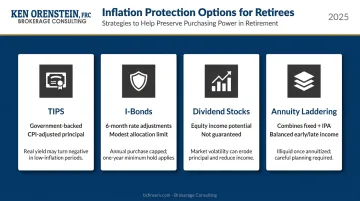
IPAs aren't the only tool for managing inflation risk in retirement:
- TIPS — Treasury Inflation-Protected Securities adjust principal with CPI; TreasuryDirect confirms investors receive the greater of adjusted or original principal at maturity
- I-Bonds — Interest adjusts every 6 months based on inflation; useful for modest allocations
- Dividend-paying stocks — Equity income with growth potential, though not guaranteed
- Annuity laddering — Combining a standard fixed annuity with an IPA can balance early cash flow needs with long-term protection
No single tool covers every scenario. Brokerage Consulting reviews these options together, weighing what inflation protection you already have before recommending where an IPA fits.
Who Should Consider an Inflation-Protected Annuity?
The Strongest Candidates
An IPA makes the most sense when:
- Your retirement is projected to last 20+ years
- You have little or no pension COLA (especially FERS retirees, given the formula gap above 2% CPI)
- Social Security covers only a portion of expenses, and you haven't yet claimed it
- Healthcare costs are a significant budget item and expected to grow
- You want guaranteed income — not market-dependent growth — as your inflation hedge
Who May Need One Less Urgently
CSRS retirees with full CPI-W-linked pension adjustments already have strong inflation protection built in. Retirees with substantial Social Security income have another COLA layer, though even combined, these may not fully cover healthcare inflation.
The real question is whether your existing income sources already provide enough inflation protection to justify accepting a lower starting payment from an IPA.
Mapping Your Federal Income Layers
For federal employees, this analysis requires mapping each income layer — FERS pension COLA formula, Social Security, TSP distributions — against projected spending, with particular attention to healthcare costs in later retirement years.
Ken Orenstein at Brokerage Consulting specializes in this multi-layer income modeling for federal employees and retirees. As a Federal Retirement Consultant (FRC) and author of The Informed Fed: A Survival Guide to Federal Employee Benefits, he works with FERS and CSRS retirees to pinpoint real inflation gaps and determine whether a COLA annuity, CPI-linked SPIA, or laddering strategy closes them most effectively.
Initial consultations are available at no cost by phone, virtually, or in person — reach Ken at (888) 315-3608 or through bcfinserv.com.
Frequently Asked Questions
Are inflation-protected annuities worth the cost?
It depends on life expectancy, existing COLA coverage in other income sources, and how much you value long-term purchasing power over maximizing early income. For retirees with long retirements and limited COLA adjustments elsewhere, they're often worth it.
Do inflation-protected annuities actually exist?
Yes. They're available through insurance carriers, typically as income annuities — SPIAs or DIAs — with either CPI-linked payment adjustments or fixed annual COLA increases (commonly 1%–5%) built into the contract.
Does a standard fixed annuity carry inflation risk?
It does. Payments remain constant while prices rise, so real purchasing power declines every year. This is precisely the problem an IPA is designed to solve.
What is the safest way to keep up with inflation?
No single option is universally safest, but government-backed instruments like TIPS and I-Bonds are low-risk inflation hedges. Inflation-protected annuities add lifetime income guarantees on top of the inflation adjustment — a meaningful distinction for retirees who can't outlive the income need.
How much less do IPAs pay initially compared to fixed annuities?
The gap can be significant — EBRI's analysis found initial payments 25%–30% lower in its pricing example. That gap reflects the insurer pricing in future increases, making early cash flow a key trade-off to weigh.
Can Social Security replace the need for an IPA?
Not fully. Social Security's CPI-W-based COLA understates retiree costs — a CPI-E calculation would have paid 0.5 percentage points more in 2024, and average benefits have lost roughly 20% of buying power since 2010. The shortfall is sharpest in healthcare expenses.