The insurance industry uses "hybrid annuity" as a sales term, not a regulated product category. The SEC, FINRA, and NAIC do not recognize it as a distinct product class. Understanding what's actually in the contract — versus what it's being called — can mean the difference between a retirement income plan that works and one that costs more than it delivers.
This article breaks down what FIAs actually are, why the "hybrid" label exists, and how to evaluate either product on its contractual merits.
Key Takeaways
- FIAs credit interest based on a market index — your principal stays protected if the index drops
- "Hybrid annuity" is a marketing label, not a separate product — typically an FIA with a GLWB income rider added
- Both share the same core features: principal protection, tax-deferred growth, no direct market exposure
- The real differences are in rider fees, income structure, and whether you need guaranteed lifetime income
- Focus on what the contract guarantees — not what the label says
Fixed Indexed Annuity vs. Hybrid Annuity: At a Glance
In most cases, these two products are effectively identical — the table below shows why:
| Feature | Fixed Indexed Annuity | "Hybrid Annuity" |
|---|---|---|
| Regulatory classification | Named insurance product category | Not a formal product class (marketing term) |
| Principal protection | Yes — floor at 0% | Yes — same mechanism |
| Interest crediting | Index-linked with cap/participation/spread | Index-linked — identical base structure |
| Income options | Optional GLWB/income rider | FIA + income rider (this IS the "hybrid") |
| Fees | Rider fees if income rider added | Same rider fees — often 0.95%–1.30%/year |
| Surrender charges | Yes — typically 7–12 year schedule | Yes — same terms |
| Market investment | No direct market exposure | No direct market exposure |
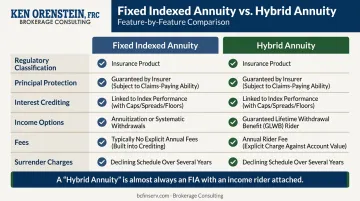
The two columns look nearly identical because a "hybrid annuity" is almost always an FIA — typically one with a guaranteed lifetime withdrawal benefit (GLWB) rider attached.
One less common usage worth noting: some advisors use "hybrid" to describe owning a fixed annuity alongside a variable annuity as a combined strategy. That's a portfolio approach, not a single product. When you see "hybrid annuity" in a sales context, it almost never refers to that portfolio arrangement.
What Is a Fixed Indexed Annuity?
A Fixed Indexed Annuity (FIA) is a state-regulated insurance contract designed to protect your principal while still offering growth potential tied to market performance. Your premium is never invested directly in the stock market. Instead, the insurer credits interest based on how a chosen index performs (the S&P 500, Nasdaq 100, Russell 2000, or proprietary volatility-controlled indexes), subject to specific limits.
How the Floor and Cap Work
The core protection mechanism is straightforward:
- When the index rises: You earn interest, up to the cap or participation limit
- When the index falls or is flat: Credited interest is zero — not negative
- Your principal is never reduced by index performance
As Athene explains, a floor guarantee ensures interest credits are never less than zero, even if the index declines. Unlike variable annuities (where you can lose money) or direct index investing, FIAs won't reduce your principal due to index performance.
Understanding Crediting Method Terms
Three mechanisms limit how much index gain you actually receive:
- Participation rate — You receive a percentage of the index gain. A 70% participation rate on an 8% index return credits 5.6%
- Annual cap — Gains above a set ceiling aren't credited. A 6% cap means you earn 6% even if the index returned 12%
- Spread — A deduction taken before crediting. A 2% spread on an 8% index return produces a 6% credit
These aren't hidden fees — they're how the insurer funds the principal guarantee. The tradeoff is real: you give up some upside in exchange for downside protection.
The Role of Income Riders
FIAs are commonly paired with Guaranteed Lifetime Withdrawal Benefit (GLWB) riders. This is the feature most often marketed as "hybrid."
A GLWB rider maintains a separate income base that grows at a guaranteed roll-up rate during your deferral period, regardless of index performance. Here's how the mechanics work:
- Roll-up rate: The income base grows at a guaranteed rate, commonly 5%, 6%, or 7% annually
- Income base: A separate calculation used solely to determine your lifetime payment — not a lump sum you can withdraw
- Payout: When you're ready to draw income, you receive a set percentage of the accumulated income base as a lifetime annual payment
The income base and your actual account value are distinct figures. The roll-up applies to the income base only.
Tax treatment: FIAs grow tax-deferred. Withdrawals are taxed as ordinary income. Per IRS Publication 575, distributions before age 59½ may also trigger a 10% additional tax on the taxable portion — separate from any surrender charges the insurer imposes.
What Is a "Hybrid Annuity" — And Why the Label Can Mislead You
There is no legal or regulatory definition of a hybrid annuity. The NAIC categorizes annuities as fixed, variable, and indexed. The SEC's investor guidance uses "indexed annuity." FINRA uses "hybrid" only to describe variable annuities as hybrid investments (insurance + securities features) — not as an FIA category.
When an agent calls something a "hybrid annuity," they typically mean one of two things:
- An FIA with an income rider (the vast majority of cases)
- Less commonly, a combined strategy using both a fixed and variable annuity
Sales Pitch Red Flags to Watch For
FINRA warns that indexed annuities are complex products with risks consumers should understand before buying — including the fact that some contracts allow issuers to change caps, participation rates, and fees after issue.
Common "hybrid" sales pitches that warrant scrutiny:
- "Market upside with no downside" — Technically true but incomplete. Caps and participation rates significantly limit the upside you actually receive
- Bonus offers — Allianz Rate Watch notes that bonus annuities often come with higher surrender charges, longer surrender periods, lower caps, or higher spreads
- Complexity as a selling point — when a product requires extensive explanation to justify its costs, that complexity often obscures what you're actually paying
What to Actually Evaluate
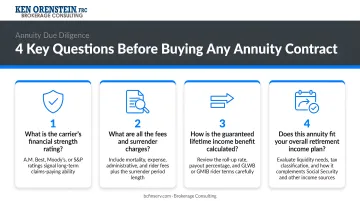
Once you recognize a pitch for what it is, the label stops mattering. Strip it away and ask four direct questions:
- What type of annuity is this — FIA, variable, fixed?
- What riders are attached, and what does each one cost annually?
- What is the surrender period and early withdrawal schedule?
- What does the income guarantee actually pay, and when does it start?
One distinction that catches many buyers off guard: the income account value on an FIA with an income rider is a separate calculation used only to determine lifetime income payments — it cannot be withdrawn as a lump sum. As American Equity notes in its rider disclosures, the income account and the contract value are two different numbers. Knowing which one applies to your situation is the difference between a guaranteed income plan and a misunderstood contract.
Fixed Indexed Annuity vs. Hybrid Annuity: Which Is Right for You?
Since both usually refer to the same base product, the real decision is whether to add an income rider — and whether that rider's cost is worth it for your specific situation.
Choose a Standard FIA (No Income Rider) If:
- Your primary goal is tax-deferred accumulation with principal protection
- You already have sufficient guaranteed income from pensions or Social Security
- You don't want to pay for income guarantees you may not use
- A MYGA offers a comparable rate for your time horizon
Choose an FIA With an Income Rider (the "Hybrid" Structure) If:
- You need a guaranteed income stream starting in 5–15 years
- You want that income base growing at a guaranteed rate during deferral
- You're building a retirement income floor to complement other guaranteed sources
- You're a federal employee layering a third income pillar on top of FERS and Social Security
The Cost Tradeoff
Income riders aren't free. Annual charges are deducted from your accumulation value — the actual account balance — not just the income base. Two real-product examples:
- Allianz 360: 0.95% annual rider charge on accumulation value (can increase, capped at 3%)
- Nationwide Peak 10 Bonus Income+ Rider: 1.00% for single life, 1.30% for joint life
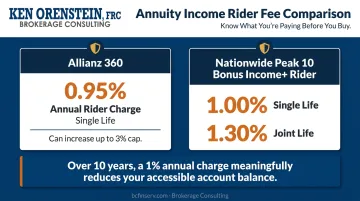
Over a 10-year deferral period, a 1% annual rider charge compounds into a meaningful reduction in your accessible account balance. The income guarantee is is often worth that cost — but you need to see the math for your specific deposit amount and deferral timeline before deciding.
The Federal Employee Case
That cost math matters most when the income guarantee is doing real work — and for FERS employees, it often is. An FIA with a GLWB rider can serve as the third pillar in a structured retirement income plan, sitting alongside your FERS pension and Social Security. The rider continues paying regardless of how long you live, transferring longevity risk directly to the insurance carrier.
Ken Orenstein at Brokerage Consulting works with federal employees to model this structure across multiple carriers — comparing caps, participation rates, income rider growth rates, and surrender schedules for your specific deposit and timeline. No-cost consultations are available at bcfinserv.com or by calling (888) 315-3608.
Conclusion
A fixed indexed annuity and a "hybrid annuity" are, in practice, the same product. The distinction is in how the product is positioned, not what it does. What matters is the contract: what the floor and cap actually deliver, what the income rider costs and pays, when you can access your money, and how all of it fits within your broader retirement income plan.
Three priorities typically determine which product fits your situation:
- Principal protection — critical for anyone who cannot absorb a market loss in the years just before or after retirement
- Income guarantees — essential if you need reliable cash flow beyond what pensions and Social Security provide
- Fee awareness — even a 1% annual charge, sustained over a decade, meaningfully affects what you actually accumulate
No label, whether "hybrid," "indexed," or otherwise, replaces a thorough review of the specific contract terms.
Frequently Asked Questions
Are hybrid annuities worth it?
They can be, for retirees who need both principal protection and a guaranteed income stream. Whether the value holds up depends on the specific rider fees, cap rates, and how the income guarantee fits within your overall retirement income plan — not the product label on the brochure.
What is the difference between a fixed annuity and a fixed indexed annuity?
A fixed annuity credits a guaranteed interest rate for a set period regardless of market conditions. A fixed indexed annuity credits interest based on index performance, up to a cap — offering more growth potential while maintaining the same principal protection.
What is the typical base product for a hybrid annuity?
In most cases, it's a Fixed Indexed Annuity (FIA) paired with a guaranteed lifetime withdrawal benefit (GLWB) rider. The GLWB provides a defined income stream in retirement based on a separately tracked income base — a notional value used to calculate your guaranteed payments, separate from your account's cash value.
Can you lose money in a fixed indexed annuity?
You cannot lose principal due to index performance (your money isn't directly invested in the market). However, early withdrawals may trigger surrender charges, and withdrawals before age 59½ may incur a 10% IRS penalty on the taxable portion.
What fees should I look for in a fixed indexed annuity or hybrid annuity?
The key fees are income rider charges — deducted annually from your account value — administrative charges, and surrender penalties for early withdrawals. All fees must be disclosed in writing before you sign.
Who should consider a fixed indexed annuity for retirement?
FIAs are best suited for conservative to moderate risk savers, typically within 5–15 years of retirement, who want to protect principal from market losses, grow savings tax-deferred, and potentially secure a guaranteed lifetime income stream.