
This matters most for retirees, pre-retirees, and federal employees building retirement income around guaranteed sources. If you're coordinating FERS pension income, Social Security, and TSP distributions, an annuity's payout duration can either reinforce that structure or leave a gap precisely when you need coverage most.
This article breaks down how annuity duration actually works — from payout structures to surrender periods to common misconceptions — so you can make an informed decision before committing.
Key Takeaways
- Annuity duration ranges from 5 years to a lifetime, depending on the payout option selected at purchase
- Fixed-period annuities pay for a set number of years (typically 5–30); lifetime annuities pay until death
- Expect age, gender, health, and interest rates to shape your payment amounts — not just the duration you choose
- Surrender periods (usually 5–10 years) are separate from payout duration — and limit early access to your money
- Choosing the wrong structure can leave you — or your spouse — without income in retirement
What Is Annuity Duration?
Annuity duration refers to the length of time an annuity makes income payments to the annuitant. That duration is determined by the payout option selected when the contract is purchased, regardless of the product type.
One persistent source of confusion: many people conflate duration with the accumulation phase. These are two distinct periods in any deferred annuity's lifecycle:
- Accumulation phase — money grows tax-deferred before payments begin
- Distribution (payout) phase — the annuity makes income payments according to the chosen structure
The NAIC confirms that deferred annuities have both an accumulation period and a payout period, with annuitization options including lifetime income, a specific period, life plus a set period, or joint survivor coverage.
Not all annuities pay for life — and choosing a payout structure without understanding the alternatives can create real income gaps down the road. Once annuitization begins, that choice is generally permanent, which makes understanding your duration options a critical step before signing any contract.
How Long Can an Annuity Last: Payout Structure Options
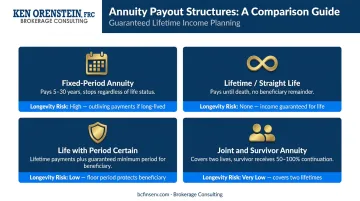
Four primary structures determine how long you'll receive income. The right structure depends on your retirement timeline, marital status, and income needs — so understanding each one before committing matters.
Fixed-Period Annuity
A fixed-period (or period-certain) annuity pays income for a specific number of years — typically 5 to 30 years — regardless of whether you are alive. If you die before the period ends, payments continue to your named beneficiary.
Monthly payment amounts are calculated based on the premium amount and chosen period, not on your age or life expectancy. This makes fixed-period annuities the most predictable in terms of total payout but the most vulnerable to longevity risk. If you outlive the period, payments stop permanently.
Lifetime (Straight Life) Annuity
A lifetime annuity pays income for as long as you live. No matter how long that turns out to be, payments continue — making this the only structure with true longevity protection.
The trade-off: if you die early, payments stop and no remaining balance passes to heirs (unless a death benefit rider is included). According to SSA actuarial data, remaining life expectancy at age 65 is 17.48 years for men and 20.12 years for women — which gives a sense of the statistical payout horizon insurers price against.
Life Annuity with Period Certain
This hybrid structure combines the two above. The annuity pays for your lifetime but also guarantees a minimum number of years of payments. If you die before the guaranteed period ends, your beneficiary receives the remaining payments until the period closes.
Common guaranteed periods run from 5 to 30 years. For example, a life annuity with a 10-year period certain pays for life , but if you die in year 4, your beneficiary receives six more years of payments. You get longevity protection without completely forfeiting the premium if death comes early.
Joint and Survivor Annuity
This option covers two lives (typically spouses) and continues payments to the surviving partner after the first annuitant dies. Survivor continuation options typically include:
- 50% of the original payment
- 66.67% of the original payment
- 75% of the original payment
- 100% of the original payment (full continuation)
Monthly payments are lower than a straight-life annuity because the insurer accounts for a longer combined payout period. For married retirees who need both partners to maintain income security, this structure is often the most appropriate choice. For married clients, Brokerage Consulting reviews joint-life vs. single-life selection as part of the annuity suitability process — since the wrong choice here can leave a surviving spouse significantly underprotected.
Key Factors That Affect How Long Your Annuity Pays Out
Duration is one dimension. The other is how much you receive — and several factors shape both.
Age and Gender
The older you are when payments begin, the shorter your expected lifetime payout period. Insurers use actuarial tables to price payments accordingly, which is why a 70-year-old receives a higher monthly amount than a 60-year-old for the same premium.
Gender also affects lifetime annuity amounts. Because women have statistically longer life expectancies — the SSA's 2022 Period Life Table shows a 2.64-year gap at age 65 — a woman of the same age will typically receive lower monthly payments than a man, since her expected payout period is longer.
Health Status
Pre-existing conditions that reduce life expectancy can shorten the effective payout period of a lifetime annuity, meaning you may collect fewer total payments than the actuarial average. Some insurers offer enhanced or impaired-risk annuities for applicants with documented health conditions. Key features of these products include:
- Higher monthly payments reflecting the insurer's shorter expected payout period
- Eligibility based on documented medical conditions such as diabetes, heart disease, or cancer history
- Underwriting that the Society of Actuaries recognizes as a distinct market segment within income annuities
Interest Rates and Inflation
Higher interest rates at the time of purchase generally produce higher monthly payments. This is especially relevant for deferred annuity holders waiting to annuitize — locking in during a higher-rate environment can meaningfully improve income.
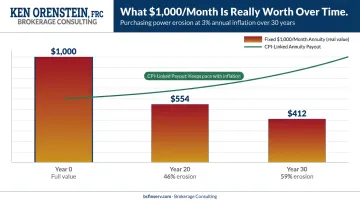
Inflation, however, doesn't change contractual duration — it erodes purchasing power. A fixed $1,000/month payment is worth approximately $554 in real terms after 20 years at 3% annual inflation, and roughly $412 after 30 years. Inflation-adjusted (CPI-linked) payout options exist and raise monthly income annually at the cost of a lower starting payment. For federal employees coordinating annuity income alongside a FERS pension and Social Security, inflation protection structure deserves careful attention — the compounding erosion over a 20-to-30-year retirement is substantial.
The Accumulation Phase and Surrender Periods
Before an annuity makes any payments, most deferred annuities go through an accumulation phase — a period when premiums grow tax-deferred. This phase can last anywhere from a few years to several decades, depending on when you purchase and when you choose to annuitize. It is separate from payout duration.
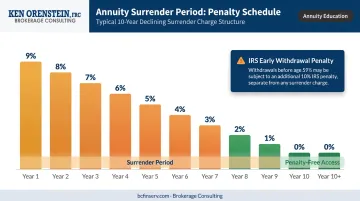
Surrender periods restrict access to your funds for a set number of years after purchase — withdrawals or transfers made before that window closes typically incur penalties. Key facts:
- Surrender periods for variable annuities typically last 6 to 8 years, and sometimes up to 10 years, according to Investor.gov
- Early withdrawals during this period incur surrender charges — often a declining schedule (for example, 9-8-7-6-5-4-3-2-1-0% over 10 years)
- Withdrawals before age 59½ may also trigger an additional 10% IRS penalty on the taxable portion under IRS Publication 575
The 5-year rule for inherited annuities operates on a different timeline entirely. Under IRC Section 72(s), when a non-spouse beneficiary inherits an annuity before the annuity starting date, the entire account balance generally must be distributed within 5 years of the original owner's death.
Beneficiaries can avoid that compressed window by electing to annuitize — spreading payments over their own life expectancy instead. This rule governs inherited contracts only and has no bearing on how long a living owner's annuity pays out.
Common Misconceptions About Annuity Duration
Three misconceptions about annuity duration show up often enough to cause real planning mistakes. Here's what the facts actually look like.
Misconception 1: Fixed-period and lifetime annuities work the same way. They don't. Fixed-period annuities end after the chosen term whether or not you're still alive. Select a 15-year period and live to 90, and payments stop at year 15. Only lifetime income structures — such as life-only or life-with-period-certain payout options — guarantee income you cannot outlive.
Misconception 2: Annuity payments always stop at death. Not true. Period-certain, life-with-period-certain, and joint-and-survivor structures all include provisions that continue or redirect payments to a surviving spouse or named beneficiary. Verifying your beneficiary designation at contract signing — a step many people skip — is what determines whether those provisions actually pay out.
Misconception 3: Your money is locked up for the life of the annuity. Surrender periods are typically limited to the first 5–10 years of the contract. After that window closes, funds can generally be accessed, transferred, or annuitized without surrender penalties — though tax rules still apply.
Conclusion
Annuity duration is a decision you make at purchase — one that shapes your retirement income for decades. The right structure depends on your health, marital status, expected longevity, and how an annuity fits alongside other guaranteed income sources.
For federal employees, that calculation includes coordinating annuity duration with FERS pension payments, Social Security timing, and TSP distribution strategy. Getting one layer wrong can leave gaps that the others can't cover.
That's where Ken Orenstein at Brokerage Consulting can help. He specializes in layered retirement income planning, evaluating payout structures, carrier options, income rider features, and inflation protections across the full annuity market. He offers no-cost initial consultations by phone, virtually, or in person. To get started, visit bcfinserv.com/request-a-quote or call (888) 315-3608.
Frequently Asked Questions
How much does a $100,000 annuity pay every month?
Monthly payouts vary significantly by age, payout type, and prevailing interest rates. Based on May 2026 market data from ImmediateAnnuities.com, a $100,000 single-life immediate annuity pays approximately $623–$685/month for a 65-year-old male and $596–$634/month for a 65-year-old female. A licensed advisor can provide a current personalized quote.
What does a guaranteed period mean on an annuity?
A guaranteed period (also called "period certain") is a minimum number of years during which an annuity will pay out, even if the annuitant dies. If death occurs within that period, remaining payments continue to a named beneficiary until the period ends.
How long does money have to stay in an annuity?
Most deferred annuities have a surrender period — typically 6 to 10 years — during which early withdrawals trigger surrender charges. After that window closes, funds can generally be withdrawn, transferred, or annuitized more freely, though standard tax rules still apply.
What is the 5-year rule for annuities?
The 5-year rule applies to inherited annuities for non-spouse beneficiaries: the full account balance must generally be distributed within 5 years of the original owner's death. The beneficiary may also elect payments spread over their own life expectancy if the contract allows.
Can an annuity run out of money?
Fixed-period annuities do end when the chosen payment period expires — at that point, payments stop. Lifetime annuities cannot be outlived; payments continue regardless of how long the annuitant lives, which is their central value for longevity protection.
What happens to my annuity payments when I die?
It depends on the payout structure: straight-life annuities stop at death, period-certain contracts continue payments to a beneficiary for the remaining guaranteed term, and joint-and-survivor annuities carry on at the agreed percentage for the surviving spouse.