
For retirement savers evaluating whether a B-share fits their situation, understanding how each cost layer works — and how it compares to alternatives — is the foundation for making an informed decision.
Key Takeaways
- B-share variable annuities put 100% of your premium to work immediately, but withdrawals beyond the allowed amount trigger a contingent deferred sales charge (CDSC) during the 6–8 year surrender period
- The mortality and expense (M&E) charge (typically around 1.25% annually) runs for the life of the contract, not just the surrender period
- Most contracts allow penalty-free withdrawals of up to 10%–15% of contract value per year during the surrender period
- B-shares are a widely used traditional VA share class, best suited for long-term savers who won't need significant liquidity within the first 7–8 years
- Withdrawn gains are taxed as ordinary income — not at capital gains rates — and early withdrawals before age 59½ may trigger an additional 10% IRS penalty
What Is a B-Share Variable Annuity?
A variable annuity is a contract with an insurance company that offers investment options tied to market performance, with the contract value fluctuating based on subaccount returns. B-shares are one version of this structure — defined primarily by how distribution costs are handled.
How the Fee Structure Works
With a B-share, 100% of the investor's premium goes to work immediately in the chosen subaccounts (the investment options held within the contract), which typically include mutual fund-like options investing in stocks, bonds, and money market instruments. There is no upfront sales charge deducted from the premium.
The insurance company compensates the selling advisor through a different mechanism: ongoing charges embedded in the contract and a declining surrender fee schedule that applies if the investor withdraws too much too soon. According to the SEC's variable annuity investor guide, surrender charges are generally used to pay the financial professional's commission, with profits from M&E charges also potentially contributing to compensation.
The "B-share" designation, as the SEC's proposed disclosure rule defines it, refers to a contract version that varies primarily based on distribution-related fees and expenses — not the underlying investment options themselves. Understanding this fee structure sets the stage for how the contract operates across its two phases.
Two Contract Phases
B-share variable annuities operate in two phases:
- Accumulation phase — premiums grow tax-deferred inside subaccounts, compounding without annual tax drag
- Payout/annuitization phase — the contract converts to an income stream, either for a specified period or for life
Tax Treatment: A Critical Detail
Investment gains inside a variable annuity accumulate on a tax-deferred basis. Upon withdrawal, however, those gains are taxed as ordinary income — not at lower capital gains rates. The SEC and FINRA both confirm this treatment.
Two tax rules every investor should know before purchasing:
- Ordinary income taxation — all gains withdrawn are taxed at your marginal rate, not the preferential capital gains rate
- Early withdrawal penalty — per IRS Publication 575, distributions before age 59½ may trigger an additional 10% federal tax penalty on the taxable portion
For investors holding appreciated securities in taxable accounts, these rules directly affect the after-tax comparison between a B-share annuity and other investment vehicles — and should factor into any suitability review before purchase.
How B-Share Costs Work: Surrender Charges, M&E, and Free Withdrawals
B-share costs operate in two distinct layers. Understanding which costs are temporary and which are permanent changes the entire economics of long-term ownership.
Surrender Charge Schedule (CDSC)
The contingent deferred sales charge applies when an investor withdraws more than the contractually allowed amount during the surrender period. The SEC's general example illustrates a schedule starting at 7% in year one, declining by one percentage point annually, reaching zero by year eight.
Carrier schedules vary. Transamerica's SEC-filed B-share summary prospectus, for example, uses an 8%, 8%, 7%, 6%, 5%, 4%, 3%, 0% schedule over seven years. These figures represent carrier-specific examples — actual schedules should always be reviewed in the contract prospectus before purchase.
Per Investor.gov, surrender charges typically no longer apply after 6 to 8 years, though some contracts extend to 10 years.
The Permanent Cost: M&E Charge
This is the piece that frequently catches investors off guard. The M&E charge does not disappear when the surrender period ends — it continues for the life of the contract.
SEC and Morningstar benchmark the typical variable annuity M&E at approximately 1.25% annually. On a $100,000 contract held for 20 years, that charge quietly erodes value every year — well past the point when the surrender period ends.
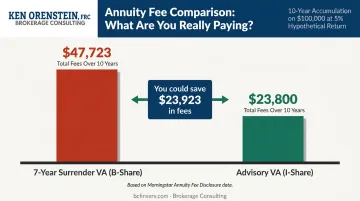
The Morningstar Annuity Fee Disclosure Report puts numbers to the gap: using a $100,000 investment at a 5% hypothetical annual return over 10 years, a 7-year surrender VA accumulated $47,723 in total fees compared to $23,800 for an advisory VA — nearly double. That gap widens further over 15–20 years.
Free Withdrawal Provision
Most B-share contracts include an annual free withdrawal allowance. According to the SEC, contracts often permit withdrawals of 10% or 15% of account value annually without triggering the CDSC.
The word "free" only means no surrender charge applies — it does not mean tax-free. Earnings withdrawn before age 59½ remain subject to the IRS's 10% early withdrawal penalty, regardless of what the contract permits.
Additional Fee Layers
Beyond the M&E and CDSC, variable annuity costs include:
- Subaccount investment management fees, which vary by fund and function like mutual fund expense ratios
- Flat administrative or contract maintenance fees charged annually
- Optional rider fees for GLWBs, GMIBs, and enhanced death benefits — often 1.0%–1.5% on the income base per rider
All-in costs on a variable annuity with riders and actively managed subaccounts can exceed 3% annually. At that level, the investment return needed just to break even — before any real growth — becomes a meaningful hurdle that deserves scrutiny before signing.
B-Share vs. Other Variable Annuity Share Classes
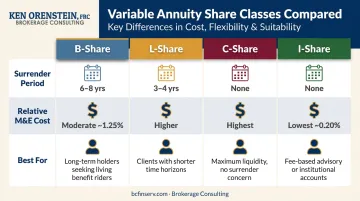
Every share class answers the same question differently: who bears distribution costs, and when? That answer creates a direct trade-off between liquidity and ongoing expense.
| Share Class | Surrender Period | Relative M&E | Best For |
|---|---|---|---|
| B-Share | 6–8 years (typical) | Moderate (benchmark ~1.25%) | Long-term savers, 10+ year horizon |
| L-Share | Shorter (3–4 years typical) | Higher than B-share | Those needing liquidity sooner |
| C-Share | None | Highest | Genuinely unpredictable liquidity needs |
| I-Share | None | Lowest (e.g., 0.20% base) | Fee-based advisory relationships |
L-Shares: Shorter Surrender, Higher Ongoing Cost
Investor.gov confirms that L-shares offer a shorter surrender period in exchange for higher ongoing fees. The trade-off sounds appealing — but an investor who holds an L-share longer than anticipated pays the premium M&E indefinitely. FINRA has taken enforcement action against firms that failed to supervise L-share sales recommendations, specifically citing cases where clients' long time horizons made the higher ongoing costs unjustifiable relative to the shorter surrender period.
C-Shares: No Surrender, Highest Ongoing Cost
C-shares eliminate the surrender period entirely. Withdrawals can be made at any time without a CDSC. The cost: the highest ongoing M&E charges among the share classes. For investors who genuinely cannot predict their liquidity needs, C-shares provide flexibility. For long-term holders who simply want to avoid surrender charges, though, the compounding M&E cost steadily erodes any benefit of that flexibility.
I-Shares: The Advisory Model
I-shares replace the commission model entirely: no CDSC, no standard commission to the selling agent — just a contract with lower base expenses and a separate advisory fee charged directly by the advisor. Transamerica's SEC-filed I-share prospectus shows base contract expenses of 0.20% — roughly 80% below the standard B-share benchmark.
The total cost comparison requires adding that advisory fee as an explicit line item. For many investors, the I-share's lower M&E more than offsets the advisory fee — but that math only holds if the advisory fee is reasonable and the ongoing relationship is active, not passive.
Who Is a B-Share Variable Annuity Best Suited For?
The investor profile B-shares are designed for is fairly specific:
- Time horizon comfortably exceeding the surrender period — ideally 10 or more years
- No near-term liquidity needs beyond the free withdrawal provision
- Priority on having 100% of premium working from day one
- Commission-based advisory relationship, not a fee-based arrangement
Who Should Consider Alternatives
B-shares are not a good fit for:
- Investors with time horizons shorter than the surrender period
- Those who may need substantial liquidity within the first several years
- Anyone already in a fee-based advisory relationship where I-share pricing would likely reduce total cost
- Retirees who need reliable, predictable access to account value for living expenses
Choosing the right share class requires evaluating individual retirement timelines, tax situations, income needs, and existing portfolio composition. At Brokerage Consulting, Ken Orenstein works with clients to compare share class structures across carriers, including whether an older variable annuity contract should be 1035-exchanged into a lower-cost alternative. That review is included in the no-cost initial consultation, offered by phone, virtually, or in person.
Common Misconceptions About B-Share Variable Annuities
"B-Shares Have No Fees"
No upfront sales charge does not mean no costs. B-shares carry ongoing M&E charges, subaccount management fees, administrative charges, and optional rider costs — all of which reduce account value each year. Skipping the front-end load is a structural feature of the contract, not a path to lower overall fees.
"Once the Surrender Period Ends, the Costs Go Away"
The CDSC disappears after the surrender period. The M&E charge does not. An investor who purchases a B-share at age 55 and holds it to age 75 pays the M&E charge for all 20 years.
That compounding cost is substantial. Morningstar fee comparison data shows $23,923 more in fees over just 10 years between a high-cost surrender VA and an advisory VA alternative, on a $100,000 starting investment — and the gap widens considerably by year 20.
"The 10% Free Withdrawal Is Truly Free"
"Free" in this context means the surrender charge doesn't apply — nothing more. Two additional cost considerations remain:
- Earnings withdrawn before age 59½ are still subject to the 10% IRS early withdrawal penalty
- All withdrawn gains are taxed as ordinary income, regardless of age or how long the funds were invested
Frequently Asked Questions
What is a variable annuity series B-share?
A B-share variable annuity invests 100% of the premium immediately with no upfront sales charge. A declining contingent deferred sales charge applies if the investor withdraws beyond the free amount during the surrender period, which typically runs 6–8 years depending on the carrier's schedule.
Who is most suitable for a variable annuity share class B?
B-shares suit long-term retirement savers with a time horizon exceeding the surrender period (generally 10 or more years) who don't expect significant liquidity needs near term. They work best within a commission-based advisory relationship.
Are Class B shares worth anything?
Yes, for the right investor. No upfront charge means 100% of the premium compounds from day one. Long-term holders who stay well past the surrender period typically benefit from lower ongoing M&E charges than C-share or L-share alternatives.
What is a surrender fee for a variable annuity?
A surrender fee (formally the contingent deferred sales charge, or CDSC) is a penalty for withdrawing more than the contractually allowed amount during the surrender period. Per the SEC's general example, the charge typically starts near 7% in year one and declines to zero by schedule's end.
What are Class C shares in a variable annuity?
C-share variable annuities have no surrender charge period, so withdrawals can be made at any time without a CDSC. The trade-off is the highest ongoing M&E charges among standard share classes, persisting for the life of the contract.
What is the typical CDSC of a variable annuity share class L in the first year?
L-share variable annuities offer a shorter surrender period than B-shares (typically 3–4 years) in exchange for higher ongoing M&E charges. The first-year CDSC varies by carrier and contract; review the specific prospectus for the applicable schedule before any purchase or exchange decision.