
Introduction
One of the most common questions people ask when exploring immediate annuities is whether they have an accumulation period. The short answer is no — immediate annuities skip that phase entirely.
Confusing how deferred and immediate annuities are structured can lead retirees to choose the wrong product — or misunderstand what they're buying altogether. That's a costly mistake to make late in the planning process.
This article explains what the accumulation period actually is, why Single Premium Immediate Annuities (SPIAs) skip it, and how that structural difference affects taxes, income timing, and retirement fit.
Federal employees and near-retirees with existing pension income will find this especially relevant when evaluating whether a SPIA belongs in their income plan.
Key Takeaways
- Deferred annuities have an accumulation period; immediate annuities (SPIAs) do not
- A SPIA converts a lump-sum premium into guaranteed income starting within 12 months of purchase
- Income delayed beyond 12 months makes the product a Deferred Income Annuity (DIA), not a SPIA
- For non-qualified SPIAs, only the interest portion of each payment is taxable — not the return of principal
- Federal retirees with FERS or CSRS pensions often use SPIAs as a third income layer on top of Social Security and their pension
What Is the Accumulation Period in an Annuity?
The accumulation period is the growth phase of a deferred annuity contract before income payments begin. During this phase, your contributions build value through interest, investment returns, or compounding. The payout period comes later, once you activate income from what you've accumulated.
Three mechanisms drive growth during accumulation:
- Contributions — either a lump sum upfront or periodic payments over time
- Investment returns — fixed interest, index-linked gains, or variable sub-account performance depending on product type
- Compounding — earnings building on previously earned interest, which accelerates growth over longer accumulation windows
One of the most significant features of this phase is tax treatment. As IRS Publication 575 confirms, commercial annuity earnings are generally not taxed until distributed. That tax deferral is why deferred annuities work well as long-term savings vehicles — gains compound without annual tax drag.
How that growth actually happens, though, depends on the type of deferred annuity you hold.
How Accumulation Differs by Annuity Type
| Annuity Type | How It Grows During Accumulation |
|---|---|
| Fixed Annuity / MYGA | Guaranteed minimum interest rate set by the carrier |
| Fixed Indexed Annuity (FIA) | Interest tied to a market index; principal protected |
| Variable Annuity | Sub-account performance; value fluctuates with markets |
| Deferred Income Annuity (DIA) | Premium locked in today; income activated at a chosen future date |
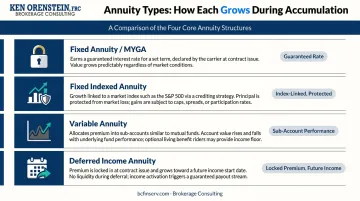
The accumulation period can span anywhere from a few years to several decades, depending on when you choose to begin income.
Do Immediate Annuities Have an Accumulation Period?
No. A SPIA has no traditional accumulation phase.
When you purchase a SPIA, a single lump-sum premium is handed to the insurance company and converted almost immediately into a guaranteed income stream. There's no growth phase to wait through. As FINRA describes, a SPIA is bought with a lump sum and typically begins income within one month to one year of purchase.
The 12-Month Boundary
"Immediate" doesn't mean the next morning. The IRS defines an immediate annuity as a single-premium contract with substantially equal payments starting within 1 year of purchase and paid at least annually. In practice, common income start options include 30 days, 2 months, 3 months, 6 months, 9 months, or up to 12 months from the contract date.
That 12-month mark is also the line between a SPIA and a DIA. Push the income start date beyond 12 months from purchase, and the product is reclassified as a Deferred Income Annuity. Both share the same core mechanics — single premium, guaranteed income — but timing is what separates the two categories.
Why There's No Accumulation Phase
SPIAs aren't designed to grow money. They're designed to transfer longevity risk. When you hand a lump sum to an insurance carrier, the carrier takes on the obligation to pay you for life — even if you outlive actuarial projections.
The insurer prices that risk into the payout rate, not into an accumulation formula.
The Early Withdrawal Tax Penalty Exception
This structure has a meaningful tax consequence. Because SPIAs have no accumulation phase and meet the IRS definition of an immediate annuity contract, distributions qualify for an exception to the 10% additional tax that normally applies to early withdrawals before age 59½.
Per IRS Publication 575, all four of the following conditions must be met:
- Contract is funded with a single premium
- Payments are substantially equal annuity amounts
- Income starts within 1 year of purchase
- Payments are made at least annually
This exception is narrow. A contract that misses even one condition does not qualify.
The Accumulation Period vs. The Payout Period
In a deferred annuity, accumulation and distribution are two sequential phases that happen years apart. The NAIC's Buyer's Guide for Fixed Deferred Annuities describes this clearly: most deferred annuities have an accumulation period where value builds, followed by a payout period when income flows.
A SPIA collapses those two phases into one. Funding and income happen in the same transaction. The payout period begins almost immediately after purchase, with no waiting phase in between.
Payout Structures Available with Immediate Annuities
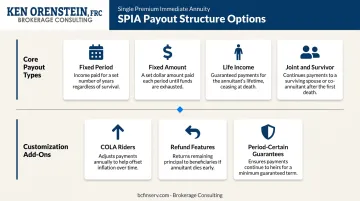
Even without a traditional accumulation phase, SPIAs offer several options for structuring how income is received:
- Fixed Period: Payments made for a set number of years (such as 10 or 20), regardless of whether the annuitant is living
- Fixed Amount: A chosen dollar figure paid periodically until the contract value is exhausted
- Life Income: Payments guaranteed for the annuitant's entire lifetime, no matter how long they live
- Joint and Survivor: Payments continue while either annuitant is living, with survivor percentages typically ranging from 50% to 100% of the original payment
Ken Orenstein at Brokerage Consulting also reviews three additional customization options with clients:
- COLA riders: Inflation-adjusted SPIAs with annual increases of 1%, 2%, 3%, or CPI-linked growth
- Refund features: Cash refund and installment refund options that return unpaid premium to beneficiaries
- Period-certain guarantees: Minimum payout duration protections that apply regardless of how long the annuitant lives
Unique Advantages of Immediate Annuities Without an Accumulation Phase
For the right buyer, skipping the accumulation phase is a deliberate choice — not a gap in the product design.
Predictability and simplicity. No ongoing contributions, no investment decisions, no market monitoring. The payment amount is contractually fixed and deposited on schedule. For retirees who want income without managing it, that reliability is the entire appeal.
Market protection. SPIA payouts don't fluctuate with economic conditions. Retirees who can't afford to wait out a market correction get a payment floor that holds regardless of what markets do. According to a 2025 Allianz Life study, 64% of Americans worry more about running out of money than dying — and guaranteed income directly addresses that fear.
Longevity protection. Life income payout options guarantee payments regardless of how long you live. This transfers longevity risk to the insurance carrier rather than leaving the retiree exposed. The joint and survivor option extends that protection to a spouse.
Tax efficiency for non-qualified SPIAs. When purchased with after-tax dollars, each payment is split between a taxable interest portion and a tax-free return of principal. Per IRS Publication 939, the exclusion ratio — investment in the contract divided by expected return — determines what percentage of each payment is tax-free. This spreads tax liability across the life of the contract rather than concentrating it in a single taxable year.
When Deferred Annuities Make More Sense
A SPIA is the right tool when income is needed now. For anyone still five or more years from retirement, a deferred annuity is usually the better fit: the accumulation period lets tax-deferred compounding build a larger eventual payout than an immediate conversion would produce.
Brokerage Consulting typically works with pre-retirees aged 55–68 for deferred annuity strategies, compared to the SPIA buyer profile of retired clients aged 65–73 who need immediate income replacement.
Key considerations before committing to a long accumulation period:
- Surrender charges typically apply during the first 6–10 years; most contracts allow annual free withdrawals of up to 10% of contract value, though terms vary by carrier
- Liquidity needs must be covered outside the annuity — Ken Orenstein's $250,000 minimum deployable lump sum threshold helps ensure clients don't over-commit illiquid capital
- SPIAs begin payments within 30 days of purchase; deferred structures let clients lock in income riders now and activate them later
- Activation timing is often coordinated with Social Security at 70 or Medicare at 65, depending on the client's income plan
Is an Immediate Annuity the Right Fit for Your Retirement?
The ideal SPIA buyer is someone at or near retirement with a lump sum available — from a 401(k) rollover, pension buyout, inheritance, or retirement account distribution — who wants predictable guaranteed income without managing investments.
For federal employees, SPIAs fit naturally into what Ken Orenstein describes as a multi-layered guaranteed income architecture:
- Layer 1: Social Security (with claiming-strategy optimization)
- Layer 2: FERS or CSRS pension
- Layer 3: Guaranteed lifetime income via annuity (including SPIAs)
- Layer 4: Discretionary portfolio for growth, legacy, and emergencies

OPM confirms that FERS benefits come from three sources — the Basic Benefit Plan, Social Security, and the Thrift Savings Plan. A SPIA at Layer 3 adds guaranteed income on top of those existing sources, covering expenses the base layers don't reach and transferring longevity risk away from the retiree's portfolio.
Whether a SPIA fits that Layer 3 role — or whether a deferred annuity is the better choice — depends on your income needs, tax situation, and timeline. Ken Orenstein at Brokerage Consulting offers no-cost initial consultations, available by phone, virtual, or in-person, specifically for retirees and federal employees navigating these decisions. Reach out at (888) 315-3608 or visit bcfinserv.com to request a consultation.
Frequently Asked Questions
Does an immediate annuity have an accumulation period?
No. SPIAs convert a single lump-sum premium into guaranteed income payments that begin within 12 months of purchase. There's no growth phase. The contract moves directly from funding to payout.
What happens during the accumulation period of an annuity?
During the accumulation period of a deferred annuity, contributions grow through interest, investment returns, and compounding on a tax-deferred basis. This phase ends when the annuitant chooses to begin receiving income.
What is the difference between the accumulation period and the annuity period?
The accumulation period is the pre-income growth phase. The annuity (or payout) period is when the annuitant receives income, either as a lump sum or periodic payments. In deferred annuities, these phases happen in sequence. In SPIAs, only the payout period exists.
How soon do immediate annuity payments begin?
Payments from a SPIA typically begin as soon as 30 days after the contract is issued. The owner can defer the start date up to 12 months; income delayed beyond that window makes the product a Deferred Income Annuity (DIA).
What is the difference between a SPIA and a Deferred Income Annuity (DIA)?
Both are single-premium income products, but a SPIA starts income within 12 months while a DIA delays income to a chosen future date. DIAs are often used for longevity planning, activating income at age 80 or 85.
Are immediate annuity payments taxable?
For non-qualified SPIAs (purchased with after-tax dollars), each payment includes a tax-free return of principal and a taxable interest portion, calculated using the IRS exclusion ratio. Only the interest portion is taxable, distributing the tax burden over each payment received.