
The good news: for most annuity owners who hold to term and stay within their free withdrawal limits, the MVA never comes into play at all. But understanding how it works — before you buy and before you withdraw — is the difference between a smooth retirement income strategy and an unwelcome financial shock.
This article explains what an MVA is, how rising and falling interest rates drive it in opposite directions, when it applies (and when it doesn't), how it interacts with surrender charges, and what steps can reduce your exposure to a negative adjustment.
Key Takeaways
- MVA (Market Value Adjustment) adjusts your withdrawal or surrender value based on interest rate shifts since your contract was issued
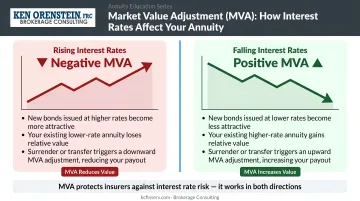
- When rates rise after purchase, the MVA is typically negative (reduces payout); when rates fall, it's typically positive (increases payout)
- MVA applies only during the surrender charge period and only on withdrawals exceeding the free withdrawal allowance
- Surrender charges and MVA are separate mechanisms that can both apply to the same withdrawal at once
- Most contract holders are never affected by the MVA if they hold to term and respect free withdrawal limits
What Is a Market Value Adjustment in a Fixed Annuity?
The MVA is a contractual feature that adjusts what you receive when you withdraw or surrender a fixed annuity early, based on how interest rates have moved since the contract was issued. It is not a fee or a penalty — it's a market-driven adjustment that can work in your favor or against you, depending on rate direction.
When an insurer accepts your premium, they invest it in long-term bonds and similar instruments to fund the guaranteed rates they've promised. Exit early — before those investments mature — and the insurer may need to sell assets at unfavorable prices, especially when rising rates have pushed bond values down. The MVA transfers a portion of that market risk to the contract holder who initiates the early exit.
Which Annuity Types Carry an MVA?
Not every annuity carries this feature. According to the NAIC's Buyer's Guide for Deferred Annuities, the MVA is a product design choice — not a universal characteristic. Products that commonly include it:
- Fixed annuities (including MYGAs — multi-year guaranteed annuities)
- Fixed indexed annuities (FIAs)
Variable annuities generally do not carry this feature because their separate-account structure operates differently. And within the fixed annuity category, some products are specifically marketed without an MVA — so always confirm before purchasing.
The Two-Way Nature of the MVA
This is where many people get the wrong impression. The MVA is not designed solely to benefit the insurer. When interest rates fall after you purchase, the MVA works in your favor — increasing your withdrawal amount and potentially offsetting all or part of any applicable surrender charge. The adjustment runs in both directions, and that two-way design is intentional.
How the MVA Works: The Interest Rate Connection
The MVA formula compares a reference interest rate at the time your contract was issued to that same reference rate at the time of withdrawal. That difference, multiplied by the remaining term of the contract, determines how large the adjustment is and whether it works for or against you. The specific benchmark varies by contract (many use a corporate bond yield index or the insurer's current rate on new premiums), so check your contract documents for the exact index used.
When Rates Rise: Negative MVA
Suppose your annuity was issued when the reference rate was 3.5%, and at the time you request a withdrawal, the rate has climbed to 5.5%. The insurer's existing bond holdings — purchased at 3.5% yields — are now worth less relative to what new money can earn. The MVA reduces your withdrawal to reflect that decline in market value.
Hypothetical example: You request a $50,000 excess withdrawal with a 2-percentage-point rate increase and 4 years remaining in the surrender period. A representative MVA formula might apply something like: (rate change) × (remaining years) = approximately 8% adjustment applied against the withdrawal amount. Your net received would be reduced accordingly, on top of any surrender charge.
Note: Actual formulas vary widely by carrier. North American Company uses formulas such as [(i₀ - iₜ - 0.005) × T], but this is product-specific, not universal.
When Rates Fall: Positive MVA
When the reference rate drops after issuance (say, from 4.0% to 2.5%), the insurer's bond holdings become more valuable in relative terms. The MVA adds value to your withdrawal and, depending on the size of the adjustment, can partially or fully cancel out a surrender charge.
This is one reason MVA-bearing annuities often offer more competitive credited rates than non-MVA products: you're sharing some interest rate risk with the carrier, and they compensate for that with higher rates upfront.
Floors, Ceilings, and State Limits
Contracts include safeguards on both ends:
- Your surrender value cannot drop below the contract's guaranteed minimum (the nonforfeiture floor), no matter how unfavorable the rate environment
- The MVA cannot push your surrender value above your full accumulation value, even when rates move sharply in your favor
- Per Insurance Compact standards, any cap on upward MVA adjustments must be matched by an identical dollar-amount limit on the downside — protections must be symmetric
Beyond these contract-level protections, MVA availability itself varies by state. Some states restrict or prohibit certain MVA structures, so your contract disclosures will specify which rules apply in your jurisdiction.
When Does an MVA Apply — and When Does It Not?
MVA Triggers
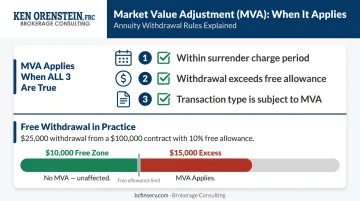
The MVA applies when all three of these conditions are true:
- You are still within the surrender charge period
- You withdraw more than the allowed free withdrawal amount (typically up to 10% of contract value per year, though this varies)
- The specific transaction type is subject to MVA under your contract terms
These conditions cover the most common scenarios: excess withdrawals, full surrenders before the period ends, and annuity transfers or replacements while the surrender period is still active.
When the MVA Does NOT Apply
The MVA generally does not apply:
- After the surrender charge period ends (full contract value becomes available without MVA)
- On withdrawals within the free withdrawal allowance
- At the contract's guaranteed benefit dates (dates specifically defined in the contract when values are accessible without adjustment)
Keep in mind: Whether death benefits, annuitization, or hardship waivers (nursing home confinement, terminal illness) are exempt from the MVA is contract-specific. NAIC Model Regulation #245 notes that MVA may apply to death benefit payments or annuitization if those events occur outside specified guaranteed benefit dates. Do not assume any exemption without reviewing your actual contract language.
The Free Withdrawal Threshold in Practice
The free withdrawal allowance listed above is worth examining more closely, because the MVA only applies to the excess portion of a withdrawal above that threshold — not the entire amount.
Example: You hold a $100,000 contract with a 10% annual free withdrawal provision. You withdraw $25,000 in year 3. The first $10,000 is unaffected. The MVA (and any surrender charge) applies only to the remaining $15,000.
MVA vs. Surrender Charges: How They Work Together
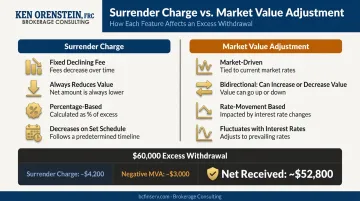
Surrender charges and MVAs are often confused for the same thing — they're not. Each operates through a different mechanism, and understanding the distinction matters when evaluating a withdrawal decision.
| Feature | Surrender Charge | Market Value Adjustment |
|---|---|---|
| What it is | Fixed, declining fee schedule | Market-driven, bidirectional adjustment |
| Direction | Always reduces withdrawal value | Can increase or decrease value |
| Basis | Percentage of excess withdrawal amount | Interest rate movement × remaining term |
| Changes over time | Decreases on a set schedule | Fluctuates with interest rate environment |
Both can apply to the same withdrawal simultaneously.
Say you make a $60,000 excess withdrawal (after the free allowance) in year 3 of a 7-year surrender period. Your contract carries a 7% surrender charge, reducing the amount by $4,200. A negative MVA of roughly 5% — based on a hypothetical rate increase and remaining term — reduces it by an additional $3,000. Net received: approximately $52,800 instead of $60,000.
The reverse is also true. In a falling-rate environment, a positive MVA can partially or fully offset the surrender charge, which is precisely why MVA-bearing annuities tend to carry higher credited rates than comparable non-MVA products. You're accepting rate-movement exposure in exchange for a better guaranteed return from day one.
How to Minimize a Negative MVA
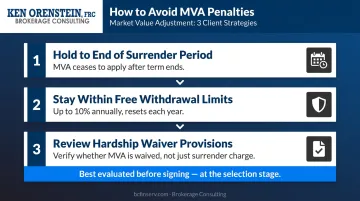
Three strategies address most MVA exposure before it happens:
1. Hold to the end of the surrender period. Once the surrender charge period ends, the MVA typically ceases to apply and your full accumulation value is accessible. If your liquidity timeline matches the contract term, MVA is irrelevant to you.
2. Stay within free withdrawal limits. Most contracts allow up to 10% of contract value per year without triggering a surrender charge or MVA. These limits typically reset annually. Careful planning — particularly for clients coordinating annuity income with TSP distributions, FERS pension, or Social Security — can allow meaningful annual access without crossing the threshold.
3. Check hardship waiver provisions before assuming the worst. Many contracts include waivers for nursing home confinement, terminal illness diagnosis, or disability. However, whether the MVA itself is waived (vs. just the surrender charge) is contract-specific. Review your actual contract language or contact your insurer directly before assuming a waiver covers both.
These three strategies work best when evaluated at the selection stage — before you sign. Ken Orenstein at Brokerage Consulting reviews surrender charge schedules and free withdrawal provisions across competing carriers as part of the annuity advisory process, helping clients match contract structure to their actual liquidity needs. Clients holding existing contracts who want to understand their current MVA terms and withdrawal options can schedule a no-cost consultation at bcfinserv.com or call (888) 315-3608.
Common Misconceptions About Market Value Adjustments
"The MVA is always a penalty against me"
Not accurate. When interest rates fall after your purchase, the MVA increases your withdrawal value. Framing it purely as a penalty misrepresents how the mechanism functions: it works in both directions by design.
"The MVA and the surrender charge are the same thing"
They are separate features with entirely different calculations. A surrender charge is a fixed, predetermined percentage that declines on a set schedule regardless of market conditions. An MVA fluctuates based on interest rate movement and remaining contract term. Confusing them leads to inaccurate expectations about early-exit costs.
"All fixed annuities have an MVA"
Not true. The NAIC consistently uses "some annuities" language when describing MVA — it is not a universal feature. Review your contract terms carefully before assuming an MVA applies.
"The MVA can wipe out my contract value"
Also wrong. Contracts that include an MVA have hard contractual limits: a floor at the guaranteed minimum surrender value prevents catastrophic loss, and a ceiling at the accumulation value prevents windfall gains. The MVA adjusts within a defined range, not without limit.
Conclusion
The MVA is a feature, not a flaw. It allows insurers to offer more competitive credited rates by sharing some interest rate risk with contract holders who choose to exit early. For the majority of annuity owners — those who hold to term and keep withdrawals within free limits — the MVA has no practical effect on their experience.
What creates problems is not the MVA itself but misunderstanding when it applies and how it interacts with surrender charges. Reviewing your contract's MVA formula, reference index, and applicable waivers before purchase — and again before any early withdrawal — is the most direct way to avoid unexpected costs at withdrawal.
If you're evaluating a fixed annuity with an MVA provision and want a plain-language review of how it affects your specific situation, a no-cost consultation with Ken Orenstein at Brokerage Consulting can help you compare contracts and understand the terms before you commit.
Frequently Asked Questions
What does MVA stand for in a fixed annuity?
MVA stands for Market Value Adjustment — a feature in some fixed annuities that adjusts your withdrawal or surrender value based on how interest rates have shifted since the contract was issued. The adjustment can be positive or negative depending on rate direction.
Can an MVA ever increase the amount I receive on withdrawal?
Yes. When interest rates have fallen since you purchased the annuity, the MVA is positive and increases your withdrawal amount. This can partially or fully offset any applicable surrender charge on the same transaction.
Does a Market Value Adjustment apply to free withdrawals?
No — the MVA typically applies only to the portion of a withdrawal that exceeds the free withdrawal allowance specified in your contract (often up to 10% annually). Amounts within the free allowance are unaffected.
What is the difference between an MVA and a surrender charge?
A surrender charge is a fixed, declining percentage fee applied to excess withdrawals during the surrender period. An MVA is a market-driven adjustment that varies based on interest rate movement — it can be positive or negative. Both can apply to the same excess withdrawal simultaneously.
Are all fixed annuities subject to a Market Value Adjustment?
No. MVA is a specific contract feature present in some fixed and fixed indexed annuities, not all of them. Availability also varies by state, and some products are marketed explicitly without an MVA.
How can I avoid a negative Market Value Adjustment?
Hold the annuity through the full surrender period, keep annual withdrawals within the free withdrawal limit, and check whether hardship waivers apply. Always review contract terms before purchasing and before taking any withdrawal.