That's a problem worth understanding. Annuity compensation is embedded in product pricing rather than shown as a line-item charge. Most buyers don't realize they're absorbing the cost — which can influence which products get recommended and why.
This guide breaks down exactly how advisor compensation on annuities works in practice — from upfront commissions to fee-based structures — so you can evaluate any recommendation with full context.
Key Takeaways
- Advisors typically earn a commission paid by the insurance company, not directly by you
- Commission rates vary by product type — fixed annuities are lowest, variable annuities mid-range, and fixed indexed annuities typically highest
- That commission isn't free — it's built into lower credited rates, ongoing fees, and surrender charge periods
- Some advisors operate on a fee-only model and earn no commission on annuity sales
- Understanding how an advisor is paid helps you evaluate whether a recommendation serves your retirement goals or their bottom line
What Are Annuity Commissions?
An annuity commission is a payment made by the insurance company to the financial advisor when a client purchases a contract. The client doesn't write a check for it — but that doesn't mean they aren't paying it.
As the NAIC's producer disclosure puts it plainly: "Commissions are generally paid to Me by the insurance company while fees are generally paid to Me by the consumer." The distinction matters — but both are real costs.
Insurance companies use commissions to motivate advisors to sell their products. Instead of charging the cost separately, they embed it in the product's pricing, fee structure, or credited interest rate. The buyer absorbs it indirectly, whether or not they ever see a commission disclosure.
Two Ways Commissions Get Paid
Commissions typically take one of two forms — or a combination of both:
- Upfront commission — a lump sum paid at the time of sale, calculated as a percentage of the premium invested
- Trail commission — a smaller ongoing payment, usually a fraction of a percent annually, paid as long as the client holds the contract
Not every advisor earns commissions at all. Fee-only advisors charge clients directly for advice and don't accept commissions from insurers. Commission-based and fee-based advisors may earn compensation from product sales — and the structure differs significantly depending on which model they use.
Here's how that plays out in practice: at Brokerage Consulting, Ken Orenstein is compensated through commission paid by the issuing insurance carrier for annuity placements. Clients pay no direct fee for annuity brokerage services. That's separate from investment advisory services through Brookstone Capital Management (BCM), where an ongoing advisory fee based on assets under management applies instead.
How Annuity Commissions Are Structured and Paid
Commissions follow a defined chain: the insurer pays the broker-dealer or agency, which then compensates the individual advisor. Understanding this flow explains why certain products get recommended more than others.
The Upfront Commission Model
With an upfront commission, the insurer pays the advisor a lump sum at the time of sale — a percentage of the premium the client invests. The advisor receives this immediately, regardless of how the annuity performs afterward.
That structure creates a direct incentive: the advisor's financial benefit peaks at the moment of recommendation, before any long-term results appear. The larger the premium and the higher the commission rate, the stronger that pull.
The Trail Commission Model
Trail — or "renewal" — commissions are smaller ongoing payments, typically 0.25% to 1% annually, paid as long as the client holds the contract. This model ties advisor income to the annuity's continued value — a meaningful structural difference from the upfront approach.
Trail commissions are more common in fee-based annuity structures and are sometimes paired with a reduced upfront commission.
The Surrender Charge Connection
Surrender charges — the penalties clients face for early withdrawals — are directly tied to commission levels. The SEC explains that surrender charges "may be used to pay for the cost of selling the annuity, including commissions paid to your financial professional."
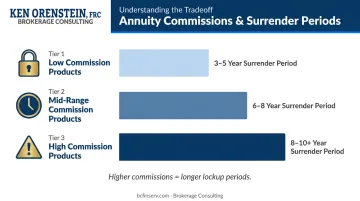
The logic: a higher upfront commission means the insurer needs more time to recoup that payment through the contract's earnings. Longer surrender periods provide that runway. Higher-commission products almost always carry longer surrender schedules as a result:
- Low-commission products: surrender periods of 3–5 years
- Mid-range commission products: surrender periods of 6–8 years
- High-commission products: surrender periods of 8–10 years or longer
Commission Rates by Annuity Type
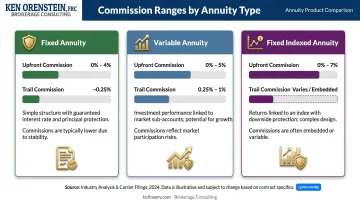
Commission rates are not uniform. They vary by product complexity, surrender period length, and insurer pricing strategy. The ranges below come from public broker-dealer and carrier disclosures — carrier- and broker-specific figures, not universal market standards.
Fixed Annuities
Fixed annuities offer a guaranteed interest rate for a set period, the simplest structure in the annuity category. They typically carry the lowest commission rates.
According to Morgan Stanley's fee and compensation disclosures, fixed annuity advisor commissions generally range from 0% to 4% of invested funds, with trail commissions around 0.25%. Carrier commission schedules reviewed in industry filings show fixed-rate products often falling in the 1.5% to 3.0% range at issue depending on term and age band.
Variable Annuities
Variable annuities link returns to investment sub-accounts, making them more complex to sell and service. Commission structures reflect that complexity.
Morgan Stanley's disclosures show variable annuity commissions generally ranging from 0% to 5% upfront, with trail commissions of 0.25% to 1% of assets annually. On top of that, the SEC notes that mortality and expense (M&E) charges are often around 1.25% per year of account value — a portion of which can flow back to advisor compensation.
Fixed Indexed Annuities (FIAs)
FIAs link returns to a market index like the S&P 500 while protecting against losses, making them a popular middle-ground product. They've recorded five consecutive years of sales growth, reaching $127.9 billion in 2025.
Commission rates on FIAs tend to run higher than other fixed products. Morgan Stanley's indexed annuity disclosures show commissions generally running 0% to 5%, while some carrier schedules show at-issue rates of 5% to 7% for certain products and age bands.
Unlike variable annuities, FIAs carry no visible upfront sales load. Compensation is built into the product's cap rates, participation rates, or spread margins rather than charged as a separate line item — which is why independent carrier comparison matters more than it might appear.
Because these costs are embedded rather than disclosed as a fee, working with an independent advisor who compares multiple carriers is the most direct way to ensure the product structure actually serves your income goals. At Brokerage Consulting, Ken Orenstein evaluates income riders, caps, participation rates, and surrender schedules across carriers before making any recommendation.
Quick reference: commission ranges by annuity type
| Annuity Type | Upfront Commission | Trail Commission |
|---|---|---|
| Fixed Annuity | 0% – 4% (typically 1.5%–3%) | ~0.25% annually |
| Variable Annuity | 0% – 5% | 0.25% – 1% annually |
| Fixed Indexed Annuity | 0% – 7% (varies by carrier/age) | Varies; often embedded |
Source: Morgan Stanley fee and compensation disclosures; industry carrier filings.
How Advisor Pay Affects What You Actually Receive
Commissions don't appear as named charges on annuity contracts. But they're factored into product design from the start — insurers set interest rates, fee schedules, and product features with commission payouts already built in.
Here's how that shows up by product type:
- Fixed annuities — a slightly lower credited interest rate compared to what a no-commission equivalent might offer
- Variable annuities — higher M&E charges and fund-level fees that compound annually over the life of the contract
- Fixed indexed annuities — tighter caps, lower participation rates, or wider spreads that reduce the index-linked returns credited to the account
- All types — surrender charge schedules designed to protect the insurer's ability to recoup the upfront advisor payout
These embedded costs don't disqualify annuities as a retirement tool. A well-matched annuity's guarantees, income features, and tax-deferral benefits often deliver real value once you account for compensation costs. What matters is knowing exactly where the cost is hiding — and whether the features you're getting justify it.
Commission-Based vs. Fee-Based Advisors: Making an Informed Choice
Two Compensation Models
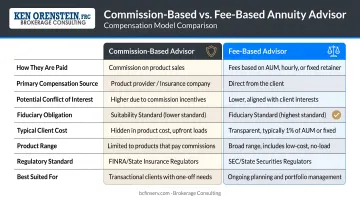
Commission-based advisors earn their pay from the insurance company at the point of sale. No direct fee appears on the client's statement, but the cost is embedded in the product. This is the standard model for most annuity sales.
Fee-based or fee-only advisors charge the client directly — typically as a percentage of assets under management or a flat advisory fee. Annuities purchased through fee-based advisory accounts typically don't pay commissions to the advisor; compensation comes from the advisory fee charged to the account instead.
Fee-based annuity sales are growing. InvestmentNews reported, citing LIMRA data, that fee-based variable annuity sales rose 21% year over year in Q1 2025, driven partly by broader RIA channel adoption. That trend makes transparency more important than ever — knowing which model your advisor uses shapes every question you should ask before signing.
What to Ask Before Buying
When evaluating any annuity recommendation, ask these questions directly:
- How are you compensated for this recommendation?
- What is the commission rate or advisory fee on this product?
- How long is the surrender period, and what are the penalties?
- Are there ongoing fees embedded in the product — M&E charges, rider fees, administrative fees?
- Is this annuity on a preferred or proprietary product list?
The Brokerage Consulting Approach
At Brokerage Consulting, Ken Orenstein's compensation on annuity placements comes through commission paid by the issuing insurance carrier — clients pay no direct fee for annuity brokerage services. The practice's website discloses this clearly: "Fiduciary duty extends solely to investment advisory advice and does not extend to other activities such as insurance or broker dealer services."
That distinction matters. Investment advisory work delivered through Brookstone Capital Management (BCM) operates under fiduciary obligation with an AUM-based fee. Annuity and insurance placements are commission-based — a regulatory reality that Ken Orenstein discloses upfront before any product recommendation.
As an independent broker representing carriers including Aetna, Humana, and TransAmerica, every annuity review includes:
- Carrier financial-strength analysis
- Income rider comparisons (GLWB/GMIB)
- 1035 exchange analysis for existing annuity holders
- Full suitability review before any product recommendation
No-cost initial consultations are available by phone, virtually, or in person.
Frequently Asked Questions
How much do advisors get paid on annuities?
Commission rates vary by product type. Fixed annuities typically run in the 1.5% to 4% range; variable annuities run 0% to 5% upfront plus ongoing trails and product charges; fixed indexed annuities can run 0% to 7% at issue depending on the carrier and product. Fee-only advisors earn no commission at all.
Are annuity commissions bad for investors?
Commissions aren't inherently harmful, but they do create a potential conflict of interest. The real question is whether the recommended product genuinely fits your situation. Understanding how your advisor is paid helps you evaluate that objectively.
What is the difference between a commission-based and fee-based annuity advisor?
Commission-based advisors are paid by the insurer at the point of sale — the cost is embedded in the product. Fee-based advisors charge the client an ongoing advisory fee instead, typically deducted directly from the account. The difference affects both advisor incentives and how costs appear over time.
Do financial advisors have to disclose their annuity commissions?
Disclosure requirements vary by advisor type. Broker-dealers follow FINRA suitability rules or Regulation Best Interest; RIAs carry a fiduciary duty under the Advisers Act; and NAIC Model #275 requires producers to disclose compensation sources and, upon request, a reasonable commission estimate. Always ask for written disclosure before buying.
Can I buy an annuity without paying a commission?
Yes. No-load annuities exist and are sold without advisor commissions — products like Fidelity's FPRA carry no surrender charges and an annual fee of 0.25% below $1M. These are typically accessed through fee-only advisors who charge separately for advice rather than earning product-based compensation.
What questions should I ask a financial advisor about annuity compensation before buying?
Before buying, get written answers to these questions:
- How are you compensated on this product?
- What is the commission or fee rate?
- How long does the surrender period last?
- What fees are embedded in the contract?
- Is this product on a preferred or proprietary list?