
Choosing the wrong one carries real consequences. Pick a SPIA too early and you forfeit years of tax-deferred growth while locking away liquidity you may still need. Wait too long and you delay guaranteed income at the moment you need it most. According to LIMRA, only 47% of working adults aged 50–75 believe they'll cover basic living expenses with guaranteed income in retirement — an 11-percentage-point drop from 2017. The stakes are high.
This article breaks down both products — definitions, mechanics, a side-by-side comparison, and situational guidance — so you can walk into any advisor conversation with clarity.
Key Takeaways
- FIA = accumulation-focused, tax-deferred growth linked to a market index, with downside protection — best used before or during early retirement
- SPIA = income-focused, converts a lump sum into guaranteed payments that begin almost immediately — best used at or in retirement
- FIAs offer growth potential and flexibility; SPIAs offer simplicity and lifetime income certainty — with one key trade-off: SPIAs are generally irrevocable once issued
- Neither product is directly invested in the stock market; both are backed by the claims-paying ability of the issuing insurer
- Some retirees use both — FIA during accumulation, SPIA at income start
FIA vs. SPIA: At a Glance
| Feature | Fixed Index Annuity (FIA) | Single Premium Immediate Annuity (SPIA) |
|---|---|---|
| Primary Purpose | Accumulation / deferred growth | Income distribution / immediate paycheck |
| When Payments Begin | Deferred — years after purchase | Within 30 days to 12 months of purchase |
| Growth Mechanism | Interest linked to market index (e.g., S&P 500) | No growth — premium exchanged for income stream |
| Principal Protection | Yes — floor typically 0% | N/A — principal surrendered at purchase |
| Liquidity / Access | Free withdrawals (often 10%/year); surrender charges apply | Generally irrevocable once payments begin |
| Contract Length | Long-term (often 7–10 year surrender period) | Immediate; payments begin right away |
| Tax Treatment | Tax-deferred growth; taxed on withdrawal | Partially or fully taxable depending on funding source |
| Best Suited For | Pre-retirees and early retirees building assets | Retirees needing guaranteed income now |
This table is a starting framework. Caps, participation rates, payout options, and contract terms vary significantly across insurers — always review a specific contract with a licensed advisor before committing.
FIAs and SPIAs are not mutually exclusive. A sequencing strategy — using a FIA to grow assets during accumulation years, then converting a portion to a SPIA when income is needed — is a legitimate approach explored later in this article.
What Is a Fixed Index Annuity (FIA)?
As defined by the NAIC, a Fixed Index Annuity is a type of fixed annuity where interest is credited based on changes in an external market index — such as the S&P 500 — rather than a fixed rate. Critically, the buyer is not directly invested in the market or the index. The insurer uses index performance as a crediting benchmark only.
How the Crediting Mechanics Work
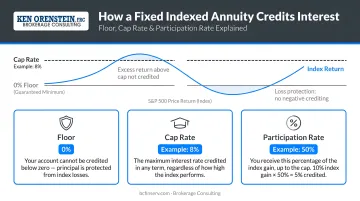
Three terms define how interest is calculated:
- Floor — typically 0%, meaning the account cannot lose value due to poor index performance
- Cap rate — the maximum interest the contract will earn in a given period (e.g., 6%)
- Participation rate — the percentage of index gains applied to the account (e.g., 65%)
A simple example: if the S&P 500 rises 10% and the cap is 6%, the account is credited 6%. If the index falls 5%, the account is credited 0% — no loss, but no gain either. That trade-off — accepting a ceiling on gains in exchange for a floor on losses — is what distinguishes FIAs from both direct market investing and traditional fixed annuities.
Accumulation, Income, and Riders
During the accumulation phase, earnings grow tax-deferred inside the contract. FIAs typically carry surrender charge periods — commonly ranging from 7 to 10 years — during which early withdrawals beyond the free withdrawal amount trigger penalties. Most contracts allow free withdrawals of roughly 10% of account value per year after year one.
At the end of the surrender period, the owner can annuitize, take withdrawals, or activate an optional income rider. These Guaranteed Lifetime Withdrawal Benefit (GLWB) or Guaranteed Minimum Income Benefit (GMIB) riders provide predictable lifetime income without fully surrendering the contract. Rider fees typically run around 1.0%–1.5% annually on the income base — a cost worth evaluating against the guarantee it provides.
Who FIAs Are Best Suited For
FIAs work well for:
- Pre-retirees or early retirees (roughly ages 50–68) who want market-linked growth with principal protection
- Individuals rolling over a 401(k) or IRA who want continued tax deferral with income options
- Those building a "safe-money bucket" within a diversified retirement portfolio
- Federal employees transitioning to retirement who want a FIA to complement — not replace — their existing TSP fund structure
What Is a Single Premium Immediate Annuity (SPIA)?
A SPIA is the most direct form of converting savings into retirement income. The annuitant pays a one-time lump sum to an insurance company in exchange for guaranteed periodic payments that begin almost immediately — within one year of purchase, often within 30 days.
How Payouts Are Calculated
The insurer determines payment amounts based on:
- Premium amount — larger premiums produce larger payments
- Annuitant's age and gender — older buyers typically receive higher payments
- Chosen payout structure — life only, joint life, period certain, etc.
- Prevailing interest rates — higher rate environments generally produce more favorable payouts
Payout Structure Options
| Structure | Description | Key Trade-Off |
|---|---|---|
| Life Only | Highest payout; stops at death | No residual value for heirs |
| Life with Period Certain | Payments guaranteed for minimum period (e.g., 10 or 20 years) | Lower payout than life-only |
| Joint and Survivor | Continues to surviving spouse | Lower initial payment |
| Cash/Installment Refund | Returns unpaid premium balance to beneficiaries | Reduced monthly income |
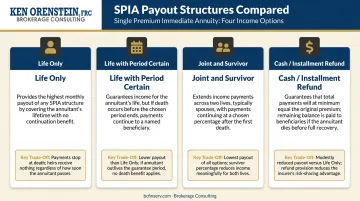
Once a payout structure is selected and payments begin, it cannot be changed. This irrevocability is the central trade-off of a SPIA.
Tax Treatment
- Non-qualified (after-tax) money — only the earnings portion is taxable; the return of principal is tax-free, calculated via the exclusion ratio under IRS Publication 939
- Qualified money (IRA, 401(k)) — the full payment is taxable as ordinary income, since contributions were never taxed
When the Irrevocability Trade-Off Makes Sense
A SPIA's lack of liquidity is acceptable when:
- The annuitant is in stable health with a longer life expectancy
- There is a clear, ongoing income gap to fill
- Simplicity and predictability are priorities
The calculus shifts when liquidity may be needed, longevity is uncertain, or leaving assets to heirs matters. In those cases, structure selection becomes critical: period-certain and cash refund options can preserve some legacy value at the cost of a lower monthly payment.
Who SPIAs Are Best Suited For
SPIAs fit retirees already in the distribution phase (ages 65+) with an identifiable income gap. Common scenarios include replacing employment income at retirement, supplementing Social Security, or converting a pension buyout lump sum into guaranteed income.
Pension lump-sum decisions are a recurring focus at Brokerage Consulting. Ken Orenstein works through the key trade-offs with clients: joint-life versus single-life payout elections, COLA rider costs, and whether a SPIA can replicate pension-style income for those who took the lump sum route.
FIA vs. SPIA: Key Differences That Matter
Income Timing and Purpose
This is the foundational distinction. FIAs are built for deferred accumulation — you're growing a retirement asset over many years before income is needed. SPIAs are built for immediate distribution — you're converting an existing lump sum into income right now. This single difference should shape which product a buyer considers first.
Growth Potential vs. Income Certainty
FIAs offer the possibility of market-linked gains (subject to caps and participation rates) along with downside protection — the account value can grow meaningfully over time. SPIAs offer no account value or growth; the premium is exchanged for an income stream.
SPIAs do deliver something FIAs with income riders can't always replicate: complete certainty about payment amounts from day one, with no crediting calculations, no rider fees, and no ongoing management required.
Liquidity and Flexibility
- FIA — free withdrawals typically available (often 10%/year after year one); income start dates can be adjusted; contract features can evolve with life circumstances
- SPIA — once payments begin, you can't reclaim the original premium; the arrangement is fixed; unexpected expenses must be funded from other sources
This distinction matters most for retirees who may face large medical expenses, home repairs, or other unplanned needs in retirement.
Fees and Costs
- FIA — base contracts may carry no explicit annual fee; optional income riders typically add 1.0%–1.5% annually on the income base
- SPIA — no ongoing fees; the insurer's compensation is embedded in the payout rate
The right choice comes down to trade-offs: rider fees on an FIA are only worth paying if you need flexibility and growth potential; a SPIA's embedded cost makes sense when predictability and simplicity matter most.
Legacy and Beneficiary Considerations
FIAs generally retain a residual account value that passes to beneficiaries (subject to applicable taxes). A "life only" SPIA leaves nothing to heirs if the annuitant dies early. Period-certain or cash refund SPIA options provide some legacy protection — but at the cost of a lower monthly payment.
Key trade-off: Higher lifetime income or preserved assets for heirs. Retirees with estate planning goals should model both scenarios with actual payout quotes before deciding.
Which Annuity Is Right for You?
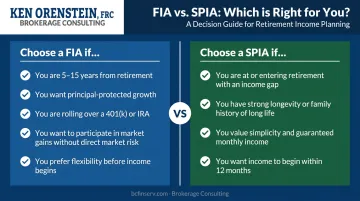
Choose a FIA if you:
- Are 5–15 years from full retirement
- Want principal-protected growth with market-linked upside
- Need flexibility to access funds during accumulation
- Are rolling over tax-deferred assets (401(k), IRA) and want continued deferral with income options
- Are a federal employee coordinating with TSP during pre-retirement years
Choose a SPIA if you:
- Are at or in retirement with an identifiable income gap
- Have strong longevity or a family history of it
- Value simplicity and income certainty over flexibility
- Want to eliminate the ongoing risk of outliving your assets
The "Both" Scenario
Some retirees benefit from a combined approach: using a FIA to grow assets with downside protection during accumulation years, then converting a portion of those accumulated funds into a SPIA at retirement to fund guaranteed income. A 1035 exchange can facilitate this transition without triggering immediate taxation, though the mechanics require careful execution to qualify under IRS rules.
This sequencing strategy is especially relevant for federal employees transitioning out of active service. Coordinating FERS pension, Social Security, TSP, and supplemental annuity income into a cohesive plan requires individualized analysis — and that's where mapping all income layers first helps identify whether a FIA, a SPIA, or both belong in the picture. Ken Orenstein at Brokerage Consulting offers no-cost consultations (phone, virtual, or in-person) focused on exactly this type of layered federal retirement income planning.
Neither product is universally superior. The right choice depends on timing, income needs, liquidity requirements, health status, legacy goals, and the full retirement income picture. Contract terms, surrender schedules, and payout options vary significantly across carriers, so working through those details with a licensed retirement advisor before purchasing is the right move.
Frequently Asked Questions
Can you lose money with a fixed index annuity?
In a standard FIA, principal is protected by the contract's floor — typically 0% — meaning the account will not lose value due to poor index performance. In a down market year, credited interest may simply be zero. However, withdrawals beyond the free withdrawal amount or surrendering the contract during the surrender period can reduce account value through applicable charges.
Is a SPIA a good idea if I already have a pension or Social Security?
Existing guaranteed income sources reduce the urgency for a SPIA but don't eliminate it. A SPIA may still add value if a meaningful income gap remains after accounting for pension and Social Security income. A financial advisor can help assess whether the gap justifies the irrevocability trade-off.
What happens to my SPIA payments if I die early?
It depends on the chosen payout structure. A "life only" SPIA stops payments at death with no residual value. A "period certain" option guarantees payments to a beneficiary for the remaining guaranteed period. A "joint and survivor" option continues payments to a surviving spouse. Choose a payout structure that reflects your health status, marital situation, and legacy priorities.
Can I use a fixed index annuity to eventually fund a SPIA?
Yes. Some retirees grow assets tax-deferred in a FIA, then use a portion of those funds to purchase a SPIA when guaranteed income is needed — typically via a 1035 exchange executed as a direct insurer-to-insurer transfer to qualify as tax-free. Receiving a check and redepositing it to a new carrier does not meet IRS requirements.
Which annuity option is better for federal employees?
It depends on timeline and existing benefits. A FIA can complement TSP assets during pre-retirement years, while a SPIA can fill income gaps not covered by the FERS pension and Social Security. Because FERS pension, TSP, and Social Security each play distinct roles, integrated and individualized planning is essential.
What minimum investment is typically required?
Carrier minimums vary across the market, though larger premiums typically yield more favorable contract terms and payout amounts. Brokerage Consulting's annuity practice generally works with clients who have a minimum of $250,000 available as a deployable lump sum for annuity placement.
This article is for educational purposes only and does not constitute investment or insurance advice. Annuity products involve surrender charges, fees, and other terms that vary by carrier and contract. Contact a licensed advisor to evaluate suitability for your specific situation.