
That's exactly what an immediate annuity — purchased with what's often called a "face amount" — is designed to do. You hand over a single, upfront premium payment, and the insurer hands back a guaranteed income stream, often starting within a month. Simple in concept, but the mechanics matter enormously before you commit.
According to Allianz Life's 2025 research, 64% of Americans worry more about running out of money than dying — yet only 23% have discussed that fear with a financial professional. For retirees converting savings into income, understanding exactly what happens to your lump-sum premium is non-negotiable.
Key Takeaways
- An immediate annuity converts a one-time purchase payment ("face amount") into guaranteed income starting within one year of purchase
- The face amount is your purchase price — not a savings balance, not a death benefit, and not something you can withdraw after annuitization
- Monthly income depends on four factors: premium size, your age, your gender, and interest rates at purchase
- The decision is generally irrevocable, so sizing the purchase correctly from the start matters
- This structure is best suited for retirees who need predictable, guaranteed lifetime income
What Is an Immediate Annuity Purchased with a Face Amount?
A Single Premium Immediate Annuity (SPIA) is an insurance contract where you pay a one-time lump-sum premium — commonly called the "face amount" — in exchange for guaranteed income payments that begin within one year of purchase, per the NAIC's definition of immediate annuities.
What "Face Amount" Actually Means Here
In life insurance, "face amount" means the death benefit paid to your beneficiaries. In an immediate annuity, it means something different: the total purchase price stated in the contract — the single premium you pay to fund your income stream. (Carriers may also call this the "single purchase payment," "premium amount," or simply "premium" — same concept, different label.)
Once you pay the face amount:
- The insurer pools it with other premiums and invests it, primarily in investment-grade bonds
- It funds your guaranteed income payments for the duration of the contract
- It is no longer held as an asset on your balance sheet
- It cannot be accessed as a lump sum unless you selected a refund option at purchase
Immediate vs. Deferred Annuities
The key distinction: in a deferred annuity, your premium grows over an accumulation phase before income begins. In an immediate annuity, there is no accumulation phase: your face amount is annuitized at purchase and income begins almost immediately.
Common sources of immediate annuity face amounts include:
- 401(k) or IRA rollover distributions
- TSP (Thrift Savings Plan) rollovers for federal employees and retirees
- After-tax personal savings
- Pension buyout lump sums
- Inheritance proceeds
- Proceeds from selling a business or property
- A 1035 tax-free exchange from an existing annuity or life insurance policy
How the Immediate Annuity Purchase Process Works
Three decisions drive the immediate annuity purchase: how much income you need, which payout structure fits your situation, and when payments start. Getting these right — in order — is what separates a well-funded retirement income plan from one that leaves gaps or over-commits your assets.
Step 1: Determine Your Face Amount and Income Needs
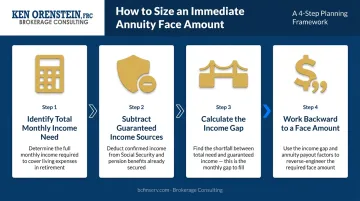
Before submitting a premium, calculate how much guaranteed income the annuity needs to produce. That requires mapping your full retirement income picture:
- Identify your total monthly income need — what does retirement actually cost you?
- Subtract guaranteed income you already have — Social Security, pension, FERS annuity (for federal retirees), other sources
- Calculate the income gap — this is what the SPIA needs to fill
- Work backward to a face amount — using carrier quotes, determine what lump sum produces that income
A key rule: the face amount should not represent all your liquid assets. Liquidity is permanently surrendered when you annuitize. Emergency reserves, healthcare costs, and unexpected expenses must be funded from assets held outside the annuity.
This sequencing — mapping Social Security and pension income first, then sizing the SPIA to fill only the remaining gap — is what prevents over-annuitization. It's the approach Brokerage Consulting follows through its Guaranteed Lifetime Income Planning process, and it's why starting with your full income picture matters before you commit a lump sum.
Step 2: Select Contract Terms and Submit the Application
The payout structure you select determines how much monthly income your face amount generates. Key options include:
| Payout Option | Effect on Monthly Income |
|---|---|
| Life-only (single life) | Highest monthly income; payments stop at death |
| Life with period certain | Slightly lower income; payments guaranteed for minimum period |
| Joint and survivor | Lower income; continues while either spouse lives |
| Cash refund / installment refund | Lower income; returns unused premium to beneficiaries |
| Period certain only | Fixed duration (5–30 years); no lifetime guarantee |
A life-only contract produces more monthly income from the same face amount than any other structure — because the insurer assumes no obligation beyond your lifetime.
Once you select your terms, the insurer issues a quote and you submit the face amount as a single premium payment.
Step 3: Income Begins
After the contract is issued, income payments begin on the schedule specified — typically within 30 days for monthly income, and no later than 12 months after contract issue. From this point, the face amount is fully annuitized and the insurer is contractually obligated to make payments for the selected period or lifetime. There is no account balance to draw from, withdraw, or redirect — the lump sum has converted permanently into income.
What Determines Your Face Amount and Monthly Payout
Getting the most income from your face amount comes down to four variables — and understanding how they interact helps you make a smarter purchase decision.
1. The Size of Your Premium
The relationship is direct: a larger face amount produces a larger monthly payment. The American Academy of Actuaries published illustrative monthly benefit figures for a $100,000 SPIA at age 65 (June 2022 data — dated examples, not current quotes):
| Option | Male | Female | Joint (couple) |
|---|---|---|---|
| Life-only | $602/mo | $569/mo | — |
| Cash refund | $581/mo | $558/mo | — |
| 100% joint & survivor | — | — | $522/mo |
| 10-year period certain | $988/mo | $988/mo | — |
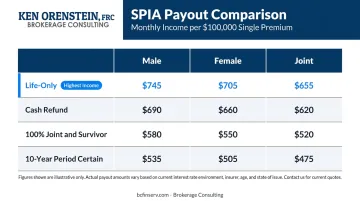
A $250,000 face amount would scale these figures proportionally — roughly 2.5x the monthly income shown. Current market quotes will differ based on prevailing interest rates at the time of purchase.
2. Age and Gender
Insurers apply actuarial assumptions to your age and gender when calculating the payout rate applied to your face amount. Older buyers receive a higher payout rate — their shorter actuarial life expectancy reduces the insurer's total payment obligation. A 75-year-old gets roughly 15–20% more monthly income per dollar of face amount than a 65-year-old purchasing with the same premium.
3. Prevailing Interest Rates
Insurers invest your face amount primarily in investment-grade bonds. When bond yields are higher, insurers credit higher payout rates. The American Academy of Actuaries notes that a 1-percentage-point increase in interest rates raises SPIA benefit values by approximately 10–12% — meaning the same face amount generates noticeably more income in a higher-rate environment.
4. Payout Structure Selection
As shown in the table above, the structure applied to your face amount significantly affects monthly income. The joint & survivor option, for example, drops the male life-only payout from $602 to $522 per month — an $80 difference that buys continued income for a surviving spouse. Adding a period-certain guarantee or cash refund feature carries similar trade-offs.
Each structure shifts the balance between maximizing your monthly income and protecting a spouse or leaving a legacy. Modeling these variables side-by-side with a licensed advisor is the clearest way to find the right fit for your situation.
Key Factors That Influence the Purchase Decision
Liquidity — The Non-Negotiable Warning
Once the face amount is annuitized, it is gone as a liquid asset. No withdrawals, no early surrender (in most standard contracts). Emergency reserves, medical costs, and large future expenses must be funded from assets held completely outside the annuity. This is not a limitation to manage around — it's a hard constraint to plan for before purchase.
Inflation Exposure
A fixed monthly payment from the same face amount will purchase less in 15 years than it does today. A COLA (Cost-of-Living Adjustment) rider addresses this by increasing payments annually — commonly at 1%, 2%, 3%, or a CPI-linked rate — but it reduces the starting monthly income. Brokerage Consulting presents this trade-off explicitly: higher inflation protection comes at the cost of lower initial cash flow.
Tax Treatment of the Face Amount Source
Where your face amount comes from determines how payments are taxed:
- Qualified funds (401(k), IRA, TSP rollover): All payments are fully taxable as ordinary income — the entire face amount was pre-tax money
- Non-qualified funds (after-tax savings): Only the earnings portion of each payment is taxable; the principal portion is returned tax-free under the IRS exclusion ratio, as defined in IRS Publication 939
The source of funds affects total tax liability on every payment for the life of the contract. A federal retiree rolling a TSP balance into a SPIA will receive fully taxable payments — a factor worth modeling carefully before committing the face amount.
Longevity Pooling Benefit
Beyond tax treatment, the structure of an insured annuity itself offers something a portfolio cannot replicate: pooled longevity risk. The insurer spreads that risk across all policyholders, so annuitants who live longer than average receive more in total payments than the same face amount could generate from a fixed-income portfolio.
This mechanism is sometimes called "mortality credits." It's what makes lifetime income from an annuity structurally different from simply drawing down a bond ladder — and why face-amount allocation to a SPIA can make sense even for investors comfortable managing their own portfolios.

Insurer Financial Strength
The guaranteed income is only as secure as the company backing it. AM Best Financial Strength Ratings — with Superior ratings at A++/A+ and Excellent at A/A- — are the standard measure of an insurer's ability to meet policy obligations. Before placing any SPIA, Brokerage Consulting evaluates carriers across AM Best, Moody's, S&P, and Fitch ratings — not just payout rates — to ensure the insurer behind the guarantee is financially sound.
Common Misconceptions and When This Purchase May Not Be Appropriate
Three Misconceptions Worth Addressing Directly
Three beliefs consistently lead buyers to misunderstand what they're purchasing:
- "It works like a savings account." After annuitization, there is no balance to check or withdraw from. The premium is gone as a liquid asset — full stop.
- "Heirs automatically receive what's left." In a life-only SPIA with no riders, payments stop at death and the insurer retains any unused value. A refund or period-certain option can pass remaining value to beneficiaries, but it reduces monthly income.
- "The face amount is a death benefit." In a standard life-only SPIA, there is no death benefit. This is categorically different from life insurance, despite the shared terminology.
When a SPIA May Not Be the Right Tool
Clearing up these misconceptions also clarifies when a SPIA simply isn't the right fit. Committing a face amount to an immediate annuity is the wrong decision if:
- You don't have sufficient liquid assets outside the annuity for emergencies
- You anticipate needing access to the lump sum for near-term medical costs
- You're significantly younger than 65 and decades from needing steady income (deferred structures are usually more appropriate)
- Your primary goal is market-linked growth rather than guaranteed income
- You lack other income sources and would be annuitizing too large a share of total assets
Determining the right face amount — and whether a SPIA is even the right vehicle — requires a full review of your income sources, assets, tax situation, and beneficiary priorities. Ken Orenstein at Brokerage Consulting offers no-cost consultations (phone, virtual, or in-person) to work through exactly this analysis before you make any irrevocable commitment. You can reach his office at (888) 315-3608 or request a consultation at bcfinserv.com.
Frequently Asked Questions
What exactly is the "face amount" in an immediate annuity contract?
The face amount is the lump-sum premium you pay at purchase — the total dollar amount stated in the contract that the insurer uses to calculate and fund your income stream. It is not a balance that grows, earns interest separately, or can be withdrawn after the contract is issued.
Is the face amount of an immediate annuity the same as a death benefit?
No. In a standard life-only SPIA, the face amount is not a death benefit — it funds your income stream, and payments stop at your death. Adding a refund rider or period-certain option can ensure some remaining value passes to beneficiaries, but doing so reduces your monthly income.
How does the size of my face amount affect how much income I receive?
Directly and proportionally. A larger face amount produces larger payments. The insurer applies an age- and rate-adjusted payout factor to your specific face amount to determine the monthly benefit — which is why getting quotes from multiple carriers matters.
Can I change or recover my face amount after purchasing an immediate annuity?
Generally, no. Once the contract is issued, the premium is irrevocable and cannot be returned or modified. Some contracts include a 30-day free-look cancellation period at issue, and limited commutation riders exist on certain contracts — but standard SPIAs do not offer this flexibility.
Does it matter whether my face amount comes from pre-tax or after-tax savings?
Yes — significantly. Qualified (pre-tax) funds like a 401(k) or TSP rollover result in fully taxable income payments. Non-qualified (after-tax) funds allow a portion of each payment to be received tax-free as a return of principal under the IRS exclusion ratio rules.
What is the minimum face amount needed to purchase an immediate annuity?
Minimums vary by carrier. Major carriers like MassMutual and New York Life set their SPIA minimums at $10,000. Brokerage Consulting typically works with clients deploying $250,000 or more as a lump sum, which supports meaningful income generation alongside other retirement assets.