
Introduction
Picture this: a federal employee approaches retirement with $400,000 in TSP savings and an advisor who recommends rolling it into a specific annuity product — quickly, confidently, with no written explanation of why that product over any other. No documentation. No comparison. Is that recommendation genuinely in your best interest, or does it reflect the highest commission available that month?
That's exactly the problem regulators set out to fix.
In February 2020, the National Association of Insurance Commissioners (NAIC) updated its Model Regulation #275 (the governing framework for annuity sales) to require that advisors act in their clients' best interest, not just recommend a "suitable" product. The shift sounds subtle. In practice, it changes what advisors must do, document, and disclose before you sign anything.
This article covers:
- What the Best Interest Standard actually requires
- The four obligations every advisor must satisfy
- What information a qualified advisor needs from you
- How to protect yourself when evaluating an annuity recommendation
TLDR: Key Takeaways
- The NAIC updated its annuity suitability guidelines in 2020 to require a Best Interest Standard — going beyond mere "suitability."
- Your advisor must satisfy four obligations: Care, Disclosure, Conflict of Interest, and Documentation.
- Before recommending an annuity, your advisor must gather details on your finances, risk tolerance, liquidity needs, and tax status.
- As of April 2025, all 50 states have adopted a best interest standard for annuity sales.
- You have the right to ask how your advisor is compensated — and they are required to tell you.
From Suitability to Best Interest: How the Standard Evolved
The Original Suitability Framework
NAIC Model Regulation #275 — formally titled "Suitability in Annuity Transactions Model Regulation" — was first adopted in 2003 and amended multiple times, including in 2010 and 2015. Under that earlier framework, an advisor had to demonstrate a "reasonable basis" to believe the recommended annuity was suitable based on the consumer's profile.
Suitable, however, is a low bar. Think of it like buying a car: a suitable vehicle gets you from point A to point B. A best-interest recommendation factors in your budget, your long-term maintenance costs, whether you need cargo space, and what else is available on the lot — including options the dealer may not have in stock.
Suitability didn't require advisors to weigh all available options. It didn't prohibit advisors from prioritizing products that earned them higher compensation. It just required that the product broadly fit.
Those limitations made reform inevitable.
What Changed in 2020
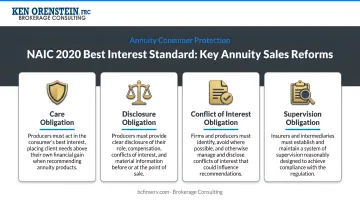
The NAIC approved revisions to Model #275 in February 2020, requiring that recommendations be in the consumer's "best interest." The revised model's core changes include:
- Prohibits advisors from placing their own financial interests ahead of the client's
- Bars insurers from structuring compensation to incentivize unsuitable recommendations
- Aligns with the SEC's Regulation Best Interest for consistency across financial product types
- Gives state regulators a clear enforcement framework for annuity sales accountability
The timing was deliberate. In 2018, the Fifth Circuit Court of Appeals vacated the Department of Labor's 2016 fiduciary rule, which had extended fiduciary protections to retirement investment advice. That ruling left a notable gap in consumer protection for annuity purchasers. The NAIC's 2020 revisions directly addressed that gap at the state level.
What Is the Best Interest Standard for Annuities?
The Core Definition
Model #275 states that a producer must "act in the best interest of the consumer under the circumstances known at the time the recommendation is made, without placing the producer's or the insurer's financial interest ahead of the consumer's interest."
This standard does not require advisors to find the cheapest product, and it does not prohibit commissions. What it does require is that compensation and incentives cannot be the deciding factor. The recommendation must be driven by your needs, not the advisor's payout.
Who the Standard Applies To
The Best Interest Standard under Model #275 covers:
- Insurance producers (agents and brokers) recommending fixed, fixed indexed, and certain other annuity products
- New York — which operates under a separate framework, Regulation 187 (11 NYCRR 224), effective August 1, 2019 for annuities and February 1, 2020 for life insurance — applying comparable standards to both life insurance and annuity transactions
- Variable annuities — classified as securities and therefore also subject to SEC Regulation Best Interest and FINRA Rule 2330 for broker-dealers
The Insurer's Role
Accountability doesn't rest only with the advisor. Model #275 requires insurers to establish and maintain supervision systems reasonably designed to achieve compliance — including reviewing recommendations before issuance and maintaining procedures to detect non-compliant sales. In practice, this means consumers have accountability protections at two levels: the producer who made the recommendation and the insurer whose systems allowed it to proceed.
The Four Obligations Every Advisor Must Meet
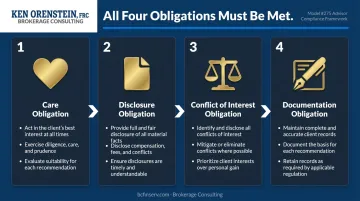
An advisor satisfies the Best Interest Standard by fulfilling all four of the following obligations. Partial compliance isn't enough.
Care Obligation
The Care obligation requires "reasonable diligence, care and skill" — the exact language used in Model #275. The advisor must:
- Know your financial situation, insurance needs, and financial objectives
- Understand the available recommendation options across the market
- Have a reasonable basis to believe the recommended annuity effectively addresses your specific circumstances
- Communicate the basis of that recommendation to you
Disclosure Obligation
The advisor must disclose:
- Their role and the products they are licensed to sell
- The insurers they are authorized to represent
- Sources and types of cash and non-cash compensation
- Upon request, a reasonable estimate of cash compensation — which may be stated as a range
You should receive these disclosures before you sign anything. If an advisor can't explain how they're compensated, that's a problem.
Conflict of Interest Obligation
Model #275 defines a material conflict of interest as "a financial interest of the producer in the sale of an annuity that a reasonable person would expect to influence the impartiality of a recommendation." The advisor must identify any such conflict, then either avoid it or reasonably manage and disclose it.
Model #275 also requires insurers to eliminate sales contests, sales quotas, bonuses, and non-cash compensation tied to the sale of specific annuities within a limited time period — all of which undermine impartial recommendations.
Documentation Obligation
The advisor must create a written record of the recommendation and the reasoning behind it. Three specific scenarios require documentation:
- Standard recommendation: The basis for the recommended annuity and how it fits your situation
- Refused profile: If you decline to provide your financial information, the advisor must obtain a signed statement of that refusal
- Client-directed transaction: If you proceed with a product the advisor didn't recommend, that decision must be documented in writing
Prudential's annuity suitability guide suggests retaining records for the life of the contract plus five years — a reasonable benchmark, though that reflects Prudential's internal compliance practice rather than a specific NAIC model requirement. Either way, that written record is your strongest protection if a dispute arises.
What Information Must an Advisor Gather Before Recommending an Annuity?
A recommendation can only be assessed as being in your best interest if the advisor has a complete, accurate picture of your situation. Providing incomplete information compromises the quality of the recommendation — and potentially weakens your legal recourse if something goes wrong.
Required Consumer Profile Information
Model #275 specifies the following categories an advisor must collect:
| Category | Why It Matters |
|---|---|
| Age | Affects product eligibility, payout timing, and tax treatment |
| Annual income | Determines how much you can afford to commit long-term |
| Financial situation and needs, including debts | Ensures the annuity doesn't strain your overall budget |
| Financial experience | Calibrates how complex an explanation you need |
| Insurance needs | Identifies whether the product fills a genuine protection gap |
| Financial objectives | Aligns product type (growth vs. income) with your goals |
| Intended use of the annuity | Income replacement? Legacy? Longevity hedge? |
| Financial time horizon | Short-term liquidity vs. long-term lock-up tolerance |
| Existing assets and financial products | Prevents over-concentration in one asset class |
| Liquidity needs | Critical — annuities carry surrender charges for early withdrawal |
| Liquid net worth | Assesses how much of your accessible wealth is being committed |
| Risk tolerance | Fixed vs. indexed vs. variable product suitability |
| Financial resources used to fund the annuity | Identifies whether the source is appropriate (IRA, savings, etc.) |
| Tax status | Determines qualified vs. nonqualified treatment and tax efficiency |
Concentration and Liquidity Benchmarks
Two practical benchmarks commonly cited by major carriers — though not established as NAIC regulatory thresholds — are worth knowing:
- Prudential's guidance suggests no more than 50% of a client's net worth should be concentrated in annuity contracts
- Nationwide's guidance flags cases requiring additional explanation when annuity concentration exceeds 70%, and may decline cases above 75%
- Both Prudential and Nationwide also expect clients to have 3–6 months of liquid assets available before committing funds to an annuity — recognizing that surrender charges can make early access costly
These are insurer-level review practices, not NAIC mandates. In practical terms, they signal a clear expectation: an annuity should fit within a diversified financial plan, not absorb the majority of your accessible wealth. That same logic applies when an advisor proposes replacing a contract you already hold.
Annuity Replacement Scenarios
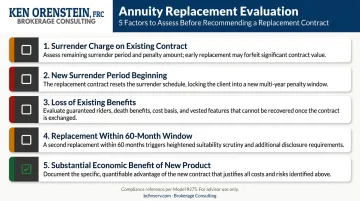
When an advisor recommends replacing an existing annuity with a new one, the best interest standard requires explicit comparison. Model #275 requires the advisor to evaluate:
- Whether you will incur a surrender charge on the existing contract
- Whether a new surrender period begins
- Whether you would lose existing benefits — death benefits, living benefits, or other contractual features
- Whether the replacement occurred within the preceding 60 months (a flag for churning)
- Whether the new product provides a substantial economic benefit
This is especially relevant for seniors, who are disproportionately targeted for unnecessary replacements. At Brokerage Consulting, Ken Orenstein's practice includes 1035 tax-free exchange analysis, which evaluates whether transferring an existing contract genuinely improves the client's position before any replacement moves forward.
Which States Have Adopted the Best Interest Standard?
State-by-State Adoption
NAIC creates model regulations, but each state must adopt them independently through its own regulatory process. Adoption timelines have varied significantly: some states acted within months of the 2020 revision, while others took several years.
As of April 21, 2025, ACLI reported that all 50 states had adopted a best interest standard for annuity sales after New Jersey became the final state to act.
NAIC's own August 2025 government affairs brief separately counted 49 jurisdictions that had implemented the 2020 Model #275 revisions as of August 8, 2025. The difference reflects how each organization defines "adoption" rather than a factual conflict.
Training Requirements for Producers
Model #275 includes producer education requirements:
- New producers must complete a one-time four-credit annuity training course covering the Best Interest Standard
- Existing producers who completed prior training can satisfy the requirement with a one-credit supplemental course covering appropriate sales practices, replacement, and disclosure requirements
Checking Your State's Status
To confirm your state's specific requirements, check your state's Department of Insurance website — the authoritative source for current adoption status and producer obligations.
New York clients should note that Regulation 187 applies independently of the NAIC model and in some respects imposes stricter requirements than Model #275.
What the Best Interest Standard Means for You as an Annuity Buyer
Questions to Ask Before You Sign
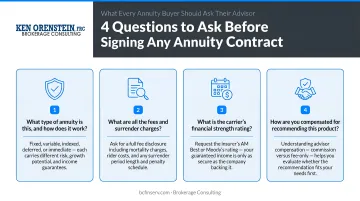
Any advisor operating under best interest principles should be able to answer these without hesitation:
- "How are you compensated for this recommendation?" — Commissions must be disclosed; if the advisor deflects, that's a red flag.
- "What other annuity products did you consider before recommending this one?" — A best-interest review involves comparing options, not just presenting one.
- "Can you provide written documentation of your recommendation rationale?" — This is a regulatory requirement, not a special request.
- "Do you have any conflicts of interest I should know about?" — Ask directly, and note the response.
Red Flags to Watch For
- Pressure to decide quickly or before you've reviewed the documentation
- A recommendation that doesn't account for your existing assets, liquidity needs, or surrender charges on a current contract
- An advisor who cannot explain why this specific annuity is better for you than alternatives they considered
- No written disclosure of compensation provided before signing
Working With an Advisor Who Takes This Seriously
Knowing what red flags look like makes it easier to recognize the alternative. The clearest sign that the best interest standard is being followed is an advisor who slows down — asking about your retirement timeline, income sources, tax situation, and liquid reserves before recommending anything.
For federal employees, the stakes are higher than average. TSP rollovers, FERS pension coordination, and QLAC strategies each carry distinct tax and income implications — which means a sloppy suitability review can have compounding consequences well into retirement.
Frequently Asked Questions
What is the difference between the suitability standard and the best interest standard for annuities?
The suitability standard required only that a recommendation broadly fit the consumer's profile — it didn't prohibit advisors from favoring products that paid them more. The best interest standard requires advisors to prioritize your interests above their own and consider available options before recommending any specific product.
Does the best interest standard for annuities apply in my state?
As of April 2025, all 50 states have adopted a best interest standard for annuity sales, though adoption timelines and specific requirements vary. Check your state's Department of Insurance website or consult a licensed advisor to confirm the rules in your state.
Can an advisor still earn a commission under the best interest standard?
Yes. Commissions remain permitted, but advisors must disclose how they are compensated and cannot allow compensation to override your best interest when making a recommendation.
What information will an advisor need from me before recommending an annuity?
Expect questions covering:
- Age, income, and overall financial situation
- Existing assets and liquidity needs
- Risk tolerance, tax status, and time horizon
- Insurance needs and intended use of the annuity
Thorough information gathering is a regulatory requirement, not an optional courtesy.
What should I do if I think an annuity was not recommended in my best interest?
First, request written documentation of the recommendation rationale from your advisor. If you believe the best interest standard was not followed, contact your state's Department of Insurance to file a complaint and review your options.
How does the NAIC best interest standard differ from the DOL fiduciary rule?
The DOL fiduciary rule applies to retirement investment advice under federal ERISA authority, while the NAIC Best Interest Standard governs annuity recommendations at the state level. The two frameworks can overlap (for example, when an annuity is purchased inside a retirement account), but they are separate regulatory structures enforced by different authorities.