
Annuities show up in almost every retirement conversation, but usually in the abstract: tax deferral, guaranteed income, insurance contracts. Their real value becomes concrete when a market crash hits during your first year of withdrawals, when healthcare costs arrive unexpectedly, or when retirement stretches into its third decade.
This article explains how annuities actively protect retirement savings across three specific dimensions — market volatility, longevity risk, and tax efficiency — with practical detail on how each protection works and when it matters most.
Key Takeaways
- Annuities convert savings into predictable, guaranteed income — creating a financial floor that market-exposed accounts cannot replicate
- Fixed and fixed index annuities shield principal from market downturns; account values cannot decline due to index drops
- 87% of annuity owners are confident their savings will last a lifetime, versus only 66% of non-owners
- No IRS contribution limits and tax-deferred growth make annuities a strong option once 401(k)s and IRAs are maxed out
- Annuities work best as part of a broader strategy alongside Social Security, pensions, and portfolio investments
What Are Annuities? A Practical Overview
An annuity is a contract between you and an insurance company. You contribute a lump sum or series of payments, and in return, the insurer agrees to make regular payments back to you — either immediately or at a future date. The NAIC describes annuities as insurance products "designed to protect an individual from outliving his or her assets."
The Three Primary Types
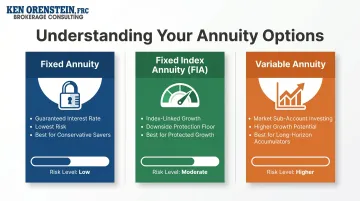
Each type serves a different purpose:
| Type | How It Works | Risk Profile | Best For |
|---|---|---|---|
| Fixed Annuity | Guaranteed interest rate, no market exposure | Lowest | Conservative savers, CD alternatives |
| Fixed Index Annuity (FIA) | Interest tied to a market index with a downside floor | Moderate | Protected growth + income planning |
| Variable Annuity | Sub-account investing with market participation | Higher | Younger accumulators with long time horizons |
Ken Orenstein at Brokerage Consulting most commonly recommends Fixed Indexed Annuities for pre-retirees and retirees, particularly those aged 65–73 who have recently stopped receiving employment income and need to replace a paycheck without exposing principal to market swings.
That's the practical case for annuities: they convert accumulated savings into income you can't outlive, regardless of market conditions, inflation pressure, or how long retirement actually lasts.
Three Ways Annuities Protect Your Retirement Savings
The protections below map directly to the most common and costly retirement risks — loss of principal, outliving income, and tax inefficiency. Each has real, measurable consequences when left unaddressed.
Protection 1: Shielding Savings from Market Volatility
Fixed and fixed index annuities protect principal from market downturns. Unlike a 401(k) or brokerage account, the account value cannot decline because an index fell or markets crashed.
Here's how it works in practice with a Fixed Index Annuity:
- Interest is credited based on upward index movement, subject to caps or participation rates
- If the index drops during a contract year, the account earns zero interest, not a loss
- Once interest is credited, it's locked in permanently through the annual reset mechanism
That last point matters more than it might seem. The annual reset ensures that prior gains can never be clawed back by a future downturn.
Charles Schwab identifies the "fragile decade" — the five years before and after retirement — as the period when portfolio losses cause the most permanent damage. A 15% drop in years one and two of retirement, combined with ongoing withdrawals, can permanently impair a portfolio's ability to sustain income over 20–30 years. This is sequence of returns risk: two retirees with identical average returns can end up with dramatically different outcomes depending on when losses occur.
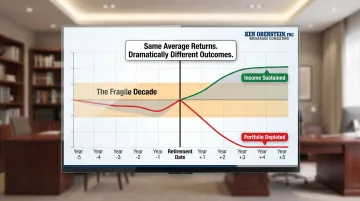
Fixed and fixed index annuities eliminate this risk for the protected portion of savings. What stays in the contract cannot drop from market action alone.
This protection is highest-impact for retirees already drawing income, anyone within 10 years of retirement, and those who cannot afford to wait out a multi-year market recovery.
Protection 2: Guaranteeing Income You Cannot Outlive
Longevity risk is the risk of outliving a fixed pool of savings. And the math has gotten harder: SSA actuarial data shows that 1 in 4 current 65-year-olds will live past age 90, and 1 in 10 past age 95. For a couple, there's a 50% chance at least one spouse reaches age 94.
Planning for a 20-year retirement is statistically insufficient for most households.
Annuities are the only retail financial product that can contractually guarantee income for as long as the annuitant lives. No mutual fund, ETF, bond, or CD can make that promise.
Three structures deliver this guarantee:
- Single Premium Immediate Annuities (SPIAs): payments begin within ~30 days of purchase and continue for life, regardless of account value
- Deferred Annuities with lifetime income riders (GLWBs): funds accumulate with a guaranteed roll-up rate during deferral, then activate at a chosen retirement date
- Joint-and-survivor options: income continues after the first spouse passes, with survivor percentages of 50%, 66.67%, 75%, or 100% of the original payment
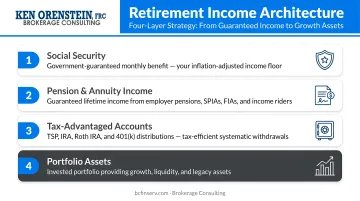
Ken Orenstein uses a layered income architecture: Social Security as Layer 1, FERS pension as Layer 2 (for federal employees), guaranteed annuity income as Layer 3, and discretionary portfolio assets as Layer 4. The annuity layer specifically addresses what Social Security and pension income alone may not fully cover — particularly longevity and sequence risk.
The behavioral impact is documented. The same BlackRock survey found 81% of annuity owners feel they have enough money to live their desired retirement lifestyle, versus 63% of non-owners. Guaranteed income doesn't just protect finances — it changes how confidently retirees actually spend.
This guarantee matters most for retirees without a pension, single retirees, anyone with a family history of longevity, and federal employees transitioning off active employment income.
Protection 3: Tax-Deferred Growth Without Contribution Limits
Annuity earnings grow tax-deferred. No taxes are owed annually on credited interest — only upon withdrawal. This means the full balance (principal + interest + deferred taxes) compounds uninterrupted, rather than being reduced each year by tax obligations.
Compare that to a taxable brokerage account: a high-bracket investor loses a portion of each year's gains to taxes, slowing the compounding effect every single year.
The contribution limit gap is worth understanding:
| Account Type | 2025 Standard Limit | Catch-Up (Age 60–63) |
|---|---|---|
| 401(k) | $23,500 | +$11,250 |
| Traditional/Roth IRA | $7,000 | +$1,000 |
| Nonqualified Annuity | No IRS limit | N/A |
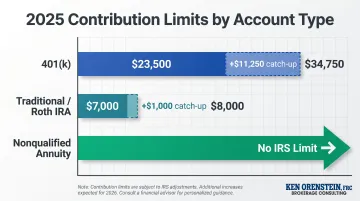
For 2026, the 401(k) limit increases to $24,500 and the IRA limit to $7,500 — still capped. Nonqualified annuities have no IRS-mandated contribution limits, though individual carriers set their own maximums.
This creates a practical opening for high earners who have already maxed out qualified plans and still have additional savings they want sheltered from annual tax drag. A financial advisor who specializes in annuities can help identify whether a nonqualified annuity fits within a broader tax-efficient strategy.
One trade-off to note: withdrawals are taxed as ordinary income, not at capital gains rates. And distributions before age 59½ carry a 10% IRS early withdrawal penalty per IRS Publication 575.
This protection is most valuable for high earners during peak income years, those expecting lower tax rates in retirement, and anyone who has already maxed out qualified plan contributions.
What Happens When Annuity Protection Is Missing
Retirees who rely exclusively on market-exposed accounts face compounding risks that are harder to recover from after retirement than before.
Three consequences stand out:
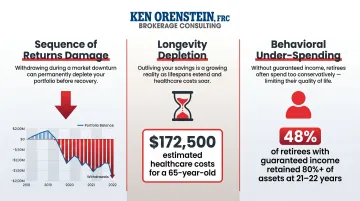
- Sequence of returns damage — withdrawing from a portfolio during a downturn locks in losses and permanently reduces the account's ability to sustain 20–30+ years of income, even when markets recover
- Longevity depletion — without a lifetime income guarantee, even a well-funded account can run dry. Fidelity estimates a 65-year-old may need $172,500 in after-tax savings for healthcare expenses alone, before factoring in inflation or a longer-than-expected lifespan
- Behavioral under-spending — EBRI research found that 48% of middle-asset retirees with guaranteed income retained 80% or more of their starting assets 21–22 years into retirement, while retirees without guaranteed income tended to under-spend out of fear — reducing quality of life while failing to actually solve the sustainability problem
The under-spending finding is counterintuitive — and it's backed up elsewhere. BlackRock found that 85% of retired Boomers say having a secure income stream made a larger difference in retirement than they initially expected. Guaranteed income changes spending behavior in both directions — retirees spend more confidently from non-guaranteed assets precisely because core expenses are already covered.
How to Choose the Right Annuity for Your Retirement Goals
There is no single "best" annuity. The right product depends on income timeline, risk tolerance, current savings mix, and whether the primary need is accumulation, protection, or income now.
A practical decision framework:
- Need principal protection with growth potential? → Fixed Index Annuity during the accumulation phase
- Need income to start immediately? → Single Premium Immediate Annuity (SPIA) or a Deferred Income Annuity (DIA) with a lifetime rider
- Need to shelter a large lump sum from annual tax drag? → Tax-deferred fixed or fixed index annuity
- RMD management concern? → Qualified Longevity Annuity Contract (QLAC), which excludes up to $200,000 from RMD calculations
Before purchasing any annuity, understand the trade-offs:
- Surrender periods typically run 5–10 years, with declining penalty schedules (e.g., 9-8-7-6-5-4-3% declining annually)
- Most contracts allow 10% free withdrawals annually without surrender charges
- Variable annuities can carry all-in costs exceeding 3% per year; FIAs have lower explicit fees but embed costs in participation rate caps and spreads
- A 10% IRS penalty applies to withdrawals before age 59½
These trade-offs interact differently depending on your situation, which is where independent guidance makes a meaningful difference. Ken Orenstein at Brokerage Consulting compares products across multiple top carriers, evaluating caps, participation rates, income rider growth rates, and surrender schedules alongside carrier financial strength ratings from A.M. Best, Moody's, S&P, and Fitch.
Conclusion
Annuities offer three forms of retirement protection that reinforce each other: a floor against market losses, a guarantee against outliving income, and a tax-efficient vehicle for continued growth. No single benefit solves everything on its own — but together, inside a well-structured plan, they address the three risks that most often derail retirement income.
Choosing the right annuity type, at the right time, with a fee structure that makes sense for your situation takes more than a product comparison — it takes a full picture of your retirement income needs. Ken Orenstein at Brokerage Consulting offers no-cost initial consultations — phone, virtual, or in-person — to review your specific situation and identify the annuity structure that fits. Reach out at (888) 315-3608 or request a consultation at bcfinserv.com.
Frequently Asked Questions
How can annuities protect retirement savings?
Annuities protect retirement savings by shielding principal from market downturns (in fixed and fixed index products), guaranteeing income that cannot be outlived, and growing savings tax-deferred. Together, these features create a stable financial floor that market-exposed accounts — 401(k)s, brokerage accounts, mutual funds — cannot contractually provide.
Are annuities good for retirement savings?
Annuities are well-suited for retirees seeking predictable income, those without a pension, or anyone concerned about longevity risk. The trade-off is lower liquidity: surrender periods and early withdrawal penalties make these long-term commitments. For the right client profile, the guaranteed income benefit typically outweighs the reduced flexibility.
How much will a $100,000 annuity pay per month?
Based on April 2026 rates, a 65-year-old male purchasing a single life SPIA with $100,000 can expect roughly $590–$625/month; a female the same age, approximately $548–$590/month. Amounts vary by carrier, state, payout option, and current interest rates — a personalized quote will reflect what's available today.
Can you leverage an annuity?
Not in the traditional investment sense. Annuity income can, however, free up a retiree's overall portfolio: guaranteed income covering core expenses lets remaining assets take on more growth-oriented risk or be preserved for heirs, without drawing down the only financial resource available.
What is the 30/30/30/10 rule for retirement?
The 30/30/30/10 rule allocates retirement income across four categories: 30% housing, 30% living expenses, 30% healthcare and long-term needs, and 10% discretionary or legacy spending. Annuities are well-suited to anchor the non-negotiable portions — housing and healthcare — since guaranteed income covers essential expenses regardless of market conditions.