
That's a problem. The maturity date isn't just administrative housekeeping. It determines what happens to your contract value, your riders, your tax situation, and your retirement income. Missing the deadline or failing to plan around it can trigger automatic consequences you didn't choose.
This guide breaks down exactly what the maturity date means, how it differs from the surrender period, what your options are, and what happens to riders and taxes when the date arrives.
Key Takeaways
- The maturity date is the contractual point when tax-deferred accumulation ends and you must elect what happens next
- Unlike fixed annuities, variable annuity values fluctuate with subaccount performance — making the timing of this decision especially consequential
- At maturity, owners typically have four choices: annuitize, surrender, execute a 1035 exchange, or request an extension
- Most optional living benefit riders are terminated once you annuitize — a common surprise for contract holders
- Doing nothing triggers a default: most contracts automatically annuitize under the insurer's payout terms if no election is made
What the Variable Annuity Maturity Date Actually Means
The maturity date — also called the "Annuity Date" or "Annuity Payout Date" in contract language — is the point when the accumulation period ends and annuity payments are expected to begin. It's a contractual trigger, not a suggestion you can ignore.
The SEC's guide to variable annuities describes this as the transition from the accumulation phase to the payout phase.
Contract language spells it out directly: WRL's contract defines the maturity date as "the date the accumulation period ends and annuity payments begin," while Ohio National uses the term "Annuity Payout Date" for the same concept.
Maturity Date vs. Surrender Period: Not the Same Thing
This distinction trips up a lot of owners. They're two separate clocks running simultaneously:
- Surrender period: The window (typically 6–10 years) during which early withdrawals trigger surrender charges
- Maturity date: The contractual deadline — often decades later — when the accumulation phase must end
Surrender charges may expire when you're in your 60s. The maturity date may not arrive until you're 90 or 95. Assuming you're "free and clear" once surrender charges lapse is a costly misconception.
Where to Find Your Maturity Date
Check your contract's schedule pages, usually in the first few pages of the contract document. Look for terms like:
- "Annuity Date"
- "Maturity Date"
- "Annuity Payout Date"
- "Annuity Commencement Date"
It may appear as a specific calendar date or as an age milestone (e.g., "the first day of the month following the annuitant's 90th birthday"). If you can't locate it, call your insurer or request a contract summary from your advisor.
Factors That Shape When and How Maturity Affects You
Contract Age Thresholds Vary Widely
There's no single industry standard for the maturity age. SEC-filed contracts show a range:
- Age 89: WRL's GMIB rider required annuitization no later than 30 days after the rider anniversary following the annuitant's 89th birthday
- Age 90: Brighthouse Class VA sets the annuity date as the later of age 90 or 10 years from issue
- Age 95: Guardian's specimen contract sets annuity commencement no later than the anniversary after the annuitant's 95th birthday; Investor.gov notes contracts may automatically annuitize at an advanced age such as 95
- Age 99: Great-West's contract requires annuity commencement no later than the annuitant's 99th birthday
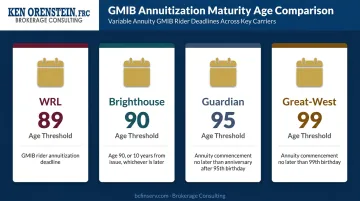
Read your specific contract — newer contracts have tended to push maturity dates later, but there's no universal rule.
Market Performance Changes Everything
Variable annuity account values fluctuate based on subaccount performance, and you bear the investment risk. This makes maturity timing uniquely consequential compared to fixed annuities.
If markets have declined significantly in the years before your maturity date, your contract value may be significantly lower than you expected. That affects which election makes financial sense:
- A depressed account value makes annuitization less attractive (lower income payments)
- It may make a 1035 exchange into a new contract with better terms worth considering
- It underscores why annuitization in a down market can lock in permanently reduced income
Payout Rates Are Based on Age at Maturity, Not at Purchase
Market conditions affect your account value, but your age at annuitization determines your payout rate. When you annuitize, the insurer calculates payments using your age at that time — not your age when you originally bought the contract. Both Guardian and WRL contracts confirm this in their filed language.
This cuts both ways. Older annuitants receive higher per-payment amounts because their life expectancy is shorter. If your maturity date arrives at 90 instead of 80, your monthly income payments will be meaningfully larger — but you'll have fewer years to receive them.
Your Options When a Variable Annuity Reaches Its Maturity Date
At maturity, you typically have four paths. Each carries different income, tax, and legacy implications. Understanding each one before the deadline arrives can save you from a costly default election.
Annuitize the Contract
Annuitization converts your accumulated contract value into a guaranteed stream of payments. Common payout structures include:
- Life only
- Joint life (covers a surviving spouse)
- Period certain (guaranteed for a fixed number of years)
- Life with period certain (combination)
Critical caveat: annuitization is generally irrevocable. Once elected, you give up control of the principal in exchange for the income guarantee. You also cannot change the payout option after the maturity date passes — both Guardian and WRL contracts confirm this explicitly.
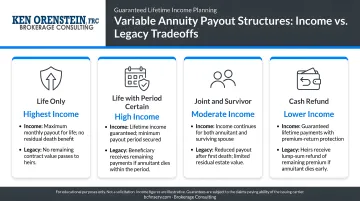
For contracts with income riders (GMWB or GMIB), annuitization is a separate election from activating the rider benefit. Traditional annuitization typically terminates most optional riders; payout is then based on actual account value or a guaranteed minimum depending on contract terms.
Surrender the Contract
A full surrender means receiving the contract's cash value as a lump sum. The tax consequences are immediate: all gains are taxable as ordinary income in the year of surrender, not as capital gains.
Two risks to weigh:
- If markets have declined, the surrender value may be below your original investment
- Even if surrender charges have expired (common at true maturity), the tax hit can be substantial on a large contract
Execute a 1035 Exchange or IRA Transfer
For non-qualified contracts, a Section 1035 exchange allows you to transfer the contract to a new annuity without triggering a taxable event. For IRA-based variable annuities, a direct trustee-to-trustee transfer accomplishes the same goal while preserving tax deferral.
This path is often worth exploring for owners who want:
- Lower all-in fees (variable annuity costs can exceed 3% annually)
- Different investment options or subaccount choices
- Updated income riders with stronger guarantees at current rates
An independent advisor can run a side-by-side VA replacement analysis across multiple carriers — comparing whether exchanging into a fixed indexed annuity or fixed annuity makes sense given your fee structure, income needs, and principal protection goals.
Request a Maturity Date Extension
Many insurers allow owners to extend the maturity date — often to age 95 or 100 — by submitting the appropriate form before the deadline arrives. This keeps the contract in the accumulation phase.
Notice requirements are strict. Brighthouse requires 30 days prior notice; Guardian requires 60 days. Great-West also requires 30 days to elect or change payout options. Don't wait for a letter from your insurer — by the time it arrives, you may have very little time to act.
What Happens to Riders and Death Benefits at Maturity
Two of the most valuable contract features — living benefit riders and the death benefit — can both terminate at the maturity date. Knowing exactly what happens to each one before that date arrives can prevent costly, irreversible mistakes.
Riders Are Often Terminated at Annuitization
Brighthouse's SEC-filed contract explicitly states that annuitizing terminates selected living benefit riders — including GMIB, GWB, and GLWB riders — if they're in effect. Great-West's contract states that if installments under a rider haven't begun by the annuity commencement date, the entire account value is annuitized and the rider benefit terminates.
The practical consequence: a GMWB benefit base that may have grown substantially over the accumulation period disappears at annuitization. The guaranteed benefit base no longer protects heirs or income after that event.
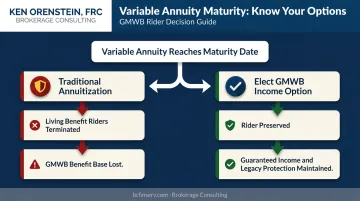
GMWB Activation Is Not the Same as Annuitization
If you have a GMWB rider and want to preserve it, you generally need to elect the GMWB income option rather than traditional annuitization. These are contractually different elections with different outcomes for income, liquidity, and legacy. Confirm the specific terms in your contract before the maturity date arrives.
Death Benefits End Before Maturity
The rider discussion above focuses on income guarantees — but the death benefit operates under a separate and equally firm deadline. The standard death benefit, which may exceed the contract value in a down market, is payable to beneficiaries only before the annuity commencement date. WRL's SEC-filed contract states explicitly that death benefit proceeds are not payable after the maturity date.
This means if the owner passes before the maturity date, the beneficiary receives the death benefit (which may be higher than the current account value). Once the contract annuitizes, that protection ends — and cannot be reinstated. Reviewing your maturity date well in advance gives you time to evaluate whether the current election still aligns with your legacy goals.
Tax Implications and RMD Rules at Maturity
Non-Qualified Contracts: Two Different Tax Regimes
Before annuitization (withdrawals and surrenders): Earnings come out first under LIFO (Last In, First Out) rules and are taxed as ordinary income. Many owners expect capital gains treatment — that's not how it works. The entire gain is taxable at ordinary income rates.
After annuitization: The insurer splits each payment between taxable earnings and a tax-free return of basis. The exclusion ratio — your investment in the contract divided by your expected return — determines what portion of each payment is excluded from income. Once you've recovered your entire basis, all remaining payments are fully taxable.
Qualified (IRA-Based) Contracts: RMDs Add Complexity
For IRA-based variable annuities, all distributions are generally fully taxable as ordinary income. RMD rules also apply:
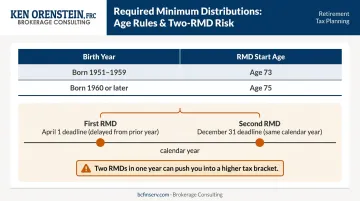
- Born 1951–1959: RMDs begin at age 73
- Born 1960 or later: RMDs begin at age 75 (under the SECURE 2.0 framework)
Delaying your first RMD to April 1 of the following year forces a second RMD by December 31 of that same year. Two RMDs in one calendar year can push you into a higher tax bracket and affect Medicare IRMAA thresholds.
The IRMAA Risk Nobody Mentions
A large taxable distribution from a variable annuity at maturity can trigger Medicare's Income-Related Monthly Adjustment Amount (IRMAA). 2026 IRMAA surcharges begin above $109,000 in individual MAGI (or $218,000 joint), based on your 2024 income (a two-year lookback). Monthly surcharges range from $81.20 to $487.00 on top of the standard Part B premium of $202.90.
A single-year taxable event from a large annuity surrender or annuitization election can push MAGI over multiple IRMAA thresholds, increasing Medicare premiums for two full years. Run a tax projection with your advisor before finalizing your election — the premium impact can persist for two years after a single distribution event.
Common Misunderstandings About Variable Annuity Maturity Dates
"Once surrender charges expire, I'm done." Not true. The surrender period ends the window for early withdrawal penalties. The maturity date — often decades later — is a completely separate milestone. Conflating the two can leave owners unprepared for a contractual deadline they didn't know was coming.
"The insurer will give me plenty of warning." Most contracts allow just 30–60 days to make elections or request extensions. Don't wait for a letter. Know your maturity date and start planning at least 12–18 months in advance.
That urgency makes the third myth especially costly.
"Doing nothing is safe." It isn't. Specific default payout options are contractually defined:
- Guardian defaults to monthly variable payments with a 10-year guaranteed period
- WRL defaults to Variable Life Income with 10 years guaranteed
- Great-West defaults to life income with 15 years guaranteed
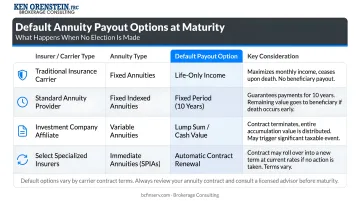
The default may not align with your income goals, tax situation, or legacy objectives. A proactive review with an independent advisor before the deadline ensures you're making an active, informed choice — not having one made for you. Ken Orenstein at Brokerage Consulting offers no-cost consultations specifically for situations like this.
Frequently Asked Questions
Do variable annuities have a maturity date?
Yes. Every variable annuity contract includes a maturity date (also called the annuity date or annuity commencement date), typically tied to the annuitant reaching a specific age — commonly 89, 90, 95, or 99 depending on the contract. At that point, the contract is expected to transition from accumulation to the payout phase.
What should I do when my annuity matures?
The right move depends on your income needs, tax situation, and whether you want to preserve riders or legacy value. Your main options are annuitizing, surrendering, doing a 1035 exchange, or requesting an extension. Review these with a financial advisor at least 12–18 months before the deadline.
What is the difference between the surrender period and the maturity date?
The surrender period (typically 5–10 years after purchase) is when early withdrawal penalties apply. The maturity date is a separate, later contractual milestone — often decades away — when the accumulation phase must end and an income election is expected. The two dates are distinct and should not be confused.
What happens to optional riders like a GMWB when a variable annuity reaches its maturity date?
Most optional riders, including GMWBs and GMDBs, terminate upon traditional annuitization at maturity. To preserve rider benefits, owners should consider activating the GMWB income option instead — a contractually distinct election from annuitization — per their specific contract terms.
Can I extend the maturity date on my variable annuity?
Many insurers allow extensions (often to age 95 or 100) by submitting the appropriate form before the maturity date. Notice requirements are tight — typically 30–60 days. Contact your insurer or advisor well in advance; don't wait for the insurer to reach out first.
Are distributions from a variable annuity at maturity taxable?
For non-qualified contracts, withdrawals are taxed as ordinary income under LIFO rules (earnings first), while annuitized payments use the exclusion ratio — part taxable, part tax-free return of basis. IRA-based variable annuities are fully taxable as ordinary income. Either way, large distributions can trigger Medicare IRMAA surcharges based on a two-year income lookback.