
This guide covers the legal transfer methods available for non-qualified annuities, how the Section 1035 exchange works in practice, the tax consequences of withdrawals and surrenders, and how to decide whether a transfer actually makes sense for your situation.
TL;DR — Key Takeaways
- Non-qualified annuities are funded with after-tax dollars; only the earnings are taxable when you withdraw
- A Section 1035 exchange is the primary tax-free transfer method — same owner, direct insurer-to-insurer transfer
- Ownership changes or cashing out first triggers ordinary income tax on all gains, plus a 10% penalty if you're under 59½
- Partial 1035 exchanges are allowed under IRS Revenue Procedure 2011-38, but withdrawals within 180 days can invalidate the tax-free status
- Surrender triggers taxes on earnings, possible surrender charges, and an early withdrawal penalty if you're under 59½
What Makes an Annuity "Non-Qualified"?
A non-qualified annuity is funded with after-tax dollars — money you've already paid income tax on. Because the principal was taxed before it went in, only the growth is taxable when you take money out. This contrasts with qualified annuities, which are funded with pre-tax dollars from IRAs or 401(k)s, where every dollar distributed is taxable.
According to IRS Publication 575, non-qualified annuities are commercial annuity contracts purchased directly by an individual investor, distinct from qualified employee plans.
For people who've already maxed out employer-sponsored retirement accounts, non-qualified annuities offer several practical advantages:
- No IRS contribution limits — you can fund them with as much after-tax money as you want
- No required minimum distributions (RMDs) — unlike IRAs or 401(k)s, no mandatory withdrawal age applies under federal law
- Tax-deferred growth — earnings compound without annual tax drag until withdrawn or annuitized
One eligibility constraint matters when it comes to transferring these contracts: to qualify for a 1035 exchange, the annuity must not have begun paying out income. Once annuitization starts, the contract is locked in and can no longer be exchanged.
Non-Qualified Annuity Transfer Options
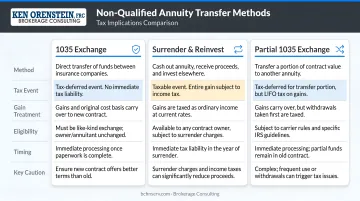
Three main paths exist for moving a non-qualified annuity. Only two of them avoid a tax bill.
| Transfer Method | Taxable? | Key Requirement |
|---|---|---|
| Full Section 1035 exchange | No | Same owner/annuitant, direct transfer |
| Partial 1035 exchange | Conditionally no | No withdrawals within 180 days |
| Ownership change or surrender | Yes | Gain recognized as ordinary income |
The 1035 Exchange: Tax-Free Transfer to a New Annuity
IRC Section 1035(a)(3) allows a non-qualified annuity to be exchanged for another non-qualified annuity without triggering a taxable event. The funds move directly between insurance companies — the annuity owner never touches the money. The original cost basis carries over to the new contract.
Key requirements for a valid 1035 exchange:
- The exchange must be annuity-to-annuity (non-qualified to non-qualified) — you can switch between fixed, variable, and indexed types without issue
- The owner and annuitant must remain the same on both contracts (Treasury Regulation 1.1035-1 uses the term "same obligee")
- Funds must move institution-to-institution — if you personally receive the check, the exchange is disqualified immediately
- Under IRC Section 1035(a)(4), a non-qualified annuity can also be exchanged for a qualified long-term care insurance contract tax-free
Even though a properly executed 1035 exchange isn't taxable, it still must be reported on your federal return. The transferring insurer will issue a Form 1099-R with Code 6 — keep this on file, as the IRS uses it to confirm the exchange qualifies for tax-free treatment.
Partial 1035 Exchanges
You don't have to move everything. IRS Revenue Procedure 2011-38 permits transferring only a portion of a non-qualified annuity's cash surrender value to a new contract — useful when you want to preserve an existing contract's terms while moving part of the balance to one offering higher participation rates, lower fees, or stronger income riders.
The critical rule: no withdrawals from either the original or new contract within 180 days of the transfer. If you take money out during that window, the IRS may treat the partial exchange as a taxable distribution rather than a tax-free exchange.
Additional considerations for partial exchanges:
- Not all insurers permit partial transfers — confirm before initiating
- Moving part of the balance can affect guaranteed income riders, death benefits, and other contract features
- The 180-day restriction does not apply to annuity payments received over 10+ years or for life
Ownership Changes and Surrenders
Transferring an annuity to a new owner — a child, sibling, or anyone other than a spouse — does not qualify as a 1035 exchange. Under IRC Section 72(e)(4)(C), the IRS treats this as a taxable distribution. The original owner recognizes the gain (earnings above cost basis) as ordinary income that year, plus a 10% early withdrawal penalty if under age 59½.
One narrow exception applies in divorce situations. Under IRC Section 1041, transferring an annuity to a spouse or former spouse as part of a divorce settlement — within one year of the marriage ending — is tax-exempt for the original owner. The receiving spouse then assumes full tax responsibility for future withdrawals.
How to Execute a 1035 Exchange: Step-by-Step
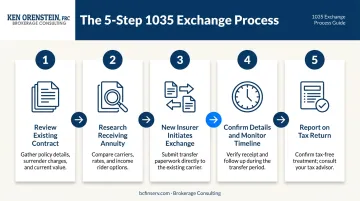
Step 1 — Review Your Existing Contract
Before doing anything, pull your current contract and check:
- Surrender charge schedule — these typically run 5–10 years and can cost as much as 9% of your contract value in early years
- Guaranteed benefits — living benefit riders, death benefit guarantees, and bonus interest that you'd forfeit
- Cash surrender value — your actual walkaway value after surrender charges
Request a current statement from your existing insurer showing both figures. If surrender charges wipe out the gains a new contract offers, the exchange doesn't make financial sense — that comparison comes next.
Step 2 — Research and Select the Receiving Annuity
Identify a replacement annuity that genuinely improves your situation. Compare:
- Interest rates or cap rates (for fixed or indexed annuities)
- Annual fees, particularly mortality and expense charges on variable annuities
- Income rider payout rates (GLWB or GMIB)
- Carrier financial strength ratings from A.M. Best, S&P, Moody's, and Fitch
The goal is a clear, documentable improvement. If you can't quantify it, the exchange may not be worth the cost or complexity.
Step 3 — Let the New Insurer Initiate the Exchange
The new insurer, not you, initiates the 1035 exchange process with your current insurer. You'll complete a 1035 exchange form with the new company. Never cash out the old annuity yourself and deposit the proceeds — this immediately converts a tax-free exchange into a fully taxable distribution.
Step 4 — Confirm Details and Monitor the Timeline
Most 1035 exchanges take 2–6 weeks. During that time:
- Confirm that the owner and annuitant names match exactly on both contracts
- Get written confirmation from the new insurer when the transfer is complete
- Don't initiate any partial withdrawals from either contract while the exchange is pending
Step 5 — Report the Exchange on Your Tax Return
A properly executed 1035 exchange is not taxable, but it must still be reported. Your Form 1099-R should show Code 6 in Box 7. Work with a tax professional to confirm this coding, because an incorrectly coded 1099-R can result in the IRS treating the exchange as a taxable event.
Ken Orenstein at Brokerage Consulting provides 1035 exchange analysis as part of the annuity advisory process, reviewing surrender charges, carrier ratings, and income rider comparisons to help clients assess whether a transfer makes sense for their situation.
Tax Implications of Transfers, Withdrawals, and Surrenders
The LIFO Rule: Earnings Come Out First
For non-qualified annuities purchased after August 13, 1982, the IRS applies Last-In, First-Out (LIFO) treatment to withdrawals. Every dollar you withdraw is treated as coming from earnings first — fully taxable as ordinary income — until you've pulled out all accumulated gains. Only then do withdrawals become a tax-free return of your original investment.
This means a partial withdrawal is almost never a "partial tax" situation. If your annuity has significant earnings, even a small withdrawal can be fully taxable.
The Exclusion Ratio for Annuitized Payments
If you convert your annuity into an income stream (annuitization), the IRS applies an exclusion ratio to each payment. This ratio separates the tax-free return of your cost basis from the taxable earnings portion, based on your life expectancy at the time annuitization begins.
For example, if your cost basis represents 60% of your total expected payments, then 60% of each payment is tax-free and 40% is taxable — until your basis is fully recovered. Once you've received payments long enough to exhaust your original investment, all subsequent payments are fully taxable. There's no ongoing tax-free portion after that point.
Unlike withdrawals subject to LIFO, annuitized payments spread the tax burden across your payment stream rather than front-loading it — an important distinction when comparing payout strategies.
Early Withdrawal Penalty: IRC Section 72(q)
Withdrawals from a non-qualified annuity before age 59½ trigger a 10% federal early withdrawal penalty on the taxable (earnings) portion, in addition to ordinary income tax. This applies under IRC Section 72(q) — the non-qualified annuity equivalent of the Section 72(t) penalty that applies to qualified plans such as IRAs and 401(k)s.
Full Surrender: What to Expect
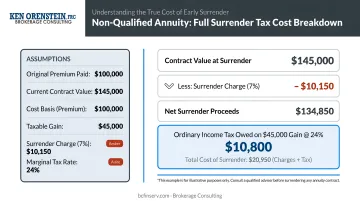
Surrendering a non-qualified annuity triggers immediate tax consequences:
- Taxable amount: The earnings portion (current value minus your original cost basis)
- Surrender charges: Deducted directly by the insurer before you receive proceeds
- Early withdrawal penalty: Applies to the taxable portion if you're under 59½
Example: If you invested $100,000 and your contract is now worth $150,000, the $50,000 in earnings is taxable as ordinary income in the year of surrender. Surrender charges reduce the proceeds you receive, and the 10% early withdrawal penalty applies to the $50,000 taxable earnings if you're under 59½ — so the combined tax cost can be substantial.
What a 1035 Exchange Does Not Carry Over
The cost basis and tax-deferred status transfer — but the surrender charge clock resets entirely on the new contract. You may be locked in for another 5–10 years. Favorable guaranteed rates, bonus credits, or riders from your original contract are also forfeited. According to SEC investor guidance, a 1035 exchange can start a new surrender period lasting up to 10 years, with charges as high as 9% of purchase payments in the early years.
When a Transfer Makes Sense — and When It Doesn't
Good Reasons to Transfer
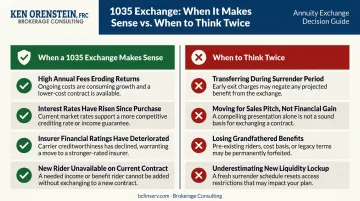
A 1035 exchange makes clear financial sense when:
- Your current annuity carries high annual fees eroding returns — variable annuities can exceed 3% per year when combining M&E charges, administrative fees, sub-account expenses, and living benefit rider costs
- Interest rates have risen significantly since purchase, and a current-market MYGA would offer meaningfully better guaranteed rates
- Your current insurer's financial strength ratings have deteriorated
- A new contract offers a rider your current contract lacks — such as a guaranteed lifetime withdrawal benefit or long-term care coverage
Before moving forward, document the specifics: a side-by-side fee comparison, the rate differential between contracts, and the net benefit after any surrender costs. A clear paper trail protects the decision.
Reasons to Think Twice
The most common transfer mistakes:
- Transferring during a surrender period — surrender charges can cost 5–10% of contract value, wiping out any benefit from switching
- Moving for a sales pitch, not a financial advantage — a new bonus credit or introductory rate doesn't automatically justify resetting your surrender clock
- Losing grandfathered benefits — older contracts sometimes carry higher guaranteed payout rates or death benefit structures unavailable in today's market
- Underestimating the liquidity impact — a new 7–10 year surrender period significantly limits access to funds
Federal employees face an additional layer of complexity. A non-qualified annuity sits outside FERS, Social Security, and TSP — but how it's positioned relative to those income sources matters for both tax planning and income sequencing.
Ken Orenstein at Brokerage Consulting specializes in federal retirement income planning and can evaluate how a non-qualified annuity transfer fits within a broader federal retirement strategy.
Frequently Asked Questions
How do you transfer a non-qualified annuity?
The standard method is a direct Section 1035 exchange, initiated by the new insurance company. Funds move institution-to-institution — the owner never takes possession of the money. Both contracts must carry the same owner and annuitant; any change in either triggers a taxable event.
What can a non-qualified annuity be exchanged tax-free for?
Under Section 1035, a non-qualified annuity can be exchanged tax-free for another non-qualified annuity — fixed, variable, or indexed — or for a qualified long-term care insurance contract. It cannot be exchanged tax-free for a qualified retirement account like an IRA or 401(k).
Can I roll over a non-qualified annuity?
Traditional rollovers don't apply to non-qualified annuities. The equivalent process is a 1035 exchange, which achieves the same result — moving funds without a taxable event — but follows different IRS rules. Non-qualified annuities cannot be rolled into an IRA.
What happens when you surrender a non-qualified annuity?
A full surrender triggers ordinary income tax on the earnings portion (growth above your original investment), surrender charges deducted by the insurer, and a 10% early withdrawal penalty under IRC Section 72(q) if you're under age 59½.
Is there a penalty for withdrawing before age 59½?
Yes — and it applies to partial withdrawals, not just full surrenders. The 10% IRC Section 72(q) penalty hits the taxable (earnings) portion of any distribution before age 59½. One exception: annuitizing the contract generally avoids the penalty entirely.
Do non-qualified annuities have required minimum distributions?
No. Because contributions were made with after-tax dollars, non-qualified annuities fall outside IRS RMD rules. Some individual contracts or state laws may set their own distribution schedules, so confirm the terms of your specific policy.