
An immediate annuity is the guaranteed monthly payment that begins within 30 days of your separation from federal service. Get it right, and you have a lifetime income floor that no market downturn can touch. Miss a key eligibility requirement or miscalculate your high-3, and the consequences are permanent.
The stakes extend well beyond your monthly check. Your immediate annuity status determines whether you can continue FEHB health coverage into retirement, whether you qualify for the FERS Annuity Supplement, and when cost-of-living adjustments begin — making it one of the most consequential decisions in your entire federal career.
TLDR: Key Takeaways
- A federal immediate annuity starts within 30 days of your separation — not months or years later
- FERS eligibility turns on age/service combos: 62 with 5 years, 60 with 20 years, or MRA with 30 years (unreduced)
- Your annuity = high-3 average salary × years of service × 1% (or 1.1% at age 62+ with 20+ years)
- Immediate retirement unlocks FEHB continuation and the FERS Annuity Supplement — deferred retirement forfeits both
- Interim payments begin within 7 days of OPM receiving your complete application; full processing averages 78 days
What Is a Federal Retirement Immediate Annuity?
OPM defines an immediate annuity as a retirement benefit that "starts within 30 days from the date you stop working." That 30-day window is what separates an immediate annuity from deferred and postponed annuities, where payments begin at a much later date.
Both FERS (Federal Employees Retirement System) and CSRS (Civil Service Retirement System) offer immediate annuities, though with different eligibility rules and calculation formulas. CSRS closed to new entrants in 1987, so the vast majority of today's federal workforce is under FERS. This guide emphasizes FERS rules throughout, with CSRS noted where the differences are meaningful.
Why Immediate vs. Deferred Matters More Than Most Employees Realize
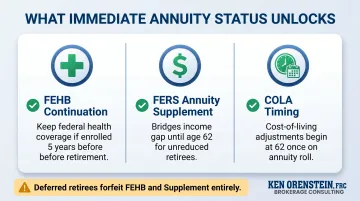
Choosing immediate retirement isn't just about when your check arrives. The retirement type you qualify for determines access to three other major benefits:
- FEHB continuation — Only immediate retirees (meeting the 5-year enrollment rule) can keep federal health coverage; deferred retirees lose it entirely during the waiting period
- FERS Annuity Supplement — Available only to immediate, unreduced retirees under age 62; not available to deferred or MRA+10 reduced retirees
- COLA timing — FERS COLAs don't begin until age 62 for most retirees, but the clock starts only once you're on the annuity roll
For federal employees, retirement planning centers on one core question: how much guaranteed monthly income will you receive for life? The immediate annuity is where that answer starts — and what you qualify for shapes every benefit decision that follows.
Who Is Eligible for a Federal Immediate Annuity?
FERS Voluntary Immediate Retirement
OPM's eligibility rules outline four combinations for unreduced and reduced immediate retirement under FERS:
| Age | Years of Service | Annuity Type |
|---|---|---|
| 62 | 5+ | Unreduced |
| 60 | 20+ | Unreduced |
| MRA | 30+ | Unreduced |
| MRA | 10–29 | Reduced (5% per year under age 62) |
The MRA+10 reduction is permanent — 5% for every year you're under 62 when the annuity begins. An employee retiring at MRA of 57 with 10 years of service faces a 25% permanent cut compared to waiting until 62.
FERS Minimum Retirement Age (MRA) Table
Your MRA depends on your year of birth:
| Year of Birth | MRA |
|---|---|
| Before 1948 | 55 |
| 1948 | 55 and 2 months |
| 1949–1952 | 55 and 4–10 months (incremental) |
| 1953–1964 | 56 |
| 1965–1969 | 56 and 2–10 months (incremental) |
| 1970 and after | 57 |
Most employees born between 1953 and 1964 share an MRA of 56 — the largest single cohort in the federal workforce.
CSRS Eligibility
CSRS operates on a separate track from FERS. Immediate retirement requires one of these combinations, plus service in a CSRS-covered position within the last two years before retirement:
- Age 62 with 5 years of service
- Age 60 with 20 years
- Age 55 with 30 years
Special Categories and VERA
Two groups face different eligibility thresholds than standard FERS or CSRS employees:
- Law enforcement officers, federal firefighters, and air traffic controllers can retire at age 50 with 20 years of covered service, or at any age with 25 years. They also receive a higher computation rate — 1.7% for the first 20 years of covered service under FERS.
- VERA (Voluntary Early Retirement Authority) temporarily mirrors those same thresholds (age 50 with 20 years, or any age with 25 years) — but only when an agency receives OPM approval during a restructuring or downsizing event.
What Counts as Creditable Service?
Not all federal work counts automatically. Creditable service includes:
- Career and career-conditional federal civilian service with FERS deductions withheld
- Military service (honorably discharged), generally requiring a deposit for service after 1956
- Peace Corps and VISTA volunteer service
- Prior federal civilian service where deductions weren't withheld — only if a deposit is paid (typically 1.3% of basic pay plus interest)
Verify your Official Personnel Folder is complete before setting a retirement date. Missing service records are one of the most common sources of processing delays.
How Is Your Federal Immediate Annuity Calculated?
The FERS Formula
OPM's computation rules use a straightforward formula — but the multiplier changes depending on your age and years of service at retirement:
| Retirement Condition | Multiplier |
|---|---|
| Under 62, OR age 62+ with fewer than 20 years | 1% × high-3 × years of service |
| Age 62 or older with 20+ years | 1.1% × high-3 × years of service |
That 0.1% difference sounds small. Over a 30-year retirement, it isn't.
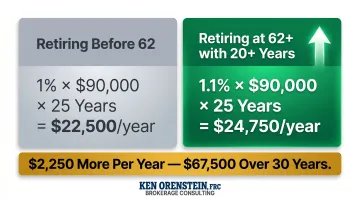
Example: An employee with a $90,000 high-3 and 25 years of service:
- Retiring before 62: $22,500/year (1% × $90,000 × 25)
- Retiring at 62+: $24,750/year (1.1% × $90,000 × 25)
That's $2,250 more per year — or roughly $67,500 over 30 years — just from waiting until 62 with 20+ years of service. For federal employees near that milestone, this is one of the most important numbers in retirement planning.
Defining Your High-3 Average Salary
Your high-3 is the average of your highest 36 consecutive months of basic pay — typically your final three years.
What counts toward your high-3:
- Basic salary
- Locality pay
- Shift differentials (where retirement deductions are withheld)
What does NOT count:
- Overtime pay
- Bonuses or awards
- Lump-sum annual leave payments
The CSRS Formula
CSRS uses a tiered structure with an 80% cap:
| Service Period | Rate |
|---|---|
| First 5 years | 1.5% of high-3 |
| Years 6–10 | 1.75% of high-3 |
| Years 11+ | 2.0% of high-3 |
| Maximum | 80% of high-3 (reached at ~41 years 11 months) |
Sick Leave and Annuity Reductions
Unused sick leave adds service credit at retirement for computation purposes — but not for eligibility. OPM's conversion tables (pamphlet RI 83-8) translate your hours into additional months and days of service credit. Annual leave works differently: it pays out as a lump sum at separation and contributes nothing to your service calculation.
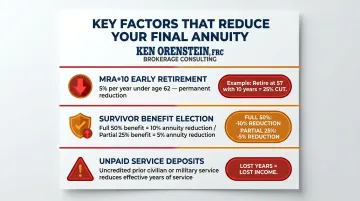
Beyond leave balances, several other factors can reduce your final annuity amount:
Key reductions to factor in:
- MRA+10 early retirement: 5% per year under age 62 (permanent)
- Survivor benefit election: Full (50%) benefit reduces your annuity by 10%; partial (25%) reduces it by 5%
- Unpaid service deposits: Uncredited prior civilian or military service reduces your effective years of service
Each of these variables can shift your annuity by thousands of dollars annually. Ken Orenstein at Brokerage Consulting is a credentialed Federal Retirement Consultant (FRC) who can run the numbers for your specific situation before you finalize a retirement date — at no cost. Reach him at (888) 315-3608 or bcfinserv.com.
How Federal Immediate Annuity Payments Work
Payment Schedule and the Interim Period
OPM pays annuities on the first business day of each month for the prior month. Your February payment, for example, covers January.
What surprises many new retirees: your first payments are interim amounts — typically around 80% of your estimated final benefit — while OPM completes the full adjudication.
According to OPM's published processing times, interim pay begins within 7 days of receiving a complete application, but final processing averages 78 days.
During the interim period, only federal income tax is withheld — health and life insurance premiums are not deducted until finalization, at which point they're applied retroactively. That retroactive deduction can catch retirees off guard if they haven't budgeted for it.
FERS COLAs: The Age-62 Gap
OPM's COLA rules create a meaningful difference between FERS and CSRS retirees:
| Retiree Type | When COLAs Begin |
|---|---|
| FERS (most retirees) | Age 62 |
| FERS disability retirees | Immediately |
| FERS special category (LEO, FF, ATC) | Immediately |
| CSRS (all retirees) | Immediately |
FERS COLAs are also capped relative to inflation when CPI exceeds 2%: in 2026, CSRS retirees received 2.8% while FERS retirees received 2.0%. For employees retiring well before 62, this gap compounds over multiple years without any inflation protection — which is one reason the FERS Annuity Supplement matters so much for early retirees.
The FERS Annuity Supplement
Federal employees who retire before 62 on an immediate, unreduced annuity may qualify for the FERS Annuity Supplement. It approximates the Social Security benefit you earned during your FERS-covered service and fills the income gap until age 62.
Three rules determine whether — and how much — you receive:
- Ends at age 62, regardless of whether you claim Social Security
- Not available for MRA+10 reduced retirements or deferred retirements
- Subject to a Social Security-style earnings test: in 2025, the exempt amount was $23,400; earnings above that reduce the supplement by $1 for every $2 over the limit
If you plan to work after an early federal retirement, model the earnings test before you retire — the reduction can be substantial.
Immediate vs. Deferred vs. Postponed Retirement: Key Differences
These three retirement types are among the most consequential — and most commonly confused — choices in federal retirement planning. Getting this wrong can cost you years of health coverage or thousands in avoidable benefit reductions.
| Feature | Immediate | Deferred | Postponed |
|---|---|---|---|
| When payments begin | Within 30 days of separation | Age 62 (or MRA with reduction) | Chosen future date after MRA+10 separation |
| FEHB continuation | ✅ Yes (if 5-year rule met) | ❌ No | ✅ Can re-enroll when payments begin |
| FERS Annuity Supplement | ✅ Yes (if unreduced, under 62) | ❌ No | ❌ No |
| COLA timing | Age 62 (most FERS) | Age 62 | Age 62 |
| Age penalty | None (or MRA+10 reduction) | May apply | Reduced/eliminated by delaying start |
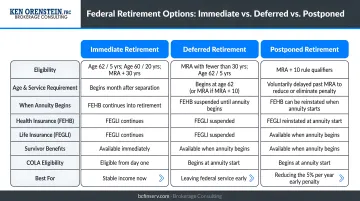
Deferred retirement applies when you leave federal service before meeting any immediate retirement criteria. You preserve your annuity entitlement, but you forfeit FEHB coverage for the entire waiting period — potentially years without federal health insurance.
Postponed retirement is specifically for MRA+10-eligible employees who delay their annuity start date to reduce or eliminate the 5% annual age penalty. The critical advantage over deferred retirement: you can re-enroll in FEHB when payments begin, provided you were enrolled at separation.
For employees near MRA with 10+ years but short of 30, postponed retirement often makes more financial sense than taking an immediate reduced benefit. The right answer depends on your specific benefit numbers, expected health insurance costs during the gap, and how long you plan to delay — which makes running the actual calculations essential before separating.
How to Apply for Your Federal Immediate Annuity
The Application Forms
| Retirement System | Form | Purpose |
|---|---|---|
| FERS | SF 3107 | Application for Immediate Retirement |
| CSRS | SF 2801 | Application for Immediate Retirement |
Both forms have three components:
- The employee-completed portion
- An agency-certified service record (completed by your HR office)
- A spousal consent/notification section
Recommended Timeline
OPM advises submitting at least 30 days before your separation date — and your agency HR office may want it even earlier. Here's why early submission matters:
- Agency personnel and payroll offices need time to certify your service record
- Incomplete documentation is the primary cause of processing delays
- The sooner OPM receives a complete package, the sooner interim pay begins
Before submitting, ensure your Official Personnel Folder reflects your complete service history. Service gaps or unresolved deposit balances that surface during processing add weeks to your timeline.
Retirement Date Strategy
Getting your timeline right is only part of the equation. Your actual retirement date carries its own financial consequences.
Under FERS, retiring at the end of a month or on the last day of a pay period is generally optimal. The timing affects:
- Continuity of pay between your last paycheck and the first interim annuity payment
- How your lump-sum annual leave payout interacts with the leave year calendar
- Coordination with Social Security filing timing and TSP withdrawal strategy
Coordinating your annuity start date with TSP distributions and Social Security filing requires careful sequencing — small misalignments can affect months of income. Ken Orenstein, author of The Informed Fed: A Survival Guide to Federal Employee Benefits, offers no-cost consultations specifically to model these scenarios. Call (888) 315-3608 before committing to a date.
Frequently Asked Questions
What is a federal immediate annuity?
A federal immediate annuity is a lifetime monthly retirement benefit paid to eligible federal employees that begins within 30 days of their separation from service. It's available under both FERS and CSRS, and unlike deferred retirement, it allows retirees to continue FEHB health coverage and receive COLAs once eligible.
Who is eligible for an immediate annuity from a federal civilian retirement system?
Under FERS, eligibility depends on age and service: age 62 with 5 years, age 60 with 20 years, or MRA with 30 years for a full benefit, or MRA with 10+ years for a reduced benefit. CSRS uses different thresholds, and special-category employees such as law enforcement officers and federal firefighters qualify earlier.
How are immediate annuities paid out?
OPM pays annuities monthly on the first business day of each month for the prior month. Initial payments are interim amounts (usually around 80% of the final benefit) while OPM completes adjudication, which averages 78 days. The remaining balance is paid as a lump sum once adjudication is complete.
Is a FERS annuity paid for life?
Yes. FERS pays a lifetime benefit that continues as long as the retiree lives. Retirees can also elect a survivor annuity for a spouse or eligible beneficiary, though this reduces the monthly benefit by 5% or 10% depending on the election level.
What happens to my FEHB coverage when I retire on an immediate annuity?
Federal employees who retire on an immediate annuity and have been enrolled in FEHB for the five years immediately before retirement can continue their health coverage into retirement. OPM pays the government's share of premiums, just as during active service. Employees with fewer than five years of service may still qualify if they were enrolled for all service since first eligible.