
That pitch is genuinely appealing. The problem is that EIAs are among the most complex financial products available to retail investors. The gap between how they're marketed and how they actually perform is wide enough that FINRA has specifically characterized them as complex instruments — not suitable for unsophisticated investors. Before committing to one, you need to understand exactly how the mechanics work, what the fine print costs you, and whether the product actually fits your situation.
Key Takeaways
- EIAs credit interest based on a market index (usually the S&P 500), but the minimum return guarantee applies to only 87.5–90% of premiums — not your full balance
- Caps, participation rates, spreads, and excluded dividends significantly limit upside compared to holding index funds directly
- Gains are taxed as ordinary income, not capital gains — and there's no step-up in basis at death
- Agent commissions on 10-year fixed-index annuities run 6–8%, according to AARP
- EIAs suit conservative investors with long time horizons; they're poorly suited for anyone needing near-term liquidity
What Is an Equity-Indexed Annuity?
An equity-indexed annuity is a type of fixed annuity issued by an insurance company. Instead of crediting a flat, predetermined interest rate, the insurer ties credited interest to the performance of a stock market index (most commonly the S&P 500) while also guaranteeing a minimum interest rate, typically 1–3% on at least 87.5% of premiums paid, according to FINRA.
That last detail is easy to miss: the minimum guarantee doesn't apply to your entire premium. It applies to a portion of it, meaning the effective floor is lower than it first appears.
Where EIAs Sit on the Annuity Spectrum
EIAs occupy a middle position between two better-known products:
| Product | Market Exposure | Principal Guarantee |
|---|---|---|
| Traditional Fixed Annuity | None | Yes — fully predetermined rate |
| Equity-Indexed Annuity (EIA) | Indirect — index-linked | Partial — minimum rate on portion of premium |
| Variable Annuity | Direct — investment subaccounts | No — value fluctuates with markets |
They're not variable annuities. You don't directly own securities, and you don't bear full market risk. They're also not traditional fixed annuities, because returns aren't fully predetermined. The upside potential is higher than a fixed annuity; the downside protection is stronger than a variable annuity.
There's also a regulatory distinction worth understanding: most standard EIAs are regulated by state insurance commissioners and are not registered as securities with the SEC or FINRA. This means the person selling you one needs a state insurance license but not necessarily a securities license, which affects what disclosures are required and what oversight applies to the sale.
How Equity-Indexed Annuities Work: The Mechanics
EIAs have two phases. During the accumulation phase, premiums earn interest tied to the linked index. During the distribution phase, the contract begins issuing periodic payments. These are designed as long-term retirement vehicles — FINRA confirms surrender periods commonly run 6 to 10 years or longer.
Three Crediting Methods
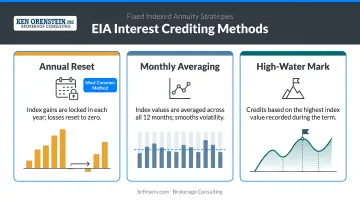
How your interest is actually calculated depends on which crediting method the insurer uses. The three most common:
Annual reset (point-to-point): Measures index performance from the start to the end of each contract year. If the index drops in a given year, that loss doesn't carry forward — you simply receive zero credit for that year rather than a negative. In a sustained down market, that floor matters.
Monthly averaging: Calculates the average index value across all 12 months of the term. This smooths out volatility but can underperform annual reset in a strong bull market, because gains made late in the year are diluted by lower values recorded earlier in the year.
High-water mark: Looks at the index value at each contract anniversary and uses the highest recorded value compared to the starting value to calculate interest. Favorable in theory, but complex and less commonly available.
The Dividend Problem
EIAs calculate index gains based on price performance only — dividends are excluded. This cost rarely surfaces in sales presentations.
This matters more than most investors realize. According to Hartford Funds research, from 1960 to 2025, reinvested dividends and compounding accounted for 85% of the S&P 500's cumulative total return. Dividend income alone contributed roughly 30% of average annual total return over the same period.
Over a 20- or 30-year accumulation window, that gap between price-only crediting and total-return investing compounds into a meaningful difference in final account value.
Tax Treatment
The dividend exclusion is one cost. The tax structure introduces another tradeoff worth understanding. EIA gains accumulate tax-deferred — you don't owe taxes each year as interest is credited, which benefits long accumulation periods.
The catch: when you withdraw, gains are taxed as ordinary income, not at the lower capital gains rate. And unlike stocks or real estate, EIAs don't receive a step-up in basis at death. Beneficiaries inherit the tax liability on accumulated gains as income in respect of a decedent, per IRS Publication 575.
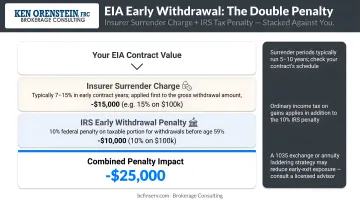
Withdrawals before age 59½ also trigger a 10% IRS penalty on the taxable portion, on top of any surrender charges from the insurer.
Key Terms That Affect Your Returns
The features below are the primary levers determining whether an EIA delivers meaningful returns or disappoints. Note that insurers can change many of these terms at renewal — so contract language deserves careful scrutiny before signing.
Participation Rate
The participation rate is the percentage of the index's gain that actually gets credited to your annuity.
Example: If the S&P 500 gains 15% and your participation rate is 80%, you receive a 12% credit — not 15%.
Participation rates can be adjusted by the insurer in subsequent contract periods. A rate that looks competitive at purchase may not stay that way.
Interest Rate Cap
The cap is an absolute ceiling on credited returns, regardless of how much the index gains.
Example: If the index rises 18% but your cap is 7%, you receive 7%. In a strong bull market, caps can dramatically limit your upside relative to simply owning index funds.
Spread, Margin, or Asset Fee
Some EIAs use a spread — a fixed percentage subtracted from any index gain before crediting occurs.
Example: An index gain of 10% minus a 3.5% spread yields a credited return of only 6.5%.
Some contracts use a spread in addition to a participation rate or cap, layering the reductions.
Surrender Charges
Surrender charges apply when you withdraw funds before the end of the surrender period. They can reduce your actual return — or produce an effective loss even when the contract has credited positive interest.
Example: A 7% surrender charge on a $100,000 withdrawal costs $7,000 out of pocket, regardless of credited gains.
Two penalties can stack if you withdraw early:
- Insurer's surrender charge — typically 7–10% in early years, declining over the surrender period
- 10% IRS early withdrawal penalty — applies to the taxable amount if you're under age 59½
The Pros and Cons of Equity-Indexed Annuities
Potential Advantages
EIAs offer a specific combination of features that appeals to conservative investors who still want some growth potential. The three core benefits:
- Principal protection means down years don't cost you. When the linked index declines, the minimum guarantee applies and annual reset crediting ensures losses don't carry forward — making this the central appeal for risk-averse investors who still want market exposure.
- Gains compound without annual taxation. For investors who've already maxed out 401(k) and IRA contributions, tax-deferred growth in a nonqualified EIA adds real value over long accumulation periods.
- You don't own securities directly, which insulates you from the day-to-day volatility that makes equity portfolios difficult to hold through bear markets.
Significant Drawbacks
The same structural features that create those protections also introduce meaningful limitations. Four drawbacks worth understanding before committing:
- Complexity is significant. FINRA has called these products "anything but easy to understand." Crediting methods, participation rates, caps, spreads, and renewal terms interact in ways that make accurate return projections nearly impossible without carrier-specific analysis.
- Commission costs are baked into the product. According to AARP's 2024 reporting, agent commissions on a 10-year fixed-index annuity range from 6% to 8%. You won't see this fee at purchase, but insurers structure caps and participation rates to recover it over the surrender period.
- Rider fees add up. A guaranteed lifetime withdrawal benefit (GLWB) rider introduces annual charges against the income base, reducing the net credited return available for accumulation.
- Dividend exclusion limits real growth. Crediting based on price-only index performance means you miss the component that has historically driven the majority of long-term equity returns.
How EIAs Compare to Other Annuity Types
Understanding where EIAs fit requires a direct look at how they stack up against other annuity types — particularly on protection, participation, and regulatory oversight.
| Feature | Fixed Annuity | EIA | RILA | Variable Annuity |
|---|---|---|---|---|
| Market linkage | None | Indirect (index-linked) | Indirect (index-linked) | Direct (subaccounts) |
| Principal guarantee | Full floor | Partial floor | Buffer only | None |
| Dividends included | N/A | No | No | Depends on fund |
| Regulatory oversight | State only | State only | SEC + State | SEC + State |
| Complexity | Low | High | High | Medium-High |
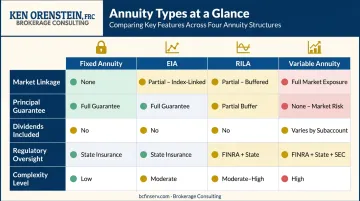
Registered index-linked annuities (RILAs) are the closest relative to EIAs, but with a key tradeoff: greater market participation in exchange for reduced downside protection. Where EIAs use floors (guaranteeing a minimum return), RILAs use buffers — absorbing the first X% of loss but leaving the holder exposed beyond that threshold. The SEC adopted new registration requirements for RILAs in 2024, making them registered securities subject to federal oversight. Standard EIAs carry no such federal registration requirement.
Because EIAs are insurance products, FDIC coverage doesn't apply. They're backed by the claims-paying ability of the issuing insurance company and covered by state guaranty associations, which NOLHGA reports provide $250,000 or more in annuity benefits across all member associations — though specific limits vary by state. That makes insurer financial strength ratings from A.M. Best, Moody's, S&P, and Fitch a meaningful factor in carrier selection.
Is an Equity-Indexed Annuity Right for You?
Who May Benefit
An EIA is most likely to serve someone who:
- Is at or within a few years of retirement
- Has a moderately conservative risk tolerance and a genuine fear of principal loss
- Has a long enough horizon to outlast the surrender period without needing the funds
- Has already secured base income from Social Security or a pension, and wants to add a protected growth layer on top
Federal employees approaching retirement are a practical example. Someone with a FERS pension providing reliable baseline income may find that rolling a portion of their TSP into an IRA — and then allocating part of that IRA to an EIA — creates a protected growth layer that complements their pension without exposing those assets to direct market risk.
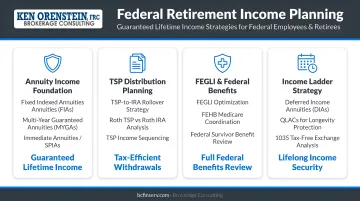
Ken Orenstein at Brokerage Consulting works specifically with federal employees on this type of integrated planning — evaluating how FIAs fit within the full FERS + Social Security + TSP income architecture before any product is recommended.
Who Should Likely Avoid EIAs
- Anyone who may need access to the funds within the surrender period
- Investors who want to fully participate in equity returns — including dividends
- Younger investors with decades until retirement who can absorb market volatility
- Anyone who doesn't fully understand the crediting method, participation rate, cap, or how insurer-adjustable terms could change after the first contract period
Getting Proper Guidance
The complexity of EIAs makes working with a knowledgeable, independent advisor essential. An advisor who can compare products across multiple carriers — evaluating caps, participation rates, income rider terms, surrender schedules, and carrier financial strength side by side — gives you a fuller picture than one limited to a single insurer's lineup.
Ken Orenstein's practice at Brokerage Consulting offers no-cost initial consultations — by phone, virtually, or in person — specifically for annuity suitability reviews. As an independent broker representing multiple top carriers including Aetna, Humana, and TransAmerica, he conducts side-by-side product comparisons rather than being limited to a single carrier's offerings.
To schedule a review, contact his office at (888) 315-3608 or request a consultation at bcfinserv.com/request-a-quote.
Frequently Asked Questions
What is an equity-indexed annuity?
An EIA is a fixed annuity issued by an insurance company that credits interest based on the performance of a stock market index — typically the S&P 500 — while guaranteeing a minimum return on a portion of premiums paid. It's designed as a long-term retirement savings vehicle, not a short-term investment.
Are equity-indexed annuities good?
EIAs suit conservative investors who want market-linked growth potential with principal protection. But caps on returns, excluded dividends, high agent commissions, and long surrender periods mean they're not the right fit for everyone. Individual circumstances and careful product comparison are essential before purchasing.
Is an equity-indexed annuity a security?
Most standard EIAs are not registered as securities and are regulated only by state insurance commissioners — so the seller needs a state insurance license but not necessarily a securities license. Some index-linked annuity products, like RILAs, are registered with the SEC and subject to federal oversight.
How can I tell if my annuity is fixed or variable?
A fixed annuity (including an EIA) guarantees at least a minimum return and doesn't expose your principal to direct market losses. A variable annuity's account value fluctuates with underlying investment subaccounts — meaning its value can fall with the market.
Is an IUL a variable annuity?
No. An Indexed Universal Life (IUL) policy is a life insurance product — not an annuity of any kind. It's structured as life insurance and serves a fundamentally different purpose in a financial plan, despite its cash value being index-linked.