
Income annuities are one structured solution worth knowing before you make any major retirement decisions. They won't be right for everyone — but for the right person, they can do something an investment portfolio simply cannot: guarantee you a paycheck for life, no matter how long you live.
This article covers what income annuities are, how they work mechanically, the difference between immediate and deferred types, what you can realistically expect to receive, and how to evaluate whether one belongs in your retirement plan.
Key Takeaways
- Income annuities convert a lump sum into guaranteed lifetime payments — no market exposure, no ongoing management required
- Two main types: SPIAs (near-term income, starting within 13 months) and DIAs (delayed income, used for longevity protection)
- A 65-year-old male purchasing a $100,000 single-life SPIA can expect roughly $623–$685/month at current rates
- Illiquidity is the biggest trade-off — once committed, the premium is generally not accessible as a lump sum
- Works best alongside Social Security, pensions, and liquid savings — not as a standalone income source
What Is an Income Annuity?
An income annuity is a contract between you and an insurance company. You pay a lump sum; the insurer guarantees a stream of income payments in return — either immediately or at a future date — for a set period or for the rest of your life.
Where income annuities differ from other annuity types comes down to purpose.
Income Annuities vs. Accumulation Annuities
Not all annuities work the same way. Variable and indexed annuities are designed to grow assets over time, with performance tied to market activity. Income annuities serve a different function: converting accumulated savings into predictable income.
Income annuities are a form of fixed annuity. Payments are not linked to stock market performance. Instead, they're determined at the time of purchase based on:
- The premium amount you pay
- Your age and gender
- Current interest rates
- The payout structure you select
Once the contract is issued, the payment amount is set. There's no rebalancing, no monitoring, and no withdrawal decisions to manage. The income arrives on schedule.
How Income Annuities Work
The Basic Mechanics
You pay a single premium to the insurer. The insurer pools that money alongside premiums from many other annuity purchasers, invests it in relatively conservative instruments — primarily investment-grade corporate bonds and Treasuries — and pays you back in regular installments: monthly, quarterly, or annually.
Annuity payouts track closely with prevailing interest rates on investment-grade bonds, which is why the rate environment at the time of purchase meaningfully affects how much you receive. Higher rates mean larger guaranteed payments.
Mortality Credits: The Math Behind Lifetime Guarantees
When annuity owners die earlier than statistically expected, the funds that would have continued paying them don't disappear — they stay in the pool and help fund payments to those who live longer. This redistribution is called a mortality credit.
It's the feature that allows an insurer to guarantee income for someone who lives to 100, even if the math on their premium alone wouldn't support it. The pooling across thousands of policyholders is what makes lifetime guarantees financially viable.
Tax Treatment
Growth inside an income annuity is tax-deferred. When payments begin, taxes are owed on the income received. The specifics depend on how the annuity was funded:
- Funded with pre-tax dollars (IRA, 401(k)): The full payment is taxable as ordinary income
- Funded with after-tax dollars: A portion of each payment is treated as a return of your original principal and is not taxable — this is calculated using what the IRS calls the exclusion ratio, covered in IRS Publication 575
For clients holding an existing annuity, a 1035 tax-free exchange can move those funds into a new income annuity without triggering a taxable event. Ken Orenstein at Brokerage Consulting conducts 1035 exchange analysis to compare older contract terms against current rates — a step worth taking before committing to a new purchase.
Death Benefits and Payout Options
Tax treatment determines what you pay — payout structure determines what your heirs receive. The two decisions are separate, and both matter. What actually passes to beneficiaries depends entirely on which payout option you select:
- Life only: Highest monthly payment, but income stops at death — nothing passes to heirs
- Period certain (10 or 20 years): If you die before the period ends, payments continue to a beneficiary for the remainder of that term
- Cash refund: If you die before receiving back your full premium, a lump sum goes to your beneficiary
- Joint life: Continues payments while either you or your spouse is living; income is lower than single-life to account for the longer payout period
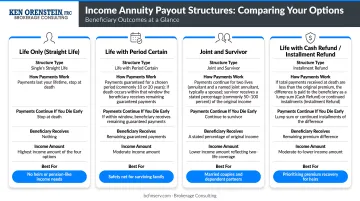
Each protection feature reduces the monthly payout. A life-only contract might pay $400/month more than a joint-life contract on the same premium — a meaningful gap if your spouse depends on that income.
Immediate vs. Deferred Income Annuities
Immediate Income Annuities (SPIAs)
A Single Premium Immediate Annuity (SPIA) does exactly what the name suggests. You make one lump-sum payment, and income begins almost immediately — often within 30 days, and always within 13 months of purchase, according to FINRA.
There's no accumulation phase. The premium goes directly into generating income, which makes SPIAs straightforward to compare across insurers. You look at what each carrier will pay for your premium, age, and chosen payout structure.
SPIAs are well-suited for retirees who need income now: someone who has just stopped working and wants to replace their paycheck, or someone supplementing Social Security and a pension with additional guaranteed monthly income.
Federal retirees who receive a pension buyout or a lump-sum rollover from the TSP often use SPIAs to convert that asset into predictable income without ongoing investment management.
Deferred Income Annuities (DIAs)
A Deferred Income Annuity (DIA) separates the purchase date from the income start date, sometimes by 5, 10, or even 20+ years. You lock in the income start date at purchase. The longer the deferral, the larger the eventual monthly payment, because mortality credits accumulate over the waiting period and the insurer has more time to generate returns on your premium.
DIAs serve a distinct strategic purpose: longevity insurance. Rather than funding your entire retirement from day one, a DIA can be purchased in your 60s to guarantee income beginning at 80 or 85 — the years when portfolio depletion becomes a real risk and managing investments becomes more burdensome.
A few important limitations to know:
- DIA contracts are generally irrevocable
- No cash surrender value
- No withdrawals permitted before the income start date
QLACs (Qualified Longevity Annuity Contracts) are a specialized form of DIA purchased inside an IRA or qualified plan. They carry the same deferred income structure, with an added tax benefit: premiums up to $200,000 (indexed for inflation) are excluded from Required Minimum Distribution calculations, making them a useful tool for retirees looking to reduce RMDs while insuring against late-in-life longevity risk.
Pros and Cons of Income Annuities
Key Advantages
- A life annuity contractually pays as long as you live — a direct hedge against longevity risk. Per SSA life tables, a 65-year-old woman has a 56% chance of reaching 85 and nearly 34% of reaching 90. An income annuity hedges that risk directly.
- Payments are completely fixed — a market crash in 2030 doesn't change what arrives in your account that month.
- The annuitized portion of your income requires no rebalancing decisions, no withdrawal strategy, and no sequence-of-returns anxiety.
Important Limitations
- The premium is locked in once committed. Keep separate liquid savings for emergencies before purchasing an annuity.
- A fixed payment buys less over 20 years. A COLA rider addresses this, but it reduces your starting payment and adds cost.
- The guarantee is only as strong as the insurer behind it. Ratings from A.M. Best, Moody's, and S&P matter. State guaranty associations typically protect up to $250,000 in present value of annuity benefits if an insurer becomes insolvent — important context for larger premium amounts.
That counterparty risk is exactly why carrier vetting belongs in every annuity review. Ken Orenstein's suitability process at Brokerage Consulting explicitly includes carrier financial-strength analysis (A.M. Best, Moody's, S&P, Fitch) alongside product feature comparison, ensuring payout rate isn't the only criterion.
How Much Can You Expect to Receive?
Payout amounts depend on several variables:
| Factor | Effect on Monthly Payment |
|---|---|
| Premium amount | Larger premium = larger payment (proportionally) |
| Age at purchase | Older annuitants receive higher payments |
| Gender | Males typically receive higher payments due to shorter average life expectancy |
| Interest rates | Higher rates = higher payments |
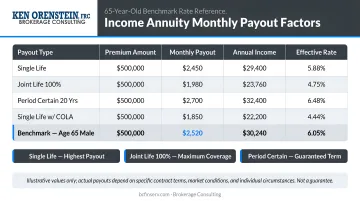
| Payout structure | Life only pays more than joint-life or period-certain |
| Optional riders | COLA, refund features reduce the base payment |
Benchmark Figures for a 65-Year-Old (Single-Life, Life Only)
Based on rates surveyed in May 2026 by ImmediateAnnuities.com for a $100,000 premium:
| Gender | Best Available | Market Average |
|---|---|---|
| Male | $685/month | $623/month |
| Female | $634/month | $596/month |
For larger premiums ($300,000, $500,000, or $1,000,000), payouts scale proportionally — but actual quotes vary by insurer and should be pulled directly from carriers for accuracy. Getting quotes from multiple insurers is essential, since payout rates vary meaningfully across the market.
Joint-life payouts covering both spouses will be lower than single-life payouts for the same premium. Adding a period-certain guarantee or death benefit rider reduces the monthly amount further. Each reduction reflects a deliberate trade-off: accepting less monthly income in exchange for protecting a spouse or leaving a benefit to heirs.
Is an Income Annuity Right for You?
Who Benefits Most
Income annuities work best for people who:
- Have already covered basic expenses with guaranteed income sources (Social Security, pension) but have a remaining income gap to fill
- Maintain separate liquid savings for emergencies and unplanned costs
- Want predictable income without ongoing portfolio management decisions
- Have concerns about cognitive decline or the complexity of managing investments late in retirement
Federal Employees: A Natural Fit
Federal employees and retirees often represent an ideal profile. FERS already provides three income sources — the Basic Benefit Plan, Social Security, and TSP — but many retirees still face a gap between guaranteed income and monthly expenses. An income annuity can close that gap without requiring ongoing investment decisions.
Ken Orenstein's federal retirement planning practice structures income around four layers:
- Layer 1: Social Security
- Layer 2: Pension income
- Layer 3: Guaranteed lifetime income via annuity
- Layer 4: Discretionary portfolio for growth and emergencies
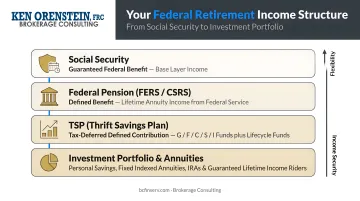
Income annuities sit in Layer 3 — converting a portion of TSP or other savings into a guaranteed income floor that supplements what FERS and Social Security provide.
For federal retirees considering annuity laddering — stacking a SPIA for immediate income with a DIA or QLAC for later-life coverage — that strategy can provide structured income across multiple decades while keeping part of the portfolio liquid and invested.
A Note on Suitability
Income annuities are one component of a retirement income plan, not a substitute for all savings. Before committing a significant premium, run a full retirement income analysis with an advisor who can evaluate your Social Security timing, pension elections, TSP distribution options, tax situation, and liquid asset needs together.
Ken Orenstein at Brokerage Consulting (bcfinserv.com | (888) 315-3608) offers no-cost initial consultations — phone, virtual, or in-person. As an independent broker representing multiple carriers, he can compare income amounts across the market to find the best fit for your situation.
Frequently Asked Questions
How much does a $100,000 income annuity pay per month?
A 65-year-old male purchasing a $100,000 single-life immediate annuity can currently expect roughly $623–$685 per month based on May 2026 market rates. Women typically receive slightly less — around $596–$634 — due to longer average life expectancy. Age, gender, payout structure, and current interest rates all affect the final number.
How much does a $300,000 income annuity pay per month?
Payouts scale roughly proportionally with the premium, so a $300,000 premium would produce approximately three times the monthly income of a $100,000 contract. Exact figures vary by insurer, so pulling live quotes from multiple carriers is the most reliable approach.
Are lifetime income annuities a good idea?
For retirees who prioritize income certainty and want protection against outliving their savings, lifetime income annuities can be a sound choice — but not for everyone. They're less suitable for those who need flexibility or anticipate large near-term expenses, and they work best as one component of a broader retirement income plan.
Can a lifetime income annuity run out of money?
A true lifetime annuity is contractually obligated to pay as long as you live — whether you reach 85 or 105. Period-certain and fixed-term annuities are different: they stop when the contract term ends. Knowing which type you hold matters.
Does income from an annuity affect SSDI benefits?
Annuity income is classified as unearned income by Social Security and does not count against SSDI earnings limits the way wages do. However, it may affect SSI eligibility or Medicaid qualification. If you receive both annuity income and SSI or Medicaid, a benefits specialist can clarify how the two interact.
Does atrial fibrillation affect income annuity rates?
Standard SPIAs and DIAs price based on age, gender, premium, and payout structure — not medical history. Conditions like atrial fibrillation generally don't affect standard annuity rates. That said, specialized products called impaired or enhanced annuities may offer higher payouts to applicants with serious health conditions and reduced life expectancy — a potential advantage worth exploring.