
Introduction
Your variable annuity's subaccounts are where your retirement money actually lives. They're not held in the insurer's general account or some abstract contractual promise — they sit in specific investment portfolios that rise and fall with market performance every business day.
Most annuity investors don't fully grasp what subaccounts are, how they're structured, or what they cost until they're already locked into a contract. That gap is expensive.
Fee layers that look modest in isolation can compound over decades into tens of thousands of dollars of lost growth. Subaccount choices made on last year's performance rarely serve a 20-year retirement timeline.
This guide covers what you need to evaluate subaccounts clearly before committing:
- How subaccounts are structured and how they work
- The main subaccount types and what each is designed to do
- The full fee picture — from expense ratios to mortality charges
- Selection criteria that match subaccounts to your actual retirement timeline
Key Takeaways
- Variable annuity subaccounts are individually managed investment portfolios held within a legally segregated separate account — you choose how your money is allocated
- They work like mutual funds but are classified as distinct securities, with tax-deferred growth and no annual capital gains distributions
- Common types include equity, fixed income, balanced, money market, and specialty/sector subaccounts
- Fees stack quickly across expense ratios, M&E charges, administrative costs, and optional rider add-ons
- The ability to reallocate between subaccounts without triggering a taxable event is one of the most underappreciated practical advantages of the structure
What Are Variable Annuity Subaccounts?
A variable annuity subaccount is a distinct investment portfolio within the annuity's separate account — a legally segregated master account that holds policyholder assets apart from the insurance company's general account. Under the Investment Company Act of 1940, the separate account is registered as a unit investment trust, and each subaccount within it invests in a specific underlying fund.
The Separate Account Distinction
This segregation matters more than most policyholders realize. Assets held in the separate account equal to contract liabilities cannot be used to satisfy the insurer's other liabilities, which provides meaningful protection in the unlikely event of insurer insolvency. The NAIC confirms that separate account assets and liabilities for variable products are maintained independently of the insurer's general account operations.
Each subaccount carries its own investment objective, professional management team, and expense structure. The policyholder — not the insurer — decides which subaccounts to use and what percentage of contributions to allocate to each.
How Accumulation Units Work
Instead of holding shares as you would in a mutual fund, subaccount investors hold accumulation units. Each subaccount has its own Accumulation Unit Value (AUV), recalculated daily after the NYSE closes. The new AUV is calculated by multiplying the prior AUV by a Net Investment Factor: a figure that reflects underlying fund performance minus applicable fee deductions.
That daily recalculation is what drives your account value up or down — and it connects directly to one of the most valuable features of the annuity structure: tax deferral.
The Tax-Deferred Advantage
Because subaccounts sit inside an annuity wrapper, the SEC confirms that policyholders can transfer money among investment options during accumulation without paying tax on gains at the time of transfer. IRS Publication 575 also confirms that variable annuity earnings are not taxed until distributed through withdrawals or annuity payments.
This tax deferral carries a practical benefit for portfolio management as well. Subaccount managers don't need to optimize for tax efficiency the way taxable mutual fund managers do — they can buy, sell, and rebalance without generating taxable distributions for policyholders. That's a structural freedom pure mutual fund ownership doesn't offer.
Types of Variable Annuity Subaccounts
Most variable annuities offer subaccounts spanning four broad categories: equity (capital appreciation), fixed income, balanced, and money market. Specialty/sector options also appear in many contracts.
Equity Subaccounts
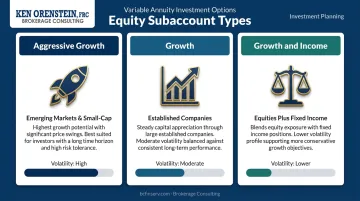
Equity subaccounts target capital growth and carry the highest risk-return profiles in the subaccount menu. Three primary types:
- Aggressive Growth — Targets maximum appreciation through emerging markets and small-cap stocks. Highest volatility; suited only to investors with long time horizons and genuine risk tolerance
- Growth — Invests in financially stable, established companies for steady long-term appreciation with moderate volatility
- Growth and Income — Combines equities with fixed income components to pursue appreciation alongside current income, with lower volatility than pure growth funds
International and global equity subaccounts are also common, offering exposure to foreign markets and potentially reduced portfolio correlation with U.S. economic cycles. That correlation benefit can meaningfully reduce portfolio volatility, though currency risk adds an exposure domestic equity investors don't face.
Fixed Income Subaccounts
Bond subaccounts serve income-generation and capital preservation objectives. The main categories:
- Corporate Bond — Investment-grade debt; returns influenced by issuer credit quality and bond maturity
- Government Bond — U.S. Treasury instruments and agency securities; no credit risk, but subject to interest rate sensitivity
- High-Yield Bond — Lower-rated debt with higher yield potential and meaningful default risk; appropriate only for investors comfortable accepting that default exposure
- Global/International Bond — Foreign fixed-income with diversification potential and currency exposure
Balanced and Money Market Subaccounts
These two categories serve investors who want simplicity or stability built into their allocation:
- Balanced subaccounts (sometimes called Total Return funds) — Mix equities, bonds, and convertible securities; suited to investors who want a single manager handling asset allocation rather than building their own mix across multiple subaccounts
- Money market subaccounts — The most conservative option, focused on capital preservation with modest yields; best used as a temporary hold during market uncertainty or a low-volatility anchor, not a long-term position
Specialty and Sector Subaccounts
Many contracts include dedicated subaccounts for sectors like real estate, technology, health care, utilities, energy, and precious metals. SEC-filed prospectuses from issuers like Principal list options spanning Technology, Health, Global Real Estate, and Natural Resources.
These carry the highest concentration risk in the subaccount menu. A sector fund's performance depends entirely on one industry's health — which can diverge sharply from broader market trends in either direction.
They can reduce overall portfolio correlation when the sector moves independently of your other holdings. Even so, keep allocations small; concentration this narrow amplifies downside just as fast as it amplifies upside.
How Variable Annuity Subaccounts Differ from Mutual Funds
Subaccounts often mirror mutual funds closely — managed by the same investment companies, following the same mandates, holding the same underlying securities. But the differences matter.
Regulatory and Structural Distinctions
FINRA confirms that variable annuity contracts contain both securities and insurance features and are regulated by FINRA, the SEC, and state insurance departments. The separate account itself is registered with the SEC under the Investment Company Act of 1940 — making it a distinct legal entity from any mutual fund it resembles.
Because subaccounts live inside a different registered entity, their historical performance records must be maintained separately. An investor comparing a subaccount to its mutual fund counterpart may find shorter track records and performance divergence due to fee and tax treatment differences.
Performance Differences That Affect Returns
Two structural differences have direct return implications:
- No annual capital gains distributions — Taxable mutual funds must distribute realized capital gains to shareholders annually. Subaccounts retain those gains within the tax-deferred shell, which benefits investors who rebalance frequently
- No tax-efficiency mandate — Subaccount managers aren't constrained by the need to minimize taxable distributions, giving them more flexibility in portfolio management decisions
That flexibility comes with a trade-off: annuity-specific fee layers that don't exist in direct mutual fund ownership. When evaluating a subaccount's historical performance, the underlying mutual fund's track record — where one exists — typically provides more useful context than the subaccount's own shorter history.
Understanding Variable Annuity Subaccount Fees
Fees are where variable annuities get complicated — and where many investors underestimate the long-term cost. Multiple layers stack on top of each other, and their cumulative effect compounds over decades.
The Fee Layers
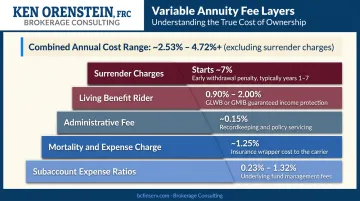
According to the SEC's investor guide, variable annuity costs typically include:
| Fee Type | Typical Range | Notes |
|---|---|---|
| Subaccount expense ratios | 0.23%–1.32% annually | Varies by asset class and strategy |
| Mortality & Expense (M&E) charge | ~1.25% annually | Compensates insurer for death benefit guarantee |
| Administrative fee | $25–$30/year or ~0.15% | Flat or asset-based |
| Living benefit rider charges | 0.90%–2.00% annually | Optional; charged on income base |
| Surrender charges | Often start at 7%, declining | Typically apply for 6–10 years |
Lincoln's 2024 SEC filing lists a base contract expense of 1.00% of average daily net assets in subaccounts, with underlying fund expenses ranging from 0.23% to 1.32%. Voya's 2024 filing shows underlying fund expenses of 0.48% to 0.69%. These are contract-specific numbers — your actual costs depend on the contract you hold.
Why Small Differences Compound Into Large Numbers
The fee gap between annuity products isn't theoretical. The SEC's investor bulletin on fees quantifies it directly: a $100,000 investment growing at 4% annually for 20 years reaches $219,112 with no fees. With a 1% ongoing fee, that same investment reaches approximately $180,000 — a difference of roughly $39,000.
A 0.25% fee on the same investment would result in a final value nearly $30,000 higher than a 1% fee scenario. When M&E charges, subaccount expenses, and rider fees combine — as they often do in variable annuity contracts — total annual costs can exceed 3%, erasing a substantial portion of long-term growth. That's why fee analysis sits at the center of any variable annuity suitability review, not at the margins. Brokerage Consulting's process accounts for each layer to give clients a clear picture of net-of-fee income projections before any contract decision is made.
How to Choose the Right Subaccounts for Your Retirement Goals
Subaccount selection is not a one-time decision. Markets shift, personal circumstances change, and an allocation appropriate at 55 may be poorly suited at 68.
Key Evaluation Criteria
The SEC recommends evaluating each subaccount option across several dimensions:
- Investment objective alignment — Each subaccount's stated goal should complement your overall retirement plan, not just look appealing in isolation
- Risk-adjusted performance — Morningstar's rating system applies to subaccounts with at least a 3-year history, with 5 stars assigned to the top 10% within each category — a useful starting point for comparison
- Expense minimization — A lower-cost subaccount with comparable risk-adjusted returns should generally be preferred over a higher-cost alternative
- Diversification — Spreading allocations across multiple categories reduces concentration risk
Federal Employees and Equity Tolerance
Federal employees with FERS pensions, Social Security, and TSP income already have a guaranteed income floor that most private-sector clients don't. That established base can support higher equity exposure within subaccounts, since the variable component isn't carrying the entire weight of retirement income. This is one of the planning nuances Brokerage Consulting examines when structuring variable annuity allocations for clients with existing pension coverage.
The Tax-Free Rebalancing Advantage
That allocation flexibility connects directly to one of the most underused structural advantages variable annuities offer: the ability to move money between subaccounts without triggering a taxable event. In a direct mutual fund account, selling a growth fund that has appreciated to rebalance into bonds generates a capital gains liability. Inside a variable annuity, the same transaction has no immediate tax consequence.
This makes it easier to maintain target allocations as markets shift. Investors shouldn't hesitate to rebalance when their allocation drifts — the tax friction that discourages rebalancing in taxable accounts simply doesn't apply here.
Common Mistakes When Selecting Subaccounts
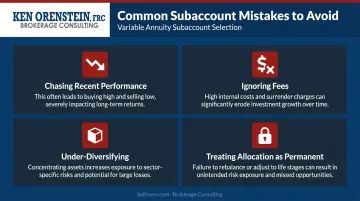
Several patterns consistently undermine subaccount performance:
- Chasing recent performance — Last year's top-performing subaccount is a poor guide to next year's returns. Long-term, risk-adjusted track records are more meaningful
- Ignoring fees — A subaccount with strong gross returns but high expense ratios may net less than a lower-yielding, lower-cost alternative after fees compound over 20 years
- Under-diversifying — Concentrating heavily in one sector or asset class amplifies volatility without proportionate return benefit
- Treating allocation as permanent — A subaccount mix that made sense at 55 often needs adjustment by 65, especially as the retirement income picture becomes clearer and risk tolerance shifts
Avoiding these mistakes requires looking at the complete picture — existing guaranteed income, tax situation, timeline, and how subaccounts interact with the rest of the retirement plan. For a no-cost review of how your subaccount allocation fits your goals, contact Brokerage Consulting by phone, virtual meeting, or in person at (888) 315-3608.
Frequently Asked Questions
Do variable annuities have subaccounts?
Yes. All variable annuities contain subaccounts — they are the investment portfolios within the annuity where policyholder funds are directed. The number and variety of subaccounts available depend on the specific contract and insurer.
What are examples of variable annuity subaccounts?
Common examples span several categories: aggressive growth, growth, growth and income, and international equity funds on the equity side; corporate bond, government bond, and high-yield bond on the fixed income side; plus balanced, money market, and specialty options such as real estate, utilities, or technology sector funds.
Does variable life insurance allow investment in subaccounts?
Yes. Variable life insurance products — including variable universal life — use subaccounts structured similarly to those in variable annuities. They reside in a separate account, grow tax-deferred, and allow the policyholder to allocate among investment options.
How are variable annuity subaccounts different from mutual funds?
While subaccounts often mirror mutual fund holdings, they are registered as distinct securities under the Investment Company Act of 1940. They don't distribute annual capital gains the way taxable mutual funds do, and they carry additional annuity-specific fee layers — M&E charges, administrative fees, and rider costs — that mutual funds don't include.
Can I switch between variable annuity subaccounts without paying taxes?
Yes. Transfers between subaccounts during the accumulation phase are not taxable events, as confirmed by both the SEC and IRS Publication 575. This is an advantage over direct mutual fund investing, where selling one fund to buy another can trigger capital gains taxes.
What fees should I expect with variable annuity subaccounts?
Expect four main layers: subaccount expense ratios (fund management fees), mortality and expense risk charges (approximately 1.25% annually per the SEC), administrative fees, and optional rider charges for living or death benefits. Total costs vary by contract and the options you elect.