
Get it right, and you have a predictable income floor for life. Get it wrong, and you may leave a surviving spouse without income, forfeit your principal early, or lock into a structure that doesn't match your actual cash flow needs.
This guide is written for retirees, pre-retirees, and federal employees who hold or are considering an annuity contract. We break down each of the six standard payout options, explain the "modal" frequency dimension, and identify the key factors that should drive your election — before you make an irrevocable choice.
Key Takeaways
- Annuitization converts accumulated annuity value into a guaranteed income stream; once elected, the choice is almost always permanent
- The six core modal payout options are: Period Certain, Life Only, Life with Cash Refund, Life with Period Certain, Joint Life and Survivor, and Joint Life with Period Certain
- Life Only pays the highest monthly income — but leaves nothing for beneficiaries; every other option trades some income for added protection
- "Modal" also describes payment frequency — monthly, quarterly, or annual — with over 85% of immediate annuity requests opting for monthly payouts (IRI)
- Your health, marital status, legacy goals, and cash flow needs should all shape which option you elect
What Is Annuitization and How Does It Work?
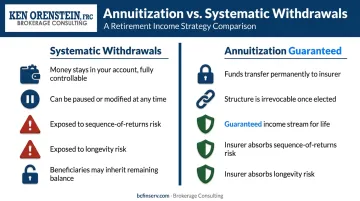
Annuitization is the formal process by which an insurance company converts a lump-sum annuity value into a guaranteed income stream. This is distinct from systematic withdrawals, which leave your assets in the account and can be paused or reversed at any time. Annuitization works differently: the money legally transfers to the insurer, which then assumes the longevity risk and commits to making payments under the terms you selected.
Every annuity contract moves through two phases:
- Accumulation phase — the period during which your contributions grow, tax-deferred, inside the contract
- Payout/annuitization phase — the period during which the insurer makes scheduled income payments to you based on the election you locked in at annuitization
The Four Parties in an Annuity Contract
Each party in an annuity contract has a distinct role that determines how benefits transfer at death:
- Contract owner — holds legal rights to the contract; can be an individual or a trust
- Annuitant — the person whose life expectancy drives the payment calculation
- Beneficiary — receives any remaining benefit at the annuitant's death, depending on the payout option selected
- Insurance company — issues the contract and guarantees the payment stream in exchange for the premium
In many contracts, the owner and annuitant are the same person. The distinction matters most when joint life, period certain, or cash refund features are involved, since those provisions determine what a beneficiary receives.
The 6 Common Modal Annuitization Payout Options Explained
Insurers typically offer six standard payout structures. Each represents a distinct trade-off between monthly income amount, payment duration, and beneficiary protection. The American Academy of Actuaries confirms that once the benefit payment option is selected and the contract is purchased, the choice generally cannot be changed — so understanding each option before you elect matters enormously.
Here's how each of the six options works — and who each one fits best.
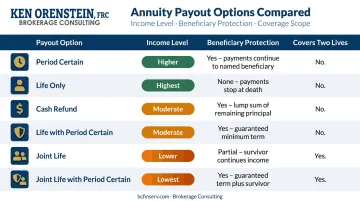
| Option | Income Level | Beneficiary Protection | Covers Two Lives? |
|---|---|---|---|
| Period Certain | Moderate | Yes (during term only) | No |
| Life Only | Highest | None | No |
| Life with Cash Refund | Moderate-High | Yes (principal refund) | No |
| Life with Period Certain | Moderate | Yes (during period) | No |
| Joint Life and Survivor | Lower | No (after both die) | Yes |
| Joint Life with Period Certain | Lowest | Yes (during period) | Yes |
Period Certain
This option guarantees payments for a fixed number of years — commonly 5, 10, 15, or 20 — regardless of whether the annuitant is alive. If the annuitant dies before the period ends, the beneficiary receives the remaining scheduled payments. When the guaranteed term expires, payments stop entirely, whether or not the annuitant is still living.
Best for: Individuals who need income for a defined window (such as bridging to Social Security) or who want beneficiary protection without lifetime coverage.
Key limitation: No income after the term ends. If you outlive the period, you receive nothing further — so this option should not serve as your only income source in retirement.
Life Only (Pure Life / Straight Life)
Life Only pays the highest monthly income of all six options. The calculation is based solely on the annuitant's life expectancy with no contingencies attached. Payments stop the moment the annuitant dies.
There is no death benefit, no residual payment to a beneficiary, and no refund of unused principal.
Best for: Single individuals in excellent health with no dependents, who want to maximize monthly income and are comfortable with the risk of early death forfeiting remaining value.
Key limitation: If death occurs early, the insurer retains the unused balance. A surviving spouse receives nothing.
Life with Cash Refund
This option guarantees two things: payments for life AND that the total amount paid out will equal at least the original premium. If the annuitant dies before receiving back their full initial deposit, the beneficiary receives the shortfall as a lump-sum cash payment.
Best for: Annuitants who want lifetime income but are uncomfortable losing their principal if they die early.
Key limitation: The monthly payment is lower than Life Only because the insurer takes on the additional refund obligation.
Life with Period Certain
This option combines lifetime income with a minimum guaranteed payment window — typically 10 or 20 years. If the annuitant dies within the chosen period, the beneficiary receives the remaining scheduled payments. Once the annuitant outlives the period, income continues for life but with no further death benefit.
Best for: Annuitants who want lifetime income protection but also want to ensure beneficiaries receive something if they die relatively early. This is the most commonly quoted immediate annuity structure — IRI reports it represents approximately half of all SPIA quote requests, with 10 years being the most common period chosen.
Key limitation: Once you outlive the certain period, no death benefit applies — the option shifts to a pure life structure.
Joint Life and Survivor
This option covers two lives — typically spouses — with payments continuing until the last survivor dies. At the first death, the survivor receives a pre-elected percentage of the original payment — typically 50%, 67%, or 100%.
Under IRS qualified plan rules, that survivor benefit must fall between 50% and 100% of the joint-life payment amount.
Best for: Married couples who need income to continue for whichever spouse lives longer, eliminating survivor income risk entirely.
Key limitation: Monthly income is lower than single-life options because the insurer is covering two lifetimes. No benefit passes to heirs after both annuitants die.
Joint Life with Period Certain
This option adds a minimum guaranteed period on top of joint life coverage. If both annuitants die before the guaranteed period ends, the beneficiary receives the remaining payments. It provides the broadest protection available across two lives — but also carries the lowest monthly payout of all six options because the insurer takes on the most risk (covering two lifetimes plus a guaranteed term).
Best for: Married couples who want both survivor income continuity and beneficiary protection in case both spouses die early.
Key limitation: The lowest starting income of any option. For couples with substantial other income sources, that trade-off may not be worth it.
Understanding Modal Payment Frequency
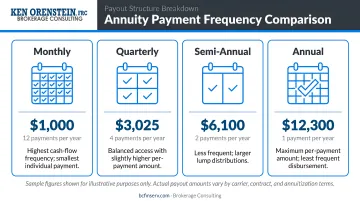
"Modal" in annuity contracts has a second meaning beyond payout structure: it also refers to how frequently payments are disbursed. The standard options are monthly, quarterly, semi-annual, and annual.
This choice is separate from the payout type you select above — and it's equally irrevocable once annuitization begins.
How Frequency Affects Your Effective Annual Payout
Payment frequency is an actuarial pricing input, not simply a scheduling preference. The Society of Actuaries' annuity factor calculator explicitly incorporates payment frequency and beginning/end-of-period timing as distinct variables. In practical terms:
- Monthly payments may result in a marginally lower effective annual total compared to annual disbursements, due to how insurers account for the timing of payments throughout the year
- Annual payments can produce a slightly higher effective total for the same contract, though the difference is typically modest
- Most annuitants choose monthly — IRI data shows more than 85% of immediate annuity quote requests specify monthly payment frequency, reflecting how retirees actually use annuity income (as a recurring paycheck replacement)
Choosing the Right Frequency for Your Cash Flow
The right modal frequency depends on your income architecture:
- Rely on annuity income for monthly expenses? Monthly mode aligns with how you spend — mortgage, utilities, groceries all arrive monthly
- Have other regular income sources (Social Security, pension)? Quarterly or annual modes may be worth evaluating for their marginally higher effective payouts
- Federal employees with FERS pension income: The pension itself is paid monthly, so complementary annuity income in quarterly or annual mode can be layered without creating cash flow gaps
For federal employees integrating a TSP rollover annuity with existing FERS and Social Security income, frequency decisions shouldn't be made in isolation. Coordinating payout timing across all income layers — pension, Social Security, and annuity — helps avoid cash flow gaps and reduces unnecessary tax friction.
Ken Orenstein at Brokerage Consulting works with federal retirees to align annuity payout timing with their broader retirement income picture, including FERS and Social Security income streams.
Key Factors to Consider When Choosing a Payout Option
Health and Life Expectancy
Your health status is probably the single most important variable in this decision:
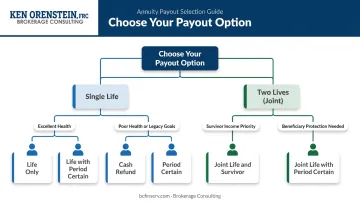
- In excellent health with family longevity? Life Only or Life with Period Certain options reward annuitants who outlive actuarial assumptions — the longer you live, the more favorable these options become
- Diagnosed with a serious condition? Period Certain or Cash Refund options ensure more of your premium is recovered, regardless of lifespan. Some carriers also offer medically underwritten or impaired-risk annuities that provide higher payouts for annuitants with reduced life expectancy — worth exploring if health is a factor
Insurers price payouts using actuarial mortality tables. Knowing where you sit relative to those assumptions helps you select the option that aligns with your realistic income horizon.
Marital Status and Dependent Needs
- Married: Strongly consider joint life options. Electing a single-life payout when a spouse exists could leave them without income at your death — a risk that's entirely avoidable
- Qualified plans (including TSP rollover annuities): IRS rules require written, witnessed spousal consent to waive a qualified joint and survivor annuity. Skipping this step isn't just inadvisable — in many plans, it's prohibited by regulation
- Single with no dependents: Single-life options become the stronger choice, since there is no survivor to protect
Legacy and Beneficiary Goals
- Want to pass remaining value to heirs? Favor Period Certain, Cash Refund, or Joint Life with Period Certain
- No estate planning objectives? Life Only maximizes your monthly check without any concession to legacy
- Have a trust or specific heir arrangement? Confirm how beneficiary designations interact with your chosen payout option before annuitizing
Tax Implications
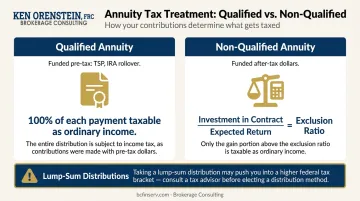
All annuity payouts are taxed as ordinary income — not capital gains. The tax treatment depends on how the annuity was funded:
- Qualified annuities (funded with pre-tax dollars, such as a traditional TSP or IRA rollover): 100% of each payment is taxable in the year received
- Non-qualified annuities (funded with after-tax dollars): Only the gain portion is taxable; IRS Publication 939 defines the exclusion percentage as your investment in the contract divided by expected return
- Lump-sum distributions: Treated as income in the year received, which can push you into a higher bracket in a single year — another reason annuitized income often makes more sense than lump-sum withdrawal
Flexibility vs. Permanence
Annuitization is generally irrevocable. The TSP, for example, explicitly states that once a life annuity is purchased, it cannot be changed or stopped. A small number of insurers permit partial commutations — an advance on a portion of future income payments — but these are exceptions, not standard features.
If you need flexibility to adjust income as circumstances change, consider whether a non-annuitization strategy better fits your situation before committing. Alternatives include:
- Systematic withdrawals from a deferred account
- Income riders on a deferred annuity
- A Guaranteed Lifetime Withdrawal Benefit (GLWB) rider
Ken Orenstein works with federal retirees to build tax-efficient retirement income plans that integrate annuity payouts with FERS pension, Social Security, and TSP distributions. A no-cost consultation is available at (888) 315-3608.
Common Misconceptions About Annuity Payouts
"Life Only always makes the most financial sense because it pays the most."
Life Only does produce the highest monthly check — but only if you live long enough for the math to work in your favor. Die early, and you forfeit the unpaid balance. Married? Your spouse receives nothing. Life Only fits specific situations, not every household. Evaluate it against your health, household structure, and legacy goals before assuming it's the right choice.
"Annuitization and systematic withdrawals are the same thing."
They are not. Systematic withdrawals leave your money inside the annuity contract, remain fully under your control, and can be modified or stopped at any time. Annuitization permanently transfers your funds to the insurer in exchange for guaranteed income.
The risk profiles differ fundamentally:
- Systematic withdrawals expose you to sequence-of-returns risk and longevity risk
- Annuitization transfers both of those risks to the insurer
"Once I choose a payout option, I can change it if needed."
Almost universally false. Most annuitization elections are irrevocable by contract — once payments begin, the structure is locked. This is why the pre-election analysis must be thorough. Before signing, work through:
- Current health and life expectancy
- Household income needs and monthly cash flow
- Marital status and spousal protection goals
- Beneficiary priorities and legacy intentions
- Preferred payment frequency (monthly, quarterly, annual)
Frequently Asked Questions
What is an annuitization option?
An annuitization option is the specific payout structure you choose when converting an annuity's accumulated value into a guaranteed income stream. It determines how long payments last, who receives them, and whether any benefit passes to a beneficiary at death.
What are common annuitization payout options?
The six primary options are Period Certain, Life Only, Life with Cash Refund, Life with Period Certain, Joint Life and Survivor, and Joint Life with Period Certain. Availability varies by insurer and contract type — not every carrier offers all six.
Which annuitization option offers the highest monthly payout?
Life Only (pure life) produces the highest monthly payment because it is calculated solely on the annuitant's life expectancy with no beneficiary protection or guaranteed minimum period.
What are common settlement options for beneficiaries of an annuity?
Beneficiary settlement options depend on the payout structure elected: continuing period certain payments, a lump-sum cash refund under the Life with Cash Refund option, or the remaining guaranteed period under a Period Certain or Life with Period Certain election. Under a Life Only election, beneficiaries receive nothing.
Is annuitization reversible once a payout option is selected?
Almost never. Once the payout option is elected and the contract is annuitized, the structure is fixed by contract terms — making the pre-election review of income needs and beneficiary goals essential.
How does modal payment frequency affect my annuity payout amount?
Monthly payments typically produce a slightly lower effective annual total than quarterly or annual disbursements, due to actuarial timing adjustments by the insurer. For most retirees, the cash flow predictability of monthly income outweighs that marginal difference.