
Life insurance settlement options are the payout arrangements insurers offer beneficiaries to determine how and when a death benefit gets distributed. The right choice depends on your immediate cash needs, long-term income goals, tax situation, and overall financial picture.
This article covers the five primary settlement options, how taxes apply to each, the key difference between "life insurance settlement options" and "life settlements," and a practical framework for making this decision.
Key Takeaways
- Five settlement options exist: lump sum (most common), interest only, fixed period, fixed amount, and lifetime income.
- Death benefit principal is generally federal-income-tax-free; interest earned under any other option is taxable as ordinary income.
- Policyholders can pre-designate an option, but beneficiaries typically make the final choice at claim time.
- "Life settlement" (selling a living policy to a third party) is an entirely different concept — don't confuse the two.
- Getting this decision wrong has lasting tax, income, and estate planning consequences.
What Are Life Insurance Settlement Options?
Settlement options are the formal payout methods insurers offer for distributing a death benefit after the insured dies. According to the NAIC, life insurance policies provide for a single payment of the death benefit but may also offer other payout options designed to fit different beneficiary needs. Who makes that choice, and how much flexibility exists, depends on how the policy was structured.
Who Makes the Decision?
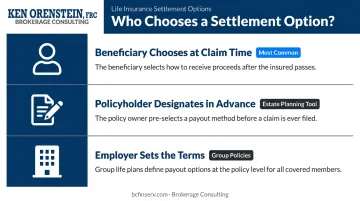
The answer varies by policy type and how it was set up:
- Beneficiary chooses at claim time — the most common scenario, giving the recipient flexibility based on their financial situation at that moment
- Policyholder designates in advance — a useful estate planning move that locks in the preferred method before death
- Employer sets the terms — for some group policies, the employer may have agreed to a specific payout structure, leaving beneficiaries with limited or no choice
Settlement options apply across all policy types — term, whole life, universal life. They determine how proceeds are paid out, not what kind of policy was purchased. Understanding this distinction helps beneficiaries evaluate their choices before a claim is filed.
The Five Main Settlement Options
Lump-Sum Payment
The lump sum is the most straightforward option: the beneficiary receives the entire death benefit in a single payment. As Nationwide notes, it's the most common type of life insurance payout.
Key advantages:
- Immediate, full access to funds
- Maximum flexibility — pay debts, invest, or cover expenses on your own timeline
- The principal is generally excluded from gross income under federal tax law
The main risk is mismanaging a large, one-time payment. Without a plan, windfalls can disappear to premature spending or missed investment opportunities. FINRA recommends treating any financial windfall with careful, structured planning before making major decisions.
Interest-Based Options
When you don't need the full death benefit immediately, interest-based options let the insurer hold the principal while still generating income. Two variations exist, and they're often confused:
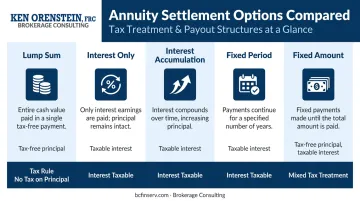
Interest Only: The insurer holds the full death benefit principal and pays you only the interest earned — monthly, quarterly, or annually. You can typically make withdrawals of principal if your circumstances change. This works well for beneficiaries who don't need the full amount immediately but want access if needed.
Interest Accumulation: Both the principal and earned interest stay with the insurer, compounding over time, until you choose to withdraw. Useful when you need time to plan and don't require income right away.
Critical tax point for both: Per IRS Publication 525, if an insurer pays interest on proceeds left on deposit, that interest is taxable income. The insurer will typically report it on a Form 1099-INT. The principal remains tax-free — only the interest earned is taxable.
Fixed Period and Fixed Amount Payments
These installment options convert the death benefit into a structured income stream.
Fixed Period: The insurer pays the death benefit in equal installments over a set time frame you select — say, 10 or 20 years. Remaining funds continue earning interest during that period, and the interest portion is included in each installment. Good fit for covering a specific financial obligation, like a mortgage, or bridging income until retirement benefits begin.
Fixed Amount: Instead of choosing a time frame, you specify a dollar amount per payment. Payments continue until the funds (plus accumulated interest) are exhausted. The duration varies depending on interest performance. If you die before the funds are depleted, remaining amounts typically pass to a contingent beneficiary.
Tax treatment for both: Each installment contains two components — an excludable principal portion and a taxable interest portion. Per IRS Publication 525, calculate the excludable portion by dividing the total death benefit by the number of installments; anything above that is taxable as interest income.
Lifetime Income Options
These function like an annuity — the insurer converts the death benefit into a monthly payment guaranteed for life.
Life Only (Life Income): Payments are calculated based on the death benefit amount and your age and life expectancy at claim time. The key limitation: payments stop at your death. No remaining balance passes to heirs. This option suits older beneficiaries or those primarily concerned with guaranteed income longevity, not legacy.
Lifetime Income with Period Certain: Guarantees payments for your lifetime or a minimum guaranteed period (such as 10 or 20 years) — whichever is longer. If you die early, payments continue to a secondary beneficiary for the remainder of the guaranteed term.
Two important cautions with lifetime income options:
- Once established, these arrangements typically cannot be changed
- No lump-sum withdrawals are generally permitted
For beneficiaries with existing pension income — such as FERS or CSRS retirees — the picture looks different than for someone with no other income source. Layering a lifetime income settlement on top of pension and TSP distributions can create income redundancy or gaps, so coordination with your overall retirement income plan is essential.
Life Settlements vs. Life Insurance Settlement Options
These two terms get confused constantly, and they describe completely different transactions.
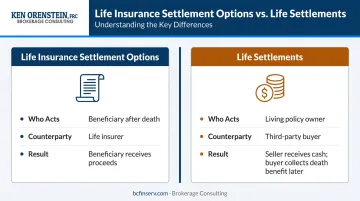
Life insurance settlement options are payout methods for beneficiaries after the insured dies.
A life settlement is a transaction where a living policyholder sells their policy to a third-party buyer for a cash amount greater than the cash surrender value but less than the death benefit. The buyer takes over premium payments and collects the death benefit when the insured eventually dies.
| Settlement Options | Life Settlements | |
|---|---|---|
| Who acts | Beneficiary, after death | Living policy owner |
| Counterparty | Life insurer | Third-party buyer |
| Result | Beneficiary receives proceeds | Seller receives cash; buyer collects death benefit later |
Life Settlement Market Data
According to LISA's 2024 Market Data, the life settlement market showed meaningful activity in 2024:
- Life settlement providers paid $601 million to consumers
- Total face value purchased reached $3.4 billion — an implied aggregate payout of roughly 17.7% of face value
- The average payout exceeded 6.5x the cash surrender value
Using that aggregate ratio as an illustration only: a $100,000 policy might yield roughly $17,700 — though actual amounts depend heavily on the insured's age, health, and policy type.
Life settlements work well for elderly policyholders who no longer need coverage and want liquidity. However, they carry legal, tax, and regulatory complexity — including IRS Form 1099-LS reporting requirements for the buyer. State regulation varies significantly. A no-cost consultation with a licensed advisor can help you evaluate whether a life settlement fits your situation before you commit.
How to Choose the Right Settlement Option
No single option fits every situation. A practical decision framework:
Consider lump sum if:
- You have urgent debts — mortgage payoff, funeral costs, medical bills
- You have strong investment knowledge and a clear plan for the funds
- You want maximum flexibility without ongoing insurer involvement
Consider fixed period or fixed amount if:
- You need income replacement for a defined period
- You want to bridge income until Social Security or pension benefits begin
- You have a specific recurring expense to cover (education, mortgage)
Consider lifetime income if:
- You're an older beneficiary without other guaranteed income sources
- You're concerned primarily about outliving your money
- You don't need to leave a financial legacy
Consider interest-only or accumulation if:
- You're not ready to decide and want time to plan
- You don't need the money immediately but want access preserved
For federal employees and retirees, this decision intersects with FERS or CSRS pension income, TSP distributions, and Social Security timing. A death benefit received on top of a stable government pension looks very different from one received by a surviving spouse with no other income stream.
Ken Orenstein at Brokerage Consulting specializes in life insurance planning and retirement income coordination for federal employees, individuals, and seniors across New Jersey and the broader Northeast. A no-cost initial consultation — by phone, virtually, or in person — can help you weigh your settlement options against your pension, TSP, and Social Security income. Reach his office at (888) 315-3608 or visit bcfinserv.com.
Tax Considerations
The tax rules here are straightforward but often misunderstood:
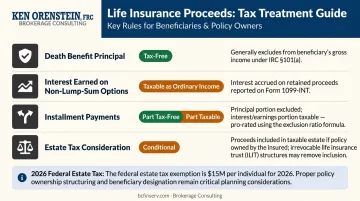
- Death benefit principal: You don't report it as income and you don't owe tax on it — it's excluded from gross income under federal law.
- Interest earned through non-lump-sum options: Fully taxable as ordinary income in the year received. This applies to interest-only, fixed period, fixed amount, and lifetime income options.
- Installment payments: Each payment contains a tax-free principal portion and a taxable interest portion. The insurer should provide a Form 1099-INT or Form 1099-R to document the split.
- Estate tax: If the policyholder's estate is the named beneficiary, or if the decedent owned the policy, the death benefit may be included in the gross estate. The federal estate tax basic exclusion amount is currently set at $15,000,000 for 2026. For large estates, this is worth evaluating with a tax advisor.
The settlement option you choose affects your annual tax liability every year the arrangement continues. This is particularly relevant if you're already in a high income tax bracket — years of taxable interest income from a fixed period option can push your effective rate higher each year the arrangement runs.
Frequently Asked Questions
What is the most common life insurance settlement option?
Lump-sum payment is widely considered the most common option because it provides immediate, full access to the death benefit. It's the default expectation for most beneficiaries and requires no ongoing relationship with the insurer after the claim is paid.
What is a fixed period settlement option?
The fixed period option pays the death benefit in equal installments over a set number of years you select. Remaining funds continue to earn interest during that time, and the interest is factored into the regular payments — with the interest portion taxable and the principal portion excluded.
What is the average payout for a life settlement?
Based on LISA's 2024 market data, consumers received $601 million on $3.4 billion of face value, roughly 17.7% of face value in aggregate and more than 6.5x cash surrender value. Actual proceeds depend on the insured's age, health, and policy specifics.
How much can you sell a $100,000 life insurance policy for?
Using LISA's 2024 aggregate data as an illustration only, a $100,000 policy might yield approximately $17,700. This is not a quote or guaranteed range; actual amounts vary considerably based on underwriting factors specific to each policy.
Are life insurance settlement options taxable?
The death benefit principal is generally income-tax-free. However, any interest earned through non-lump-sum options — including interest-only, fixed period, fixed amount, and lifetime income arrangements — is taxable as ordinary income in the year it's received.
Can a policyholder choose the settlement option in advance?
Some insurers allow policyholders to pre-designate a preferred settlement option for each beneficiary, which can be a useful estate planning tool. That said, in most cases the beneficiary retains the right to choose or adjust the option at the time of the claim, subject to what the policy contract and applicable state rules permit.