
These are technical actuarial terms that describe when payments occur within each period—not how quickly income begins after you buy a product. Getting this wrong means misreading contracts, miscalculating payment stream values, and making retirement income comparisons that don't hold up.
This article breaks down both structures clearly, shows you the math in plain English, and explains what actually matters for your retirement.
Key Takeaways
- Annuity immediate (ordinary annuity) = payments at the END of each period; annuity due = payments at the BEGINNING
- Because payments arrive sooner, an annuity due has a higher present and future value — at a 6% rate, the gap is $441.61 on a $1,000/year, 10-year stream
- Mortgages, car loans, and most pension distributions follow annuity immediate structure; rent and insurance premiums follow annuity due
- SPIAs, FERS/CSRS pensions, Social Security, and TSP annuities all pay after benefits accrue — annuity immediate structure
- Knowing which structure applies helps you compare offers accurately and avoid mispricing your income stream
Annuity Due vs. Annuity Immediate: Quick Comparison
| Feature | Annuity Immediate | Annuity Due |
|---|---|---|
| Payment Timing | End of each period | Beginning of each period |
| First Payment Date | One full period after start | Immediately at start |
| Present Value (relative) | Lower | Higher by factor of (1 + r) |
| Future Value (relative) | Lower | Higher by factor of (1 + r) |
| Common Examples | Mortgages, car loans, bond coupons, SPIAs | Rent, insurance premiums, some leases |
| Role in Retirement Planning | Governs most income products | Rarely used in formal retirement products |
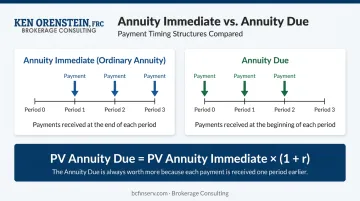
The formula connecting them: PV of annuity due = PV of annuity immediate × (1 + r), where r is the periodic interest rate. Every payment arriving one period earlier is worth slightly more today — it has less time to be discounted.
What Is Annuity Immediate?
Annuity immediate is the technical actuarial term for what most people call an ordinary annuity: a series of equal payments made at the end of each period. Per SOA Exam FM notation, it's also called an annuity in arrears.
The name confuses most people. "Annuity immediate" sounds like income starts right away — but historically, "immediate" distinguishes it from deferred annuities (where the entire payment stream is postponed for years), not from when within a period the payment lands.
How the Present Value Works
Each future payment gets discounted back to today. The further a payment sits in the future, the less it's worth now. For annuity immediate, every payment is discounted one full period because it arrives at the end.
Using a concrete example — $1,000/year, 10 years, 6% discount rate — the Financial Mathematics for Actuaries formula produces:
- Present Value: $7,360.09
- Future Value: $13,180.79
The last payment arrives at the end of period 10 and earns no additional interest after receipt — which is why, in this example, the annuity immediate future value comes in $813 below its annuity due equivalent ($13,994.79).
Common Annuity Immediate Use Cases
- Mortgage payments — paid at month-end after occupying the home
- Car loan repayments — paid after the loan period passes
- Corporate bond coupons — typically paid semiannually at period-end
- Structured settlement payments — industry default is end-of-period
- SPIAs and TSP life annuities — 2024 TSP materials confirm monthly payments begin approximately one month after purchase
For most retirees, this structure already governs their income — lenders and plan administrators have used end-of-period payments as the standard convention for decades. OPM confirms that FERS and CSRS annuity benefits are paid on the first business day of the month after the month in which they accrue, consistent with an annuity immediate framework. Social Security follows the same pattern: July's benefit arrives in August.
What Is Annuity Due?
Annuity due is a series of equal payments made at the beginning of each period. The first payment arrives immediately at the start date, and every subsequent payment arrives one period earlier than it would under an annuity immediate structure.
That one-period shift has real financial consequences. Each payment is available to earn interest for one additional period, which pushes both present value and future value higher.
The Value Advantage, Illustrated
Using the same numbers — $1,000/year, 10 years, 6% — the annuity due calculation multiplies the annuity immediate PV by (1 + 0.06):
- Present Value: $7,801.69 (vs. $7,360.09)
- Dollar advantage: $441.61
- Future Value: $13,971.64 (vs. $13,180.79)
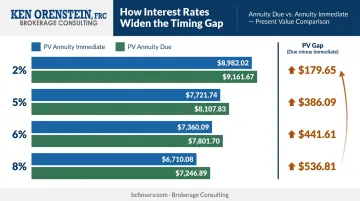
That 6% premium reflects the 6% discount rate used. The premium isn't a fixed "5–8%" across all scenarios — it equals the per-period rate. At 2%, the gap shrinks to $179.65; at 8%, it widens to $536.81 on this same payment stream. As the table below shows, the dollar gap scales directly with the rate — making timing more consequential in high-rate environments.
How Interest Rates Affect the Gap
| Rate | PV Annuity Immediate | PV Annuity Due | Dollar Gap |
|---|---|---|---|
| 2% | $8,982.59 | $9,162.24 | $179.65 |
| 5% | $7,721.73 | $8,107.82 | $386.09 |
| 6% | $7,360.09 | $7,801.69 | $441.61 |
| 8% | $6,710.08 | $7,246.89 | $536.81 |
Common Annuity Due Use Cases
- Rent payments collected before the tenant occupies the space
- Insurance premiums paid before coverage takes effect
- Equipment and property leases requiring advance payment at commencement
Annuity due structures appear far less often in formal retirement income products. This matters for one specific confusion worth clearing up: a "SPIA" or "immediate annuity" insurance product begins making income quickly after purchase, but those payments are internally structured as annuity immediate — end of period — not annuity due. Understanding this distinction helps you ask the right questions when evaluating payout timing and present-value calculations for any income annuity.
Which Structure Matters for Your Retirement?
Most retirees won't choose between these structures — your pension, Social Security, and any SPIA you purchase are already structured as annuity immediate. The selection happens at the product design level, not yours.
Where this distinction does matter:
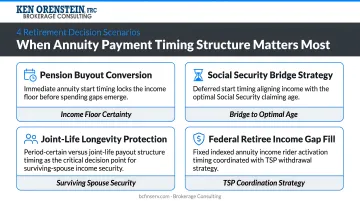
When Payment Timing Changes Your Decision
- Comparing a lump sum vs. periodic payments: Present value calculations depend entirely on whether payments are beginning-of-period or end-of-period. Misidentifying the timing overstates or understates the stream's value.
- Evaluating a structured settlement buyout: If two offers use different timing conventions, you're not comparing equivalent streams without adjusting for it.
- Reading annuity contract terms: Knowing whether your first payment arrives in 30 days (annuity immediate convention) or immediately changes your near-term cash flow expectations.
- Large, long-duration payment streams: The dollar gap grows with payment size and duration. On a $500,000 premium generating $3,000/month, the timing difference is no longer trivial.
Situational Guidance
| Your Situation | Relevant Structure |
|---|---|
| Buying a SPIA or pension-equivalent income | Annuity immediate (end-of-period) — industry default |
| Paying rent or insurance premiums | Annuity due (beginning-of-period) |
| Evaluating a pension buyout offer | Confirm timing before running present value |
| Comparing two annuity income quotes | Verify both use the same payment timing convention |
| Structuring loan repayments or bond investments | Annuity immediate |
For federal employees navigating FERS, CSRS, or TSP decisions, payment timing is one piece of a larger retirement income picture. At Brokerage Consulting, Ken Orenstein provides retirement income analysis covering annuity structures, lump-sum vs. periodic income comparisons, and federal benefit coordination.
To discuss your specific situation, schedule a no-cost consultation or call (888) 315-3608.
Conclusion
Annuity due and annuity immediate aren't competing products — they're structural descriptions of when payments occur. Understanding the difference helps you read annuity contracts accurately, make fair comparisons between income streams, and recognize when timing shifts the value of what you're being offered.
For most retirees, annuity immediate already governs their income. The practical payoff of knowing this terminology comes when evaluating pension buyout offers, comparing annuity quotes, or deciding between a lump sum and a payment stream. Getting that comparison right requires getting the timing right first.
Brokerage Consulting works with clients across FERS, CSRS, Social Security, SPIAs, and TSP distributions to build low-cost, tax-efficient retirement income plans tailored to each client's full financial picture. If you're approaching a retirement income decision, schedule a no-cost conversation with Ken Orenstein to work through the specifics of your situation.
Frequently Asked Questions
Are "immediate annuity" and "annuity due" the same thing?
No. "Annuity due" is a payment timing structure where payments occur at the beginning of each period. An "immediate annuity" (SPIA) is an insurance product where income begins shortly after purchase, but those payments are typically made at the end of each period — making it an annuity immediate structure internally, not annuity due.
How much does a $100,000 immediate annuity pay per month?
Payouts vary significantly by age, gender, and interest rates. According to Blueprint Income's 2024 data, a 65-year-old male might receive approximately $630/month and a female approximately $600/month for a $100,000 lifetime SPIA. These figures shift with market conditions. Consult a licensed advisor for a current, personalized quote.
What is the difference between annuity due and ordinary annuity?
The only difference is payment timing. Annuity due pays at the start of each period; ordinary annuity (annuity immediate) pays at the end. Because of this single shift, annuity due has a higher present value and future value than an equivalent ordinary annuity at the same interest rate.
Does an annuity due pay more per payment than an ordinary annuity?
The individual payment amounts are identical. The annuity due is worth more in total present value terms because payments arrive sooner — each one is discounted less. The advantage comes from timing, not a larger payment amount.
Which type of annuity is more common in retirement income products?
Annuity immediate (ordinary annuity) is the standard structure in retirement products — including SPIAs, most pensions, TSP annuities, and Social Security — with first payments typically arriving 30 days after the contract or benefit start date.
What real-world examples illustrate the difference?
Rent is a classic annuity due — you pay at the start of the month before occupying the space. A mortgage is a classic annuity immediate — you pay at the end of the month after living in the home. Insurance premiums are typically annuity due; car loans are typically annuity immediate.