Introduction
Most people contributing to an annuity couldn't tell you what it will actually be worth when they retire. That's not a criticism — it reflects a genuine gap in how annuities are understood. A 2025 TIAA Institute-GFLEC survey found that U.S. adults answered only 2.2 out of 6 retirement fluency questions correctly on average.
The future value of an annuity is the calculation that closes this gap. It tells you precisely how much a series of regular payments will accumulate to at a specific future date, given a fixed rate of return. Without it, decisions about contribution amounts, rate selections, and term lengths are guesswork.
This guide covers the definition, both core formulas, a fully worked example, and the key variables that drive the outcome. By the end, you'll know exactly how to project what your annuity is worth — and whether your current contributions get you there.
Key Takeaways
- Future value of an annuity = total worth of equal recurring payments at a future date, with compound interest included
- Ordinary annuities pay at period-end; annuities due pay at period-start and always produce a higher future value
- Three inputs drive the calculation: payment amount (PMT), periodic interest rate (r), and number of periods (n)
- Higher rates, longer timeframes, and more frequent compounding each push the future value higher
- The FV figure is a projection; fees, taxes, and inflation all affect what you actually receive
What Is the Future Value of an Annuity?
The future value of an annuity is the accumulated worth of a stream of equal, recurring payments at a designated future date, assuming those payments earn a consistent rate of return throughout the term. In practical terms: $400 a month invested over 20 years at 6% annual return doesn't sum to $96,000 — it compounds to over $185,000.
This is different from present value, which runs the calculation in reverse — it estimates how much a future stream of payments is worth in today's dollars. Future value looks forward; present value looks backward.
The Role of Compound Interest
Compound interest is what separates the future value of an annuity from a simple sum of contributions. Each payment earns interest not just on the principal amount, but on all previously accumulated interest — so each year's growth builds on a larger base than the year before.
The first payment you make has the most time to compound, while the last payment earns almost no interest at all. This is why starting earlier has such an outsized effect — a 10-year head start can add more to your final balance than doubling your contribution amount.
Ordinary Annuity vs. Annuity Due
Not all annuities calculate the same way. The two main structures are:
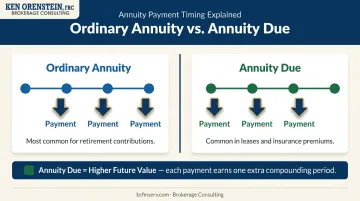
- Ordinary annuity — payments occur at the end of each period; the most common structure for retirement contributions
- Annuity due — payments occur at the beginning of each period; common in lease agreements and insurance premiums
The timing difference has a direct compounding effect. Annuity due payments each get one additional period to earn interest, which produces a higher future value than an equivalent ordinary annuity — even with identical payment amounts and rates.
How to Calculate the Future Value of an Annuity
The Two Core Formulas
Both formulas share the same base variables:
- PMT = the fixed payment amount per period
- r = the interest rate per period (expressed as a decimal)
- n = the total number of payment periods
Ordinary Annuity:
FV = PMT × [((1 + r)ⁿ − 1) / r]
Annuity Due:
FV = PMT × [((1 + r)ⁿ − 1) / r] × (1 + r)
The bracketed portion — ((1 + r)ⁿ − 1) / r — is called the future value factor. It captures the cumulative compounding effect of all payments over the full term. The annuity due formula multiplies this by (1 + r) to account for the extra compounding period each payment receives.
Step 1: Identify Your Inputs
Before running the formula, you need three things:
- Fixed payment amount — the amount contributed each period
- Nominal annual interest rate — and how frequently it compounds
- Total number of payment periods — payments per year × number of years
Always convert annual rates to periodic rates before calculating. The formula requires a periodic rate, not an annual one. If you're making monthly payments, divide the annual rate by 12. A 6% annual rate becomes 0.005 per month. Skipping this step will overstate your projected balance.
Also confirm that your payment frequency matches your compounding frequency. When they don't align (called a general annuity), an additional rate conversion is required before applying either formula.
Once your inputs are confirmed, you're ready to plug in the numbers. Here's a complete worked example using the ordinary annuity formula:
Step 2: Apply the Formula
- PMT = $500/month
- Annual rate = 6% → periodic rate = 6% ÷ 12 = 0.5% = 0.005
- Term = 20 years × 12 = 240 periods
Calculation:
FV = 500 × [((1 + 0.005)²⁴⁰ − 1) / 0.005]
FV = 500 × [((1.005)²⁴⁰ − 1) / 0.005]
FV = 500 × [(3.3102 − 1) / 0.005]
FV = 500 × [2.3102 / 0.005]
FV = 500 × 462.04
FV = $231,020.45
If these were annuity due payments instead, multiply by (1 + 0.005):
$231,020.45 × 1.005 = $232,175.55
The annuity due produces $1,155.10 more — from the timing shift alone.
Step 3: Interpret the Result
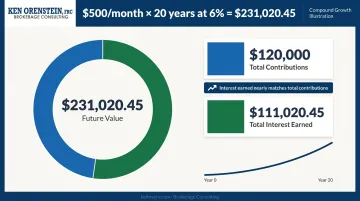
The $231,020.45 figure represents your total accumulated balance at the end of 20 years. To understand how much of that is interest versus contributions:
- Total contributions: $500 × 240 = $120,000
- Total interest earned: $231,020.45 − $120,000 = $111,020.45
Interest earned nearly matches total contributions — that's the power of compounding over 20 years. For retirement planning purposes, this projection tells you whether your savings strategy is on track. If your target balance is $400,000 and the annuity projects $231,000, that gap is now visible — and you can adjust payment size, rate assumptions, or timeline accordingly.
Why This Calculation Matters for Retirement Planning
The FV calculation gives pre-retirees a concrete number to plan around. Without it, contribution decisions are made blind.
The need for this clarity is real: the Federal Reserve's 2025 report on 2024 household data found that only 35% of non-retirees said their retirement savings plan was on track. The majority are making retirement decisions without a clear target.
Where FV Calculations Are Most Useful
- Evaluating a new annuity contract to see whether projected accumulation meets your retirement income target
- Comparing fixed annuities with the same nominal rate but different compounding structures, which can produce meaningfully different outcomes
- Projecting deferred annuity growth during the accumulation phase, before distributions begin
- Quantifying supplemental annuity income for FERS employees, where a private annuity fills the gap alongside the federal pension
A Note on Personalized Projections
The formula works under constant-rate assumptions. Real planning needs to account for tax treatment (qualified vs. nonqualified annuities), inflation's effect on purchasing power, and the specific rate environment at the time of purchase.
Ken Orenstein at Brokerage Consulting works with federal employees and pre-retirees to build annuity projections that reflect their actual retirement timeline, FERS pension income, and TSP distributions. No-cost consultations are available by phone, virtually, or in person.
Key Factors That Affect Future Value
Interest Rate and Compounding Frequency
The interest rate is the single most powerful input. A small difference in rate produces dramatically different results over a long term. Using the same $500/month over 20 years:
| Annual Rate | Future Value |
|---|---|
| 5% | $205,516.83 |
| 6% | $231,020.45 |
| 7% | $260,463.33 |
The difference between 5% and 7% is $54,946 on identical contributions. Compounding frequency amplifies this further: monthly compounding always outperforms annual compounding at the same stated rate because interest is being calculated on a larger base more often.
Payment Amount and Time Horizon
Payment size scales the FV directly: doubling the monthly contribution doubles the future value. The time horizon, though, is where compounding creates its biggest surprises.
Because of compounding, starting contributions five years earlier can produce a higher future value than starting later with significantly larger payments. That gap widens the longer the delay — a dynamic worth running the numbers on before assuming a larger contribution can compensate.
Annuity Type and Rate Alignment
Two structural issues that frequently cause incorrect projections:
- Payment timing — annuities due always produce a higher FV than ordinary annuities with identical inputs; mixing up which type you have leads to the wrong number
- General annuities — when compounding frequency and payment frequency differ, the periodic rate must be converted using an adjusted formula before applying the FV calculation; skipping this step overstates the result
Common Mistakes in Future Value Calculations
Using the Annual Rate as the Periodic Rate
This is the most frequent error. If payments are monthly, the formula requires a monthly rate. Plugging in 6% when the correct input is 0.5% produces a badly inflated future value — a number that looks promising but doesn't reflect reality.
Fix: Always divide the annual nominal rate by the number of compounding periods per year before running the formula.
Assuming the Same Nominal Rate Means the Same FV
Two annuities quoting 6% can produce different future values depending on:
- Compounding frequency (monthly vs. annual)
- Payment timing (ordinary vs. due)
- Whether it's a simple or general annuity
Comparing annuities by stated rate alone misses these structural differences.
Treating the FV as a Guaranteed Outcome
The formula assumes a constant rate for the entire term. In practice:
- Variable-rate annuities don't deliver a fixed return
- Fees and surrender charges reduce the actual accumulated balance (the SEC notes these charges often apply for 6 to 10 years on variable annuities)
- Inflation erodes purchasing power — $231,000 in 20 years won't have the same real value as $231,000 today
- Taxes on distributions reduce the after-tax income from the account
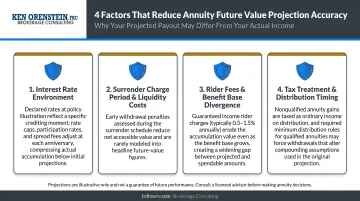
The FV figure is a useful projection tool — but running the numbers with different rate and fee assumptions gives you a far more realistic range of outcomes than a single headline projection.
Frequently Asked Questions
How do you calculate the future value of an annuity?
Use the formula FV = PMT × [((1 + r)ⁿ − 1) / r], where PMT is the fixed payment per period, r is the periodic interest rate, and n is the total number of periods. For annuity due payments, multiply the result by (1 + r) to account for the earlier payment timing.
What is the PV and FV of an annuity?
Present value estimates how much a future stream of payments is worth in today's dollars, which is useful when evaluating a lump-sum payout option. Future value estimates how much a series of contributions will accumulate to at a future date — the core calculation for retirement accumulation planning.
What is a compound annuity?
"Compound annuity" isn't a formal product category. It describes how annuity growth works: each payment earns compound interest on both principal and previously earned interest. That compounding mechanism is what drives the future value calculation.
What is a future annuity?
The term usually refers to a deferred annuity, a contract where contributions are made now and income distributions begin at a later date. The future value calculation projects the accumulated balance at the point when distributions start.
What is the difference between an ordinary annuity and an annuity due?
Ordinary annuities make payments at the end of each period (most retirement contribution plans work this way), while annuities due make payments at the beginning. Annuities due produce a slightly higher future value because each payment has one additional compounding period.
Does a higher interest rate always mean a higher future value?
Yes, all else being equal — but higher-rate products may carry more risk or fees that reduce net return. A 7% stated rate with significant charges can underperform a 6% rate with minimal fees. What matters is the effective after-cost rate, which a qualified advisor can help you evaluate.