
This guide walks through the specific, legitimate methods to access your annuity funds without triggering penalties, who qualifies for each, and the contract variables that determine your outcome.
Key Takeaways
- Most contracts allow up to 10% of account value withdrawn annually without a surrender charge — confirm this provision exists in your specific contract before acting
- The IRS's 10% early withdrawal penalty and the insurer's surrender charge are completely independent, with different rules and exceptions for each
- Age 59½ eliminates the IRS penalty but does nothing about surrender charges still in effect
- Penalty-free paths include: free withdrawal provisions, waiting out the surrender period, crisis waivers, systematic schedules, and 1035 exchanges
- Federal employees with TSP-linked or FERS-adjacent annuities face additional tax complexity that a specialized federal retirement advisor can help navigate
Understanding the Two Types of Annuity Penalties
The confusion around annuity withdrawals comes down to one misunderstanding: most owners treat the penalty system as a single thing. It isn't.
The Surrender Charge (Insurer Penalty)
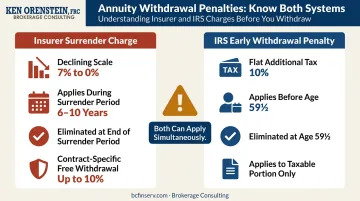
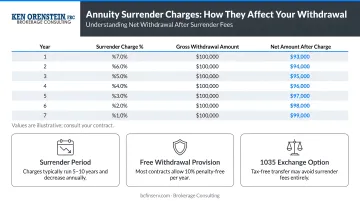
Surrender charges are fees the insurance company imposes when you withdraw funds before the surrender period ends. They're structured on a declining scale — highest in year one, dropping each year until they reach zero.
Here's a representative schedule based on SEC and Investor.gov variable annuity guidance:
| Contract Year | 1 | 2 | 3 | 4 | 5 | 6 | 7 | 8+ |
|---|---|---|---|---|---|---|---|---|
| Surrender Charge | 7% | 6% | 5% | 4% | 3% | 2% | 1% | 0% |
Surrender periods typically run 6–8 years for variable annuities and up to 6–10 years for fixed and fixed indexed annuities, according to SEC and NAIC guidance. Longer MYGA contracts commonly use a staggered schedule — such as 9-8-7-6-5-4-3-2-1-0% over 10 years — so always confirm your specific contract's timeline.
Most contracts allow up to 10% of the account value to be withdrawn annually without triggering a surrender charge. Some contracts permit 15%. But not all contracts include this provision — you need to verify it in your specific contract documents before assuming it applies.
The IRS Early Withdrawal Penalty
The IRS imposes a 10% additional tax on withdrawals taken before age 59½, on top of ordinary income tax owed. IRS Publication 575 covers the full details.
The tax treatment differs based on how your annuity was funded:
- Qualified annuities (funded via pre-tax dollars — IRA rollovers, 401(k)s, TSP accounts): the full withdrawal amount is subject to ordinary income tax, plus the 10% penalty if you're under 59½
- Non-qualified annuities (funded with after-tax dollars): only the earnings portion is taxable — your original premium comes back to you tax-free; the 10% penalty applies only to the taxable earnings portion
Both penalties can apply simultaneously — and independently. Knowing which one you're dealing with is the first step toward a withdrawal strategy that avoids unnecessary costs.
How to Withdraw from Your Annuity Without Penalties
Several legitimate paths exist for accessing annuity funds without penalties. Which one applies to you depends on your age, annuity type, and what your contract actually says.
Method 1: Use the Free Withdrawal Provision
Many annuity contracts include a free withdrawal provision — the right to withdraw a set percentage annually without a surrender charge. There are two versions:
- Account value-based: withdraw up to 10% of the current account value each year. This amount grows as your account grows, making it better for owners who take withdrawals regularly
- Original premium-based: withdraw up to 10% of the original premium paid, regardless of current value. More predictable, but the amount doesn't increase over time
To confirm whether your contract includes this provision, log into your insurer's online portal or review your contract prospectus. If the provision isn't explicitly stated, it doesn't exist — don't assume it does.
Method 2: Wait Until Age 59½ or Later
The cleanest path for those who can plan ahead. Once you reach 59½, the IRS's 10% early withdrawal penalty disappears entirely.
If you're also past the surrender period, withdrawals are penalty-free from both the IRS and your insurer — though ordinary income tax on earnings still applies. This combination (post-59½ and post-surrender period) is the optimal withdrawal window for most annuity owners.
If you're over 59½ but still within the surrender period, you'll still face the insurer's charge. Being past the IRS threshold only solves half the problem.
Method 3: Apply a Crisis or Hardship Waiver
Many contracts suspend surrender charges under specific hardship conditions, including:
- Terminal illness diagnosis
- Confinement in a nursing home or long-term care facility
- Disability (varies by contract)
These waivers are contract-specific — not every policy includes them, and the triggering conditions differ across carriers. Ask about crisis waiver provisions before purchasing an annuity, not after you need one.
One important note: even if your insurer waives the surrender charge under a hardship clause, the IRS's 10% penalty may still apply if you're under 59½ — unless a separate IRS exception, such as total and permanent disability, also applies.
Method 4: Set Up a Systematic Withdrawal Schedule
A systematic withdrawal plan involves taking regular, pre-scheduled distributions — monthly, quarterly, or annually — structured to stay within your contract's free withdrawal limit each year. Benefits include:
- Avoids accidental surrender charges from exceeding the annual cap
- Satisfies IRS Required Minimum Distribution (RMD) rules for qualified annuities after age 73
- Creates predictable income without requiring active management
Missing RMDs carries a stiff penalty: IRS guidance sets the excise tax at 25% of the amount not distributed as required, though this drops to 10% if corrected within two years.
Systematic withdrawals work best for owners who need ongoing income, not a one-time lump sum. If you need cash quickly, this approach won't help.
Method 5: Execute a 1035 Exchange
If you don't need cash but want out of a poorly performing contract, a 1035 exchange lets you transfer funds into a new annuity without triggering immediate income tax on accumulated gains. Under IRS Revenue Ruling 2007-24, the IRS recognizes no gain or loss on a qualifying annuity-to-annuity exchange, as long as the annuitant remains the same and no funds pass through your hands.
This works best when your current contract has:
- High internal fees eroding returns
- Poor crediting performance
- Unfavorable surrender terms worth replacing
Surrender charges on the original annuity may still apply when you transfer out. The new annuity will start its own surrender period — potentially another 6–10 years. A 1035 exchange is tax-free, not cost-free.
Before executing one, it's worth having an advisor compare remaining surrender charges, new surrender periods, and income rider terms to confirm the move makes financial sense. Brokerage Consulting offers this type of analysis as part of its no-cost initial consultation.

Timing Your Withdrawal the Right Way
Knowing when to withdraw matters as much as knowing how. Two milestones drive the decision:
- End of the surrender period — eliminates the insurer's charge
- Reaching age 59½ — eliminates the IRS penalty
Ideally, both conditions are met before you take a significant distribution. Someone who is 50 years old and two years into a 7-year surrender period faces both an insurer penalty and an IRS penalty simultaneously — a combination that can take a serious bite out of what you actually receive.
Immediate annuities and annuitized contracts generally do not allow withdrawals once income payments begin. The window to take money out is before annuitization — after that, you receive scheduled payments and nothing more.
Some contracts include a commutation feature, which adjusts or eliminates future payments in exchange for a lump sum. It's a limited option, but worth confirming with your carrier before annuitizing.
Deferred annuities preserve withdrawal access throughout the accumulation phase, subject to surrender charges and tax rules. Knowing exactly where you stand on both milestones — surrender period and age 59½ — makes the difference between a costly early exit and a clean, penalty-free distribution.
Key Variables That Determine Your Withdrawal Strategy
No two annuity contracts are identical. The right strategy depends on several factors specific to your situation.
Annuity Type
| Annuity Type | Withdrawal Access |
|---|---|
| Fixed deferred | Generally allows withdrawals before payout, subject to surrender charges |
| Fixed indexed (FIA) | Same as fixed deferred — contract-specific terms apply |
| Variable deferred | Allows withdrawals during accumulation, subject to surrender charges |
| Immediate / SPIA | Generally no partial withdrawals once income begins |
| Annuitized contract | No additional withdrawals after income payments start |
| Deferred income annuity (DIA) | More restrictive; generally no cash surrender value |
| QLAC | No cash surrender, commutation, or similar features after required beginning date |
| Medicaid-compliant annuity | Irrevocable, non-assignable — no withdrawals |
One way to work around these restrictions is annuity laddering — stacking multiple contracts with staggered surrender periods so that penalty-free withdrawal windows open at different points in your retirement timeline, rather than locking everything into a single schedule. This is a core planning approach at Brokerage Consulting for clients who need flexibility without sacrificing guaranteed income.
Qualified vs. Non-Qualified Status
This distinction directly affects how much you receive after taxes:
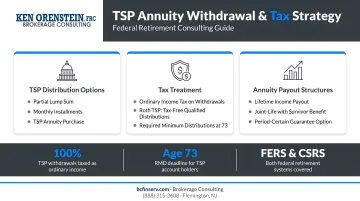
- Qualified annuities (TSP rollover, traditional IRA, 401(k)): the full withdrawal is taxed as ordinary income
- Non-qualified annuities (after-tax premium): only earnings are taxable ; principal returns tax-free
Federal employees with TSP-linked or FERS-adjacent annuities are working with qualified assets, meaning distributions are fully taxable.
The interaction between TSP distribution rules, RMD timing, and annuity contract terms creates layered complexity that trips up even experienced planners. Ken Orenstein, a Federal Retirement Consultant (FRC) and author of The Informed Fed, works specifically with federal employees to navigate these distinctions accurately.
Rider Provisions
If your annuity includes a Guaranteed Lifetime Withdrawal Benefit (GLWB), Guaranteed Minimum Income Benefit (GMIB), or similar income rider, withdrawals — even penalty-free ones — may:
- Reduce the protected benefit base used to calculate future guaranteed income
- Trigger a step-down in guaranteed payout amounts
- Affect the accumulation phase of roll-up rate calculations
Before taking any withdrawal on a rider-equipped contract, confirm the specific impact with your insurance company in writing.
Common Mistakes That Trigger Avoidable Penalties
Exceeding the Annual Free Withdrawal Cap
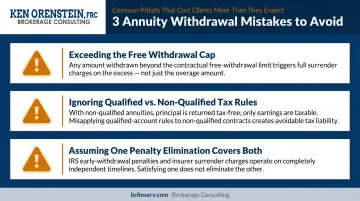
Going over by even a small amount triggers surrender charges on the excess. Example: if your contract allows 10% free withdrawals and you withdraw 12%, the extra 2% is subject to the full surrender charge rate for that year. The insurer doesn't prorate — the cap is a hard line.
Ignoring the Qualified/Non-Qualified Tax Distinction
Many non-qualified annuity owners assume all withdrawal proceeds are taxable. That's not how it works. Your original premium (cost basis) returns tax-free; only accumulated earnings are subject to income tax and the potential 10% IRS penalty. Confusing the two can cause over-withholding — or leave you underprepared for a larger tax bill than expected.
Assuming One Penalty Elimination Covers Both
This is the most common error. Once the surrender period ends, many owners assume they're fully in the clear — but the IRS penalty still applies independently if they're under 59½. The reverse is equally true: turning 59½ does nothing about a surrender charge that's still active. Each threshold operates on its own timeline, and both must be cleared before you're penalty-free on all fronts.
Quick recap — the three mistakes to avoid:
- Withdrawing even slightly over the free withdrawal cap (the excess triggers full surrender charges)
- Assuming all non-qualified annuity withdrawals are taxable (your cost basis returns tax-free)
- Treating surrender period expiration or age 59½ as a single green light (both penalties exist independently)
Alternatives When Penalty-Free Withdrawal Isn't Possible
Selling a Portion of Your Annuity Payments
Structured settlement and annuity payment purchasing companies allow owners to sell some or all of their future payment stream in exchange for a lump sum today. This sidesteps surrender charges but comes at a cost — you receive less than the full value of those future payments. Court approval is required in most states, and the transaction is reviewed for the owner's best interest before it proceeds.
Taking the Surrender Charge as a Known Cost
Sometimes paying the penalty is the right call. Several situations can justify the cost — provided you've calculated the full picture first:
- A medical emergency requiring immediate liquidity
- A time-sensitive investment opportunity with a stronger net return
- Exiting a poorly performing contract before further losses accumulate
Run the numbers on the net amount after surrender charges, income taxes, and any applicable IRS penalty before deciding. Going in with clear figures turns a difficult choice into a calculated one.
Frequently Asked Questions
How much can I withdraw from my annuity without penalty?
Most contracts allow up to 10% of the account value or original premium annually as a penalty-free withdrawal, but the specific cap depends on your contract. Some contracts allow up to 15%. Exceeding the cap — even slightly — triggers surrender charges on the excess amount.
How do I waive the 10% early withdrawal penalty?
The main IRS exceptions include reaching age 59½, total and permanent disability, and terminal illness. Substantially equal periodic payments (SEPP) under Section 72(t) also qualify. Insurer crisis waivers are a separate mechanism — they suspend surrender charges, not the IRS tax.
How much tax will I pay if I cash out my annuity?
For qualified annuities, the full withdrawal is taxed as ordinary income. For non-qualified annuities, only the earnings portion is taxable — your premium comes back tax-free. Add the 10% IRS penalty on the taxable portion if you're under 59½.
When can I withdraw from a deferred annuity?
Deferred annuities allow withdrawals at any point before annuitization. The lowest-cost timing is after the surrender period ends and you've reached age 59½ — once both conditions are met, both the surrender charge and IRS penalty drop away.
What is the best way to cash out an annuity?
It depends on urgency. The free withdrawal provision is the lowest-cost option; a full surrender costs the most. A 1035 exchange or structured sale of future payments works well when you need more than the annual limit but want to avoid a full surrender.
Can I withdraw money from my fixed annuity?
Yes — fixed annuities generally allow withdrawals, including penalty-free withdrawals up to the contract's annual limit. Review your specific contract to confirm whether a free withdrawal provision exists and whether you're still within the surrender period.
If you're unsure where your annuity stands — or want a second opinion on whether a withdrawal, exchange, or alternative strategy makes the most sense — Brokerage Consulting offers no-cost initial consultations by phone, virtual meeting, or in-person at the Flemington, NJ office. Reach Ken Orenstein's team at (888) 315-3608 or through bcfinserv.com.