Introduction
You've worked hard to accumulate savings, and now you want those savings to work harder without putting them at risk. For retirees, federal employees, and pre-retirees evaluating their options, two products often end up side by side: the certificate of deposit (CD) and the multi-year guaranteed annuity (MYGA).
On the surface, they look nearly identical. Both offer fixed interest rates, both protect your principal, and neither ties your money to the stock market. But they work very differently — and choosing the wrong one could mean paying unnecessary taxes on interest you haven't touched yet, or earning less than you should.
This guide breaks down exactly how MYGAs and CDs differ, where each product makes sense, and how to decide which belongs in your retirement plan.
Key Takeaways
- MYGAs are fixed deferred annuities issued by insurance companies, offering guaranteed rates for 3–10 years with tax-deferred growth
- CDs are bank deposit products with FDIC insurance, typically covering terms from 3 months to 5 years
- MYGA rates generally outpace CDs: top 5-year MYGAs were around 6.30% as of May 2026, compared to a 1.34% national CD average
- CD interest is taxed annually; MYGA interest grows tax-deferred until withdrawal — a meaningful compounding advantage
- MYGAs are built for long-term, tax-efficient retirement accumulation; CDs better suit short-term savings goals
MYGA vs. CD: At a Glance
| Feature | MYGA | CD |
|---|---|---|
| Issuer | Insurance company | Bank or credit union |
| Term Length | Typically 3–10 years | Typically 3 months–5 years |
| Interest Rates | Generally higher | Generally lower |
| Tax Treatment | Tax-deferred until withdrawal | Taxed annually as ordinary income |
| Federal Insurance | Not FDIC-insured | FDIC-insured up to $250,000 |
| Backup Protection | Issuing insurer + state guaranty association | FDIC |
| Early Withdrawal | Surrender charges + possible 10% IRS penalty under 59½ | Bank-disclosed penalty fees |
| Penalty-Free Withdrawals | Often up to 10% annually | Varies by institution |
| End-of-Term Options | Renew, withdraw, roll over, or annuitize into lifetime income | Renew or withdraw lump sum |
| Beneficiary Transfer | Passes directly to beneficiaries outside probate | May require probate without POD designation |
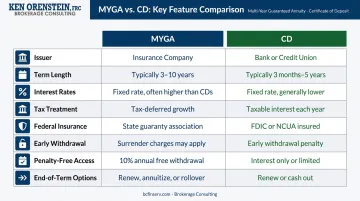
The surface-level similarities between these two products can be misleading. CDs are savings tools. MYGAs are retirement accumulation vehicles designed for a longer time horizon, with tax-deferred growth and the option to convert into lifetime income.
What Are MYGAs and CDs?
Multi-Year Guaranteed Annuities
A MYGA is a type of fixed deferred annuity issued by an insurance company. It locks in a guaranteed interest rate for the entire contract term — typically 3 to 10 years — unlike some traditional fixed annuities where the initial rate only holds for a shorter introductory period before resetting.
As the NAIC's Buyer's Guide for Fixed Deferred Annuities describes, money inside a deferred annuity earns interest on a tax-deferred basis, and you don't pay income tax on those earnings until you withdraw. MYGAs are designed primarily for retirement accumulation — not short-term savings.
Certificates of Deposit
A CD is a deposit product offered by banks and credit unions. You commit a lump sum for a fixed term in exchange for a guaranteed interest rate. According to the FDIC's consumer guide on CDs, terms typically range from 3 months to 5 years or more.
CDs are not investments and not insurance products. They are deposit accounts, and that classification is what makes them eligible for FDIC protection.
What They Share
Both products attract risk-averse savers because they offer predictability in environments where market swings are a concern:
- Guarantee principal: your starting balance is protected for the full term
- Lock in a fixed rate: returns are predetermined, not tied to market performance
- Offer defined terms: both specify exactly how long your money is committed
That shared profile makes the comparison look straightforward. But the differences in taxes, liquidity, insurance coverage, and long-term strategy pull these two products in distinctly different directions.
Key Differences Between MYGAs and CDs
Interest Rates and Return Potential
The rate gap between MYGAs and CDs is larger than most people expect. As of May 2026, Blueprint Income's fixed annuity rate aggregator showed top MYGA rates of 5.85% for 3-year, 6.30% for 5-year, and 6.50% for 7-year contracts. Over the same period, FDIC national average CD rates were 1.32% for 36-month CDs and 1.34% for 60-month CDs.
Even comparing best-available rates — not just national averages — Blueprint Income noted a 2.15 percentage-point spread between the top 5-year MYGA (6.30%) and the top 5-year CD (4.15%) at that time.
The higher MYGA rate doesn't reflect more risk. The rate is fully guaranteed for the entire term, regardless of what happens in financial markets.

Tax Treatment and Compounding Advantage
CD interest is taxed as ordinary income in the year it accrues — even if you never touch the account. Per IRS Publication 550, for CDs longer than one year where interest is deferred, the original issue discount must be included in taxable income annually as it accrues.
MYGAs work differently: interest credited inside the annuity grows tax-deferred until you withdraw it, letting the full balance compound uninterrupted year after year.
The practical effect: a CD holder pays taxes on interest each year, leaving less principal compounding over time. For someone in a higher tax bracket today who expects to be in a lower bracket at retirement, this timing difference can increase net returns meaningfully over a 5–10 year accumulation period.
One important caveat: MYGA withdrawals are taxed as ordinary income when received. And if you withdraw before age 59½, IRS Topic 410 notes that an additional 10% tax penalty may apply, similar to early distributions from retirement accounts.
Safety and Who Stands Behind Your Money
Neither product is riskless — they just carry different types of protection.
CDs held at FDIC-member banks are federally insured up to $250,000 per depositor, per institution, per ownership category. That federal backstop makes CDs among the safest financial instruments available.
MYGAs are not FDIC-insured. The FDIC explicitly states that annuities — even those purchased at a bank — are not covered deposit products. MYGAs are backed by:
- The financial strength and claims-paying ability of the issuing insurance company
- State guaranty associations, which according to NOLHGA's 2024–2025 Safety Net report, provide $250,000 or more in annuity benefit protection across all member associations (limits vary by state)
This makes insurer financial strength a critical variable. At Brokerage Consulting, Ken Orenstein evaluates MYGA carriers using ratings from A.M. Best, S&P, Moody's, and Fitch — reviewing financial strength alongside the offered rate. The goal is ensuring the guarantee behind the contract is backed by a sound issuer, not just an attractive number.
Liquidity and Early Withdrawal Penalties
Liquidity rules differ significantly between these two products — and the consequences of getting it wrong are steeper with MYGAs.
CD early withdrawal penalties are disclosed at account opening and must be paid before maturity. The FDIC and CFPB both confirm that most fixed-rate CD agreements allow early withdrawal for a fee — specific amounts vary by institution and term.
MYGA surrender charges typically start higher and decline each year throughout the surrender period. The NAIC notes that many MYGAs also allow annual penalty-free withdrawals of up to 10% of contract value — providing some liquidity without triggering surrender fees.
The additional risk with MYGAs: withdrawals before age 59½ may trigger the 10% IRS early distribution penalty, on top of any surrender charge. This makes MYGAs a poor fit for anyone who might need access to the full balance before that age threshold.
End-of-Term Options and Lifetime Income
When a CD matures, you get your principal plus interest back as a lump sum. You can withdraw it or renew at whatever rate is available. That's it.
When a MYGA reaches maturity, the options are considerably broader:
- Renew at a new guaranteed rate
- Take a full lump-sum withdrawal
- Execute a 1035 tax-free exchange into another annuity contract (IRS Revenue Ruling 2007-24 confirms no gain or loss is recognized on an annuity-for-annuity exchange)
- Annuitize — convert the accumulated balance into a stream of guaranteed lifetime income payments
That last option is what makes MYGAs a distinct retirement planning tool. Annuities pool mortality risk, protecting against the risk of outliving your assets — something no CD can replicate.
Beneficiaries and Probate
MYGAs pass directly to named beneficiaries upon the owner's death — typically outside of probate. Per Cornell Law's legal definition, certain annuities are non-probate assets that pass by operation of law to designated beneficiaries.
CDs without a payable-on-death (POD) designation may be subject to probate before heirs can access the funds — adding delays and potential legal costs. Nolo confirms that a POD designation can be added to a CD to avoid probate, but without one, the account may pass through the estate.
MYGA or CD: Which Is Right for You?
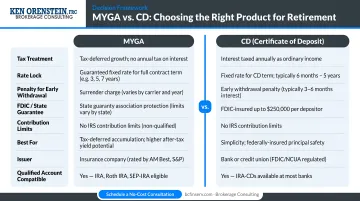
Choose a CD if:
- You need access to the funds within 1–3 years
- Federal deposit insurance is a non-negotiable requirement
- You're building an emergency fund or short-term savings reserve
- You're under age 59½ and cannot risk being subject to annuity early-withdrawal penalties
- You prefer simple annual taxation without deferred liability
Choose a MYGA if:
- You're within 5–10 years of retirement or already retired
- You want higher guaranteed yields with tax-deferred compounding
- You can commit to leaving funds untouched for the full contract term
- You're in a higher tax bracket now and expect a lower rate in retirement
- You want the option to convert savings into guaranteed lifetime income at maturity
Can You Use Both?
Yes. For most conservative retirement strategies, combining both makes sense. A practical framework:
- CDs for short-term liquidity needs (1–3 year horizon, emergency reserves)
- MYGAs for longer-term accumulation (5–10 year horizon, tax-deferred growth)
- CD ladder + MYGA combination: covers near-term access needs while the annuity accumulates tax-efficiently in the background
Brokerage Consulting formalizes this approach through annuity laddering — stacking MYGAs with staggered surrender periods or maturity dates to balance liquidity with guaranteed income over time.
A Note for Federal Employees
Federal employees have a built-in income foundation: FERS or CSRS pension, Social Security, and TSP distributions. A MYGA can serve as a fourth layer: supplemental, tax-deferred accumulation that converts to income when other sources don't fully cover expenses.
For FERS employees especially, where the base annuity is smaller than under CSRS, adding a tax-efficient guaranteed income stream through a MYGA can meaningfully improve retirement income security.
Ken Orenstein, a published Federal Retirement Consultant and author of The Informed Fed: A Survival Guide to Federal Employee Benefits, works specifically with federal employees on this kind of multi-layer planning — evaluating whether a MYGA, CD, or combination fits within the broader FERS/CSRS retirement picture. No-cost consultations are available by phone, virtually, or in person at bcfinserv.com or (888) 315-3608.
Key Questions to Ask Yourself
Before deciding, work through these:
- How long can I realistically leave this money untouched?
- Am I under age 59½ — and does the 10% IRS penalty matter to my situation?
- Am I accumulating for retirement income, or managing short-term savings?
- How important is federal deposit insurance to my peace of mind?
- Do I want the option to convert this into a lifetime income stream later?
Conclusion
MYGAs and CDs are both tools for conservative savers who want predictability and principal protection. But they aren't interchangeable.
CDs are the cleaner choice for short-term goals, emergency reserves, and anyone who needs flexibility. MYGAs are built for retirement accumulation: higher guaranteed yields, tax-deferred compounding, and the ability to convert savings into guaranteed lifetime income.
That upside comes with trade-offs — reduced liquidity and a more complex tax and penalty structure.
The right choice depends on your tax bracket, retirement timeline, income needs, and liquidity requirements. Because those factors vary widely, this is one decision that benefits from an objective second opinion.
Brokerage Consulting works with individuals, seniors, and federal employees across the U.S. to build low-cost, tax-efficient retirement strategies — evaluating whether a MYGA, CD, annuity ladder, or combination fits your specific situation. Reach out for a no-cost consultation at bcfinserv.com or (888) 315-3608.
Frequently Asked Questions
Is it better to have a multi-year guaranteed annuity or a CD?
Neither is universally better — it depends on your timeline and goals. CDs are preferable for short-term savings and those who need FDIC protection. MYGAs are better for long-term retirement savers seeking higher guaranteed yields and tax-deferred growth over 5–10 years.
Is a multi-year guaranteed annuity a good investment?
MYGAs can be a strong choice for conservative, retirement-focused savers. They offer guaranteed rates, tax-deferred compounding, and typically higher yields than CDs — but they're best suited for those who won't need early access before the term ends.
Are MYGAs as safe as CDs?
CDs are considered slightly safer because they carry FDIC insurance up to $250,000. MYGAs are backed by the insurer's financial strength and state guaranty associations, so checking ratings from A.M. Best, Moody's, or S&P before committing matters.
What are the tax advantages of a MYGA over a CD?
MYGA interest grows tax-deferred — you only pay taxes when you withdraw. CD interest is taxed annually as ordinary income, even if you don't touch the funds. Over a long accumulation period, this timing difference can significantly boost net returns through uninterrupted compounding.
Can you lose money in a MYGA?
MYGAs protect principal and offer guaranteed rates, so you won't lose money if you hold to maturity. However, early withdrawals may trigger surrender charges that reduce your net return, and there is no FDIC backstop if the issuing insurer fails.
What happens to a MYGA when you die?
MYGAs pass directly to named beneficiaries outside of probate, making the transfer faster and simpler. CDs without a payable-on-death designation may require probate before heirs can access the funds, potentially adding delays and legal costs to the process.