
The SEC addressed this directly with Rule 498A, adopted on March 11, 2020 and effective July 1, 2020. The rule modernized how variable annuity disclosures are delivered, introducing shorter summary prospectuses, standardized fee tables, and clearer conflict of interest disclosures. This article breaks down what changed, what must now be disclosed, and what it means if you're reviewing a variable annuity contract today.
Key Takeaways
- Rule 498A replaced 100+ page paper prospectuses with shorter, standardized summary prospectuses
- Insurers now issue an initial summary prospectus for new investors and an updating summary prospectus for existing holders
- A standardized Key Information Table now covers fees, risks, restrictions, taxes, and conflicts of interest in every summary prospectus
- Full statutory prospectuses remain available online or on request, at no cost, within three business days
- FINRA Rule 2330 separately governs suitability requirements for variable annuity recommendations
What Is a Variable Annuity Prospectus and Why Does It Matter?
A variable annuity prospectus is the legal disclosure document an insurance company must provide when selling a variable annuity contract. It covers fees, risks, available investment options, benefit terms, and tax implications — everything a buyer needs to make an informed decision.
Variable annuities require a prospectus because they are classified as securities, not purely insurance products. As FINRA describes, deferred variable annuities are hybrid products containing both securities and insurance features, with sales regulated by both the SEC and FINRA.
Fixed annuities work differently — they're state-regulated insurance products governed by the NAIC's Annuity Disclosure Model Regulation and don't require a prospectus at all, using a specimen policy instead.
For investors, the prospectus matters because it's the primary source for understanding:
- Surrender charge schedules and how long you're locked in
- Fee structures — including mortality and expense charges, administrative fees, and sub-account expenses
- Optional rider terms — exactly how GLWB, GMIB, or GMAB benefits work and what they cost
- Death benefit provisions and their limitations
- Tax treatment — including the fact that buying a variable annuity inside a tax-qualified account rarely adds any tax benefit beyond what the account already provides
Skipping the prospectus means accepting contract terms — including fee layers and rider restrictions — without understanding what you're actually paying for or giving up.
Why the SEC Updated Variable Annuity Prospectus Requirements
The Problem With Legacy Disclosure
Before Rule 498A, the prospectus delivery system was broken. The SEC's final rule release (33-10765) documented the problem directly: variable contract prospectuses were frequently more than 100 pages long, and contracts offered an average of 60 underlying investment options — some more than 250. Each option could trigger its own fund-level prospectus, leaving investors buried under thousands of pages that few could meaningfully review.
The SEC's goal was to make key information about contract terms, benefits, and risks available in a concise, reader-friendly format — while preserving full disclosure in the statutory prospectus for those who wanted it.
What Rule 498A Changed
Rule 498A introduced a layered disclosure framework modeled after the SEC's 2009 mutual fund summary prospectus rule. Under this framework, insurers can satisfy their prospectus delivery obligations with a shorter summary prospectus, provided the full statutory prospectus remains available online and upon request.
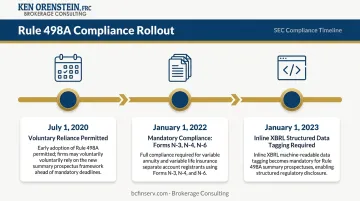
Three compliance milestones govern the rollout:
| Milestone | Date |
|---|---|
| Voluntary reliance on Rule 498A permitted | July 1, 2020 |
| Mandatory compliance for Forms N-3, N-4, and N-6 filings | January 1, 2022 |
| Inline XBRL structured data tagging required | January 1, 2023 |
The Two New Types of Summary Prospectuses
Initial Summary Prospectus
This document is delivered to new investors at the time of purchase. It covers one currently offered contract and must include:
- A standardized Key Information Table
- An overview of the contract
- Fee disclosures (transaction expenses and ongoing annual costs)
- Benefits and withdrawal information
- An appendix of available investment options
The goal is plain-English disclosure that lets a buyer understand what they're purchasing before signing.
Updating Summary Prospectus
This replaces the full statutory prospectus in annual mailings to existing contract holders. It must include:
- A description of any material changes since the previous mailing
- The Key Information Table
- The portfolio company appendix
If your insurer has changed fees, modified available investment options, or altered benefit terms since you purchased your contract, the updating summary prospectus is where that information should appear. That's why reading it each year matters.
The Key Information Table
Both summary prospectus types must include a standardized "Important Information You Should Consider About the Contract" table organized into five categories:
| Category | What It Covers |
|---|---|
| Fees and Expenses | Surrender charges, ongoing annual costs, fee ranges |
| Risks | Risk of loss, insurer financial strength, investment performance risk |
| Restrictions | Investment limitations, benefit restrictions, access constraints |
| Taxes | Tax treatment, and whether buying inside a qualified account adds any tax benefit |
| Conflicts of Interest | Agent commissions, financial incentives, exchange encouragement risk |
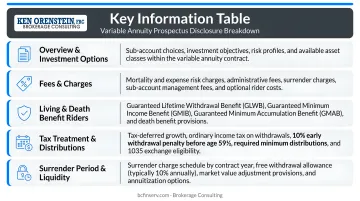
This table makes direct contract comparisons possible in a way that older full-length statutory prospectuses didn't allow — buyers had to dig through hundreds of pages of dense legal text to find equivalent information.
What Must Be Disclosed in the Updated Prospectus
Fee Disclosures
The prospectus must include a detailed Fee Table covering:
- Transaction expenses — including surrender charges based on a hypothetical $100,000 investment
- Annual contract expenses — mortality and expense risk charges, administrative fees
- Annual portfolio company expenses — sub-account fund-level costs
Always review both minimum and maximum fee ranges. Mortality and expense charges typically run 1.0–1.5% annually, rider fees add another 1.0–1.5% on the income base, and sub-account expenses layer on top of that. Combined, all-in VA costs can easily exceed 3% per year — a figure Ken Orenstein at Brokerage Consulting flags in every variable annuity review he conducts.
Risk Disclosures
The prospectus must clearly state:
- Investors can lose money
- Variable annuities are long-term products not suitable for near-term liquidity needs
- The insurer's financial strength affects guaranteed benefits
- Investment option performance is not guaranteed
These disclosures exist because variable annuities are routinely confused with CDs, fixed annuities, and savings accounts. They are fundamentally different products with different risk profiles.
Benefits Disclosures
A standardized Benefits Table must list all standard and optional benefits — GLWBs, enhanced death benefits, long-term care riders, and others — including:
- Maximum fees for each benefit
- Limitations and restrictions
- Examples illustrating how each benefit operates
Surrender and Withdrawal Terms
This section of the prospectus covers four things investors need to verify before signing:
- When and how you can access your money
- The full surrender charge schedule
- How early withdrawals affect optional benefit riders
- The free look period, during which you can cancel for a full refund
FINRA notes that variable annuities can feature surrender periods of eight years or more, with penalties for early liquidation. Confirm the full surrender schedule before committing any funds you may need access to.
Conflict of Interest Disclosures
Updated prospectus forms require explicit disclosure of how the recommending investment professional is compensated, including commissions and revenue sharing arrangements. Investors must be informed that their advisor may have a financial incentive to recommend this contract over alternatives, or to encourage an exchange from an existing contract into a new one.
How These Changes Affect Your Retirement Planning
Why Shorter Disclosures Benefit Investors
Standardized summary prospectuses make it practical to compare contracts before committing. The Key Information Table puts fees, risks, and conflicts in a consistent format — so comparing two contracts no longer requires reading two 100-page documents side by side.
For federal employees evaluating whether a variable annuity fits alongside TSP income, a pension, or Social Security, this clarity matters. Variable annuities are generally appropriate only for investors who have already secured a base layer of guaranteed income and have higher risk tolerance — not as a primary retirement income vehicle.
That clarity also makes it easier to spot problems. Knowing what good looks like helps you recognize when something doesn't add up.
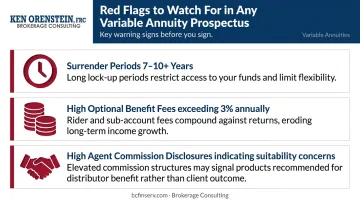
Red Flags to Watch For
When reviewing a summary prospectus or Key Information Table:
- Surrender periods lasting 7–10+ years — especially problematic for investors approaching or in retirement who may need liquidity
- High optional benefit fees — rider costs of 1.0–1.5% annually on top of M&E charges can push total costs well above 3% per year
- Conflict of interest disclosures showing high agent commissions — these may indicate the recommendation was influenced by compensation rather than suitability
What to Do With an Updating Summary Prospectus
If you currently hold a variable annuity, review your most recent updating summary prospectus carefully. Any material changes to fees, available investment options, or benefit terms since your last mailing should be disclosed there.
At Brokerage Consulting, Ken Orenstein works with clients holding existing variable annuity contracts to evaluate whether those contracts remain suitable. At Brokerage Consulting, Ken Orenstein works with clients holding existing variable annuity contracts to evaluate whether those contracts remain suitable. In some cases, a 1035 exchange into a fixed indexed annuity or fixed annuity makes more sense — lower costs, principal protection, and stronger income riders can tip the balance. No-cost consultations are available by phone, virtually, or in person. Call (888) 315-3608 or visit bcfinserv.com to schedule.
Frequently Asked Questions
What investments require a prospectus?
Securities products require a prospectus — including variable annuities, variable life insurance, mutual funds, ETFs, and stocks. Fixed annuities, fixed indexed annuities, and traditional life insurance do not require a prospectus because they are state-regulated insurance products, not securities.
What is the FINRA rule for variable annuities?
FINRA Rule 2330 governs variable annuity recommendations and requires broker-dealers to have reasonable grounds to believe any recommendation is suitable. Before purchase, investors must receive disclosures covering surrender charges, tax penalties, mortality and expense fees, rider charges, and market risk.
What is the difference between an initial summary prospectus and an updating summary prospectus?
An initial summary prospectus is given to new investors at purchase and covers full contract terms in condensed form. An updating summary prospectus is sent annually to existing holders and focuses on material changes since the last mailing, along with the Key Information Table.
Can I still receive a paper copy of my variable annuity prospectus?
Yes. Under Rule 498A, investors retain the right to request a full paper copy of the statutory prospectus, SAI, and other materials free of charge. The insurer must deliver it within three business days by first-class mail.
What is the Key Information Table in a variable annuity prospectus?
The Key Information Table is a standardized disclosure section required in all variable annuity summary prospectuses. It covers five areas: fees and expenses, risks, investment restrictions, tax implications, and conflicts of interest. The consistent format makes it easier to compare contracts across products.
When did the updated variable annuity prospectus requirements go into effect?
Insurers could begin using the summary prospectus framework on July 1, 2020. Full compliance for registration statements on Forms N-3, N-4, and N-6 was required by January 1, 2022, with Inline XBRL structured data tagging following on January 1, 2023.