
Introduction
Retirement income planning carries three risks that don't ease with time — they compound. Longevity is the one most people underestimate: Americans are living longer than actuarial tables once predicted, which means inflation quietly erodes fixed payments for more years than most plans account for, while interest rates keep shifting beneath them. According to Allianz Life's 2025 research, 64% of Americans now worry more about running out of money than death itself.
Locking all retirement capital into a single annuity at one moment in time amplifies all three risks simultaneously. You're betting on one rate environment, one fixed payment level, and one product to sustain spending needs that will almost certainly change across a 25-to-30-year retirement.
The annuity ladder is the structural answer. Instead of one large annuity purchase, you split capital across multiple contracts, staggered by time, payout date, or product type. The result is layered, predictable income that adapts as you age, with no pressure to find the "perfect moment" to commit everything at once.
What follows covers how laddering works, the three core strategies, who benefits most, and practical steps to start building one.
Key Takeaways
- An annuity ladder spreads purchases across time or product type, averaging out interest rate risk rather than locking into a single rate environment
- Staggering payout start dates creates escalating income streams that naturally address inflation and longevity risk
- A mix of MYGAs, FIAs, and income annuities (SPIAs/DIAs) balances principal protection, growth potential, and guaranteed lifetime cash flow
- LIMRA research finds annuitized income nearly doubles retirees' spending confidence versus equal non-annuitized savings
What Is an Annuity Ladder?
An annuity ladder is a retirement income strategy in which available capital is divided into multiple smaller annuity purchases rather than one large lump-sum commitment. Each "rung" represents a separate contract, start date, or term length — working together to create layered, staggered income rather than a single stream.
The Core Problem: Interest Rate Risk
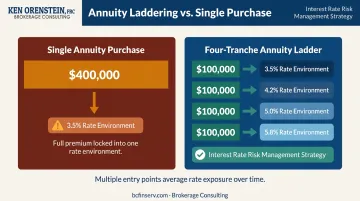
If a retiree commits $400,000 to a single annuity at 3.5% and rates climb to 5.5% the following year, that upside is permanently missed. There's no re-entry point, no adjustment mechanism. The contract simply reflects conditions that no longer exist.
Laddering solves this by creating multiple entry points across different rate environments. Consider the contrast:
| Approach | Capital Deployment | Rate Exposure |
|---|---|---|
| Single annuity | $400,000 at once | One rate environment |
| Four-tranche ladder | Four $100,000 purchases | Four rate environments |
The ladder doesn't require predicting where rates go. It averages exposure across multiple moments — removing the single biggest risk in annuity buying: committing everything to one rate environment.
What an Annuity Ladder Is Not
An annuity ladder is not a single product. It's a strategic framework applied across different annuity types:
- MYGAs (Multi-Year Guaranteed Annuities) — fixed rates locked in for 3, 5, 7, or 10 years
- SPIAs (Single Premium Immediate Annuities) — lump-sum-to-income conversion beginning within 30 days
- DIAs (Deferred Income Annuities) — premium paid today, income begins at a future fixed date (often ages 80–85)
- FIAs (Fixed Indexed Annuities) — principal-protected growth linked to a market index
Each type serves a different role within the ladder — and that structural flexibility is precisely what separates annuity ladders from their closest alternative: the bond ladder.
How Annuity Ladders Differ from Bond Ladders
Both strategies use staggered maturities, but annuity ladders offer something bond ladders structurally cannot. As Kitces.com explains, lifetime income annuities include mortality credits — the pooled longevity risk from thousands of annuity holders that allows insurers to price guaranteed lifetime income more efficiently than bonds held to maturity. Bond ladders preserve liquidity and principal access; annuity ladders deliver income efficiency and lifetime guarantees that bonds simply can't replicate.
The Three Core Annuity Laddering Strategies
These three approaches aren't mutually exclusive. Sophisticated ladders often combine all three based on the retiree's income floor needs, timeline, and inflation concerns.
Laddering by Purchase Date — Managing Interest Rate Risk
This strategy spaces annuity purchases across multiple years so each tranche captures the prevailing rate at that moment. Rather than committing everything to one rate environment, you average your entry points over time.
A practical MYGA example with a $300,000 pool:
- Year 1: Purchase a 3-year MYGA — locks in today's rate, matures in 3 years
- Year 2: Purchase a 5-year MYGA — captures next year's rate environment
- Year 3: Purchase a 7-year MYGA — locks in a third rate point
When each contract matures, proceeds can be rolled into a new annuity via a tax-free 1035 exchange, potentially at higher rates if market conditions have improved. Current MYGA rates illustrate why this matters: Annuity.org's live rate data shows MYGAs available at 5.07% for 3-year terms and 5.20% for 5-year terms, while some providers are quoting rates up to 6.50% for longer durations.
Laddering by Payout Start Date — Fighting Inflation and Longevity Risk
Here, the focus shifts from when you buy to when income activates. Because lifetime income payout rates are priced primarily on life expectancy at the time income begins, the older the retiree when a stream activates, the higher that payment will be per dollar committed.
A $400,000 payout-date ladder might look like this:
| Tranche | Amount | Income Begins | Why Payouts Rise |
|---|---|---|---|
| 1 | $100,000 | Age 70 | Baseline payout |
| 2 | $100,000 | Age 75 | Higher rate (older activation) |
| 3 | $100,000 | Age 80 | Significantly higher rate |
| 4 | $100,000 | Age 85 | Maximum longevity-credit efficiency |
This structure builds a self-funding "raise" into retirement income, without needing a COLA rider. New income streams activate precisely when spending needs tend to rise: healthcare costs, care support, and the expenses that accompany later-life living.
The numbers back this up. The CANNEX/PGIM analysis of 55,000 bi-weekly SPIA and DIA quotes confirms the payout differential is substantial: for a $100,000 premium, a male purchasing a DIA at age 65 with income starting at age 80 saw an average top-5 payout rate of 25.44%, compared to roughly 6.93% for the same premium in an immediate SPIA.

Laddering by Annuity Type — Diversification for Stability and Growth
A ladder can also be structured by mixing product types, each serving a different role:
- MYGAs — principal protection and predictable guaranteed rates for the near term
- FIAs — market-linked growth potential with downside protection for the middle horizon
- SPIAs/DIAs — guaranteed lifetime cash flow for long-term income certainty
Purchasing contracts from multiple highly rated insurance companies reduces concentration risk. No carrier is immune to financial stress, and spreading contracts across insurers means no single carrier failure can compromise the entire ladder. At Brokerage Consulting, carrier financial-strength review — AM Best, S&P, Moody's, and Fitch ratings — is a standard step in every annuity recommendation Ken Orenstein makes.
Key Benefits of Annuity Laddering for Fixed Income Stability
Annuity laddering addresses five core challenges retirees face — and each benefit compounds the value of the strategy:
Interest rate risk reduction — No one reliably times interest rates. Multiple entry points average your effective rate favorably over time, eliminating what behavioral economists call "regret risk" — the painful knowledge that you committed at exactly the wrong moment.
Inflation protection through escalating income — A payout-date ladder delivers progressively larger income streams as you age, providing organic growth aligned with rising costs. This often matches the inflation protection of a COLA rider — without the lower starting payment a COLA rider requires. The U.S. Treasury has documented that inflation-adjusted annuities carry meaningfully reduced initial payouts compared to fixed alternatives; the payout-date ladder sidesteps that trade-off structurally.
Longevity insurance without overfunding — Mortality credits let insurers price guaranteed lifetime income based on average life expectancy across thousands of policyholders, not worst-case individual scenarios. You don't need to personally fund retirement to age 100 to protect against living that long. The ladder transfers that risk to the carrier.
Liquidity preservation — Capital not yet annuitized stays accessible and investable. An all-in single-annuity purchase eliminates liquidity entirely; a ladder preserves flexibility for capital not yet committed.
Psychological security — LIMRA's "Guaranteed Income: A License to Spend" study found that retirees with annuitized income spend roughly twice as much as those with equivalent non-annuitized savings. A contractual income floor removes the anxiety of drawing from a volatile portfolio — and that confidence changes how retirees actually live in retirement.
Drawbacks and Limitations to Consider
No strategy is without trade-offs. Annuity laddering has real constraints worth understanding before committing capital.
Two structural limitations apply to nearly every annuity contract:
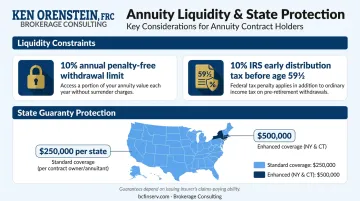
- Liquidity constraints: Funds are generally locked in for the contract term. Most contracts permit penalty-free withdrawals of up to 10% annually per NAIC guidelines, but amounts beyond that trigger surrender charges. Withdrawals before age 59½ also incur a 10% IRS early distribution tax on the taxable portion, plus ordinary income taxes.
- No FDIC protection: Unlike bank CDs, annuities are not FDIC-insured. Guarantees depend on the issuing insurer's claims-paying ability. State guaranty associations (through NOLHGA) offer a safety net — most states cover up to $250,000 in annuity protection, though limits vary. New York and Connecticut, for example, provide $500,000. This is one more reason insurer financial-strength ratings matter.
COLA riders carry a real cost. Adding a cost-of-living adjustment rider to offset inflation lowers your initial payout — insurers reduce upfront income to fund future increases. Payout-date laddering often achieves similar inflation protection more efficiently: new, higher-paying income streams activate later in retirement without reducing what you receive in earlier years.
Death benefit trade-offs deserve a direct conversation. If a retiree passes away while a contract is active, payments may stop and the insurer may keep the remaining principal, depending on contract terms. Joint-and-survivor payout structures and return-of-premium features can pass remaining value to a spouse or beneficiaries, but they typically reduce the monthly income amount. For married couples especially, this trade-off warrants deliberate planning.
Who Is an Annuity Ladder Best Suited For?
Annuity laddering works best for specific situations. It is not a universal solution.
Strong candidates include:
- Retirees and pre-retirees with a meaningful capital pool to split across multiple tranches — a comfortable ladder typically requires $100,000–$200,000 in deployable capital (Annuity.org cites the national average annuity purchase at $150,000; many per-contract minimums start around $25,000)
- Anyone without a defined benefit pension as their income floor — only about 15% of private-sector workers have access to a defined benefit plan, making guaranteed income vehicles more critical for the majority of retirees
- People who feel paralyzed by interest rate timing — laddering removes the need to pick the "right" moment
- Those with significant longevity concerns or healthcare cost anxiety in later retirement
That last group connects directly to one segment where annuity laddering gets particularly tactical: Federal employees and FERS recipients already have a guaranteed income foundation — the FERS Basic Benefit, Social Security, and TSP distributions. But predictable gaps still emerge: between FERS income and full spending needs, between Social Security claiming timing and actual retirement date, and as healthcare costs escalate in later years. An annuity ladder activates additional income streams precisely when those gaps appear.
Ken Orenstein at Brokerage Consulting works through the full FERS picture with clients — mapping pension calculations, Social Security timing, and TSP distribution schedules — then identifies where a ladder adds income that existing benefits don't cover.
How to Start Building Your Annuity Ladder
Step 1: Map Your Income Floor
Before purchasing anything, identify all existing guaranteed income sources:
- Social Security benefit amounts and planned start dates
- FERS or other pension income
- Required Minimum Distributions from IRAs starting at age 73
The gap between that floor and actual monthly spending needs is the target your annuity ladder should fill. Start with the number, not the product.
Step 2: Structure Around Your Priority
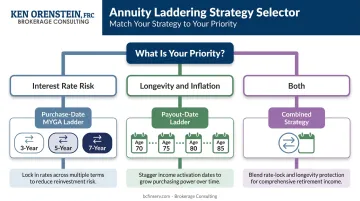
- Interest rate risk is the primary concern? Use a purchase-date MYGA ladder with 3-, 5-, and 7-year terms, with proceeds eligible for 1035 tax-free exchanges at maturity
- Longevity and inflation are the priority? Build a payout-date ladder with income streams activating at ages 70, 75, 80, and 85
- Both matter? Combine strategies (the two approaches work well together)
Shop across multiple carriers for each tranche. Annuity rates vary significantly across providers for identical product types, and the CANNEX/PGIM research found that relying on a single provider can produce dramatically less guaranteed income than broader market comparison.
Step 3: Work with a Qualified Retirement Income Advisor
Building a laddering strategy means coordinating annuity types, tax treatment (qualified vs. non-qualified funds, Roth IRA conversion timing), insurer financial ratings, and income timing. All of that needs to fit against a complete financial picture.
Ken Orenstein at Brokerage Consulting offers no-cost initial consultations by phone, virtually, or in person. As an independent broker representing top carriers, the practice can compare rates and contract terms across the market rather than being limited to any single carrier's offerings. Reach the practice at (888) 315-3608 or via bcfinserv.com.
Frequently Asked Questions
What is a fixed annuity ladder strategy?
A fixed annuity ladder uses fixed-rate products — primarily MYGAs — purchased with staggered maturity dates (for example, 3-year, 5-year, and 7-year terms) so capital becomes available at different intervals. This allows the retiree to potentially reinvest each maturing tranche at higher rates as market conditions change, without locking all capital into a single rate environment.
What does Dave Ramsey say about fixed income annuities?
Dave Ramsey is broadly skeptical of annuities, with criticism focused on high fees, commissions, and the complexity of variable and indexed products. His concerns apply most directly to fee-heavy variable annuities. Simpler income annuities and MYGAs carry a meaningfully different cost and risk profile.
How much money do I need to start an annuity ladder?
There's no universal minimum, but laddering works best when capital can be meaningfully split across multiple tranches. Annuity.org cites the national average annuity purchase at $150,000, and some per-contract minimums start around $25,000. The right amount depends on your income gap, timeline, and other retirement income sources.
What is the difference between an annuity ladder and a bond ladder?
Both use staggered maturities, but annuity ladders offer guaranteed lifetime income and mortality credits that bond ladders cannot replicate. Bond ladders preserve liquidity and capital access. The right choice depends on whether the priority is income certainty or capital flexibility — and many retirees benefit from elements of both.
Can I use an annuity ladder inside an IRA or 401(k)?
Yes — annuities can be held within IRAs, and 401(k) rollovers into annuities are possible. However, since the IRA wrapper already provides tax deferral, the annuity's deferral benefit is redundant in that context. Working with a financial advisor ensures the tax structure is handled correctly from the start.
What happens to my annuity ladder if I die before collecting all payments?
The outcome depends on contract terms. Some annuities stop payments at death and retain the principal; others include death benefits, return-of-premium features, or joint-and-survivor structures that pass remaining value to a spouse or beneficiaries — typically in exchange for a slightly reduced monthly payout.