
This guide covers every realistic option for accessing your annuity's value — full surrender, partial withdrawal, lump sum election, 1035 exchange, or selling future payments — along with the costs attached to each. Whether you hold a Fixed Indexed Annuity, Variable Annuity, MYGA, or SPIA, understanding your specific contract before making a move can save you thousands.
Key Takeaways
- Cashing out triggers surrender charges from your insurer and IRS early withdrawal penalties if you're under 59½ — two separate costs that stack
- Most deferred annuities allow a free withdrawal of up to 10% annually without surrender charges — this is often the smartest first move
- Qualified annuities are taxed as ordinary income on the full withdrawal; non-qualified annuities are taxed only on earnings
- A 1035 exchange lets you move to a better annuity contract tax-free — often a smarter option than full surrender
- Full surrender should be a last resort — exhaust free withdrawal allowances, 1035 exchange options, and hardship provisions first
What Does It Mean to Cash Out an Annuity?
"Cashing out" covers several distinct actions depending on your contract and where you are in its lifecycle:
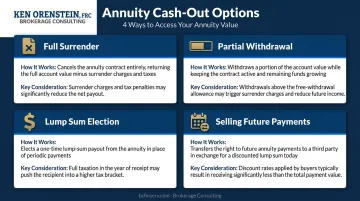
- Full surrender — terminating the contract entirely in exchange for its cash surrender value
- Partial withdrawal — taking out a portion while the contract continues
- Lump sum election — choosing a one-time payout instead of periodic income at the start of the distribution phase
- Selling future payments — exchanging scheduled payments for a discounted lump sum through a third-party buyer
Accumulation Phase vs. Distribution Phase
When you cash out depends entirely on which phase your contract is in. During the accumulation phase (before income begins), you typically have full surrender and partial withdrawal options, though surrender charges may apply. Once you enter the distribution phase and payments have started — especially with SPIAs or annuitized deferred contracts — NAIC confirms that owners generally cannot take other money out and usually cannot change payment amounts.
Account Value vs. Cash Surrender Value
These two figures are not the same, and confusing them can cost you thousands of dollars at the moment you most need clarity.
Per the NAIC Annuity Disclosure Model Regulation:
- Account value — what remains in the contract if left until payments begin
- Cash surrender value — the actual lump sum you'd receive after the insurer deducts surrender charges, bonus forfeitures, outstanding contract loans, and market value adjustments
A contract showing $100,000 on your statement with a 6% surrender charge pays out $94,000 — not $100,000.
Cashing Out vs. Annuitization
Annuitization converts your contract into a guaranteed income stream. It cannot be reversed. Cashing out provides a lump sum but permanently ends the contract's tax-deferred growth and income protection. One preserves lifetime income; the other eliminates it entirely in exchange for immediate liquidity.
Your Options for Cashing Out an Annuity
Partial Withdrawal
Most deferred annuities with surrender charges allow owners to withdraw up to 10% of the contract value annually without triggering a surrender charge — a provision confirmed by both the NAIC Buyer's Guide and the SEC's variable annuity guide. The contract stays in force, tax-deferred growth continues on the remaining balance, and you access cash without paying insurer penalties.
Taxes still apply. Withdrawals from non-qualified annuities are taxed as ordinary income on the earnings portion first (LIFO treatment). For qualified annuities, the full withdrawal is taxable.
A good first move for clients who need liquidity without fully exiting the contract.
Full Surrender
Surrendering the contract means the insurer terminates the agreement and pays you the cash surrender value. If you're still within the surrender period, the insurer deducts the applicable surrender charge. You'll owe taxes on all gains, or on the entire amount if it's a qualified annuity.
Full surrender makes the most financial sense when:
- The surrender period has ended (no charges apply)
- You're over 59½ (no IRS penalty)
- You have no ongoing need for the contract's income or growth features
Lump Sum Payout Election
Some deferred annuities allow owners to elect a one-time lump sum distribution rather than periodic income at the start of the payout phase. This avoids surrender charges if the surrender period has passed, but the tax hit can be substantial — the entire taxable amount is recognized as ordinary income in the year of distribution, which can push you into a significantly higher bracket.
Selling Future Payments
If your annuity is already in the payout phase, selling some or all of your future payments to a third-party purchasing company gives you a discounted lump sum now in exchange for forfeiting those payments.
This differs from a standard surrender. The insurer doesn't initiate or process the transaction, and in many states the transfer of structured settlement payment rights requires advance court approval under state structured settlement protection laws.
1035 Exchange (The Often-Overlooked Alternative)
Under IRS Section 1035(a)(3), you can transfer your annuity's value directly to a new annuity contract with no immediate tax consequence, meaning no gain is recognized and no penalty applies. This is useful when your goal is better terms, lower fees, higher income rider rates, or a different product structure rather than actual cash.
Ken Orenstein at Brokerage Consulting provides 1035 exchange analysis for clients holding older variable annuities or fixed annuities at below-market rates. The goal: move to a current-market MYGA or FIA with stronger income rider features, with no tax event triggered.
How the Cash-Out Process Works Step by Step
The full process typically spans a few days to several weeks, depending on the insurer, the withdrawal type, and how quickly paperwork is submitted in complete form.
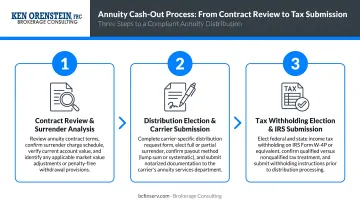
Step 1: Review Your Annuity Contract
Before contacting anyone, locate your contract and identify:
- The surrender period end date and current surrender charge percentage
- The free withdrawal provision (typically 10% annually)
- Whether the annuity is qualified (pre-tax) or non-qualified (after-tax)
- Special waiver provisions — terminal illness, nursing home confinement, or disability waivers that may reduce or eliminate surrender charges entirely
Step 2: Contact Your Annuity Issuer and Request Paperwork
Call the insurance company or work through your financial advisor to request the appropriate withdrawal or surrender forms. You'll typically need:
- Your policy/contract number
- Government-issued identification
- A completed withdrawal or surrender request form
- For larger transactions: a notarized signature or signature guarantee
Most insurers release funds within 3 to 5 business days once all required paperwork is received and verified as complete.
Step 3: Select Tax Withholding and Submit
Before your forms are finalized, you'll also need to make a tax withholding election — this is part of the submission, not a separate step afterward. IRS Publication 575 requires 10% federal withholding by default on non-periodic distributions unless you opt out in writing.
Keep these distinctions in mind:
- Withholding is not the tax itself — it's a prepayment against your liability
- Opting out doesn't eliminate the tax obligation; it means you're responsible for making estimated payments to the IRS directly
State income tax withholding requirements vary by state and should be confirmed with your advisor or tax professional.
Costs, Taxes, and Penalties Before You Cash Out
Surrender Charges
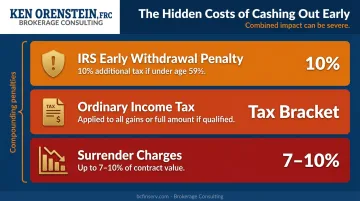
Surrender periods typically run 6 to 10 years from the contract issue date, according to the SEC. A typical declining schedule starts at 7% in year one and drops by roughly 1 percentage point annually until it reaches zero.
Example declining surrender schedule:
| Contract Year | Surrender Charge |
|---|---|
| Year 1 | 7% |
| Year 2 | 6% |
| Year 3 | 5% |
| Year 4 | 4% |
| Year 5 | 3% |
| Year 6 | 2% |
| Year 7 | 1% |
| Year 8+ | 0% |
Many Fixed Indexed Annuities use longer schedules — a 10-year contract might run 9-8-7-6-5-4-3-2-1-0%.
Surrender charges are just one layer of cost. Income taxes — and potentially an IRS penalty — can add significantly to the bill.
Income Taxes
Annuity gains are always taxed as ordinary income — never at the lower capital gains rate. How much is taxable depends on how the annuity was funded:
- Qualified annuities (funded with pre-tax IRA or 401(k) dollars): The entire distribution is taxable as ordinary income
- Non-qualified annuities (funded with after-tax dollars): Only the earnings portion is taxable; your original contributions come back tax-free
IRS Early Withdrawal Penalty
Withdrawing from an annuity before age 59½ adds a 10% IRS additional tax on the taxable portion of the distribution, in addition to ordinary income taxes. Exceptions include:
- Total and permanent disability
- Death of the owner
- Substantially equal periodic payments (SEPP / 72(t) distributions)
- Terminal illness (per IRS Publication 575)
Together, surrender charges, income taxes, and the early withdrawal penalty can consume a significant share of your annuity's value — making the timing and method of your cash-out decision critical.
Common Mistakes When Cashing Out an Annuity
Confusing account value with surrender value. The number on your statement is not what you'd receive. A $100,000 account value with a 6% surrender charge means $94,000 in your pocket — that $6,000 gap surprises more people than it should.
Assuming all annuities are equally liquid. SPIAs and annuitized deferred income contracts generally have no accessible cash value once annuitization begins. NAIC explicitly states that after payments start, owners cannot take other money out. If you chose a product for income guarantees, accessing principal may simply not be an option.
Defaulting to full surrender without exploring alternatives. Many holders don't consider:
- Using the free withdrawal provision (often 10% annually, no charge)
- A 1035 exchange to a better-performing contract
- Selling a portion of future payments
Each option can preserve substantially more of your contract's value once taxes, penalties, and surrender charges are factored in.
When Cashing Out an Annuity May Not Be the Right Move
When the Cost Stack Is Too High
If your annuity is early in its surrender period and you're under 59½, the combined effect of surrender charges, ordinary income tax, and the IRS 10% additional tax can be severe. This isn't a blanket statistic — the actual impact depends on your tax bracket, state taxes, and the specific surrender charge — but it's worth running the numbers before assuming a cash-out makes sense.
When It's Your Primary Retirement Income Source
According to LIMRA's 2024 research, 9 in 10 workers say guaranteed lifetime income is highly important to retirement security. The SSA reports that roughly 1 in 4 people who are 65 today will live past 90 — a span that demands reliable income, not just a lump sum that can be depleted.
If a guaranteed income annuity is your primary retirement paycheck and you have no other reliable income source, surrendering it removes longevity protection that is difficult to replace at your current age and health status.
When an Alternative Better Serves the Underlying Need
Before surrendering, consider whether the real goal could be addressed differently:
- Need cash for an emergency? The free withdrawal provision may cover it without charges
- Unhappy with your current contract? A 1035 exchange into a better-structured annuity may cost nothing in taxes
- Want income sooner? A deferred income annuity with a nearer activation date might accomplish the same goal
A retirement income specialist can help you map these alternatives against your specific contract terms and tax situation. Ken Orenstein at Brokerage Consulting offers no-cost consultations by phone, virtual, or in-person — visit bcfinserv.com or call (888) 315-3608.
Frequently Asked Questions
What is a cash annuity?
"Cash annuity" is an informal term for withdrawing an annuity's accumulated value as a lump sum rather than receiving it as scheduled income payments. It typically refers to a full surrender or large lump sum election, as opposed to annuitizing the contract for ongoing distributions.
Does an annuity have any cash value?
Deferred annuities have a cash surrender value — your account value minus any applicable surrender charges. Immediate income annuities and fully annuitized contracts generally have no accessible cash value once payments begin, though some include cash refund features.
How much does a cash annuity pay per month?
Monthly income varies based on principal, age, current interest rates, and payout option. As a reference point, Kiplinger reported in June 2024 that a $100,000 fixed immediate, life-only annuity at age 65 paid approximately $573 per month for a male — though rates vary by insurer, state, and purchase date.
How do you calculate the value of an annuity?
The cash surrender value equals your current account value minus any applicable surrender charges. For future income payments, those cash flows are valued using a current interest rate. Your insurer's annual statement shows your account value and the applicable surrender charge schedule.
How long does an annuity pay you?
The payout duration depends on the option you choose:
- Life-only: Pays until death
- Period-certain: Pays for a fixed number of years regardless of survival
- Joint-life: Continues while either spouse is living
- Systematic withdrawals: Continue until the account balance is depleted
Can I add money to my existing annuity?
Whether you can add funds depends on the contract type. Flexible premium deferred annuities accept ongoing contributions; single premium contracts do not. Check your contract or call your insurer to confirm.