
Introduction
You've submitted your retirement paperwork, cleared out your desk, and said your goodbyes. But weeks later, your first annuity payment still hasn't arrived — and you're wondering: what's happening to your health insurance right now?
This in-between period is one of the most confusing stretches in the entire federal retirement process. OPM doesn't finalize annuities overnight. According to OPM's published processing times, immediate retirements currently average around 78 days to process, with interim pay issued within about 7 days of separation. That's a long stretch to go without clarity on your health coverage.
Here's what this article covers:
- Who qualifies to carry FEHB coverage into retirement
- How premiums and coverage work before your annuity is finalized
- What the MRA+10 special case means for your health benefits
- What bridge options exist if there's a gap in coverage
Key Takeaways
- To keep FEHB in retirement, you need an immediate annuity and 5 years of continuous FEHB enrollment before your annuity start date.
- FEHB premiums are not deducted from interim pay; OPM reconciles the balance once your annuity is finalized, and coverage continues throughout.
- FEDVIP and FLTCIP switch to direct billing during interim pay; you must arrange payment or risk a lapse.
- MRA+10 employees who postpone their annuity lose FEHB at separation — coverage ends permanently, not temporarily.
- Canceling FEHB as an annuitant is permanent; suspending it is reversible.
Who Qualifies to Keep FEHB Coverage After Retiring?
Two requirements must both be met, per OPM's FEHB Handbook:
- You must be entitled to retire on an immediate annuity under CSRS or FERS (including MRA+10 with no postponement).
- You must have been continuously enrolled in FEHB — or covered as a family member under someone else's FEHB — for the 5 years of service immediately before your annuity start date.
What Counts Toward the 5 Years
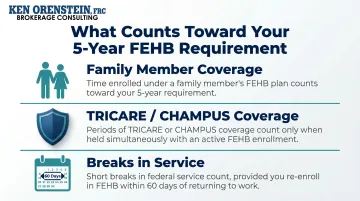
The 5-year clock measures time in a position eligible for FEHB enrollment, not just time as the primary subscriber. Three rules catch most people off guard:
- Family member coverage counts. If you were covered under a spouse's FEHB plan for part of those 5 years, that time counts.
- TRICARE/CHAMPUS counts — but only if you were also enrolled in FEHB on the day of retirement.
- Breaks in service don't automatically disqualify you. If you returned to federal service and re-enrolled in FEHB within 60 days of your return, the continuity requirement is preserved.
What Does NOT Count
- Medicare coverage
- Service as a non-appropriated fund employee
- Enrollment under TCC (Temporary Continuation of Coverage) as a former employee
OPM's Waiver Authority
OPM has authority under Public Law 99-251 to waive the 5-year requirement when denying coverage would be against equity and good conscience. Circumstances that may qualify include:
- Disability retirement
- Involuntary separations tied to a reduction-in-force (RIF) or agency buyout
- Situations where missing the threshold was genuinely outside the employee's control
Voluntary retirements generally don't qualify for a waiver unless tied to specific agency buyout authority.
Your employing office makes a tentative eligibility determination at separation, but OPM's Office of Retirement Programs makes the final call. Don't assume eligibility is confirmed until OPM completes its review.
What Happens to FEHB Before Your Annuity Payments Begin
Interim Pay and the Processing Gap
Once you retire, OPM must process your retirement claim before issuing your full calculated annuity. During that processing window — currently averaging around 78 days for immediate retirements — you receive interim pay, a partial payment designed to keep income flowing while the case is finalized.
Most federal retirees expect their benefits situation to work the same as during active employment — but several key programs handle premiums very differently once interim pay begins.
FEHB During Interim Pay
OPM's FAQ on interim payment deductions is clear: only federal income tax is withheld from interim payments. FEHB and FEGLI premiums are not deducted from interim pay.
This surprises many retirees. But it doesn't mean coverage lapses — OPM continues your FEHB enrollment and reconciles any unpaid premiums once the annuity is finalized. You may see a retroactive deduction in your first full annuity payment to cover the outstanding balance.
FEDVIP and FLTCIP: The Direct Billing Problem
These two programs work differently during the processing gap:
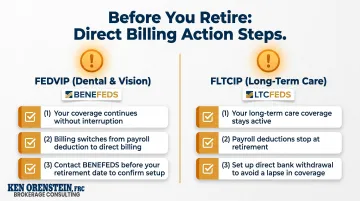
- FEDVIP (dental and vision): Coverage continues, but BENEFEDS switches to direct billing during "special pay status." Miss a bill or skip setting up automatic bank withdrawal, and your coverage could lapse.
- FLTCIP (long-term care): LTCFEDS confirms coverage stays in force as long as premiums are paid. If payroll was your payment method, you must actively set up direct billing — the transition doesn't happen automatically.
The action: contact BENEFEDS and LTCFEDS before your retirement date to arrange direct billing. Don't wait for a lapse notice.
Working with a federal retirement advisor like Ken Orenstein at Brokerage Consulting can help you map out these logistics before your last day, so every coverage transition is handled before it becomes a problem. Initial consultations are available at no cost — by phone, virtual, or in-person — at (888) 315-3608.
The MRA+10 Special Case: Postponed Annuities and FEHB
How MRA+10 Works
FERS employees who've reached their Minimum Retirement Age — ranging from 55 to 57 depending on birth year — with at least 10 but fewer than 30 years of service can retire under the MRA+10 provision. The catch: if the annuity starts before age 62, OPM applies a reduction of 5% per year (5/12 of 1% per month) under age 62.
To avoid that reduction, some employees choose to postpone their annuity start date — separating from service now, but delaying when payments begin.
The FEHB Consequence of Postponing
This is the part many employees miss: when you postpone an MRA+10 annuity, FEHB enrollment does not suspend — it terminates at separation.
Once you leave federal service, FEHB ends. You're offered Temporary Continuation of Coverage (TCC) or conversion to an individual policy — but there's no automatic bridge to retirement coverage, and the government contribution disappears with your last day of employment.
Reinstatement When You Claim the Postponed Annuity
When you later claim your postponed annuity, FEHB can be reinstated — but eligibility hinges on one condition: you must have met the 5-year continuous coverage requirement at the time of your original separation.
Once you submit to begin the annuity, OPM will notify you of your FEHB eligibility. From that notice, you have 60 days to enroll in a plan.
Taking the MRA+10 Annuity Immediately (With the Reduction)
If you accept the age-reduction penalty and take the annuity immediately, the situation is much simpler. FEHB and FEGLI continue exactly as they would for any other immediate retiree — premiums are deducted from the annuity, and coverage carries forward without interruption.
In short, the two MRA+10 paths produce very different FEHB outcomes:
- Immediate annuity: FEHB continues uninterrupted; premiums deduct from annuity payments
- Postponed annuity: FEHB terminates at separation; coverage gap until you claim; reinstatement requires the 5-year rule
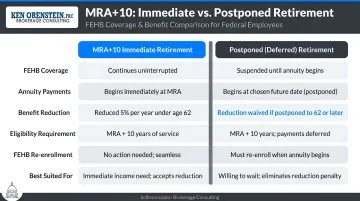
If you're weighing postponement to avoid the age reduction, factor the cost of replacement health coverage into that calculation — it can significantly offset the penalty savings during the gap period.
Your Bridge Option: Temporary Continuation of Coverage (TCC)
When FEHB ends at separation and retirement isn't immediately available — or when an annuity is being postponed — TCC provides temporary coverage.
Who TCC Covers and How Long It Lasts
Per OPM's TCC program page, TCC is available to former federal employees who lose FEHB eligibility, including:
- MRA+10 employees who postpone their annuity
- Employees who separate before meeting retirement eligibility
- Those whose retirement applications are under review
TCC lasts a maximum of 18 months from the date FEHB coverage would otherwise have ended.
What TCC Costs
TCC is expensive — and the cost shift is significant. Unlike active employment or annuitant status, where the government covers roughly 72–75% of your premium, TCC requires you to pay:
- The full premium (both your share and the government's share)
- A 2% administrative charge on top of that
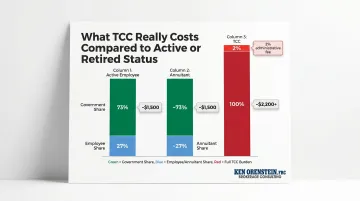
As an active employee or annuitant, the government absorbs most of that cost. Under TCC, it's entirely yours.
Important Rules at TCC's End
- When TCC expires, there is no 31-day extension of coverage (unlike regular FEHB termination at separation, which carries a free 31-day extension).
- If your retirement application is later approved with a retroactive annuity start date, OPM will reinstate your FEHB coverage retroactively and refund the TCC premiums for any overlapping period upon proof of annuitant coverage.
Other Federal Benefits During the Pre-Annuity Window
FEGLI (Life Insurance)
FEGLI continuation follows essentially the same two-part test as FEHB: immediate annuity eligibility plus 5 years of continuous coverage. At retirement, OPM sends SF 2818 (Continuation of Life Insurance Coverage), which must be completed within 60 days to lock in your post-retirement reduction election.
The three Basic insurance reduction options at age 65 are:
| Option | How Coverage Reduces | Cost After 65 |
|---|---|---|
| 75% Reduction | Drops 2%/month to 25% of original | Free |
| 50% Reduction | Drops 1%/month to 50% of original | Extra premium required |
| No Reduction | Stays at 100% of original | Higher continuing premiums |
This decision deserves serious thought — and it's irrevocable once made. Option B premiums in particular can escalate sharply with age, which The Informed Fed documents in detail. Before your 60-day window closes, it's worth pulling a private term life quote to see whether FEGLI or an outside policy offers better value at your age and health status.
Under MRA+10 with a postponed annuity, FEGLI also terminates at separation and is reinstated when the postponed annuity begins — assuming eligibility requirements were met at separation.
FEDVIP and FLTCIP
Unlike FEGLI under a postponed annuity, FEDVIP and FLTCIP don't terminate at separation — but both require attention to payment logistics once payroll deductions stop:
- FEDVIP: No action needed to continue coverage, but BENEFEDS switches to direct billing during the interim pay period. Contact BENEFEDS if you don't receive a bill shortly after retirement.
- FLTCIP: Coverage remains active as long as premiums are paid. Former payroll deductions stop at separation; you must switch to direct bank withdrawal or a direct bill arrangement to avoid a lapse.
Frequently Asked Questions
How long does it take for a government pension to begin after retirement?
OPM targets issuing interim pay within 7 days of retirement and finalizing immediate retirements in approximately 78 days on average. During that window, retirees receive partial interim payments while the full annuity is calculated. FERS cases and paper submissions can take longer than digital ones.
Should I keep federal health insurance after retirement?
Yes, for most retirees. The government continues covering roughly 72–75% of FEHB premiums in retirement — a benefit unavailable with private coverage. That subsidy alone makes FEHB worth keeping for the vast majority of federal retirees.
Is FEGLI worth keeping after retirement?
It depends on your health and coverage needs at retirement. The 75% Reduction option becomes free after 65 but leaves minimal coverage; Option B's No Reduction option provides full coverage at premiums that increase sharply with age. Private term life may offer better value — compare options before the election, because it's irrevocable.
What happens to FEHB coverage if my annuity is delayed?
During OPM's processing period, FEHB coverage continues and premiums are reconciled once the annuity is finalized — there's no gap for immediate retirees. If you've postponed your annuity under MRA+10, however, FEHB terminates at separation and TCC becomes the bridge option.
Can I re-enroll in FEHB after canceling it in retirement?
No. Cancellation of FEHB as an annuitant is permanent — there is no re-enrollment right, even during Open Season. Suspension (for Medicare Advantage, Medicaid, or TRICARE enrollment) is different; it preserves your ability to return to FEHB during a future Open Season.
What is the 31-day extension of FEHB coverage at separation?
When FEHB terminates at separation, a free 31-day temporary extension automatically applies. No premium is due during this period. It gives you time to elect TCC, convert to an individual policy, or arrange other coverage. Note: this 31-day extension does not apply when TCC itself expires.