
Introduction
Choosing an annuity payout option feels straightforward until you realize the decision is nearly impossible to reverse. According to FINRA, the decision to annuitize is generally irrevocable — once you elect a payout structure, you give up control of the investment in exchange for a guaranteed income stream. If your circumstances change after that point, the election stands.
That permanence makes understanding your options before you commit more important than most retirees realize. LIMRA's 2025 research found that only 14% of consumers said they understood annuities and their role in retirement planning "very well" — compared to 28% of financial professionals who believed their clients understood them well. Choosing the wrong payout structure based on incomplete information can mean locking in lower income, losing survivor protection, or outliving payments you expected to last a lifetime.
This article is for retirees, near-retirees, federal employees, and anyone approaching the distribution phase of their annuity. It explains each major payout option in plain terms, what drives payment size, and how to match the right option to your actual situation — before the election becomes permanent.
Key Takeaways
- Annuity payout options control how long, to whom, and in what form income is distributed
- Seven core options exist: Straight Life, Period Certain, Life with Period Certain, Joint and Survivor, Cash/Installment Refund, Systematic Withdrawal, and Lump Sum
- Life-based options guarantee income for life; period certain options guarantee income for a fixed term regardless of survival
- Your age, health, marital status, and other income sources are the primary decision factors
- Most payout elections cannot be changed after annuitization begins — get this right before you commit
What Are Annuity Payout Options?
An annuity payout option defines how your income is distributed during the payout phase. You make this election either at purchase or at annuitization — the moment the contract converts from an accumulating asset into a guaranteed income stream.
The payout option determines three things:
- Duration — how long payments continue (your lifetime, a fixed term, or the longer of both)
- Beneficiary protection — whether anyone receives payments after you die
- Flexibility — whether you retain any control over the funds once payments begin
Keep this distinction in mind: the annuity type (fixed, variable, indexed) determines how money grows during accumulation. The payout option determines how that money is distributed. They're separate decisions made at different stages — and understanding both is what the rest of this guide walks through.
A Breakdown of the Main Annuity Payout Options
Not every annuity contract offers every option listed below, and terminology can vary by insurer. What follows is a plain-language reference to the standard payout elections you're likely to encounter.
Straight Life (Life Only)
Straight Life pays guaranteed income for as long as you live — and stops entirely when you die. No payments continue to a spouse or beneficiary.
Because the insurer's obligation ends at your death, this option typically produces the highest monthly payment among life-based options. For a 65-year-old male with a $100,000 premium, the American Academy of Actuaries shows a monthly payout of approximately $602; for a female at the same age, $569, reflecting longer average life expectancy.
This option works well for single individuals with no financial dependents. For married couples, it carries significant risk: if the higher-earning spouse dies first, the surviving spouse receives nothing from the annuity.
Period Certain Only
Period Certain pays income for a fixed, annuitant-selected term — commonly 10 or 20 years — regardless of whether you're alive. If you die before the term ends, a named beneficiary receives the remaining payments.
This is the option where you directly choose the payment duration. It carries no longevity protection — if you outlive the term, payments stop. But during the term, it produces higher monthly amounts than most life-based options. Using the same $100,000 premium example:
- 10-year period certain: ~$988/month
- 20-year period certain: ~$611/month
Period Certain suits those bridging a specific income gap (such as waiting for Social Security) or situations where the annuity owner is a non-person entity like a trust.
Life with Period Certain
This hybrid option pays income for life but guarantees a minimum payment period — typically 10 or 15 years. If you die within that guaranteed window, your beneficiary receives payments for the remainder of the period. If you outlive it, payments continue until your death, with no further obligation to beneficiaries.
Monthly payments are slightly lower than straight life because the insurer's obligation extends beyond your death if you die early. This option suits retirees who want lifetime income but also need to ensure a spouse or dependent isn't left without income in the early years.
Joint and Survivor
Joint and Survivor covers two lives — typically spouses — and continues payments as long as either person is alive. When one annuitant dies, payments continue to the survivor at a pre-elected percentage: 100%, 75%, or 50% of the original amount.
A higher survivor benefit means lower payments while both are alive. Using the $100,000 / two age-65 unisex example:
| Survivor Benefit | Monthly Payment (Both Alive) |
|---|---|
| 100% | ~$522 |
| 75% | ~$535 |
| 50% | ~$551 |
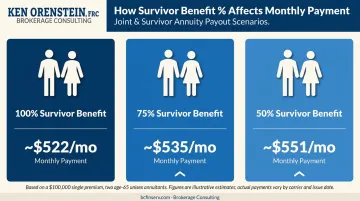
The IRS requires that qualified joint and survivor annuities pay the surviving spouse no less than 50% of the amount paid during the participant's lifetime.
A younger joint annuitant will also reduce the initial payment, since the insurer expects a longer combined payout window.
Cash Refund and Installment Refund
Both refund options address the same concern: what happens if you die before recovering your original premium?
- Cash Refund — The beneficiary receives the remaining balance as a lump sum
- Installment Refund — Payments continue to the beneficiary in the same periodic amounts until the original premium is recovered
Monthly payments are lower than straight life — approximately $581 (cash refund) and $588 (installment refund) per $100,000 for a male age 65 — because the insurer takes on the added liability of a potential refund obligation.
Systematic Withdrawal and Lump Sum
These two options sit outside traditional annuitization and work differently:
- Systematic Withdrawal — You draw down a set amount or percentage on a regular schedule until funds are depleted. You retain control, but carry longevity risk: if you live longer than your withdrawals account for, you can exhaust the contract
- Lump Sum — A one-time full distribution. Tax implications are significant, particularly for qualified annuities where the full amount is taxable as ordinary income
Neither option provides lifetime income guarantees. The Thrift Savings Plan draws this distinction plainly: TSP installment payments run only as long as there's a remaining balance, while a life annuity trades control of the funds for a guaranteed lifetime income commitment.
Key Factors That Affect Your Payout Amount
Several variables determine your monthly payout — and knowing them helps you compare options on equal footing.
Age and Life Expectancy
Younger annuitants receive smaller payments — the insurer must fund a longer expected income stream. Older annuitants receive more. Under life-based options, women typically receive lower payments than men because of longer average life expectancy, unless the plan uses unisex mortality tables (required under ERISA for employer-sponsored plans).
Payout Option Choice
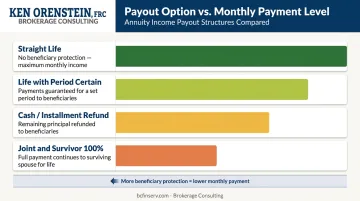
The option itself is one of the largest variables. Adding beneficiary protections progressively reduces the monthly amount:
| Payout Option | Payment Level |
|---|---|
| Straight Life | Highest |
| Life with Period Certain | Slightly lower |
| Cash/Installment Refund | Lower still |
| Joint and Survivor (100%) | Lowest among standard options |
Contract Value and Interest Credited
The accumulated contract value — your principal plus any interest or growth during the accumulation phase — is the base from which payments are calculated. A larger contract value produces a larger payment across every payout type.
Joint Annuitant's Age
When electing Joint and Survivor, the age of the second annuitant directly affects payment size. A 65-year-old electing joint coverage with a 55-year-old spouse will receive a meaningfully smaller payment than two 65-year-olds, because the insurer's projected liability extends further.
Tax Treatment
How your annuity was funded determines how distributions are taxed:
- Qualified annuities (funded with pre-tax dollars, such as IRA or 401(k) rollovers): distributions are fully taxable as ordinary income
- Non-qualified annuities (funded with after-tax dollars): only the earnings portion is taxable; return of principal is tax-free
Note that withdrawals before age 59½ may trigger a 10% IRS penalty on top of ordinary income taxes.
Payout option selection should factor in your projected tax bracket. A large monthly payment from a qualified annuity can push you into a higher bracket or trigger higher Medicare premium surcharges (IRMAA).
How to Choose the Right Payout Option
Every annuitant faces the same core trade-off: maximize monthly income versus protect a spouse or beneficiary. Neither priority is universally correct — the right answer depends on your specific circumstances.
Matching Options to Situations
| Situation | Option to Consider |
|---|---|
| Single, no financial dependents | Straight Life |
| Married couple, annuity is primary income source | Joint and Survivor |
| Bridging to Social Security or a defined income gap | Period Certain Only |
| Want lifetime coverage with some beneficiary protection | Life with Period Certain |
| Concerned about losing principal if you die early | Cash or Installment Refund |
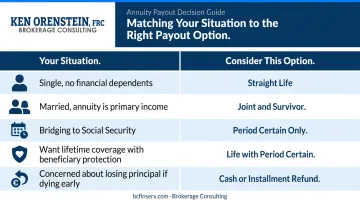
These are decision guidelines, not prescriptions. A married couple with significant other income sources might reasonably choose Straight Life and use the higher payment to fund life insurance for the surviving spouse — effectively self-insuring the survivor benefit.
The Role of Other Income Sources
Annuitants with Social Security, pensions, or other guaranteed income have more flexibility. If your basic living expenses are covered by other sources, you're less dependent on maximizing the annuity payment, which opens room for options with stronger beneficiary protection even when the monthly amount is lower.
This is especially relevant for federal employees. FERS and CSRS pensions, TSP distributions, and Social Security can collectively cover a significant portion of retirement income. When an annuity is supplemental rather than primary, the trade-offs between income maximization and beneficiary protection look very different.
Federal Employee Considerations
Federal employees face a layered set of decisions that interact with commercial annuity payout elections:
- FERS survivor benefit elections reduce the retiree annuity by 10% (for the full 50% survivor benefit) or 5% (for the partial 25% survivor benefit)
- CSRS maximum survivor annuity equals 55% of the retiree's unreduced benefit
- TSP distribution options include installment payments, annuity purchase, and lump-sum distributions — each with different tax and income implications
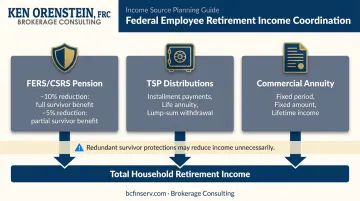
Coordinating these alongside a commercial annuity payout election requires careful sequencing. Redundant survivor protections (such as both a FERS survivor benefit and a joint-and-survivor annuity) may be unnecessary and costly.
Ken Orenstein at Brokerage Consulting focuses on this kind of federal retirement income coordination, helping federal employees integrate pension survivor elections, TSP strategy, and annuity payout structures without duplication.
Common Misconceptions and Mistakes
"The highest payment is always the best option"
Many annuitants default to Straight Life because the number looks best on paper. But a surviving spouse who loses all annuity income after their partner's death may suddenly lose half or more of household retirement income. Select a payout option that reflects household income needs, not just the individual payment amount.
"I can change my election later"
This is one of the most dangerous assumptions in annuity planning. Once annuitization begins, the payout election is locked in for the life of the contract. The NAIC confirms that after income payments begin, the owner generally cannot change the payment amount or access other funds from the contract.
Life changes — remarriage after annuitization, or the deteriorating health of a joint annuitant — cannot be accommodated once payments begin.
If you're approaching annuitization and have concerns about your current election, a 1035 tax-free exchange to a new contract may be worth evaluating — but only before annuitization occurs. A consultation to review your existing contract can clarify whether a 1035 exchange makes sense before that window closes.
"Period certain is always safer than life-only"
Period certain annuities carry longevity risk: if you outlive the fixed term, payments stop entirely. For a 65-year-old who elects a 10-year period certain and lives to 85, the annuity provides no income for the final decade. Life-based options protect against this scenario. The right choice depends on which risk concerns you more: outliving your income, or leaving nothing behind if you die early.
Frequently Asked Questions
What payment options are available to the annuitant?
The main options are:
- Straight Life
- Period Certain Only
- Life with Period Certain
- Joint and Survivor
- Cash Refund
- Installment Refund
- Systematic Withdrawal
- Lump Sum
Not every contract offers every option — availability depends on the specific annuity product and the issuing insurer.
Which annuity payout option makes no additional payments after the annuitant dies?
Straight Life (also called Life Only) ceases all payments at the annuitant's death. No death benefit or continuation is paid to any beneficiary. As a result, it offers the highest monthly payment of any life-based option.
Under which annuity option does the annuitant choose the payment period?
Period Certain Only is the option where the annuitant selects the duration (commonly 10 or 20 years). If the annuitant dies before the term ends, payments continue to a named beneficiary for the remainder of that period.
What is the difference between a life annuity and a period certain annuity?
A life annuity pays income for as long as the annuitant lives, regardless of how long that is. A period certain annuity pays for a fixed number of years regardless of survival.
Can you change your annuity payout option after annuitization begins?
Most contracts lock in the payout election at annuitization, making it irrevocable. A few contracts allow a one-time change within a short window after annuitization begins, but these exceptions are rare — confirm the terms with your insurer before signing.
How does choosing a joint and survivor option affect monthly payment amounts?
Joint and survivor options produce lower monthly payments than single-life options because the insurer accounts for two life expectancies. The reduction is larger when the joint annuitant is 10 or more years younger than the primary annuitant.