The term gets used frequently, but most people don't fully grasp what they're trading away when they select this option. According to the TIAA Institute, only 33% of U.S. adults correctly understand average life expectancy at age 65, while 32% underestimate it entirely. That's a planning problem — because the wrong annuity structure chosen today can leave a spouse without income or a retiree with far less than expected.
This guide breaks down what a straight life annuity actually is, who it's right for, and where it falls short.
Key Takeaways
- A straight life annuity pays guaranteed monthly income for your lifetime only, with no payments continuing after death
- It offers the highest monthly payout of any annuity structure because there are no survivor or residual death benefits
- Best suited for single retirees, those without dependents, or those with separate assets designated for heirs
- Couples relying on shared annuity income should consider joint-life options instead
- Typically irrevocable; evaluate your health, dependents, and other income sources carefully before committing
What Is a Straight Life Annuity?
A straight life annuity — also called a "life only" or "single life" annuity — is a retirement income contract with an insurance company that guarantees regular payments for the duration of the annuitant's life. When the annuitant dies, payments stop entirely. No funds pass to a spouse, beneficiary, or estate.
How It's Funded
You can fund a straight life annuity two ways:
- Lump-sum payment at retirement — the most common approach, often used when converting a pension payout, inheritance, or savings rollover into immediate income
- Periodic contributions during working years — premiums paid over time, with income beginning at a specified retirement date
Both funding methods produce the same guaranteed payment structure. The monthly amount is set at contract issue and does not change.
The Longevity Bet
A straight life annuity is built around one variable: how long you live. Live well past your break-even point and you extract considerable value. Die early and the insurer keeps what's left — there's no refund mechanism unless you purchase a separate rider, which reduces the monthly amount.
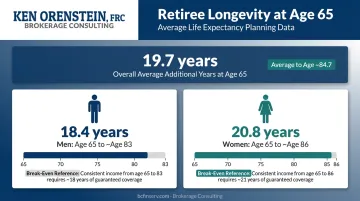
That makes longevity data worth knowing. The CDC reports that a 65-year-old can expect to live an additional 19.7 years on average — about 18.4 for men and 20.8 for women. That's a long payment window for a well-structured annuity.
Key Benefits of a Straight Life Annuity
Each of these benefits applies differently depending on your income needs, family situation, and financial goals. Here's what actually matters.
Guaranteed Income You Cannot Outlive
The defining feature is simple: payments continue no matter how long you live — 10 years into retirement or 35. This matters more than it might seem.
Allianz Life research found that 64% of Americans worry more about running out of money than death — and 44% of retirees actually spend less than they could because of that fear. A straight life annuity eliminates that anxiety for essential expenses.
This benefit matters most for:
- Retirees without substantial investment portfolios or pension alternatives
- Those whose Social Security alone doesn't cover basic living costs
- Anyone who wants a guaranteed income floor that doesn't depend on market performance
Higher Monthly Payouts Than Any Other Annuity Type
Because the insurer carries no obligation to pay survivors or beneficiaries, the entire premium is calculated to maximize income over one life — yours. That actuarial structure produces larger monthly payments.
The mechanics: insurers use what Vanguard calls a mortality credit — income generated by pooling longevity risk across many annuitants. Those who die early effectively subsidize the payouts of those who live longer. When you remove survivor obligations entirely, the monthly payment rises.
To illustrate the difference: one pension maximization example from Equitable shows a life-only payment of $2,000 per month versus $1,700 per month for a joint-and-50% survivor option — a 17.6% premium for the life-only structure. Note that the exact differential varies based on age, sex, interest rates, and survivor percentage selected; this is an illustration, not a universal benchmark.
Who gains most from this structure:
- Retirees with no financial dependents relying on their annuity after death
- Those with a separate life insurance policy that handles wealth transfer
- Anyone whose primary goal is maximizing their own income during retirement
Simplicity and Predictability in Retirement Planning
A straight life annuity has one structure: fund the contract, receive a fixed payment each month for life, and the contract ends at death. No market-linked formulas. No ongoing investment decisions. No rider complexity.
A fixed monthly income lets retirees build a reliable budget without tracking portfolio withdrawals, rebalancing, or adjusting for sequence-of-returns risk. For older retirees who prefer low-maintenance financial products, that simplicity is a core feature — not a limitation.
This structure fits well when you:
- Want income that requires no ongoing management decisions
- Prefer a predictable budget over variable portfolio withdrawals
- Are comfortable trading flexibility for guaranteed, lifelong certainty
That preference is increasingly common. LIMRA reports that investor interest in annuities rose from 33% in 2018 to 52% in 2023, with 45% of investors specifically seeking downside protection after market volatility.
Risks and Drawbacks to Consider
A straight life annuity delivers guaranteed income for life — but it comes with trade-offs worth weighing carefully before you commit.
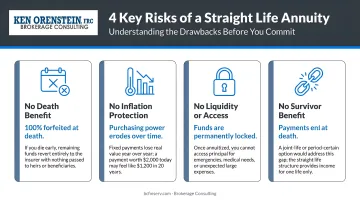
- Early death risk: Die shortly after payments begin and you may receive far less than the total premium paid, with the insurer retaining the remainder. SSA actuarial data puts a 65-year-old male's chance of dying before age 70 at roughly 9.8%, and before age 75 at 22.1%. For women, those figures are approximately 6.2% and 15.0%.
- No survivor protection: Payments stop at the annuitant's death. A surviving spouse or dependent receives nothing from the contract — a serious exposure for couples relying on that income stream together.
- Inflation erosion: Fixed payments never increase. BLS data shows $1,000 in 2000 required approximately $1,821 in 2024 to match the same purchasing power — roughly 55% of real value lost over 24 years. Across a 20–30 year retirement, that erosion compounds significantly.
- Inflexibility: Once issued, the contract cannot be restructured, paused, or surrendered for cash. Your circumstances may change; the contract terms will not.
Straight Life Annuity vs. Other Payout Options
No single payout structure is universally superior. Every alternative to a straight life annuity involves one trade-off: adding survivor protection or guarantees reduces the monthly payment.
| Payout Option | Monthly Income | Survivor Benefit | Best For |
|---|---|---|---|
| Straight Life | Highest | None | Single retirees, no dependents |
| Joint & Survivor | Lower | 50–100% to spouse | Couples sharing income |
| Life with Period Certain | Moderately lower | Payments during certain period | Early-death protection |
| Cash Refund | Moderately lower | Remaining premium to heirs | Estate-conscious retirees |
| Lump Sum | N/A (one-time) | Full balance | Those wanting liquidity |
Each alternative addresses a different concern. Joint-and-survivor continues payments at a reduced amount — typically 50%, 75%, or 100% of the original — to a surviving spouse. Period-certain structures guarantee payments for a minimum term (10 or 15 years) even if the annuitant dies during that window. Cash refund options return the unrecovered premium balance to heirs, making them a common choice for estate-conscious buyers.
The straight life annuity sits at one end of that spectrum. It delivers the highest possible monthly income — but that trade-off only makes sense when you have no dependents relying on continued payments after your death.
Who Should Choose a Straight Life Annuity?
The Ideal Candidate Profile
A straight life annuity works best for:
- Single retirees with no dependents — the lack of a survivor benefit is irrelevant when no one else is counting on that income
- Married retirees whose spouse has independent income — if your spouse has their own pension, Social Security, or annuity sufficient to cover their expenses, a straight life structure can maximize your income without leaving them vulnerable
- Retirees in good health with longevity in their family history — the longer you live, the more value you extract from a life-only structure
Who Should NOT Choose This Option
- Couples whose household budget depends on both incomes continuing
- Anyone wanting to leave financial assets to heirs through the annuity contract
- Individuals with serious health conditions who may not live long enough to recover their premium
The Life Insurance Pairing Strategy
Some retirees combine a straight life annuity with a permanent life insurance policy — often called pension maximization. The approach: elect the higher life-only payout, then use a portion of that additional income to fund a life insurance policy that provides the wealth transfer function.
For example, a retiree might receive $300 more per month from a life-only versus a joint-and-survivor election. That $300 funds a life insurance policy whose death benefit replaces what the spouse would have received through a survivor annuity.
The mechanics can work well — but as financial planner Michael Kitces has noted, these strategies require rigorous comparison and aren't automatically superior, especially when health conditions affect insurability or when the survivor annuity provides spousal benefits the insurance policy can't replicate.
Federal Employees and Pension Survivor Elections
For federal employees under FERS or CSRS, this decision takes a specific form. Electing no survivor benefit is effectively the federal equivalent of choosing a straight life annuity — and the numbers matter:
| Plan | Survivor Benefit Election | Retiree Annuity Reduction |
|---|---|---|
| FERS | Full survivor benefit | 10% |
| FERS | Partial survivor benefit | 5% |
| CSRS | Any survivor benefit | 2.5% of first $3,600, plus 10% of remainder |
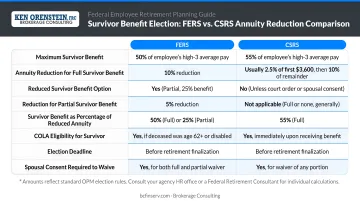
This election is largely irrevocable. OPM allows changes only within 30 days of the first regular monthly payment, with limited exceptions for specific life events after that window closes. That combination of irreversibility and financial impact makes careful scenario modeling essential — ideally well before the retirement date.
Ken Orenstein at Brokerage Consulting works with federal employees across NJ, MD, VA, DC, and other states on exactly this kind of planning. His practice covers FERS and CSRS retirement decisions, survivor benefit election analysis, and coordinating pension income with broader retirement assets.
Conclusion
A straight life annuity offers the highest possible monthly payout and guaranteed lifetime income — but the trade-offs are real and permanent: no survivor protection, no inflation adjustment, no refund if you die early.
Because this decision is irrevocable, it deserves careful evaluation alongside your full financial picture: dependents, other income sources, health outlook, and estate goals. A structure that maximizes income for a single retiree can be financially devastating for a surviving spouse left out of the planning.
Getting those scenarios modeled before locking in a structure is where professional guidance makes the biggest difference. Ken Orenstein at Brokerage Consulting offers no-cost initial consultations — available by phone, virtually, or in person.
Ken specializes in retirement income strategies for federal employees, individuals, and seniors, and is licensed across NJ, NY, MD, VA, DC, and many other states.
Frequently Asked Questions
What is a straight life annuity?
A straight life annuity is a retirement income contract that pays guaranteed monthly benefits for the annuitant's lifetime only. When the annuitant dies, payments stop completely — no funds are distributed to a spouse, beneficiary, or estate.
How does a straight life annuity pay out?
Payments are made monthly (or at another agreed interval) for as long as the annuitant lives. The contract is funded either by a lump-sum premium at retirement or periodic contributions during working years. The payout amount is fixed at the time the contract is issued.
What does "straight life annuity with no survivor benefits" mean?
This simply describes the standard structure of any straight life annuity. At death, payments stop and nothing passes to a spouse or beneficiary — distinguishing it from joint-and-survivor or period-certain options that provide continued or minimum-term payments.
Why does a straight life annuity have the highest monthly payout?
The insurer is only obligated to pay during the annuitant's lifetime with no further liabilities to survivors. The entire premium is applied to maximizing that one person's monthly income, producing higher payments than any structure that includes survivor or death benefits.
What are the main advantages and disadvantages of a straight life annuity?
Advantages:
- Guaranteed lifetime income with no expiration
- Highest possible monthly payout of any annuity structure
Disadvantages:
- No survivor or beneficiary benefits
- Risk of dying before recouping the full premium
- Fixed payments that erode in purchasing power over time