
This is the core problem annuities solve when used correctly. Yet many people dismiss them as overly complex products or misuse them as investment vehicles chasing market-like returns. Neither approach works.
This guide explains how to use annuities strategically as a volatility hedge — which types actually protect you, how to size the purchase, and what trade-offs to plan around before you sign anything.
Key Takeaways
- Fixed and fixed indexed annuities (FIAs) protect principal from market losses — variable annuities do not
- Build an income floor — guaranteed monthly income covering essential expenses — without drawing down your portfolio
- Size the annuity to fill your income gap: monthly expenses minus Social Security, pension, and other guaranteed income
- Annuity laddering — staggered purchases with different start dates — reduces interest rate timing risk
- Expect trade-offs: limited liquidity, no built-in inflation adjustment, and ordinary income tax on withdrawals
When Annuities Make Sense as a Hedge Against Market Volatility
Not every pre-retiree needs an annuity, and not every annuity purchase serves a hedging purpose. Timing matters enormously.
The Sequence of Returns Problem
The central hazard for retirees isn't average market performance — it's the sequence of returns. Wade Pfau's historical analysis across 68 rolling 30-year windows shows that identical withdrawal strategies can either deplete a portfolio within 15 years or leave substantial terminal wealth. The difference comes down almost entirely to what markets do in years one through ten.
When you're withdrawing $5,000/month from a portfolio that just dropped 25%, you're selling more shares to raise the same cash and permanently impairing the capital base. That's why guaranteed income at the start of retirement is structurally different from guaranteed income at age 80.
Who Is a Good Fit
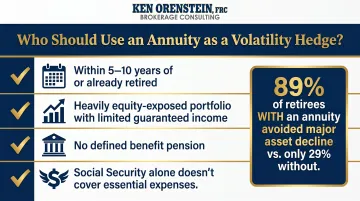
Annuities make the most sense as a volatility hedge when:
- You're within 5–10 years of retirement or already retired
- Your portfolio is heavily equity-exposed with limited guaranteed income
- You have no defined benefit pension (EBRI research shows retirees without DB pension income see median assets fall nearly 89% by year 21–22, versus 29% for those with guaranteed income streams)
- Your Social Security alone doesn't cover essential monthly expenses
When Annuities Are the Wrong Tool
Annuities get misused more often than people expect. Common mistakes include:
- Treating them as investment vehicles targeting market-like returns
- Replacing all equities with annuities (which creates inflation risk)
- Purchasing when you may need that capital within the surrender charge period (typically 5–10 years)
Prerequisites Before You Buy
Three things should be in place before committing to any annuity:
- Liquid emergency fund: at least 6–12 months of expenses held outside the annuity, in accessible accounts
- A clear income gap number: subtract all guaranteed income sources from your total monthly expenses to know exactly how much the annuity needs to cover
- Your income start date: pinpoint when you'll actually need payments to begin, since this drives product selection and pricing
Which Types of Annuities Work Best for Hedging Market Volatility
The annuity category matters more than the specific product. One type genuinely hedges volatility; another is directly exposed to it.
Fixed Annuities and MYGAs
Multi-Year Guarantee Annuities (MYGAs) offer the strongest, simplest protection. You deposit a lump sum, the insurer credits a guaranteed interest rate for a defined term (3, 5, 7, or 10 years), and market performance is completely irrelevant to your return.
MYGAs function similarly to CDs but with tax-deferred growth and typically higher rates. They're appropriate when the primary goal is principal protection with a predictable yield — not income generation.
Fixed Indexed Annuities (FIAs)
FIAs are the most widely used hedging vehicle. U.S. FIA sales hit $127.9 billion in 2025, a record, reflecting broad adoption as a protected growth tool.
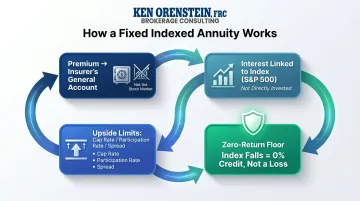
How FIAs work:
- Your premium goes into the insurer's general account — not the stock market
- Interest credits are linked to an index (commonly the S&P 500), not directly invested in it
- A zero-return floor means if the index falls, you earn 0% — not a negative return
- Upside is limited by the contract's cap rate (e.g., 6% maximum annual credit), participation rate (e.g., 65% of index gains credited), or spread (a percentage deducted from gains before crediting)
FIAs are designed to compete with CD-like returns, not equity returns. Anyone who pitches an FIA as offering "full market upside with no downside" is misrepresenting the product.
The caps and participation rates exist precisely because the insurer is absorbing your downside risk — that's the trade-off, and it's a deliberate one.
FIAs can also carry Guaranteed Lifetime Withdrawal Benefit (GLWB) or Guaranteed Minimum Income Benefit (GMIB) riders, which provide a contractual lifetime income stream regardless of account value. These riders typically accumulate using a roll-up rate (commonly 5–7% annually during the deferral period) applied to an income base.
Income Annuities: SPIAs and DIAs
Unlike the products above, variable annuities are directly exposed to market performance through investment subaccounts. Their value rises and falls with those subaccounts — which makes them unsuitable as a volatility hedge. If a variable annuity appears in a retirement plan, it's serving a growth or tax-deferral role, not a protection role.
How to Use Annuities to Hedge Against Market Volatility
Using an annuity as a hedge requires a deliberate sequence. Buying the wrong type, at the wrong allocation, for the wrong goal undermines the entire protective function.
Step 1: Assess Your Income Gap First
Calculate your income floor:
Monthly essential expenses − (Social Security + pension + any existing annuity income) = Income gap
The average Social Security retired-worker benefit is approximately $2,071/month as of early 2026. If your essential expenses run $4,500/month, your income gap is roughly $2,400 — size the annuity to fill that gap, not to replace your entire portfolio.
Federal employees and FERS participants have an additional layer to account for: their FERS pension and TSP distributions. These income sources should be fully mapped before any annuity purchase is sized — otherwise, you risk duplicating coverage you already have.
This is where working with a federal retirement specialist pays off. A consultant familiar with FERS, Social Security, and TSP can identify the true income gap rather than recommending coverage that overlaps with existing benefits. Ken Orenstein at Brokerage Consulting focuses specifically on this kind of gap analysis for federal employees.
Step 2: Choose the Right Annuity Type for Your Goal
| Goal | Appropriate Product |
|---|---|
| Principal protection + predictable yield | MYGA or Fixed Annuity |
| Protected growth + lifetime income (future) | FIA with GLWB/GMIB rider |
| Guaranteed income starting now | SPIA |
| Guaranteed income starting in 10+ years | DIA or QLAC |
Once you've selected a product type, decide whether a lump sum or installment premium fits your cash flow, and whether you need income immediately or at a future date. Both decisions hinge on how much liquidity you're keeping outside the contract.
Step 3: Implement an Annuity Ladder to Reduce Timing Risk
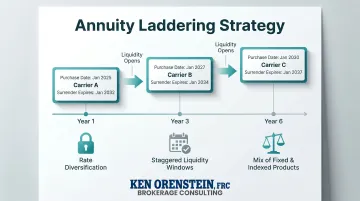
Rather than committing all annuity funds at once, a ladder staggers purchases across different times and across different carriers when rates or terms vary. The benefits:
- Reduces the risk of locking in an unfavorable rate environment
- Spreads surrender charge periods so liquidity opens at different points
- Allows combining fixed and indexed products to balance certainty with some upside potential
Payout rates shift meaningfully with interest rate moves. Purchasing in a higher-rate environment locks in better income levels, which is exactly why timing diversification matters.
Step 4: Monitor the Annuity's Role Over Time
Once a contract is in force, review annually:
- Does the income floor still cover essential expenses, given inflation and healthcare cost changes?
- Has a major liquidity need emerged that requires repositioning?
- Has the surrender charge period expired, opening options for repositioning into a better-rate contract?
Key Risks and Trade-Offs to Know Before You Commit
Inflation Risk
Fixed annuity payments are nominal — they don't automatically adjust for rising prices. With CPI running at 3.8% over the 12 months ending April 2026, a $2,400/month payment today buys significantly less in real purchasing power in 10 years.
Options to address this:
- COLA riders — available at 1%, 2%, 3%, or CPI-linked increases annually (at the cost of a lower starting payment)
- Keeping a growth-oriented portfolio alongside the annuity to compensate for purchasing power erosion over time
Fees and Surrender Charges
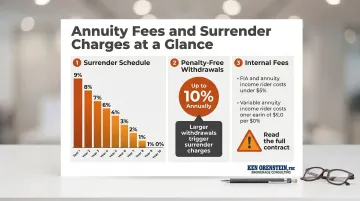
Key fee and liquidity details to review before signing:
- Surrender period: Typically 5–10 years on a declining schedule (e.g., 9-8-7-6-5-4-3-2-1-0% over 10 years)
- Penalty-free withdrawals: Most contracts allow up to 10% annually — larger withdrawals during the surrender period trigger charges
- Internal fees: FIAs and variable annuities with income riders can carry significant ongoing costs — read the full contract, not just the summary sheet
Tax Treatment
Annuity gains grow tax-deferred, but withdrawals are taxed as ordinary income — not at capital gains rates. The tax treatment differs based on how the annuity was funded:
- Nonqualified annuities (after-tax money): An exclusion ratio lets you recover your original basis tax-free over time
- Qualified annuities (IRA or TSP-funded): All distributions are fully taxable, and large withdrawals can push your income into a higher bracket or trigger RMD complications
If you're drawing from a large qualified account, coordinate annuity purchases with your broader tax plan before committing.
Best Practices for Using Annuities Effectively in a Volatile Market
Cover essentials only. SOA research on income flooring consistently frames annuities as covering essential expenses — not the full portfolio. Keep the remainder in growth assets to address inflation and long-term needs.
Scrutinize "market upside with no downside" claims. FIAs provide principal protection with limited upside, shaped by caps, participation rates, and spreads. NAIC suitability standards require full disclosure of these constraints — if an advisor can't clearly explain how your upside is capped, treat it as a red flag.
Time purchases thoughtfully, but don't wait indefinitely. Higher interest rate environments produce better annuity payouts — but waiting for the perfect rate creates its own risk. The goal is locking in a guaranteed income floor before shifting conditions erode that opportunity.
Verify carrier financial strength. Review ratings from A.M. Best, S&P, Moody's, and Fitch before committing to any carrier — guarantees are only as solid as the insurer backing them.
Frequently Asked Questions
Frequently Asked Questions
Are annuities safe if the stock market crashes?
Fixed and fixed indexed annuities are insulated from direct market losses — premiums sit in the insurer's general account, not equities, and a zero-return floor means the worst outcome in a down year is a zero credit, not a loss of principal. State guaranty associations also backstop licensed insurers up to roughly $250,000 in annuity benefits (limits vary by state).
What is a fixed indexed annuity?
A FIA is an insurance contract where interest credits are linked to a market index like the S&P 500 — subject to a cap, participation rate, or spread — but principal is fully protected from index losses. You can participate in index-linked growth without risking your original investment in a down market.
What's the average return on a fixed indexed annuity?
FIAs are designed to compete with CD-like returns, not stock market returns. Credited rates vary by contract based on cap rates, participation rates, and index performance — a licensed advisor can compare current carrier terms to give you a realistic range for your situation.
Are guaranteed income annuities a good idea?
For retirees who need predictable monthly income and want protection against outliving their savings, SPIAs and DIAs can be strong planning tools. Suitability depends on health, other income sources, and liquidity needs — immediate annuities aren't a good fit for anyone who requires flexible access to their capital.
How does a fixed annuity pay out?
Fixed annuities can pay out as periodic payments (monthly, quarterly, or annually) or as a lump sum at the end of the accumulation period, depending on the contract and the payout option selected at annuitization.
Do you get your money back at the end of a fixed term annuity?
At the end of a MYGA term, the contract owner can withdraw the full accumulated value (principal plus credited interest), roll it into a new annuity, or annuitize it for income. Provided no early withdrawals triggered surrender charges during the term, the full accumulated value is available.